





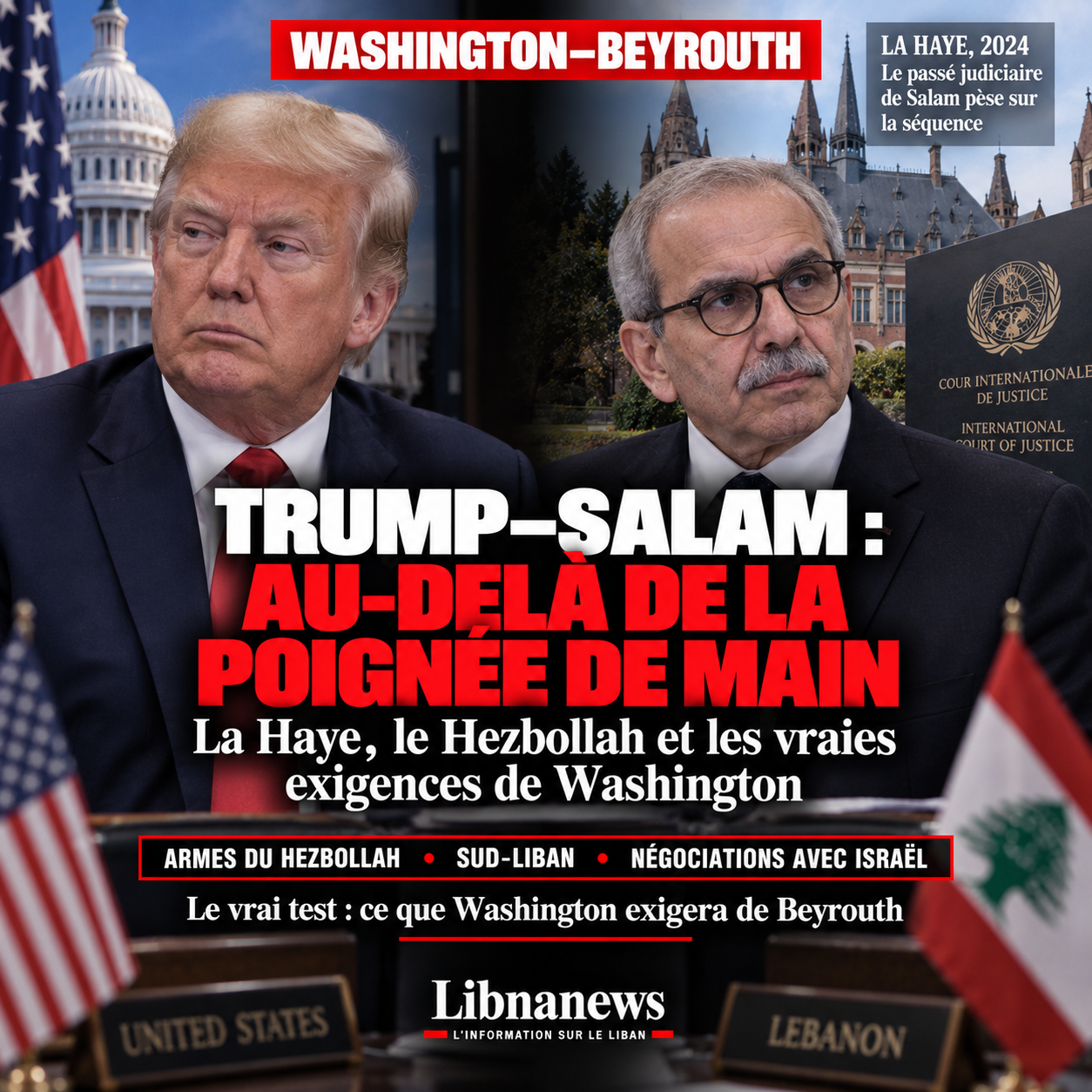
In New York, a few seconds of images were enough to trigger a debate in Lebanon that far exceeded the scene itself. Donald Trump advanced among Arab and Muslim leaders gathered around him, exchanging greetings and handshakes. Nawaf Salam was present. The handshake between the US President and the Lebanese Prime Minister was not visible. In Beirut, the episode was immediately dissected. Some saw a voluntary coldness towards Salam. Others spoke of a political message to Lebanon. A third reading refused to grant a few seconds of protocol the value of a diplomatic decision.
However, controversy was not born in a vacuum. The man Trump had in front of him has a singular path among the leaders of the region. Before entering the Serail, Nawaf Salam was a judge and then President of the International Court of Justice. In 2024, he participated in several decisions imposing measures on Israel in South Africa’s proceedings under the Genocide Convention. On 19 July of the same year, it also voted with a majority when the Court declared Israel’s continued presence in the Occupied Palestinian Territory unlawful and considered that it should end as soon as possible. Salam then accompanied his vote with a personal statement in which he stated that he shared the reasoning and conclusions of the Court.
This judicial past gives a particular depth to the New York scene. However, it would be imprudent to automatically explain Trump’s attitude. Washington did not publicly establish any link between the episode and the decisions in which Salam had participated in The Hague. The real question is elsewhere. How does the Trump administration today treat a Lebanese Prime Minister whose judicial past on Israel is also marked, while it also demands from its government major decisions on Hezbollah, weapons, the South and negotiations with Israel?
Before the Serail, Salam had voted particularly hard decisions for Israel
Nawaf Salam’s journey to The Hague deserves to be accurately recalled, without personally assigning to him collective decisions. The International Court of Justice is a jurisdiction composed of several judges. So Salam did not, alone, « condemned Israel. » On the other hand, he personally voted in favour of several major decisions concerning the Hebrew State and, in some cases, set out his own position in declarations annexed to the decisions of the Court.
On 28 March 2024, while already presiding over international jurisdiction, Salam voted in favour of further interim measures in the case between South Africa and Israel. The Court noted the worsening of the humanitarian situation in the Gaza Strip, including the increase in famine and undernourishment. It called on Israel to take the necessary measures to ensure the unimpeded and large-scale delivery of humanitarian assistance and essential services. Salam supported the entire scheme and indicated support for the reasoning behind it.
On 24 May 2024, the Court adopted new measures concerning Rafah. By thirteen votes to two, it ordered Israel to stop its military offensive and any other action in the governorate that could inflict on the Palestinians in Gaza living conditions that could result in their total or partial physical destruction. Salam again voted with the majority. This sequence placed, as President of the Court, at the forefront of a procedure followed with extreme attention by the Israeli government, the United States and all the capitals of the region.
On 19 July 2024, another case gave his position an even clearer scope. In its advisory opinion on the legal consequences of Israel ‘ s policies and practices in the Occupied Palestinian Territory, the Court found, by 11 votes to 4, that Israel ‘ s continued presence in that territory was unlawful. It considered that Israel should put an end to it as soon as possible. By fourteen votes to one, she also requested the immediate cessation of any new settlement activity and the evacuation of settlers. Salam voted in favour of these conclusions.
His personal statement is particularly important to understand his positioning. He did not merely preside over the hearings or announce the Court’s decision. He stated that he fully shared his reasoning and conclusions. It has developed its own analysis of occupation, colonization, discriminatory practices and obligations of other States in the face of a situation declared illegal.
Two years later, this judge became Prime Minister of Lebanon. And it must now negotiate with an American administration that has a close political and strategic relationship with Israel.
In Beirut, a few seconds almost erased several hours of diplomacy
The New York sequence immediately divided Lebanese social networks and political circles. Some presented the absence of a visible handshake as a sanction. Others considered that it reflected a form of contempt for the head of government. Conversely, several commentators refused to attribute political significance to a movement of a few seconds in a room where Trump met many officials.
Salam chose irony to respond to the controversy. He accused some of disturbing the waters themselves before trying to fish there, adding that they had so far caught « no fish ». The formula allowed him not to enter into a debate where he would have been forced to interpret publicly the personal intentions of the American president.
However, the vigour of controversy reveals something deeper. Lebanon is now observing Washington with special nervousness. The United States is directly or indirectly involved in almost all the issues that can determine in the coming months: negotiations with Israel, the situation in the South, support for the army, arms monopoly, the future of the international presence after the Final and regional confrontation with Iran. In such a context, every presidential gesture easily becomes a message to those who seek to anticipate the evolution of American politics.
Yet the real indicators were elsewhere in the same New York sequence.
Salam was in the room, and his presence was not annoyed
At the time when some Lebanese observers saw in the missed handshake evidence of decommissioning, Nawaf Salam was precisely attending a regional meeting convened by Donald Trump with several Arab and Muslim leaders and officials. According to diplomatic information surrounding the meeting, Lebanese participation would not have been acquired from the outset. Its inclusion was therefore seen in diplomatic circles as a positive development.
This presence obviously does not transform Lebanon into an actor equivalent to Saudi Arabia, Turkey, Egypt, Qatar or Jordan. The political, military and economic weight of these countries is incongruous with that of a Lebanon that is still weakened by its financial crisis and the consequences of war. But there is an important difference between not being at the centre of the regional game and not being invited to the table anymore. Beirut remains directly involved in the discussions because it is one of the theatres of confrontation with Israel, the regional role of Iran and the issue of armed groups allied in Tehran.
The meeting gave Salam the opportunity to present the Lebanese position at a time when Washington was conducting several simultaneous approaches. The United States consulted with its regional partners while exchanging with Iran through mediators. The Lebanese Prime Minister did not participate in the American-Iranian negotiations, but he could make the Beirut priorities heard in the regional circle around Trump.
This data weighs much heavier than the protocol scene. It shows that Washington continues to regard the Lebanese government as an interlocutor, even though this interlocutor is under increasing pressure.
The real American reserves concern weapons and the pace of execution
Because there is a problem between Washington and Beirut. He just doesn’t read in Donald Trump’s hand. Visitors to the US capital report that the administration now wants to see concrete results in the implementation of Lebanese decisions on the state monopoly of arms. Political statements would no longer be enough. Washington is interested in the deployment of the army, the effective control of the territory and the way in which government commitments are reflected on the ground.
American questions would not be limited to the South. Questions would also be asked about the presence of weapons in the Beirut region. The reasoning is that not all these weapons can be justified by direct confrontation with Israel. This geographical extension of the debate shows that Washington views the arms monopoly as a national issue and not a mere border issue.
Beirut opposes this impatience a major internal constraint. The State wants to strengthen its authority without causing confrontation between the army and part of the Lebanese population. Lebanese officials know that an operation conducted according to an externally imposed timetable could turn a sovereignty issue into an internal crisis. So they are looking for a gradual method, while Washington is asking for observable results.
Disagreement is less about the target than about the pace, means and sequence of steps. It is this difference that constitutes the real area of tension between the Trump administration and the Salam government.
Israel provides Washington with its own reading of the South
To this divergence adds a battle over the facts themselves. Israel transmits its own assessment of the situation in southern Lebanon to American officials. According to information reported by visitors to Washington, the Israeli side reported a negative assessment of some of the experiments conducted in the areas affected by the security arrangements. She claimed, inter alia, that Hizbullah members or executives had returned to certain sectors.
Beirut contests this presentation and refuses that Israeli claims automatically become the American reading grid. For the Lebanese authorities, Israeli operations make it more difficult to consolidate State authority. The destruction, strikes and military presence in certain areas prevent the normal return of the inhabitants and increase the difficulties facing the army.
The dispute therefore concerns a central question: who must make the first gesture? Washington and Israel want to see Lebanese results on arms and territorial control. Beirut believes that an Israeli withdrawal and an effective cessation of operations would create the conditions for the strengthening of the State.
This contradiction explains why discussions with the Trump administration are much more important than protocol exchanges. Salam must convince the Americans that Lebanese sovereignty cannot be built in a single sense.
Eighth meeting with Israel still waiting for real green light
The continuation of negotiations between Lebanon and Israel is the other immediate issue. An eighth meeting is envisaged. Rome is again cited as a possible place. But the timetable remains uncertain and Beirut fears that the Israeli political calculations will lead to delaying the next steps.
The Lebanese government wants to prevent a waiting period from allowing Israel to continue its operations and destruction while at the same time varying decisions on withdrawal. Each additional week can change the material situation in the villages of the South. A destroyed house, a road made unusable or a new area that has become inaccessible produces a concrete fact that negotiators will then have to deal with.
The eighth meeting was therefore of interest to Beirut only if it allowed progress to be made on specific issues: Israeli withdrawal, cessation of operations, disputed issues, return of residents and the situation of detainees. Israel places its security demands at the forefront.
Washington is at the centre of this mechanics. Without American impulse, the calendar can slow down. With stronger involvement, the US can try to obtain parallel measurements on both sides.
That’s exactly what Salam has to look for in his American talks.
Marco Rubio, much more important than a handshake
The planned appointment with Secretary of State Marco Rubio is the real test of the sequence. It is intended to address directly the issues on which Washington has a decisive influence: negotiations with Israel, the situation in the South, support for the army and implementation of arms decisions.
Salam arrives with a delicate equation. He must convince the Trump administration that the Lebanese government is not trying to save time on the arms monopoly. In the same movement, he must explain that an unrealistic timetable could provoke the confrontation that the state is trying to avoid.
Above all, it must obtain a political counterpart. While Washington demands more Beirut, Beirut wants Washington to demand more Israel. The Lebanese Government cannot defend a negotiating strategy on a lasting basis if Israeli operations continue without noticeable improvement for the people of the South.
The encounter with Rubio will therefore allow us to measure the relationship much more seriously than the images of New York. The content of American demands, the commitments obtained and the timetable for negotiations with Israel will provide concrete indicators.
If Washington agrees to exert parallel pressure on both sides, Salam can defend the idea that his diplomacy produces results. If the demands remain mainly directed towards Beirut as Israeli operations continue, the Lebanese Government will find itself in a much more difficult position.
Sixteen million rounds and over $800 million: Washington remains committed to the army
U.S. support for the army brings another concrete element. The United States has just delivered 16 million rounds of ammunition to the Lebanese Armed Forces. Over the past six years, their military assistance would have exceeded $800 million. These figures are hardly compatible with the idea of a complete American disengagement from Lebanon.
However, they show the nature of the Washington-supported project. The United States invests in the institution it considers to be the legitimate holder of the military force in Lebanon. The more the army is supported, the more the US administration believes it can ask it to assume additional responsibilities.
This logic again puts the government before a difficult equation. The army needs help to deploy, control more territory and gradually replace other armed structures. But increasing its capacity does not remove domestic political constraints. The monopoly of force cannot be built solely with ammunition. It also requires a strong enough political agreement to prevent the military institution from being drawn into internal confrontation.
Salam must therefore transform American support into state strengthening without allowing this aid to be interpreted as an instrument of confrontation between Lebanese.
The past of The Hague is impossible to erase, but it does not summarize Salam in Washington
The personal factor remains. The Trump administration knows perfectly who Nawaf Salam is. His visit to the International Court of Justice belongs to his public journey. The 2024 decisions concerning Gaza, Rafah, occupation and settlements had a global impact. His vote on 19 July and his personal statement made it particularly difficult to imagine that he would have been just a sitting chairman without a proper position.
This past may affect his image in some American or Israeli circles. In any case, he distinguishes Salam from many Arab leaders who are negotiating with Washington today. But there is nothing to reduce US policy towards it on this one dimension. The United States has much more immediate interests in Lebanon: Israel’s security, confrontation with Iran, Hezbollah’s weapons, the role of the army and the country’s stability.
Washington may therefore be in deep disagreement with certain judicial positions to which Salam has subscribed in The Hague while in need of him as an interlocutor at the Serail. Diplomacy works precisely with this contradiction. A government does not always choose its partners based on their past; It deals with those who today have the institutional capacity to make the decisions it needs.
Salam is thus in a unique situation. In The Hague, he was involved in drafting the law applicable to State conduct. In Beirut, it must now negotiate with those same States in a political power relationship where international law is only one element among others.
The real test starts where the cameras stopped
The New York scene finally has an obvious symbolic force. Donald Trump, whose policy is closely aligned with Israel, passes before a Lebanese Prime Minister who, two years earlier, presided over the International Court of Justice when it imposed measures on Israel and voted in favour of particularly harsh conclusions on the occupation.
But the symbol must not hide diplomatic reality. Salam attended Trump’s regional meeting. He must continue his exchanges with the US administration. Washington continues to fund the Lebanese army massively. The United States remains committed to the negotiating mechanism with Israel. At the same time, they are increasing pressure on Beirut to achieve results on weapons.
It is this combination that defines the relationship today. It is neither warm by principle nor broken. It is transactional, demanding and dominated by cases where American and Lebanese interests do not always coincide.