





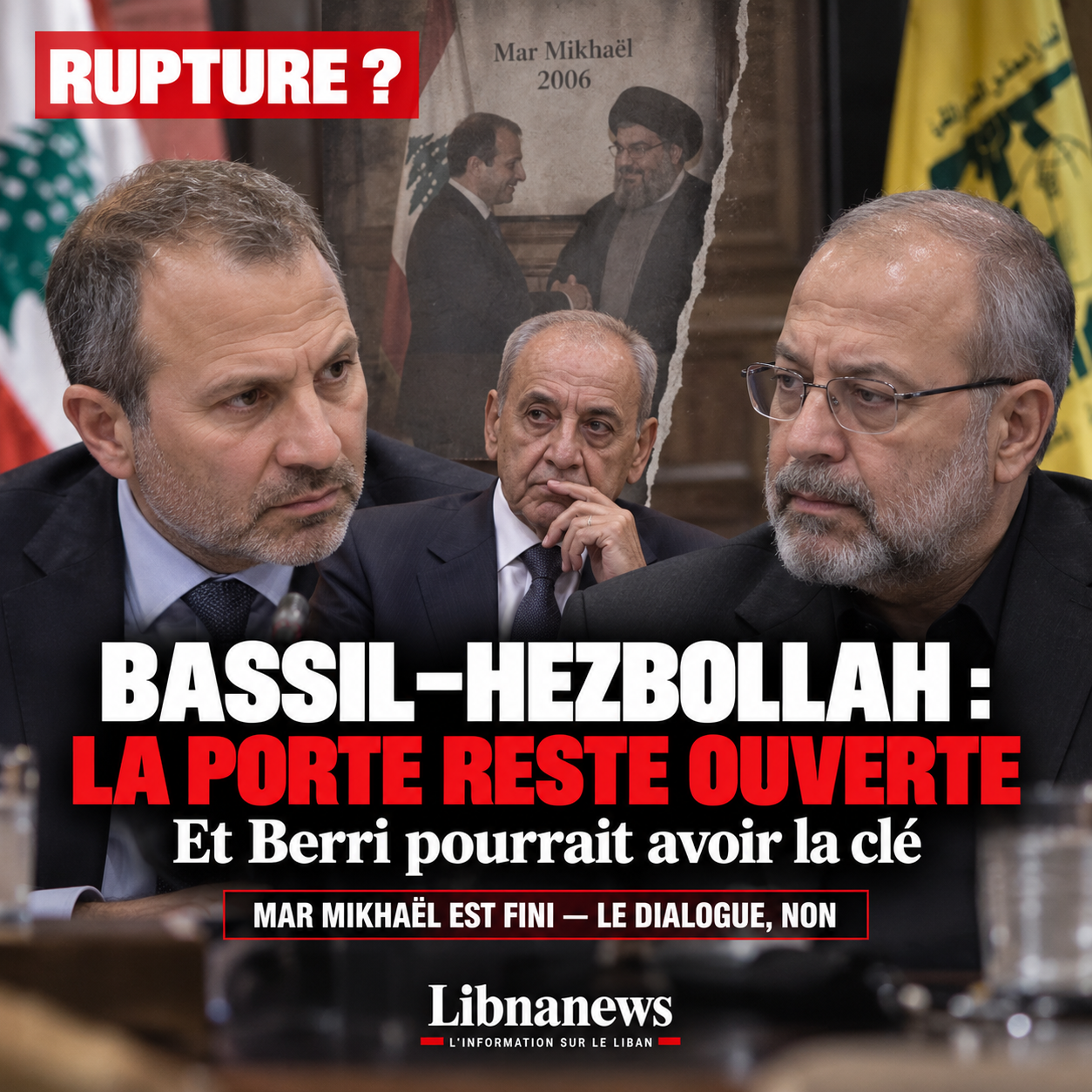
Public attacks give the image of a relationship that has reached the point of rupture. Gebran Bassil no longer spares Hezbollah. The party, for its part, no longer treats the free Patriotic Current as the privileged partner that it was during the years of Mar Mikhaël’s agreement. Yet, behind this visible deterioration, the information gathered in the circles concerned describes a more nuanced reality: communications would not be interrupted, a definitive rupture would not be desired by either side and a new relationship formula would be sought.
Above all, it would not be to resurrect the agreement of Mar Mikhael under another name. The model that had organized for years the alliance between the Free Patriotic Current and Hezbollah belongs to another political period. Relations of power have changed, electoral interests have evolved, and accumulated disagreements make it impossible to go back.
The question would now be much more pragmatic: how far can the two sides oppose without turning their dispute into a strategic break?
In this equation, Nabih Berri could play a role. Behind-the-scenes information gives him the opportunity to intervene to reduce tension and bring positions closer together. This potential role is not insignificant. The President of Parliament maintains a structural relationship with Hezbollah while having channels with virtually all political forces. Above all, it shares with the party an immediate concern: to prevent political and social tensions from leading to an uncontrollable internal confrontation.
Mar Mikhaël can no longer be the starting point
To measure the scope of the current crisis, two things must be distinguished: the end of an alliance as it has worked for years and the disappearance of any political relationship.
The information available leads precisely to this distinction.
Mar Mikhael’s formula is no longer considered reproducible. It was based on a particular political balance, complementary interests and the ability of both sides to present their differences as secondary to their strategic partnership.
This balance has gradually fallen.
Gebran Bassil has multiplied his criticism of Hezbollah and its choices. The Free Patriotic Current has sought to regain its own margin of manoeuvre. Hezbollah, for its part, no longer had the same reasons to give the knowledge of the status of a central Christian partner that he previously occupied.
Disagreements no longer concern an isolated file.
They relate to the functioning of the State, internal alliances, appointments, political representation, Hezbollah’s strategy and now to the central issue of arms and state authority.
In these circumstances, rebuilding the old agreement would be politically costly for Basil. Having distanced himself from Hezbollah, a spectacular return to the old alliance would weaken the discourse he developed with his electorate.
For Hezbollah too, conditions have changed. The party must manage the consequences of the war, international pressure, the debate on its weapons and a profoundly transformed relationship with the Lebanese state. He can no longer approach his partnership with the Free Patriotic Current exactly as before.
Yet none of these elements means that both sides have an interest in becoming absolute opponents.
Total breakup would cost both sides a lot
It is here that behind the scenes information becomes more interesting than public statements.
Despite the violence of some positions, communications would be maintained. Both parties would continue to consider that a complete break could cost them more than a cold and negotiated relationship.
For Bassil, the calculation is first political.
A total opposition to Hezbollah would place him in direct competition with the Christian forces that have long built their position around this confrontation. The free Patriotic Current should then convince that it represents a distinct alternative without simply joining an already structured camp.
Maintaining a channel with Hezbollah gives him more possibilities.
Basil can criticize the party while maintaining a negotiating capacity on some issues. It can also maintain an intermediate position that allows it to interact with several camps.
For Hezbollah, the question is different.
Even weakened, the relationship with the Free Patriotic Current has long allowed the party to avoid its alliance system being reduced to its Shia environment and to some traditional partners. A definitive break with Basil would therefore have both symbolic and political significance.
It would confirm the collapse of one of the major trans-community alliances built by Hezbollah since 2006.
The party may no longer want to pay the price of the old alliance. This does not mean that he necessarily wants to turn Bassil into an enemy.
So there is a much wider political space between alliance and hostility. It is in this space that contacts would take place.
A new formula, but without new « Mar Mikhaël »
The information gathered evokes the search for a « new formula » to organize the relationship.
The formulation is important because it implicitly excludes the return to the past.
This new relationship could be much more limited. It would be based less on a comprehensive political document than on the ad hoc management of common interests and disagreements.
In other words, both sides could stop being allies in the old sense while avoiding becoming opponents on all issues.
This transformation also corresponds to the new reality of the Lebanese political system.
Rigid alliances have become more difficult to maintain. The same parties can cooperate on an appointment, compete on a government decision and then find themselves on another institutional file.
Bassil and Hezbollah could evolve towards this model.
The former would gain greater political autonomy. The second would retain an important Christian channel without having to rebuild the entire previous covenant.
But such a formula involves determining each person’s red lines.
The main thing is now obvious: Hezbollah’s weapons.
Weapons completely change the nature of the dispute
The relationship between the two sides can no longer be analysed solely through the old disputes over appointments or electoral alliances.
Lebanon has entered a phase where the State monopoly of arms is at the centre of domestic and international discussions.
This evolution places Bassil in the face of a particular difficulty.
The Free Patriotic Current had justified for years its relationship with Hezbollah through a specific reading of resistance, protection of Lebanon and internal balance. But the military context has changed profoundly.
Israel continues its operations in Lebanon. Part of the territory remains at the centre of military tensions. At the same time, the Lebanese authorities stress the role of the army and the exclusive exercise of State authority.
Basil must therefore redefine its position in a landscape where the arguments of the old partnership no longer work in the same way.
Hezbollah considers the issue of its weapons to be existential. It cannot accept that a partner or former partner treats this as a simple administrative matter.
This is probably one of the most difficult topics for a new comprehensive agreement.
Maintaining dialogue therefore becomes more realistic than pretending to resolve disagreement immediately.
Berri, possible mediator between two former partners
It is in this configuration that the name of Nabih Berri appears.
The information available suggests a possible role for the President of Parliament in reducing tensions between Basil and Hezbollah.
Berri has several advantages for such a mission.
He’s not outside the Hezbollah camp. His Amal movement is the main political partner of the party in the Shiite environment. Any mediation on his part would therefore have a weight that would not have a further intermediary.
But Berri also has a long negotiating experience with Bassil and the Free Patriotic Current, including in periods of very high tension.
This does not mean that there is today a formal mediation with a roadmap. The information available does not make it clear.
Rather, it is a political possibility: if both sides decide that they need a mechanism to reduce tension, Berri appears as one of the few actors able to speak directly to both.
Its own interest also leads to avoid uncontrolled rupture.
The President of Parliament seeks to preserve institutional balances at a time when several fronts remain open simultaneously: South Lebanon, negotiations with Israel, economic situation, debate on arms and social tensions.
An additional political confrontation between Hezbollah and a major Christian formation would further complicate this equation.
Hezbollah would not want to turn the social crisis into a street battle
The question of the street also allows to measure the limits of confrontation.
Lebanon is undergoing a new phase of social tension. The rising cost of living, fuel and transportation fuel calls for mobilization. Trade unions are preparing protest movements and several sectors refer to the strike.
In this context, some political readings envisage the possibility that Hezbollah may seek to use social protest to increase pressure on the government.
However, the information gathered in other settings leads to a different reading.
The party would not currently have any interest in turning its political opposition into an open street confrontation. The position attributed to Nabih Berri goes in the same direction: to avoid the social crisis being absorbed by a political battle likely to escape its initiators.
This caution is explained by the context.
Hezbollah must already handle considerable external military pressure. An internal confrontation would impose a second front, this time political and community.
It could also reinforce the arguments of those who present their weapons as a threat to internal balance.
The party may therefore have an interest in supporting social demands or criticizing government policy without seeking to cause the government to collapse on the street.
This distinction is essential to understand his relationship with Bassil.
Both sides can tighten their discourse while retaining limits that they do not want to cross.
Bassil must preserve its difference without closing all doors
The difficulty is particularly great for the leader of the Free Patriotic Current.
Overly visible reconciliation with Hezbollah could blur the repositioning undertaken in recent years.
But a complete break-up also entails risks.
Basil must preserve a political identity distinct from other Christian parties. He cannot simply take all their positions without losing part of what makes his current specific.
Maintaining a dialogue with Hezbollah allows him to maintain this difference.
He can say that he opposes the party on arms, on certain decisions and on state management, while defending the idea that the major Lebanese crises must be resolved through domestic negotiations rather than confrontation.
This position can also be used in future institutional files.
Relations between parties in Lebanon are never only ideological. They also concern appointments, laws, parliamentary majorities and the formation of governments.
Breaking all channels means giving up a negotiating capacity.
Bassil knows the cost of such a decision.
Hezbollah must decide what it still expects of its former partner
The calculation of Hezbollah is just as complex.
The party may consider Basil to have become a partner too critical and too unpredictable to regain the level of confidence that has passed.
But he must also wonder what political alternative would be offered to him by a complete rupture.
Hezbollah has strong partners. Yet the question of its relations with Christian forces remains important in the Lebanese system.
A functional relationship with the free Patriotic Current therefore retains a usefulness, even if it no longer has the strategic depth of the past.
The new formula could precisely recognize this reality.
More general alliance. No reciprocal political guarantee on all files. More pretension to present both parties as one axis.
But there are ongoing communications, ad hoc compromises and the possibility of negotiating when their interests converge.
This would be less a reconciliation than an organized management of divorce.
The elections will give the real measure of rapprochement
The most concrete test will probably come from political and electoral deadlines.
Speeches can be moderated or hardened depending on the circumstances. Electoral alliances require parties to make much more specific choices.
The question will be whether Hezbollah and the Free Patriotic Movement can still find common interests in certain constituencies or whether their separation becomes complete even in the ballot box.
The documents available do not yet describe an electoral map negotiated between them.
It would therefore be premature to talk about a reconstitution of a covenant.
On the other hand, maintaining communications gives both sides the opportunity to discuss when local calculations require it.
Perhaps this is where the true meaning of current contacts lies.
It is no longer a question of rebuilding the great political compromise of 2006. It is a question of determining, after file, what remains of a relationship that has structured Lebanese politics for nearly two decades.
Public statements tell of a separation. Backstage information shows that the door is not closed.
The relationship between the two is much less spectacular than Mar Mikhaël, but perhaps more suited to the current period: two formations that no longer trust each other as before, which no longer share a common strategy, but who also know that a complete break would remove a margin of manoeuvre from them, none of which seems yet ready to deprive themselves.