

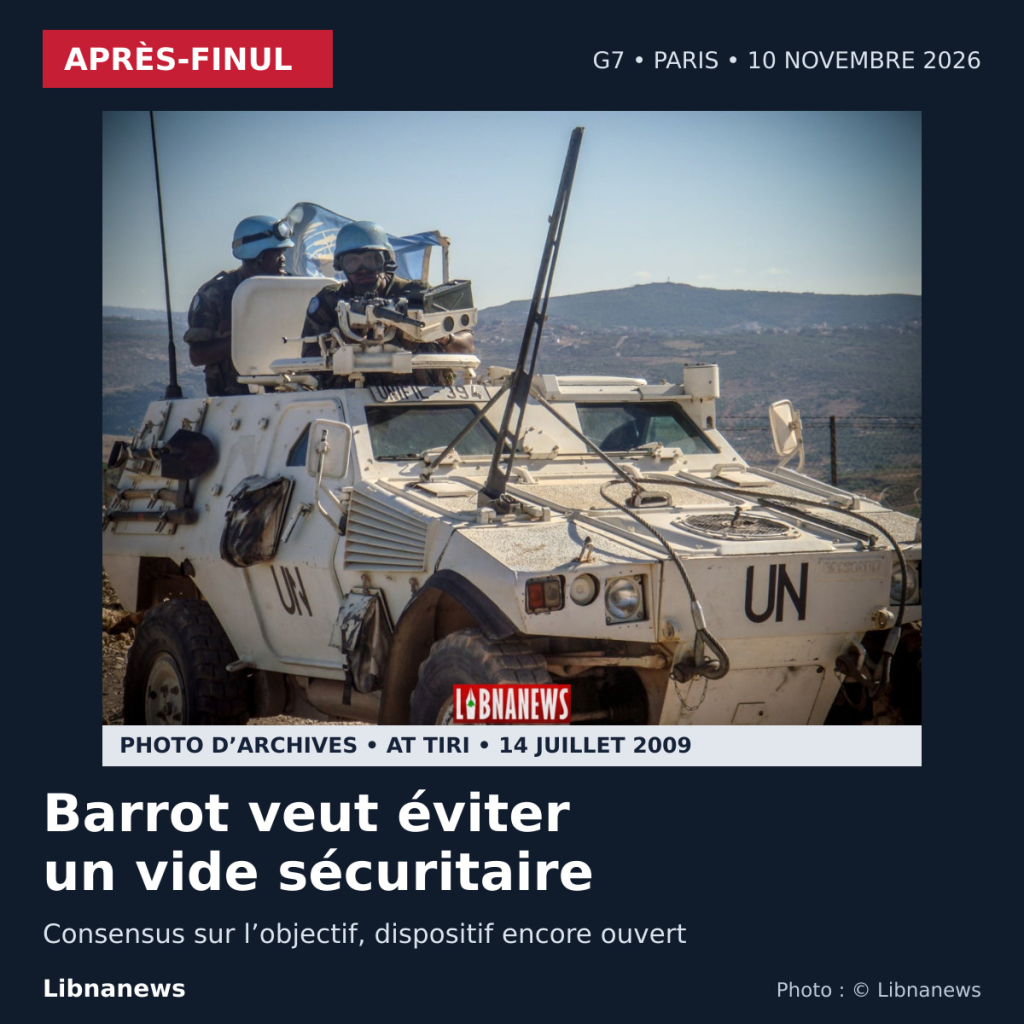
Jean-Noël Barrot spoke of a consensus to avoid a security vacuum in South Lebanon after UNIFIL. On Tuesday, 10 November, in Paris, the French Minister also reported a common will to move quickly towards a new security organisation. These comments, reported by a news agency, are not accompanied by the announcement of an approved device.
Barrot speaks of a consensus on two objectives
The head of French diplomacy spoke at the G7 Foreign Ministers’ meeting. Exchanges took place on 9 and 10 November at the Quai d’Orsay. He believes that they have made progress on the Lebanese issue.
The consensus it describes is on two objectives: to avoid a security vacuum and to accelerate the preparation of the post-FINUL. It does not define the civilian or military nature of a future mission.
The statements reported do not specify mandate, staffing or funding. Nor are they designated as contributing countries. They therefore do not allow the different options discussed to be considered adopted by the G7.
The stage announced Tuesday is diplomatic. Barrot presents a convergence on the need to act, while the form of the future international presence remains to be determined.
A separate statement from Rubio’s trail
The day before, in Paris, Marco Rubio had mentioned a possible civilian verification mission. The US Secretary of State said he had discussed it with Emmanuel Macron. It was seeking a mechanism that was deemed credible to monitor the parties’ commitments.
Rubio stressed the need for an agreement between Lebanon and Israel. It had not announced any final format or deployment schedule. Barrot’s statement does not make it clear that this American track has received collective approval.
In Beirut, other proposals are also discussed. Gebran Bassil presented Tuesday to Joseph Aoun the idea of a force involving the five permanent members of the Security Council. This initiative remains that of the leader of the Free Patriotic Current. No link to a G7 plan is established.
Two steps in the UNIFIL calendar
Resolution 2790, adopted on 28 August 2025, sets the end of UNIFIL operations as at 31 December 2026. It then provides for a reduction and withdrawal ordered within one year, at the latest by 31 December 2027.
The end of the mandate therefore does not mean the simultaneous departure of all peacekeepers at the end of this year. This calendar alone does not create the mission to take over.
The next step is to define the tasks, the institutional framework and the guarantees of this possible presence. The consensus claimed by Barrot concerns its urgency, without publicly stopping its modalities.
Photo archive: UNIFIL French contingent at At Tiri, 14 July 2009. © Libnanews. Integer photograph preserved, editorial dressing. It does not represent the November 2026 G7 meeting.





Comments