

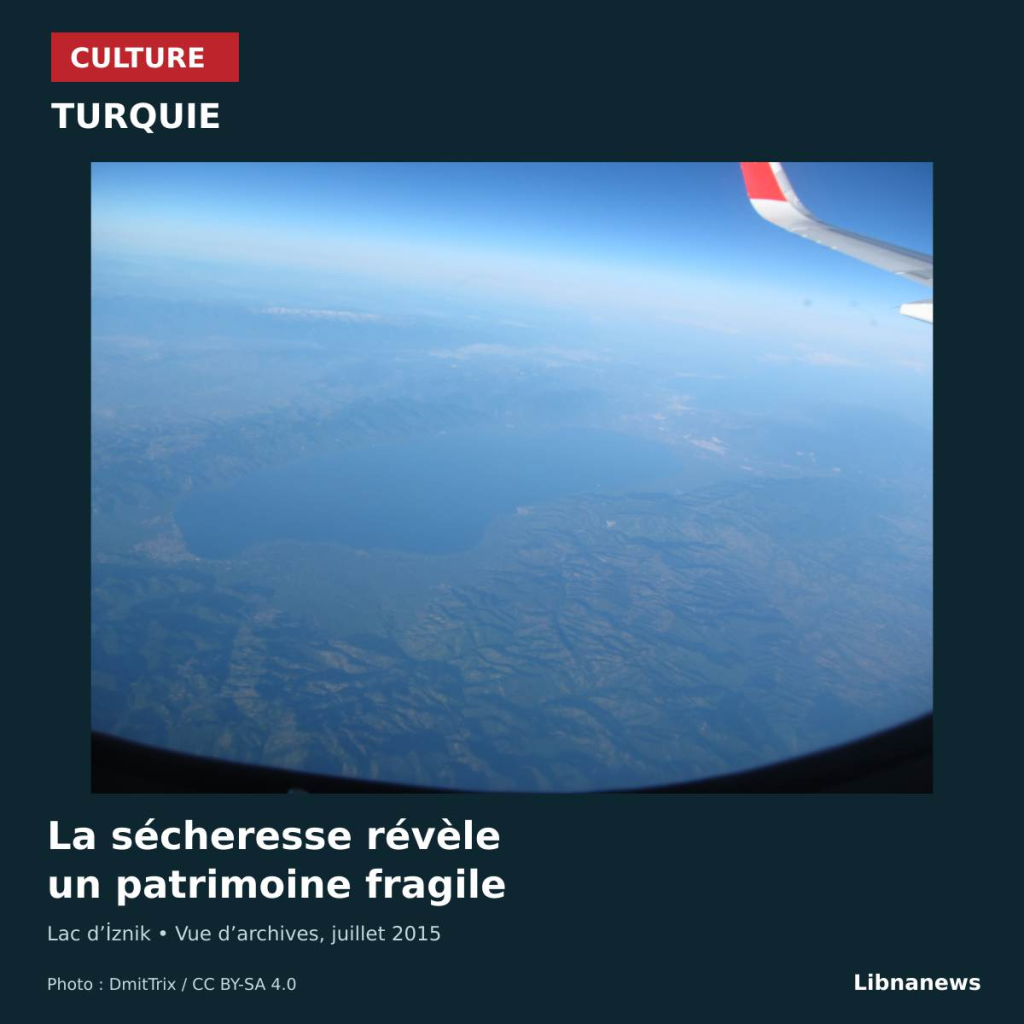
In Turkey, drought reveals remains long covered by water. Around the lake of İznik and the Atatürk reservoir, churches, engravings and prehistoric structures become accessible to researchers. But their exhibition also weakens this heritage. Some discoveries, already old, remain at the heart of archaeological investigations whose conclusions still require confirmation.
The water retreat offers spectacular images. It mainly changes the conditions under which archaeologists work. Sites studied in diving are found in the open air. Others appear a few weeks before a rise in the level covers them. A report published on 24 September 2026 in the American press highlights this difficulty: to discover more does not necessarily mean to keep better.
Turkish examples bring together very different situations. In İznik, Bursa province, researchers are studying a basilica that was identified in 2014. In Adıyaman province, rock figures were reported in 2018. More recently, T-shaped stones have joined the collections presented at Perre. These remains are neither of the same period nor of the same drought.
Drought reveals vestiges already studied in Iznik
So the basilica of Lake Díznik was not discovered this year. His plan appeared on aerial photographs made in early 2014, as part of a municipal inventory. The first underwater investigations then paved the way for the excavations, which began in November 2015. Mustafa şahin, an archaeologist at Bursa Uludağ University, is the research director.
The site bears witness to ancient Christian architecture. It preserves walls, liturgical spaces and traces of successive occupation. A scientific report published in 2022 describes among other things marble fragments, architectural elements and furniture. It also notes the damage caused by old levies in several sectors. The conservation of the site was therefore a problem before its current exposure.
The water drop is transforming the site. The previously wet sediments harden, making it difficult to clear the structures. Dropping dive equipment does not remove constraints. The teams must now work on exposed terrain and adapt their methods to its drying.
The Council of Nicaea, a hypothesis still discussed
İznik occupies the site of the ancient Nicaea, where Constantine assembles a Christian council in 325. This meeting is a major step in the formulation of Christian doctrine. But identifying the city is not enough to identify each building used by participants.
The excavation team proposes to link to the council the remains of an earlier building, spotted under the basilica. The reconciliation is based on archaeological observations and the reading of ancient texts. Therefore, the visible walls of the basilica should not be presented as proof of the meeting place.
Experts outside the construction site contest this identification. They highlight the uncertainties of dating and historical references to the imperial palace. A nearby church could have played a role, without hosting the main sessions. Research continues: the link with the council remains a hypothesis, not a result accepted by all.
In Belören, engravings whose dating remains to be specified
Further east, the Atatürk reservoir revealed rock figures near Belören, in the Kahta district. The 2018 observations mention human and animal representations engraved in the rock. The term « petroglyphs » refers precisely to this technique. They should not be confused automatically with pigment paints.
Site protection is documented. The Regional Heritage Council in Žanlıurfa adopted a decision on 23 November 2018. After examining the file submitted by the Adıyaman Museum, he classified the area as a first degree archaeological site. The text provides for its conservation and for its use.
The date of 10,000 B.C.E. is circulated in the accounts of these figures. It would correspond to a seniority of about twelve millennia. However, the administrative decision consulted does not provide a demonstration of this date. It confirms the existence and protection of the remains, without establishing this precise age. It must therefore be presented with caution and cannot be applied to all the discoveries exposed by the withdrawal of water.
T-stones sheltered in Perre
In Kızılöz, Samsat district, other remains emerged on the bank of the same reservoir. An announcement of January 27, 2026 describes two small structures and a T-shaped stone.The researchers bring them closer to the neolithic ensembles of the Göbekli Tepe region. This comparison concerns their forms and cultural context.
The archaeologist Sabahattin Ezer advanced a seniority of about eleven thousand years. He also stressed the need to broaden research. The discovery thus constitutes an important trail, without allowing the immediate reconstruction of the entire organisation of the site.
The museum explains that the movements of the water removed a land cover that was once several metres thick. The problem thus exceeds the visibility of the stones: erosion transforms their archaeological environment. The teams initiated a rescue operation prior to the rise of the water. The recovered elements then began to be presented in the ancient city of Perre.
Retaining Remnants that Change Environment
Not all long immersed materials react in the same way to their exposure. Water-sipped wood is a particularly fragile case. Its structure may have lost part of its resistance while maintaining its appearance. Uncontrolled drying may result in shrinkage, deformation and irreversible cracks.
Conservation recommendations emphasize the maintenance of suitable conditions from the moment of discovery. Save the object, its location and condition before processing. The choice of intervention depends on the material and the context. Taking out a piece of water to show it can thus compromise its preservation if no specialized device is ready.
The masonry ruins require another approach, with attention to surfaces, sediments and access to the site. The reports of the search in Díznik recall that looting has already deprived researchers of stratigraphic information. Preserving objects is not enough: their position in the different layers helps to understand the history of the place.
In Žznik, public reception has already changed. The museum opened on 28 October 2025, with a reception centre and a traffic platform. Visitors can discover this heritage as research continues. The chronology of constructions and their possible relationship to the council remain among the issues to be resolved.
References and photographic credit
- Report of 24 September 2026
- Searches in İznik: Scientific report, 2022
- Museum of the Basilica: official notice
- Debate on the Council, August 2026
- Belören: Protection decision of 23 November 2018
- Kızılöz: announcement of 27 January 2026
- Conservation of water-sipped materials
- Cover photo: DmitTrix, July 7, 2015
- Photo license and composition : CC BY-SA 4.0






Comments