


Lebanon must repair housing, restore networks and support displaced households, while its public resources remained constrained. As of 4 November 2026, the stake exceeds the amount of damage: we must distinguish between the needs, the approved financing and the money actually available. This first weekly FocusLebanon review examines the economic choices that determine the speed, cost and distribution of reconstruction in Lebanon.
The problem can be summarized in three questions. Who bears the expenses? What work must be done first? How can we prevent a reconstruction financed today from preparing a new crisis tomorrow? These issues concern taxpayers as well as owners, businesses, depositors and donors. A repaired road can restore an activity. A reconstructed dwelling without water or safe access can remain unusable. A loan can speed up a project while shifting its cost to future budgets.
This file distinguishes published observations, institutional estimates and calculation exercises. Historical data do not automatically describe the current situation. The scenarios presented are used to measure arbitrations; They are neither a forecast nor an announced government program. References, dates and limits are at the end of the article.
The 11 billion are not the balance sheet of November 2026
The most frequently cited national benchmark corresponds to the needs arising from the conflict from 8 October 2023 to 20 December 2024. The assessment published in March 2025 distinguished $6.8 billion in physical damage, 7.2 billion in economic loss and approximately 11 billion in rehabilitation and reconstruction needs. These three dimensions answer different questions. They must not be added together to produce a single invoice.
Damage measures active destruction. A loss describes, in particular, income or production that has not been realized. There is a need for resources to repair, rebuild and restore services. Rebuilding a building can cost more than the value of its destruction, according to standards, prices and schedule. Conversely, a commercial revenue lost during a closure does not automatically become a public expense to be reimbursed.
The distinction changes the budgetary discussion. The State can finance a collective service without compensating all private losses. A household can return to a dwelling without recovering the income lost while it is moving. A company can reopen with a long-term activity below its previous level. Material reconstruction and economic recovery therefore do not necessarily follow the same pace.
The date of diagnosis must also be respected. An envelope calculated on the events of 2023 and 2024 does not, by definition, incorporate all subsequent destructions. Presenting it as the final cost of reconstruction in November 2026 would give a misleading clarification. It remains a historical basis for understanding orders of magnitude and the structure of needs, not a continuously updated meter.
The destructions of 2026 impose a new needs map
Local assessments published in 2026 confirm the need to update this base. For Beirut and Mount Lebanon, a preliminary analysis focuses on damage estimated at over $365 million. It identifies 146 buildings destroyed and 264 partially damaged. Its temporal scope covers February to April 14, 2026. It combines images and field checks.
In the south of the Litani River, another assessment estimates damage to buildings at $1.38 billion. It compares an image of April 29, 2026 with that of October 23, 2025. In particular, 11,095 buildings were destroyed. This operation is based on remote validation, without ground verification. Roads, bridges and several networks remain outside its perimeter.
These results do not allow the production of a new national total by a simple addition. Periods differ, methods do not cover the same objects and destruction can affect buildings already damaged. The same good may appear in several successive diagnoses. Without common asset identification, adding up inventories may cost twice.
A useful update must therefore follow buildings and infrastructure individually. It must distinguish between new damage, aggravation of previous damage and repairs already made. The remaining expenditure depends on these three elements. The relevant figure for future work is the verified residual need, not the sum of all estimates published since the outbreak of hostilities.
Reconstruction in Lebanon requires common accounting
The first investment required is informational. Before allocating funding, authorities and donors must be able to link each project to an identified need. This requirement seems administrative. However, it determines the possibility of comparing requests, controlling payments and avoiding duplication.
A common register could include the location of the property, the nature of the damage, the technical valuation and the status of the file. It should distinguish the owner, occupant and beneficial owner of the aid. These people aren’t always the same. Identifying a destroyed building is not enough to know how many households have lost their main housing.
Data protection must accompany this organisation. Full publication of names, coordinates or land documents would create unnecessary risks. Economic transparency can be based on aggregated data, project identifiers and audits. Public control covers criteria, costs and results, without requiring the exposure of personal records.
This common accounting must also monitor funding. A promise, a signed agreement, a budget commitment and a disbursement are four distinct steps. Bringing them together under a single heading « aid obtained » prevents the measurement of the resources actually mobilised. A construction site usually awaits payment, not just an advertisement.
Finally, the scoreboard must bring the money paid closer to the achievements. Spending a budget does not prove that a service works. For a water system, the useful result is effective supply, continuity and quality. For a road, it is restored access and secure use. Physical measurement can verify what the financial effort actually brings to the inhabitants.
Housing focuses needs, not all priorities
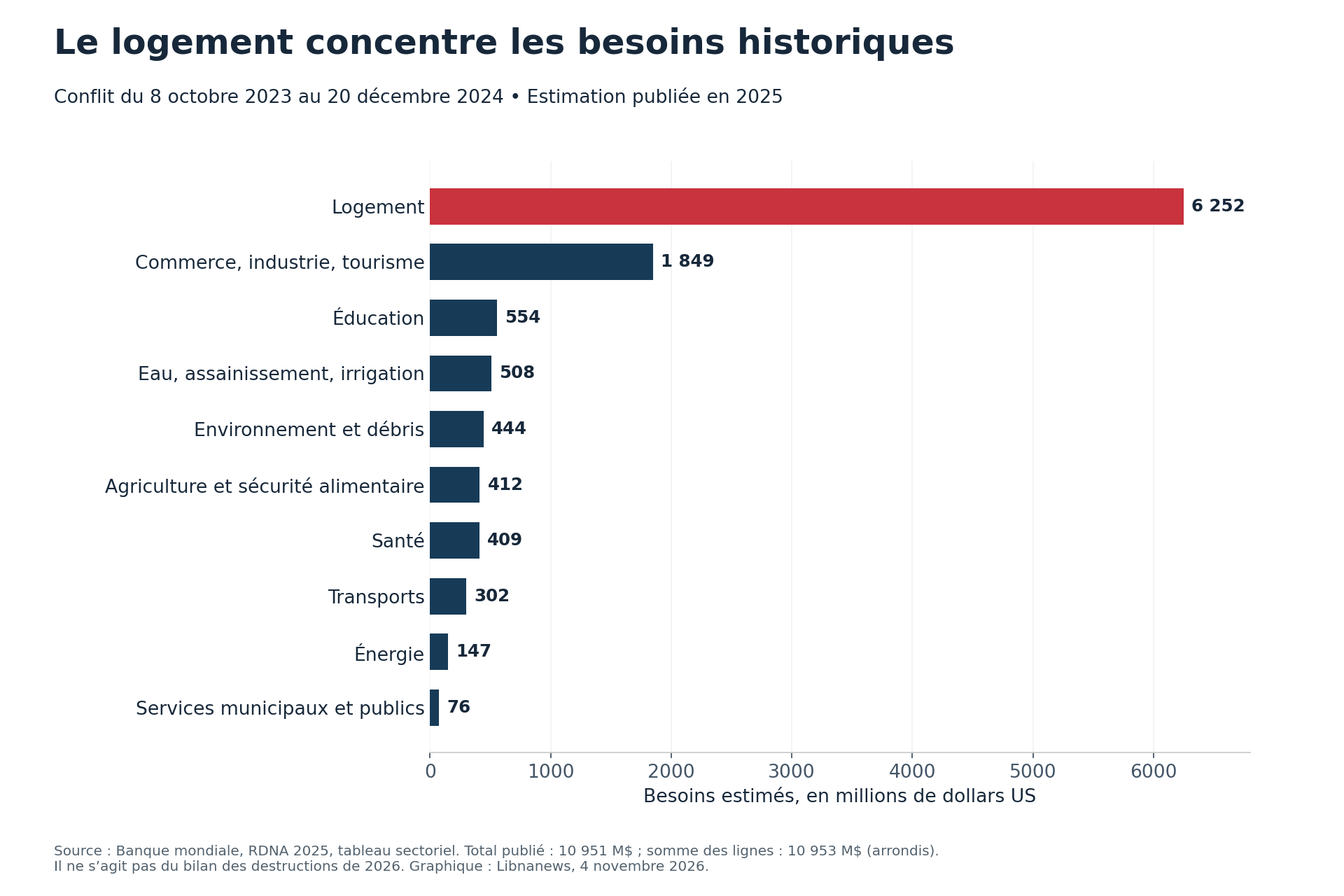
In the historical diagnosis, housing needs reached $6,252 million out of a total of $10,951 million. They therefore represent about 57.1% of the envelope, according to a calculation made from the sectoral table. Trade, industry and tourism total 1,849 million. The other sectors combine the remaining needs. The associated chart presents the detailed amounts in millions of dollars.
This concentration explains the central place of housing in the debate. It does not justify mechanically allocating the same proportion of each public funding. The ownership of the assets, the contributory capacity of the beneficiaries and the collective effects of the work differ by sector. A relatively low expenditure on a network can make several larger private investments usable.
Consider a neighbourhood where buildings are repairable, but the water supply remains interrupted. Financing each facade separately can produce renovated buildings without allowing families to return to life. First repairing the main drive can, conversely, make possible several simultaneous returns. This reasoning describes economic complementarity; it does not provide an automatic rule that is valid everywhere.
The order of interventions depends on local conditions. An occupied but dangerous dwelling requires a different response from a completely destroyed building in an inaccessible area. Light repair can be quick and inexpensive, without always being a priority in the face of a health threat. The size of the housing post requires a clean strategy. It does not remove the arbitration between urgency, feasibility and collective effects.
A framework of one billion does not amount to one billion available
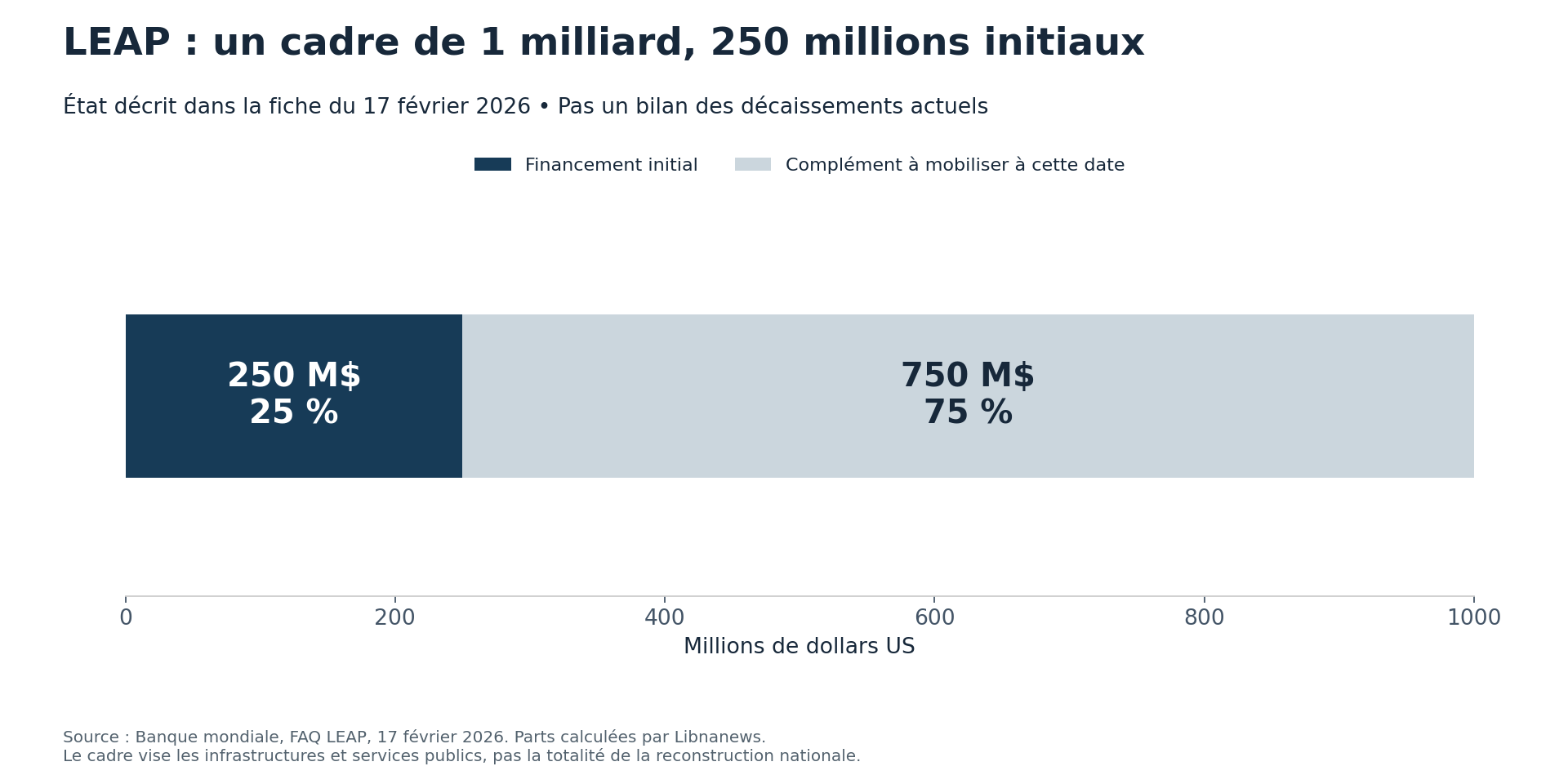
The LEAP emergency assistance project illustrates the gap between financial architecture and resources mobilized. The official card of February 17, 2026 describes an extensible framework of $1 billion, with initial funding of $250 million. By that date, $750 million remained to be mobilized. These dated amounts do not constitute a statement of disbursements as at 4 November.
The breakdown available was 50 million for immediate response, 175 million for essential services, 15 million for studies and 10 million for management. The scheme concerns public infrastructure and services. It is not a general compensation mechanism for all owners. The graph distinguishes the initial envelope from the complementary funding sought.
This distinction protects against two opposite readings. Affirm that a billion is already available to overestimate resources. To say that only 250 million can one day be mobilized ignores the extensible nature of the scheme. Monitoring must specify, on each date, what is legally committed, what can be paid and what remains conditional.
Initial funding represents a quarter of the announced framework. This does not mean that a quarter of national needs are covered or that a quarter of the work is carried out. The denominator changes: a project framework, a national estimate and a work programme do not describe the same population of expenditures. A ratio is informative only if its numerator and denominator cover the same perimeter.
Growth does not provide a reconstruction fund
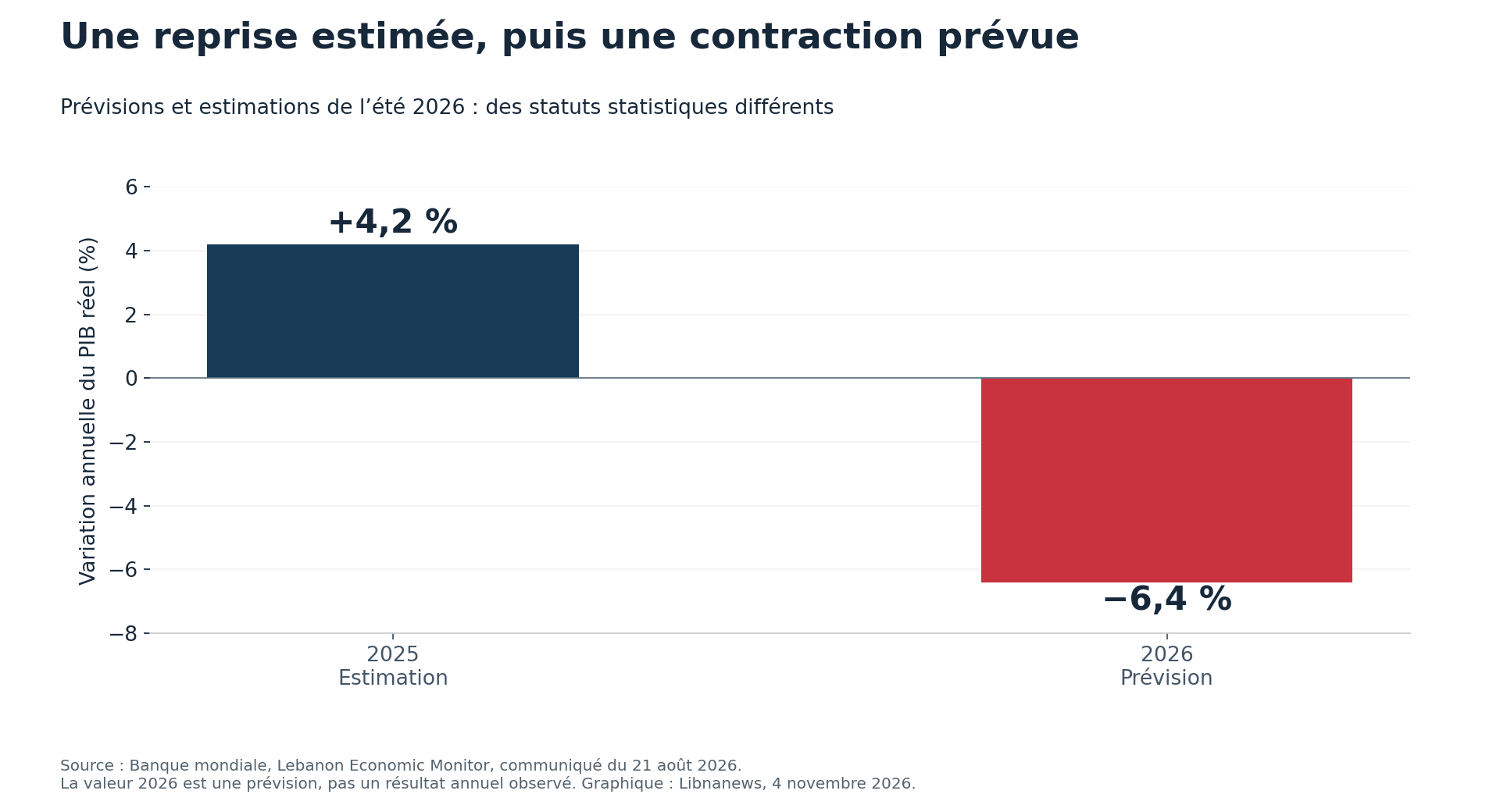
The macroeconomic context limits shock absorption capacity. The summer 2026 economic publication estimates real growth of 4.2% in 2025 and forecasts a contraction of 6.4% in 2026. The first digit is a revised estimate; the second is a forecast, not an annual result. The same document estimates the government surplus from 2025 to 3.9% of GDP.
An annual surplus does not automatically represent a reserve of liquidity free of any obligation. Its use depends on receipts, deferred expenditures, commitments and funding constraints. Similarly, an improvement in GDP does not directly indicate how much the budget can spend on work. The tax base, the recovery and the structure of activity are between production and government revenue.
Reconstruction can support activity when it involves companies, workers and suppliers. But part of the expenditure can finance imported goods. Another can be absorbed by rising costs. The total value of the contracts therefore does not measure the additional production generated in Lebanon.
We must also distinguish rebound and enrichment. Replace destroyed assets can increase year-round production without immediately restoring lost assets. A site increases measured activity, but the company would often have preferred to retain the original building. Economic success is judged on restored services and capabilities, not just on the movement of growth rates.
The three budgets to be announced by each project
A reconstruction project has at least three budgets. The first funds its preparation: diagnostics, studies, security, procedures and supervision. The second covers the work. The third ensures operation and maintenance after delivery. Omitting the latter can make an investment technically completed but economically fragile.
Let’s take a pumping station. Its construction is only part of the cost of service. Then we need energy, parts, teams and repair capacity. If these expenses are not anticipated, the station may operate intermittently. The initial funding then purchased equipment without guaranteeing the expected service.
The same applies to a school or health centre. The walls do not replace staff, supplies, or regular charges. An investment envelope announced without operating resources transfers the problem to another budget. It can also push for new emergency aid for a recently delivered asset.
The comparison between projects should therefore cover the full cost. A cheaper solution to build can cost more to exploit. Rapid repair may be preferable to full reconstruction if it restores the service for a long time. Conversely, repairing highly degraded equipment several times can mobilize more resources than a properly sized replacement.
This logic does not require a systematic choice of the most expensive technology. It requires clarification of the assumptions: lifetime, frequency of maintenance, cost of energy, availability of parts and responsible for payment. The public budget can then compare actual commitments, instead of competing incomplete entry prices.
Central bank reserves are not a budget
The balance sheet of the Bank of Lebanon is a monetary source, distinct from the budgetary accounts. Assets, liabilities and valuation rules should be examined separately. Adding active positions to deduce an immediate capacity for public funding would be an accounting error.
A foreign currency reserve performs monetary and financial functions. An asset may have a counterparty to the liability. Its mobilisation can change liquidity, confidence or ability to meet obligations. The economic question, therefore, is not only whether a value is on the balance sheet, but what consequences would be used.
The same caution applies to valuation variations. An increase in the price of an asset can increase its book value without creating a cashed revenue. Spending an added value involves a separate transaction and raises questions of law, management and risk. This file does not propose mobilization of reserves or gold.
To analyze reconstruction financing, it is necessary to identify its complete chain. Who gets the currency? Who acquires a debt? Who assumes the currency risk? Which institution pays back? Without these answers, a transfer may seem free while carrying a charge on another part of the system.
The separation of public and monetary balances also protects the readability of choices. An expenditure voted with an explicit resource can be discussed. A burden that is displaced between institutions becomes more difficult to follow. Reconstruction does not gain in making its cost less visible; It gains to make its resources more credible.
Borrow, receive a donation or guarantee: three different costs
The financing instruments are not interchangeable. A gift does not generate the same future service as a loan. A concessional loan can reduce the financial burden without removing the repayment. A guarantee may not produce any immediate cash flow, while exposing public finances if the covered risk occurs.
The comparison should cover the value and timing of commitments. A long grace period eases the first years, but does not turn a debt into a subsidy. A public guarantee can facilitate private credit. However, it must be assessed as a conditional commitment, with eligibility criteria and exposure limit.
The assignment also counts. Infrastructure financing cannot be treated as a free resource to compensate households. A donation for studies can improve the preparation without paying for the work. A loan granted to an operator may require future pricing compatible with its capacity to repay.
Finally, the actual cost includes the conditions of execution. Purchases from certain suppliers, technical requirements or too tight a schedule can influence prices. These constraints are not necessarily unjustified. They must be made visible in order to compare funding on a consistent basis.
The public debate would benefit from presenting each envelope with five informations: nature of the instrument, beneficiary, authorised use, payment schedule and future commitment. This minimum sheet would avoid the possibility that state-guaranteed private financing would be presented as a risk-free resource for the taxpayer.
The ability to pay is not confused with the loss suffered
Two families may have lost housing of comparable value and have very different means. One can benefit from accessible savings or external support. The other may have lost both housing and income simultaneously. A uniform policy based solely on the value of the property therefore does not necessarily produce fair reparation.
Poverty estimates provide a benchmark, with an important limitation. The 2022 survey published in 2024 places income poverty at 44 per cent of the population covered in five governorates. This result is not an updated national measure of poverty after the events of 2026. It documents a previous fragility, not the specific situation of each applicant.
Targeting must articulate several dimensions: principal residence, disposable income, household composition, severity of damage and absence of alternative solutions. Each criterion involves checks. Too heavy a procedure may delay the aid. An overly simple procedure may exclude households whose documents have been lost or whose occupation status remains difficult to establish.
The economic solution is to distinguish the steps. Emergency assistance can meet the immediate need for accommodation. A repair aid can then be based on expertise. Possible property compensation still requires another framework. Bringing these objectives together in a single payment complicates controls and blurs the purpose of the scheme.
Recourse must be part of the funding. A disputable decision without review may leave a household permanently excluded. A correction mechanism is not an administrative supplement: it reduces the risk that resource allocation will depend more on access to the process than on actual need.
Private credit implies credible future income
Providing some of the financing to the private sector is not enough to show loans. A credit requires a borrower capable of repaying, a lender willing to bear the risk and a framework for executing the contract. The value of a property to be rebuilt does not in itself ensure the presence of these conditions.
The need for financing can be high while debt capacity remains low. A displaced household can pay a temporary rent while having lost its activity. Offering him a loan to rebuild can solve the payment of the yard without solving the payment of monthly payments. Aid and credit respond to different constraints.
For businesses, a distinction must be made between working capital and investment. A repaired machine does not allow production to resume if stocks, energy or payment deadlines are not financed. Conversely, a cash credit does not replace destroyed equipment. The recovery plan must identify each need rather than group it together.
A targeted guarantee can mitigate certain risks. It does not make viable an activity whose demand remains insufficient. A rate subsidy may alleviate a monthly payment, but its public cost must be calculated over its entire duration. Mechanisms should avoid focusing on borrowers who are already solvent.
The macroeconomic challenge is to restore intermediation capable of evaluating projects. Reconstruction does not only require liquidity. It needs credits adapted to revenue, construction deadlines and real risks. Without this selection, funding presented as a stimulus can accumulate new debt that is difficult to repay.
Inflation can reduce the number of projects financed
In September 2026, the consumer price index increased by 1.35% over one month and 17.53 % over one year. These figures measure the prices of a consumer basket. They are not an index of construction costs. Applying them mechanically to a building estimate would produce an unproven estimate.
The problem remains concrete. Between initial evaluation and tender, prices for materials, transport or labour may change. An unchanged nominal envelope can then finance less work. The risk is particularly significant when several yards simultaneously request the same equipment or skills.
Contracts must address this risk explicitly. A fully fixed price transfers more uncertainty to the company, which can integrate it into its offer. A price review that is too open may expose the contractor to overruns that are difficult to predict. A clear formula must specify the indices, the items concerned and the limits.
The purchase schedule thus becomes an economic decision. Ordering too early can immobilize funds or create storage costs. Ordering too late can delay the construction site. A common planning of certain needs can improve visibility, without justifying a monopoly on purchase or inappropriate standardization of sites.
Monitoring must measure quantities as much as expenditure. If the amount committed increases, it is necessary to know whether it finances more work, better quality or only higher prices. This breakdown makes it possible to distinguish a programme which is progressing from a programme whose purchasing power is deteriorating.
Imports impose a foreign currency constraint
A site can pay local wages and purchase equipment abroad. Its effect on the economy therefore depends on its composition. Gross expenditure does not remain entirely in the national circuit. This distinction is essential to assess the impact of a reconstruction programme on activity and foreign exchange needs.
A purely illustrative example helps to clarify the mechanism. For a hypothetical $100 million program, an imported 30% component represents 30 million direct external purchases. At 50%, it reaches 50 million. The 20 million gap does not alone measure an effect on GDP: intermediate consumption, income and economic reactions are lacking.
These assumptions do not describe any specific projects. They show why a single multiplier would be misleading. Repairing a road with a strong local work component does not produce the same flows as importing specialized equipment. Both expenses may be useful, but their immediate effects differ.
Fostering local businesses does not mean excluding the necessary imports. Forced substitution can increase costs or degrade quality. The economic objective is to identify competitive national capacities, enable them to access markets and reduce preventable barriers.
The availability of currency must be included in the payment schedule. Publicized financing in local currency, an invoice in dollars and future revenue in another currency create a risk. The contract must specify who is carrying it. Ignoring does not remove it; it reappears at the time of payment or refund.
Choose the first works without reducing the urgency to a ratio
The scarcity of resources necessitates the classification of interventions. But no single indicator can summarize all the objectives. The cost per recipient compares certain transactions. It can also disadvantage sparsely populated areas, where a network costs more per capita.
A decision grid must combine security, restored service, user vulnerability and feasibility. It must also consider complementarities. Repairing access can make several other works possible. Restoring a health service can avoid costly travel. These effects must be documented rather than simply stated.
Quickly executable projects have a real advantage. They restore functions and demonstrate action capability. However, selecting only the easiest files can concentrate resources in already better organized territories. Areas that lack expertise may then remain on hold.
A preparation envelope can correct this bias. It funds the studies and assistance needed to transform poorly documented needs into achievable projects. Its effectiveness is measured by the number of technically ready files and their quality, not the volume of reports produced.
Arbitration must remain explainable. If two projects cannot be funded simultaneously, the priority criteria must be known. This transparency does not eliminate disagreements. It allows a public choice to be discussed about its consequences, rather than suggesting that the order of work depends on invisible negotiation.
Repairing an area does not guarantee the return of its inhabitants
Return depends on a set of conditions. Safe housing remains essential, but access, services and income perspectives are also needed. Families evaluate these conditions together. A reconstruction that treats each building in isolation may miss the decisive obstacles to return.
The local economy operates through interdependencies. A shop needs customers. Clients need revenue. Workers need transportation, school and sometimes child care. The simultaneous disappearance of several services can prevent each from restarting, even when individual funding becomes available.
Territorial choice must therefore be based on coherent sets. Restoring an axis, a network and some essential services can create the conditions for a wider recovery. This does not mean concentrating all resources in a few poles. The effects on neighbouring villages and populations that would remain isolated should be examined.
The security risk also changes the calculation. A technically ready site may not be accessible. Equipment may require prior protection or security. The funding should allow the timing to be revised without presenting each carryover as a management failure.
Performance indicators must follow the reality of return. The number of dwellings repaired, the number of occupied housing units and the number of households that have a sustainable income are three different measures. Publishing them separately would help identify a material reconstruction that advances faster than restoring economic life.
The debris represents a cost even before the first wall
Reconstruction often begins with security and clearing. Waste does not form a homogeneous whole. Their treatment depends on their composition, their danger and the possibilities of re-employment. An estimate in cubic metres describes a volume; it does not automatically provide a processing cost.
The price depends on transport, distance to authorized sites, sorting and controls. Moving debris quickly without a treatment solution can simply transfer the problem. Environmental or health costs then reappear elsewhere, sometimes in territories that do not benefit directly from the work.
Reuse of materials can reduce some purchases and transportation. However, it requires technical verification. Available material is not necessarily suitable for structural use. Quality, traceability and standards need to guide recovery so as not to turn an immediate economy into a future default.
Public order can separate sorting, transport and processing operations when such an organisation improves control. It can also retain an integrated market if responsibilities and prices are transparent. The choice depends on local capacities and the risks of coordination.
In all cases, the clearing must be linked to the reconstruction schedule. Clear but unusable land is not a ready-made project. Diagnosis, access and intervention rights must progress together. Funding becomes more effective when each step actually prepares the next step.
Taxation divides costs between households and years
Financing more public spending involves resources, savings elsewhere or additional funding. None of these choices is neutral. A consumption tax does not have the same effect as an improvement in recovery. A targeted contribution does not affect the same households as a general increase.
During its September 2026 mission, the IMF stressed a medium-term fiscal framework and the integration of externally financed expenditure. Its communiqué distinguishes draft budget 2027 from measures actually implemented. This distinction must be retained: a tax proposal or recommendation is not valid.
The distribution analysis must examine who actually pays. A levy may be formally paid by a company and then passed on to prices. An exemption can support a site, but also benefit from a purchase that would have taken place without assistance. Its cost must be brought closer to the expected additional activity.
The general exemptions on materials therefore merit careful evaluation. They can reduce the price, but their advantage depends on competition and transmission to customers. Without control, some can stay in the margins. A mechanism targeted at identified projects can be more verifiable at the cost of a more demanding administration.
Finally, the fiscal timetable must take account of recovery. Removing from a fragile activity too early can limit its restart. Deferring the necessary resources indefinitely undermines the continuity of services. A multi-year framework makes it possible to make these compromises visible, instead of settling them through successive adjustments that are difficult to anticipate.
Public procurement determines what every dollar buys
Funding only produces work after a chain of decisions. It is necessary to define the need, prepare the contract, select an offer, supervise the execution and receive the work. A weakness in one of these stages can absorb some of the gains achieved in raising funds.
Competition reduces the risk of paying too much, but requires sufficiently clear records. An imprecise specification makes offers difficult to compare. It also paves the way for costly changes after attribution. The quality of initial studies can therefore save resources far beyond its cost.
The lowest price does not always guarantee the best result. An offer may underestimate the work and then multiply the demand for amendments. Conversely, disproportionate requirements can eliminate competent small businesses. The selection must relate the required capabilities to the actual complexity of the site.
The publication of contracts, amendments and promotion allows for more useful control than the announcement of global amounts alone. Data must remain comparable over time. A change of perimeter must be reported, otherwise an increase in cost may seem unjustified when it finances additional work.
Independent supervision must verify quantity and quality. A payment related to a controlled physical step limits the risk of financing only reported progress. The complaint mechanisms and post-delivery controls complete this chain. Their cost should be foreseen from the outset, rather than treated as an optional expenditure.
Three simple tests to measure a program
A first test is on the calendar. Suppose, as a fiscal year, $600 million is spent regularly over three years. The average rate is 200 million per year. If the first year only reaches 100 million, the next two must reach 250 million each to keep the deadline. No additional funding is required in this example, but the annual delivery capacity must increase.
A second test is price. For a hypothetical $100 million envelope, a uniform 10% increase in the cost of work reduces the amount of funding to about 90.9% of the original program. The volume decrease is therefore close to 9.1%, not exactly 10%. The calculation assumes an unchanged cost structure; It is not a projection of Lebanese prices.
A third test involves maintenance. Assumptions of $20 million in equipment requiring $400,000 in annual operating costs incur a recurrent additional expenditure. Over ten years, this expenditure reaches four million before inflation, updating or exceptional renewal. The initial cost does not therefore represent the total financial effort.
These exercises are not intended to replace project studies. They show the questions that any program should ask. What volume will be actually realized? How fast? With what future burdens? Responses must remain consistent when the timing, prices or availability of resources change.
The scoreboard to be published each month
Public monitoring should avoid the accumulation of indicators without hierarchy. A monthly table could start with validated requirements, signed commitments, payments made and work received. These four series describe successive steps. Their difference makes it possible to locate blockages.
If validated needs increase but projects are still scarce, preparation is probably an issue. If contracts are signed but payments are delayed, cash and evidence should be reviewed. If payments advance without corresponding achievements, physical control becomes a priority. These readings remain investigative tracks, not automatic evidence of mismanagement.
The table should also distinguish between sectors and territories. National progress may mask the closure of some programmes. Beneficiary data should be presented in a privacy format. The publication of aggregated criteria is often sufficient to identify imbalances without exposing people.
Amounts must specify their currency and date. A dollar conversion must indicate the rate used. Multi-year expenditure must distinguish between current prices and volume comparisons. Without these precautions, a nominal increase can be misinterpreted as a real acceleration.
Finally, each series must have a reviewer and frequency. A corrected provisional data is better than a fixed figure presented as definitive. Credibility is built by the traceability of changes. The reader must be able to understand why a need, cost or schedule has been changed.
Next decisions will be taken on verifiable commitments
Reconstruction requires a link between emergency and duration. Families need immediate solutions. Infrastructure requires longer studies and work. Public finances must absorb future burdens. A credible mechanism makes these horizons compatible rather than opposing them.
Emergency aid can prevent further deterioration of living conditions. Targeted repairs can quickly restore certain services. Heavy projects must be prepared with identified funding and maintenance. This sequence must remain adaptable to new damage, access to territories and resource developments.
The next measurable progress will therefore not only be announced. This will be a comparable national update of needs, precisely qualified funding, a contract awarded under verifiable conditions or a service actually restored. Each of these results reduces a different uncertainty.
As of November 4, 2026, the documents cited are used to measure the magnitude of historical needs and several current constraints. They do not allow for a consolidated national total of 2026 damages or a comprehensive assessment of reconstruction disbursements at that date. The expected next statistical step remains a common inventory, dated and reconciled with the work already done and the funding actually committed.
Sources, method and limits
Documentation verified on November 4, 2026. Graphs are original representations of institutional data; their units, periods and status appear in each visual. Share calculations and hypothetical examples are made for this file. The analytical body has 5452 words, out of title, headings, graphics, legends and references.
Coherence Note: The original RDNA and the March 7, 2025 press release distinguish $6.8 billion in damages and 7.2 billion in losses. The LEAP FAQ resumes 7.2 billion under the word direct damage. In the absence of a detailed review, this file retains the distinction of the original report. The rounded sectoral items total $10,953 million, compared with a published total of $10,951 million. Local assessments in 2026 are not added to the RDNA. February LEAP data are not presented as a November disbursement record.
- World Bank, RDNA 2025, original report, sectoral tables. Conflict from 8 October 2023 to 20 December 2024.
- World Bank, press release of 7 March 2025: damage, loss and reconstruction needs.
- World Bank, FAQ LEAP, February 17, 2026: financing framework and initial breakdown.
- UNDP, Beirut and Mount Lebanon Evaluation, published on 9 June 2026.
- UNDP, Fact Sheet Beirut and Mount Lebanon: February–14 April 2026.
- UNDP, evaluation south of Litani, 23 June 2026; imaging stopped on 29 April.
- World Bank, Lebanon Economic Monitor, press release of 21 August 2026: GDP and budgetary situation.
- IMF, mission statement of 18 September 2026: fiscal framework and reforms.
- Central statistical administration, September 2026 price index.
- Bank of Lebanon, balance sheet page at October 31, 2026. No unaudited reserves are used in this file.
- World Bank, Poverty Assessment 2024, 2022 survey; Five governorates.
- Source: Khiam from Marjayoun, François el Bacha from Libnanews.com; Archives, without representation of current damage.





Comments