

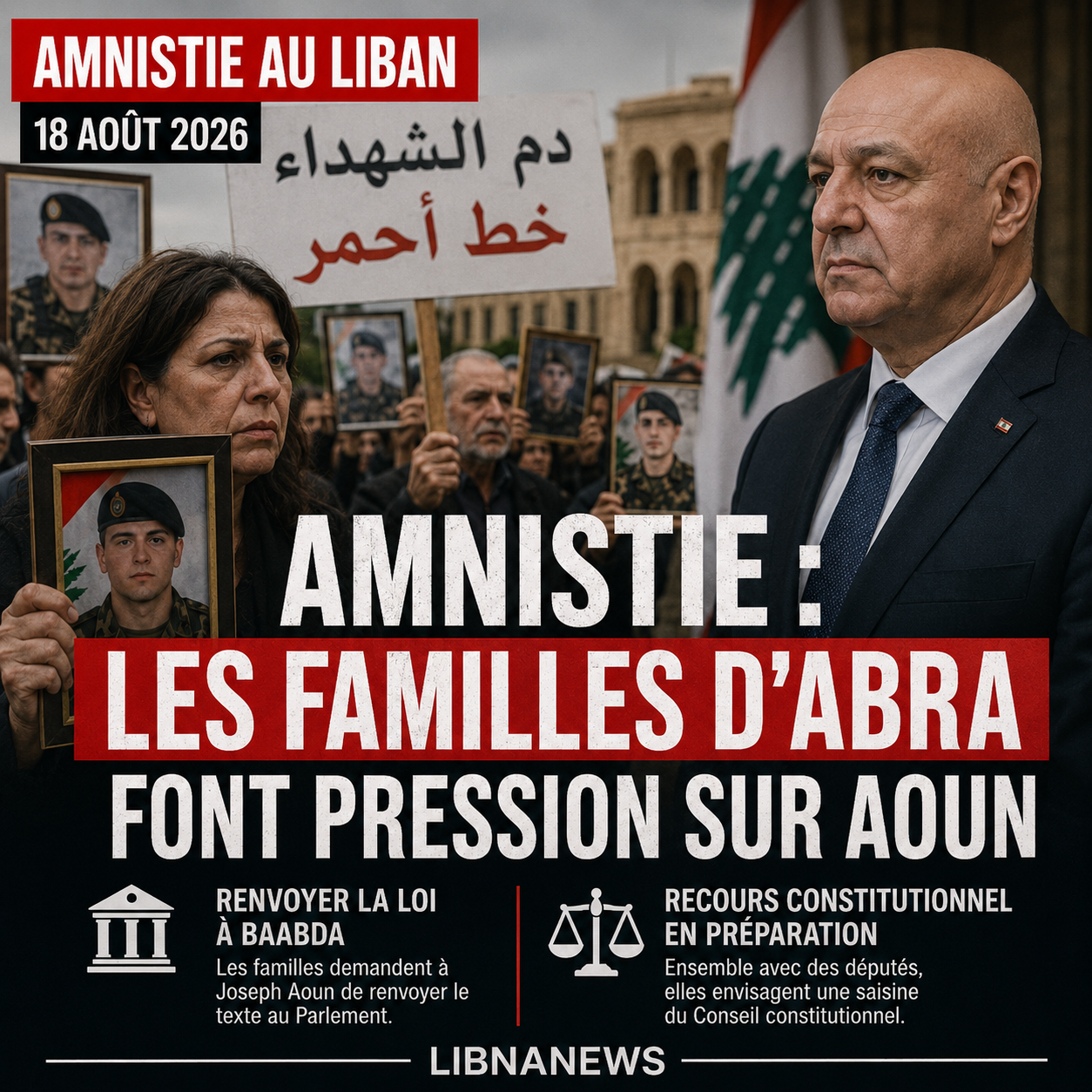
The families of the soldiers killed in the Abra clashes are preparing a new mobilization against thegeneral amnesty lawadopted by the Lebanese Parliament on 12 August 2026. Their action, reported on 18 August, must follow two paths: to ask President Joseph Aoun to refer the text back to the House or not to allow it to enter into force in its present form, and to work with MPs opposed to certain provisions for an appeal to the Constitutional Council. Their main requirement remains unchanged: to prevent a leniency measure from benefiting, without sufficient guarantees, persons prosecuted or convicted in cases related to attacks against the army and the security forces.
Abra families move battle to Baabda
Six days after the law was passed, the challenge no longer focused on the parliamentary debates themselves. Families now seek to act during the phase before the final entry into force of the text. Their first institutional target is the Baabda Palace, where they want to remind Joseph Aoun of the commitments he had made at an earlier meeting. According to the information reported on 18 August, they would like the Head of State to refuse to promulgate the law in its current form or to ask Parliament for further deliberation.
This request is based directly on Joseph Aoun’s position in front of military relatives. At their meeting, the president had assured that the blood of soldiers and members of the security forces could not be compromised. Families now believe that this declaration must have a concrete effect on the presidential decision. In their view, an unmodified enactment would be difficult to reconcile with the line previously defended in Baabda, since some provisions could reduce the length of imprisonment of persons linked to cases where military personnel were killed.
The second approach is directed at Members who are opposed to the adopted version. Families want to discuss with them the conditions for referral to the Constitutional Council. They cannot appeal against a law alone. Article 19 of the Constitution reserves this right, inter alia, to the President of the Republic, the President of the Chamber, the President of the Council of Ministers or ten deputies. The immediate challenge is therefore to bring together a sufficient number of parliamentarians and to identify precisely the provisions that could be challenged.
Amnesty law passed after months of tension
Thegeneral amnesty lawand exceptional reduction of certain sentences was adopted on 12 August 2026 after several months of negotiations. The text seeks to address several issues at once: the situation of prisoners who have been in prison for a long time, judicial delays, overcrowding and political or security issues that have been fuelling claims for years. This juxtaposition explains much of the controversy. Persons entitled to benefit from the scheme do not fall under the same offences, the same legal path or the same responsibilities.
The debate therefore quickly exceeded the general issue of prisons. Several political forces called for the exclusion of certain categories, including those involved in crimes against military personnel. Others stressed the long periods of detention and the case of qualified Islamist detainees, whose families have for years denounced too long or which they consider unfair. Parliament’s difficulty has been to draft a mechanism that is sufficiently broad to respond to the prison crisis without giving the feeling of removing particularly sensitive crimes.
Discussions in joint committees had already shown these differences in the spring. Representatives of the Ministries of Justice, Interior and Defence, as well as the security and military services, had participated in the work. Thus, military reserves did not appear at the last moment. In particular, they concerned the possible effects of the Act on convictions in cases where soldiers or members of the security forces had been targeted.
The vote on 12 August opened a crisis with the army
Tension peaked in Parliament on 11 and 12 August. The Minister of Defence, Michel Menassa, wished to present to the MPs the Lebanese Army’s comments before the vote. He had submitted a written note and wanted to explain the institution’s position on the changes made to the text during the negotiations. His intervention was considered important because these changes could change the actual duration of certain sentences and hence the fate of convicted persons in sensitive cases.
Prime Minister Nawaf Salam defended another concept of government functioning. He intended to present himself the position of the executive and to avoid several governmental voices giving the impression of conflicting positions before the House. The dispute quickly took on an institutional dimension. Several MPs called for Michel Menassa to speak directly, while the absence of the Minister of Defence in part of the debate fueled controversy.
On 12 August, both the Resistance Loyalty bloc and the strong Lebanon bloc left the meeting in protest. They requested that the military’s comments be heard before the debate continued. However, Parliament continued its work and passed the law. This sequence is now invoked by opponents of the text to show that the military institution’s reservations have not been exposed to all MPs as the Minister of Defence wished.
The day after the vote, Michel Menassa apologized to the families of the fallen soldiers. He regretted that he had been unable to make the army’s position heard before the House. His intervention has reinforced the perception among the families of victims that their concern is not limited to an emotional reaction but joins an institutional reserve expressed by the Ministry of Defence and the army.
Abra remains the red line of military families
The Abra file concentrates much of this opposition. On 23 and 24 June 2013, the Lebanese army had confronted the armed supporters of Sheikh Ahmad al-Assir in this area near Saida. Eighteen soldiers had been killed in the fighting and many injured. The confrontation had been one of the most deadly internal security episodes of that period and had been followed by numerous arrests, prosecutions and trials.
Ahmad al-Assir, a Salafist preacher known for his hostility to Hezbollah and his involvement in the war in Syria, had escaped from the security forces after the fighting. He was finally arrested in August 2015 at Beirut International Airport while trying to leave Lebanon under a false identity. Several court proceedings then dealt with the events in Abra and the responsibilities of those involved in the clashes.
Thirteen years later, the consequences of these procedures remain at the heart of the debate. The families of the military refuse to allow a general reform of the penalties to alter the fate of recognized persons involved in an attack against the army. Their position therefore does not simply refer to the abstract principle of an amnesty. It covers the definition of beneficiaries and the exclusions contained in the Act.
The relatives of the victims demand a clear distinction between persons detained for secondary offences or those facing lengthy detention without final trial, and those whose cases include acts of violence against the army. They fear that a general mechanism for reducing sentences will have the same practical effect for categories with very different responsibilities.
Families had already warned Joseph Aoun
The mobilization announced on 18 August is part of a campaign launched several months earlier. In the spring, the families of the soldiers killed in Abra had publicly requested that crimes committed against the army be excluded from any general measure. They emphasized the responsibility of the direct perpetrators, but also of the accomplices, instigators, financiers and persons who facilitated the attacks.
They then turned to Joseph Aoun. Their approach was based on an institutional as well as a symbolic argument. Prior to his election as President of the Republic in January 2025, Joseph Aoun had commanded the Lebanese Army for almost eight years. He was not at the head of the institution at the time of Abra’s fighting in 2013, but his journey linked him directly to the army and gave a special significance to his commitments to military families.
At their meeting with the head of State, the victims’ relatives had expressed their fears about amnesty and sentencing reductions. Joseph Aoun then set a limit by stating that he would not accept that the blood of soldiers and members of the security forces be compromised. This sentence is now at the centre of their political argument. They want the President to translate this commitment by using the means given to him by the Constitution.
What Joseph Aoun can do with article 57
Article 57 of the Lebanese Constitution gives the President of the Republic a clear lever. Within the time limit laid down for enactment, he may, after informing the Council of Ministers, once again request a further deliberation of a law. Parliament cannot refuse this request. If the House again adopts the text, then the Constitution sets the conditions for this second deliberation.
This prerogative explains why family mobilization is now focusing on Baabda. A removal would not automatically remove the amnesty law. However, it would reopen the parliamentary debate and allow opponents to attempt to change the contested provisions, including those relating to convictions for crimes against military personnel.
The timetable is also important. The Constitution provides that the President shall promulgate laws within one month of their transmission to the Government, except for special procedures for laws declared urgent. If the time limit expires without enactment or removal, the law becomes legally enforceable and must be published. Families therefore have a limited institutional window for presidential intervention.
Joseph Aoun’s decision will also have political significance. A referral to Parliament would mean that it considered the reservations to be sufficiently important to justify a new reading. To allow the text to follow its course would instead move the centre of the battle towards the Constitutional Council and the practical application of the reductions in sentences.
The Constitutional Council as a possible second lock
The second option studied by families is more technical. Article 19 of the Constitution allows ten deputies to apply to the Constitutional Council for review of a law. The President of the Republic, the President of the Chamber and the Prime Minister also have this faculty. Abra’s families must therefore pass through one of these institutional actors if they are to obtain a constitutional review.
An appeal would not constitute a new trial of the detainees concerned. The Constitutional Council would not have to decide who should be released or reduced. It would examine the conformity of the contested provisions with the Constitution and the applicable constitutional principles. The applicants should therefore make specific legal claims and cannot limit themselves to denouncing the unfairness of the text in their eyes.
This stage explains the envisaged contacts with MPs opposed to the law. It is not enough to count those elected politically hostile to the text. A request must be made, the necessary number of signatories must be gathered and action taken within the time limits laid down for the verification of constitutionality. The mobilisation announced on 18 August thus marks the beginning of a possible legal offensive, not the existence of an appeal already filed.
The proceedings of 11 and 12 August could also be reviewed by opponents, but any procedural challenge should be based on established constitutional arguments. The withdrawal of two blocks or the controversy over the intervention of the Minister of Defence alone is not sufficient to demonstrate the unconstitutionality of the law.
Opposite, families of prisoners also invoke justice
The challenge of military families alone does not summarize the amnesty file. The relatives of prisoners and their lawyers have long called for a resolution of situations which they present as injustices. In particular, they denounce the length of certain detentions, the judicial delays and the situation of persons who have remained in prison for years without a final decision.
This claim particularly concerns detainees often referred to in the public debate as « Islamics ». However, this category covers different situations. Some files are related to Abra, others to separate security cases. Responsibilities, counts and convictions are not identical. It is precisely this diversity that makes it difficult to draw up a general measure.
Inmate families feel that the justice system has sometimes produced disproportionate periods of imprisonment or situations that require legislative correction. They consider that an amnesty or an exceptional reduction of sentence can be a response to accumulated dysfunction. This position has found political support, especially among elected officials who have been calling for a solution to the problem of long detentions for several years.
The relatives of the military oppose this argument the right of the victims. They accept that errors or delays in the courts can be corrected, but refuse to allow such correction to benefit persons convicted of acts that resulted in the death of soldiers. Thus, the conflict is less about the existence of a prison problem than about how to draw the boundary between cases that can enter into a leniency measure and those that must remain excluded from it.
A prison crisis that fed the amnesty project
The background to the text remains the chronic crisis of the Lebanese prison system. Prisons have suffered for years from overcrowding, inadequate resources and the consequences of lengthy judicial proceedings. In some cases, pre-trial detention itself has fuelled claims for an exceptional mechanism.
Parliament wanted to respond to this situation by combining amnesty and reduction of certain penalties. But this solution quickly encountered a major political difficulty: a general law can affect files whose symbolic and security burden is very different. Crimes against the army, terrorism cases or armed confrontations are not seen as mere components of the prison crisis.
Parliamentary discussions have thus fluctuated between two objectives. The first is to reduce the consequences of a slow judicial system and a penitentiaries system in crisis. The second aims to preserve exclusions that protect the rights of victims and maintain the scope of convictions in the most serious cases.
The law adopted on 12 August constitutes the compromise reached after these negotiations. The mobilization of the Abra families, however, shows that this compromise did not resolve the disagreement. Instead, it seeks to reopen the text before it is implemented.
The case of Abra exceeds the name of Ahmad al-Assir
The strong customization of the debate around Ahmad al-Assir can give a too narrow picture of the problem. For the families of the military, the question does not concern a single man. They want the exclusions to cover all persons whose responsibility for attacks against the army has been retained in accordance with applicable judicial procedures.
This position extends to the various forms of participation in violence. Families fear that a law based primarily on the length of imprisonment will create automatic effects without due regard for the nature of the offences. They therefore require a file-by-file reading or, at a minimum, legal exclusions that are sufficiently precise to prevent a reduction of sentence from applying to cases which they consider incompatible with an amnesty.
This concern also affects the image of the army. In a country marked by repeated political, community and security crises, the military institution remains one of the main instruments of the state. Families consider that a law reducing the criminal consequences of attacks against its members would send a signal contrary to the protection due to soldiers.
A political battle that does not overlap the usual divisions
The vote on the amnesty also showed that the dividing lines do not exactly follow traditional political alliances. The Lebanese Forces defended the principle of the law, while strong Lebanon and the resistance loyalty bloc left the 12 August meeting on the question of the intervention of the Minister of Defence. Sunni MEPs in favour of a solution for some detainees have also put significant pressure on the text.
These positions do not mean that all actors support the same beneficiaries or provisions. Some defend amnesty as a response to detentions deemed excessive. Others mainly dispute the procedure in Parliament or call for further exclusions. The case thus combines judicial, community and institutional considerations without reducing itself to a confrontation between two perfectly constituted camps.
This is also why Abra’s families are now looking for MPs who can support a remedy on specific provisions rather than a general coalition against amnesty. Their stated objective is to modify or neutralize articles that they consider unfair to victims, not to transform their mobilization into partisan confrontation.
Nahr el-Bared’s precedent strengthens military sensitivity
The question also goes beyond the Abra fights alone. The Lebanese Army has experienced several deadly confrontations with armed groups over the past two decades. The battle of Nahr al-Bared against Fatah al-Islam in 2007 resulted in, inter alia, heavy casualties in the military ranks and numerous judicial proceedings.
The 2014 Ersal clashes and attacks by jihadist groups in the Bekaa also marked the institution for a long time. Military and security personnel had been killed or abducted. Some prisoners were subsequently executed. These precedents explain the high sensitivity of any legislative provision that may affect perpetrators of violence against State forces.
For Abra families, an insufficiently precise exclusion would therefore create a precedent that would go beyond their own file. Their approach aims to ensure that one principle is recognized: the correction of prison or judicial malfunctions must not erase the difference between persons detained due to excessively long procedures and those sentenced for their participation in deadly attacks against the army.
A confrontation between two concepts of equity
In the end, the amnesty debate contrasts two notions of fairness that are not necessarily conciliatable in all cases. The families of prisoners demand that the State take into account the time already spent in prison, the delays in the courts and the imperfections of the judicial system. They believe that a State which is excessively slow to try an accused person bears a share of responsibility for the duration of his detention.
The families of the military respond that the State also has an obligation to the victims. In their view, a general measure cannot transform system malfunctions into an automatic reduction in the punishment of those responsible for the death of soldiers. They therefore call for the nature of the crime to remain a determining criterion, even when the length of imprisonment is exceptionally long.
This confrontation explains why the word « amnesty » remains particularly explosive in Lebanon. An amnesty is never just a prison mechanism when it concerns episodes of political or security violence. It can be interpreted as a decision to turn a page, but also as a challenge to the judicial recognition of victims.
Parliament could be forced to reopen the compromise
If Joseph Aoun uses section 57, Parliament will have to review the law again. This hypothesis would put Members in front of the same differences which marked the vote on 12 August, but in a different context. The army’s reservations, Michel Menassa’s statements and the mobilization of families would then be known to all before the second deliberation.
Those elected in favour of the text should decide whether they maintain the current wording or agree to clarify the exclusions. Opponents could, for their part, seek to amend the provisions which they consider too broad without calling into question measures benefiting detainees who are not involved in crimes against the military.
However, such a return to Parliament would not guarantee an amendment. The Constitution provides that after a presidential dismissal, the Chamber may vote again. The aim of the family approach is therefore to create a political balance of power that is sufficiently important for the second reading not only to confirm the previous text.
A constitutional remedy would require a precise argument
The other way, that of the Constitutional Council, imposes a different logic. The anger of families, the sacrifices of the military or the political controversy surrounding the vote are not, in themselves, legal means. Applicants should demonstrate that one or more provisions contravene a constitutional norm.
The issue of equality before the law could include legal reflection according to the exact wording of the scheme and the categories it creates. However, any challenge should be based on the adopted text and the precise effects of the distinctions. It would therefore be premature to state on 18 August that an appeal would be successful or that a specific provision would be annulled.
Adoption procedures can also be examined if parliamentarians consider that a constitutional rule has been ignored. Again, the controversy caused by Michel Menassa’s impossibility of exposing the army’s remarks is not enough automatically. The distinction between a political irregularity and a constitutional violation will be decisive if the proceedings are initiated.
Joseph Aoun becomes the central actor of the post-vote
The sequence opened on 18 August thus gave Joseph Aoun a place he did not occupy during the parliamentary negotiations. The Head of State no longer drafts the compromise and does not participate in the vote, but now has the power to provoke further deliberation. This prerogative makes Baabda the first crossing point of family protest.
His past as army commander reinforced the pressure on him. The military’s relatives are not only addressed to the President as guardian of a constitutional procedure. They are also addressed to a former head of the institution whose sons or relatives were members.
This dimension does not legally determine the presidential decision, but it increases its political cost. If Joseph Aoun promulgates the text without asking for a new reading, he will have to respond to the families who invoke his previous statements. If he returns, he will reopen a case that has already created a crisis between the government, Parliament and the Ministry of Defence.
The 18 August mobilisation wants to remain within the institutional framework
Despite the strong emotional burden of the case, the announced steps currently favour legal mechanisms. Families want to address the President, convince MPs and, if conditions are met, use the Constitutional Council. This strategy seeks to transform a challenge of victims into an institutional battle rather than a street confrontation.
This orientation is important in a case that could cause high tensions. The families of detainees have themselves mobilized on several occasions to demand amnesty or a reduction of sentences. Any direct confrontation between the two groups could add a social and community dimension to an already complex issue.
The use of institutions also makes it possible to define the dispute more precisely. The question is no longer simply who is in favour or opposed to « amnesty ». The aim is to determine which provisions should be amended, which crimes should be excluded and which guarantees should accompany the reduction of sentences.
On 18 August, the decision moved to the Presidency
Today’s news is therefore less in Parliament than in the steps that are organised after the vote. The families of the soldiers killed in Abra want to remind Joseph Aoun of his word and use the constitutional time before the full entry into force of the law. Their request for removal places the President directly in front of the limit he himself had formulated on crimes against soldiers and members of the security forces.
At the same time, they are preparing a withdrawal solution or a second front by approaching MPs capable of seizing the Constitutional Council. This strategy shows that they do not consider the vote of 12 August as the end of the political procedure. They want to exploit the two mechanisms still available: the new deliberation requested by the President and the constitutional review.
For Joseph Aoun, the file concentrates several constraints. It must take into account its commitment to military families, the reservations expressed by the army, the vote of the Chamber and the demands of detainees whose relatives denounce years of judicial delays. Any decision will therefore have consequences beyond the immediate beneficiaries of the law.
As of 18 August 2026, no referral to the Constitutional Council has yet been announced as filed by families and no presidential dismissal has been established. The next concrete development depends on Baabda’s response and the ability of families to bring together parliamentarians around a remedy. It is now on these two fronts that the immediate future of the general amnesty law is being played out and, for the relatives of the soldiers who died in Abra, the possibility of preventing it from applying to cases which they consider to be a red line.




