

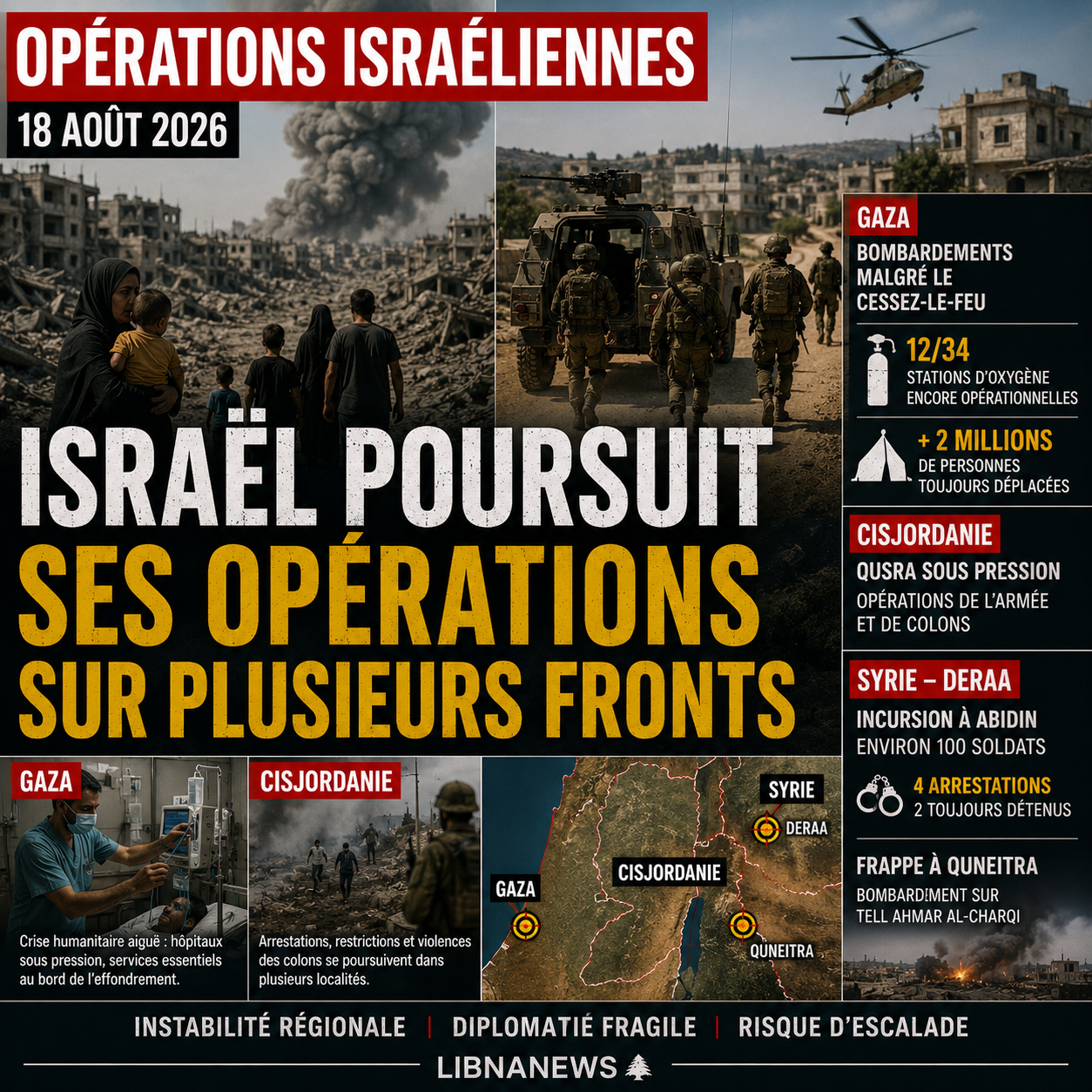
Theisraeli operationsin the Middle East, despite diplomatic efforts to reduce tensions. On 18 August 2026, new bombardments and fire were reported in the Gaza Strip despite the ceasefire, while the West Bank continued to face Israeli forces and settler operations. In southern Syria, an Israeli force of about one hundred soldiers entered the village of Abidin in western Deraa and made four arrests. Bombardment also affected the Tell Ahmar al-Sharqi area in Quneitra. These developments prolong a regional situation in which diplomatic initiatives have not yet led to full stabilization on the ground.
In Gaza, fire continues despite the ceasefire
In the Gaza Strip, new Israeli bombardments and fire were reported on 18 August. They intervene when a ceasefire is in force and diplomatic discussions seek to preserve the agreement. The Gaza Ministry of Health reported new victims and said that the record since the ceasefire came into force continued to rise. However, the available information does not allow these incidents to be assimilated to a general resumption of fighting to their previous intensity.
This persistence of violence illustrates the fragility of the situation. A ceasefire can significantly reduce clashes without eliminating all military incidents. However, every bombardment or lethal fire increases the risk of further escalation and complicates the efforts of the mediators. For Gazans, this instability means, above all, that the decline in fighting does not yet guarantee lasting security.
The military situation remains closely linked to the negotiations on the future of the Palestinian enclave. Discussions must simultaneously manage ceasefire compliance, security issues and humanitarian urgency. The gap between diplomacy and the field thus remains one of the main elements of the situation as at 18 August.
Gaza facing a critical oxygen shortage
The health crisis is a second emergency. According to data reported on 18 August, only 12 out of 34 oxygen production stations would remain operational in the Gaza Strip. The loss of nearly two thirds of the capacity mentioned directly threatens hospital services which depend on a permanent supply of medical oxygen.
Intensive care units are among the most vulnerable. Patients requiring respiratory assistance depend directly on this resource. Services for newborns are also at risk, especially when premature children need continuous assistance. A further failure of the remaining facilities could therefore have immediate consequences for the management capabilities.
This situation recalls that the effects of the conflict exceed the victims of the bombings alone. A hospital needs electricity, fuel, medicine, water and functional technical equipment. The destruction or cessation of these infrastructures continues to produce health effects even when the intensity of fighting decreases.
More than two million people still displaced
The issue of housing also remains unresolved. More than two million people still live in displacement conditions in the Gaza Strip. Nearly 200,000 families are reported to have settled in rudimentary tents that need to be replaced, according to information reported on 18 August.
These data show the gap between the conclusion of a ceasefire and a real return to normal. For a large part of the population, returning to their neighbourhood does not necessarily mean being able to return to their homes. The destruction and damage to infrastructure forces many families to stay in temporary facilities.
The consequences are multiple. Precarious shelters complicate access to hygiene and expose residents to weather conditions. Promiscuity also increases health risks, while the medical system has reduced capacity. Reconstruction and replacement of shelters are therefore an essential condition for transforming the ceasefire into a concrete improvement in daily life.
In the West Bank, Qusra under pressure
The West Bank has a different dynamic. On 18 August, new Israeli forces and settler operations against Palestinians and their property were reported. The village of Qusra, south of Nablus, is one of the localities concerned. Several houses were reportedly surrounded and restrictions imposed on the inhabitants.
These operations recall that the evolution of Gaza does not summarize the Palestinian issue. The West Bank continues to face military intervention, movement restrictions and tensions related to Israeli settlements. The inhabitants of localities near settlements are particularly vulnerable to confrontations and attacks on their property.
The Palestinian situation therefore remains divided between two realities. In Gaza, the priority is to consolidate a still fragile ceasefire and respond to a massive humanitarian crisis. In the West Bank, operations continue in a different context, with no equivalent mechanism for the sustained cessation of tensions.
Israeli operations also continue in Syria
Further north, southern Syria remains directly confronted withisraeli operations. On 18 August, an estimated force of about one hundred Israeli soldiers, accompanied by a dozen military vehicles, entered the village of Abidin, in the Yarmouk basin, west of Dar`a province. reconnaissance drones and helicopters accompanied the incursion.
The importance of the device distinguishes this operation from a simple patrol. The presence of approximately one hundred military personnel, vehicles and air support is a structured ground response. It confirms that Israeli activity in the southern Syrian Arab Republic is no longer limited to point air strikes or movements in the immediate vicinity of the separation lines.
Four Syrian youths were arrested during the operation. Two were then released, while two others remained detained according to available information. The precise reasons for their arrest were not established in the evidence. It is therefore not possible to attribute unconfirmed activities or belongings to those arrested.
The Yarmouk Basin, a particularly sensitive area
Abidin is located in a strategic region of the extreme south-west of Syria. The Yarmouk basin is close to Jordan and the Golan Heights occupied by Israel. Its geographical location gives it special importance to Israeli security concerns and to Damascus’ efforts to restore its authority over the southern regions.
The Syrian war has profoundly weakened this space. Various armed groups have been active during the years of conflict and local power relations have evolved on several occasions. The political upheavals of recent years have added an additional challenge: the Syrian authorities must rebuild their institutional capacities while seeking to control long-fragmented territories.
Israeli incursions directly complicate this goal. An operation allowing a foreign force to enter a village, make arrests and then withdraw highlights the limitations of Damascus’ control. It also raises a question of sovereignty distinct from the security considerations put forward by Israel for its operations in areas near the Golan.
Reported bombardment in Quneitra
The incursion of Abidin is not the only operation reported in Syria on 18 August. An Israeli bombardment also targeted the Tell Ahmar al-Sharqi area in Quneitra province. The available information does not provide a sufficiently established human assessment or a precise description of the target.
This lack of data requires that an unconfirmed objective should not be attributed to the bombing. However, its location remains important. Quneitra borders the Golan Heights and has been one of the most sensitive areas in Israel’s relations with Syria for decades.
The combination of a land operation in Deraa and a bombardment in Quneitra illustrates the diversity of means employed. Israeli movements in southern Syria now include incursions, arrests, aerial reconnaissance and strikes.
Lebanon observes the same tension between field and diplomacy
Lebanon is part of the same regional environment, although its situation cannot be confused with those in Gaza, the West Bank or Syria. The South Lebanon issue remains dominated by the search for a settlement to reduce tensions on a lasting basis, consolidate state authority and avoid a further major confrontation.
However, the continuity of Israeli operations in the regional environment reinforces Lebanese concerns. Developments in Syria are particularly monitored due to geographical proximity and security links between different fronts. An escalation in southern Syria or the Palestinian territories can alter the calculations of actors present in Lebanon, even when it does not automatically produce an extension of the conflict.
The challenge for Beirut therefore remains to isolate as far as possible the Lebanese front from other regional crises. This strategy depends on both diplomatic efforts, the control of the territory by Lebanese institutions and the evolution of Israeli operations.
Three distinct fronts, a persistent instability
The events of 18 August should not be presented as a single regional operation. In Gaza, bombardments occur despite a ceasefire and aggravate an already extreme humanitarian crisis. In the West Bank, operations are part of the context of occupation, settlements and restrictions imposed on Palestinians. In Syria, incursions directly raise the question of territorial sovereignty and control of the southern region.
The common point is the persistence of military activity while several political processes seek to reduce tensions. Diplomacy has changed certain parameters, particularly in Gaza, but it has not yet produced sufficient stabilization to put an end to incidents on the ground.
As at 18 August, immediate developments remain suspended from several unknowns: the effective maintenance of the ceasefire in Gaza, the evolution of operations in the West Bank, the fate of the two Syrians still detained after the incursion of Abidjan and the possibility of new operations around Daraa and Quneitra. These elements will determine whether the pressure observed on several fronts remains contained or opens a new phase of regional tensions.




