

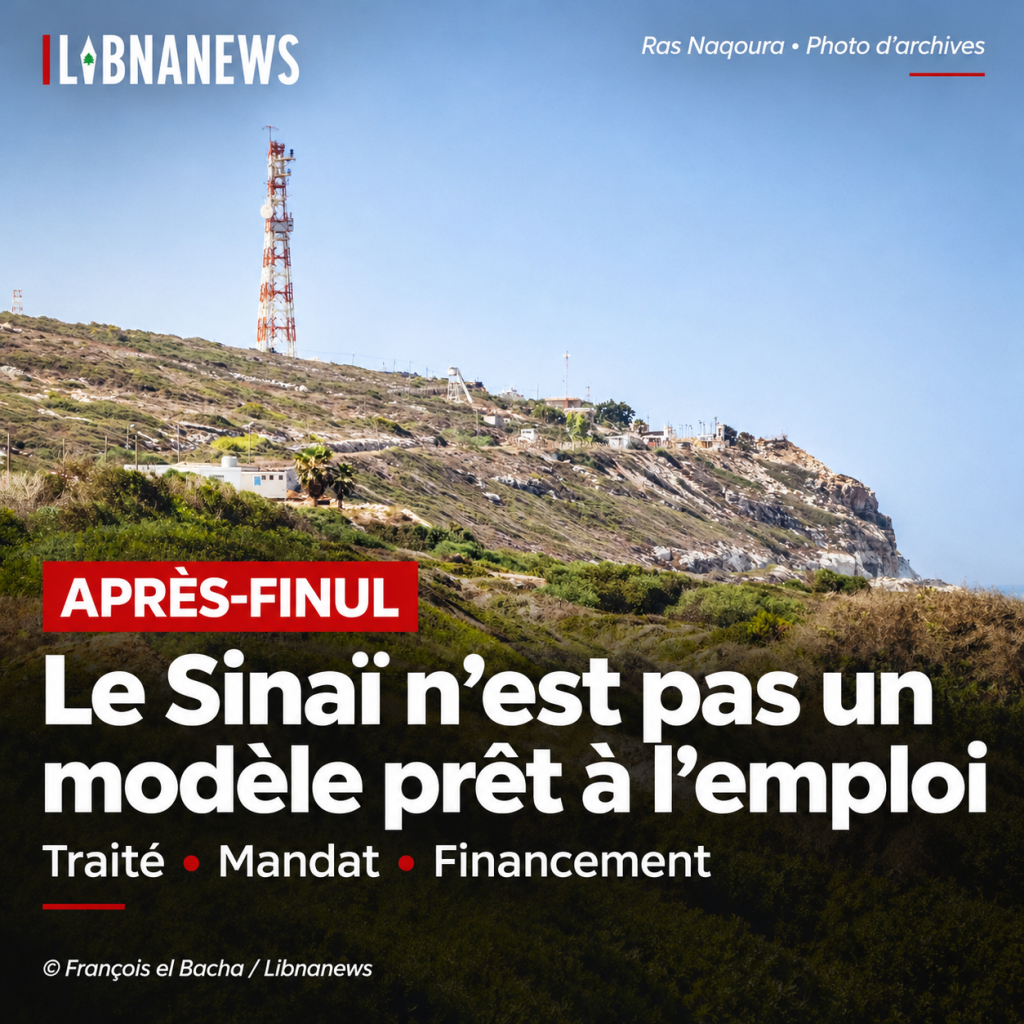
The « Sinai model » returns in discussions on post-FINUL. But the Multinational and Observer Force, known as MFO, is not a formula that Lebanon could take back by simply changing its flag. Its mandate is based on a peace treaty, defined military zones and an agreement on controls. These elements explain its operation as well as the countries that provide its troops.
The Lebanese calendar makes this comparison concrete. Security Council resolution 2790 provides for the termination of UNIFIL operations on 31 December 2026. It then arranges an orderly and secure withdrawal within one year. This text does not designate MFO as a successor. Examining the previous Egyptian-Israeli thus allows us to understand the conditions of a mission, without presenting an option discussed as an acquired decision.
The Sinai model begins with a treaty
Egypt and Israel signed their peace treaty on 26 March 1979. Its security annex included an international presence to monitor military commitments. Both States had envisaged a United Nations force. In the absence of agreement to deploy it, they negotiated an organization outside the UN framework, with the help of the United States.
The protocol of 3 August 1981 created MFO. The chronology counts: the force has come to accompany an already formalized peace, not to replace the political agreement necessary for this peace. The organisation itself stresses that it should not be a mere buffer between combatants. It had to monitor the implementation of commitments accepted by two sovereign States.
For Lebanon, the comparison thus raises a first question: what specific commitments would a possible mission have to monitor? A multinational designation does not determine its objectives or the obligations of the parties. The founding text must define what it sees, what it reports and the authorities to which it reports.
Four areas and predefined controls
In Sinai, the limits are not left to the daily appreciation of observers. The annex to the treaty distinguishes four zones: three in Egyptian territory and one in Israel. It supervises military personnel and equipment authorized in each. The audit therefore involves comparing a observed presence with pre-written rules.
MFO employs observation posts, checkpoints and reconnaissance patrols. It shall provide for periodic checks at least twice a month, unless the parties agree otherwise. A request from one of the two States may trigger additional control within 48 hours. Freedom of navigation in the Strait of Tiran is also one of his responsibilities.
These tasks describe a control mechanism, not a general territorial authority. Above all, they show that a mission must have a measurable object. In South Lebanon, any proposal should specify the areas concerned, the equipment monitored and the procedures for access. Without these details, comparing numbers or nationalities does not compare actual capacities.
A separate United Nations command
MFO has a general direction in Rome and a military command in Sinai. Its organization also includes representatives to both parties. The Director General provides overall direction, relations with governments and decisions on treaty violations. The Force Commander shall exercise operational control.
The division of responsibilities avoids confusing military observation with institutional decision-making. Command goes back to the general direction. Violations shall then be reported to the parties in accordance with the procedures laid down. National contingents are part of a common chain of command.
Transposing such an architecture would therefore require answering concrete questions: who would appoint those responsible, who would receive their findings and how would the contributing States accept their authority? The presence of foreign soldiers is not enough to resolve these issues. It requires a negotiated political and administrative organization.
Financing forms part of the agreement
The Sinai system directly involves the parties in its financing. The Protocol provides that Egypt and Israel shall cover expenditure not otherwise covered equally. The United States, for its part, has promised one third of the annual operating expenses, subject to the authorities and appropriations of Congress. Other States also make contributions.
This architecture distinguishes MFO from an operation financed by the United Nations peacekeeping budget. For a possible mission to Lebanon, the institutional choice would therefore have budgetary consequences. The contributors, the duration of their commitments and the resources actually funded should be identified. Diplomatic support alone is not a guarantee of resources.
In Lebanon, the transition mandate remains critical
Resolution 2790 distinguishes UNIFIL operations from the withdrawal phase. During the latter, it allows, inter alia, the protection of United Nations personnel and certain humanitarian functions, within existing capabilities. It also calls for a study of the future of the implementation of resolution 1701 after the departure of the force.
The Sinai precedent thus illuminates requirements, not a solution already adopted. Possible arrangements should have an accepted basis, command, verification rules and funding. None of these elements can be inferred from the word « multinational ». Their content should be reflected in the arrangements for South Lebanon.





Comments