

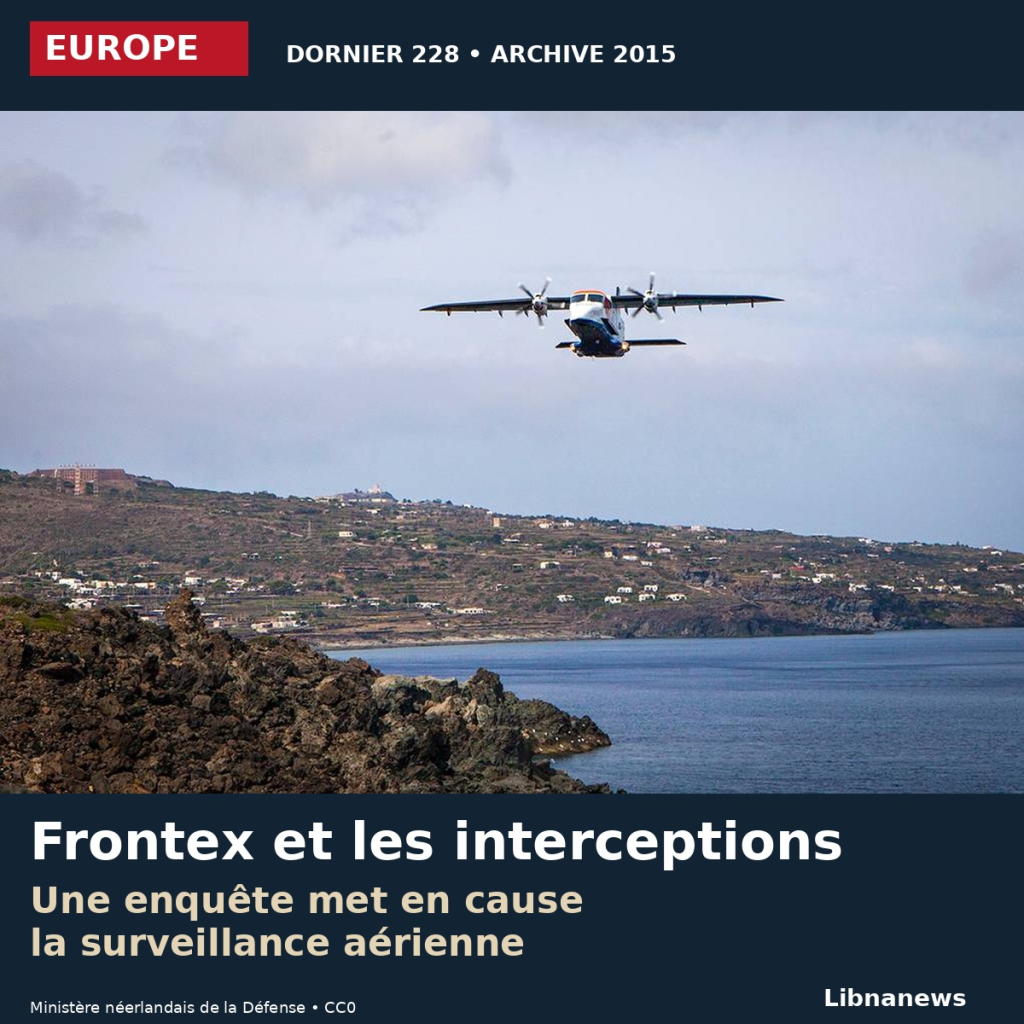
The Liminal laboratory, attached to the University of Bologna, questions the role of Frontex’s aerial surveillance in intercepting migrants in the Central Mediterranean. His « Aerial Bordering » investigation, released on November 3, 2026, links the Agency’s aircraft and drone detections to forced returns to Libya and Tunisia.
What the researchers have reconstituted
This is the result of an analysis of Liminal, not a judicial review. In particular, the team uses data from the Frontex operations reporting system obtained through access requests, as well as information from the European maritime operation Irini.
Researchers bring these elements of air trajectories together with testimonies or statements from relief organizations. They distinguish several degrees of evidence, depending on whether the agency was simply aware of an incident or whether its aircraft had directly identified the boat.
Liminal describes a communication that would favour the intervention of the Libyan and Tunisian authorities at the expense of humanitarian vessels. The authors report hidden information and incomplete aerial monitoring. In some cases, the place of landing is absent; The authors then use incident categories to identify intercepts. The survey is therefore not exhaustive.
Frontex invokes maritime rescue rules
On its institutional page dedicated to rescue, Frontex defends another reading of its missions. The agency explains that its aircraft and drones must identify boats in difficulty and notify the national centre responsible for the area, as well as the neighbouring centres.
It claims to be obliged to inform the Libyan centre when a distress is found in its search and rescue region, while declaring that it does not cooperate with the Libyan authorities. Frontex says to transmit the position, condition of the boat, estimated number of people and weather conditions. In case of imminent danger, a Mayday relay aims to alert nearby ships.
This general presentation of the protocol is not a detailed response to the cases identified by Liminal. The disagreement relates in particular to the recipients of the information and to what happens to persons after they are intercepted.
A European reform still proposed
The debate took place as the European Commission proposed on 27 October to strengthen Frontex. The project envisages a permanent force gradually increased to 30,000 officers, a return coordination centre and additional crisis response capacity.
These guidelines have yet to be agreed by the European Parliament and the Council. They are not new competences which have already entered into force. The Liminal investigation deals with the liability and effects of existing operations.





Comments