

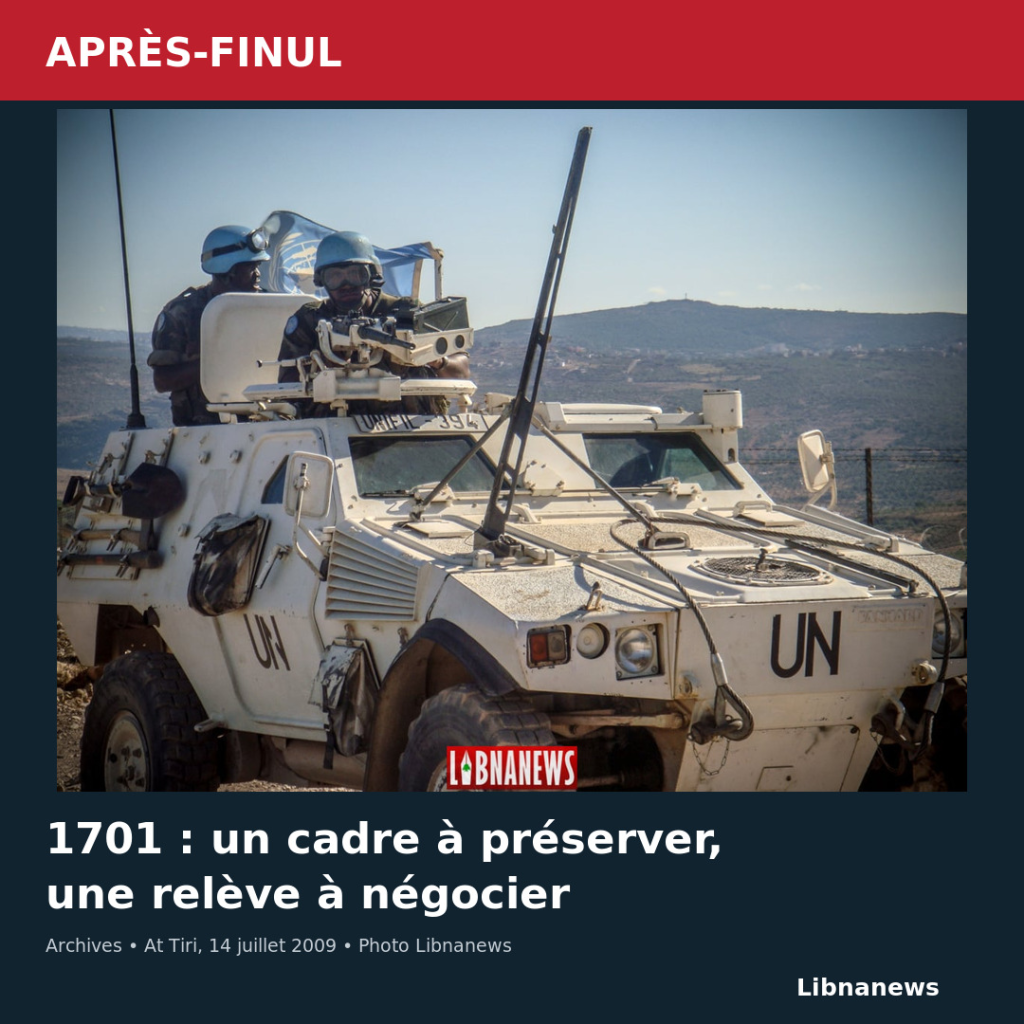
The announced termination of the mandate of UNIFIL does not mean the repeal of resolution 1701. Following Mike Waltz’s visit to Beirut, the debate focused on the possible successor arrangements for peacekeepers, the functions to be preserved and the role of the trilateral framework agreement in future arrangements. The information referring to an American will to exclude 1701 must be distinguished from public statements, proposals still under discussion and decisions actually taken by the Security Council.
Where does the hypothesis of an abandonment of 1701 come from?
Prior to the visit, the daily Ad-Diyar had reported, on the basis of unnamed diplomatic sources, an American orientation aimed at neutralizing the effects of resolution 1701 and making the framework agreement the reference of the next arrangement. This account, which was included in the press review of the Lebanese Ministry of Information on 13 November, included the use of truce observers and more limited coordination.
This information belongs to Ad-Diyar. Its republication on a ministerial site does not transform it into a government statement or authenticated American text. She describes what sources anticipated before the interviews. It does not prove that a draft of this kind was submitted to Lebanon, much less that it was adopted.
What Waltz said publicly
The report of the Lebanese Parliament of 16 November provides a direct point of comparison. After his meeting with Nabih Berri, the US Ambassador to the United Nations presented 1701 as the basis of the mission and envisaged its continuation with modifications and updates. He does not announce his cancellation.
Waltz indicates that Washington will work with France, which is responsible for drafting the draft in the Security Council, to incorporate elements of the trilateral dialogue. It places the negotiations in the weeks before the expiry of the mandate. He cited capacity to review, including demining, humanitarian and maritime support, and verification of commitments. He does not announce an already constituted successor.
In the same report, Berri presents the continuation of Israeli occupation and attacks as an obstacle to the deployment of the army and the return of the inhabitants. This is the position expressed by the President of Parliament, to be distinguished from an agreement between the interlocutors.
Two deadlines, not an instant departure
The relevant timetable is contained in resolution 2790, adopted on 28 August 2025. It last extended the mandate of UNIFIL until 31 December 2026. It then provides for the cessation of operations and an orderly and secure withdrawal within one year, in consultation with the Lebanese Government and the contributing countries.
Therefore, 31 December does not correspond to the simultaneous departure of all staff. The withdrawal phase has its own authorized functions, within the limits of available capabilities: protection of United Nations personnel and facilities, evacuation and contribution to the protection of civilians and the safe delivery of humanitarian assistance.
Above all, paragraph 2 of 2790 calls for full implementation of 1701. Paragraph 10 requires consideration of options for further application after withdrawal. The text organizing the closure of the mission does not therefore remove the political and security framework that it should contribute to the implementation.
What the 1701 reference protects
The 2006 resolution is not limited to the establishment of an international force. It links the cessation of hostilities, the Israeli withdrawal, the deployment of Lebanese forces and the extension of State authority. Paragraph 8 of the resolution included respect for the Blue Line and the absence of weapons and unauthorized armed personnel between the Line and the Litani, with the exception of Lebanese Government forces and UNIFIL.
The text also refers to the disarmament of armed groups, the absence of foreign forces without government consent and the control of arms supplies. Reducing 1701 to an obligation only concerning Hezbollah or only Israel would remove part of its architecture.
Therefore, the choice of legal reference is not a vocabulary detail. A new mission may have fewer staff or different functions without the political obligations of the parties being identical to its operational mandate. Conversely, keeping the number of a resolution in a preamble would not be sufficient to demonstrate that all its requirements still have the same means of follow-up.
Lebanese demand: international presence and reciprocity
The official communiqué of the Grand Sérail of 16 November specifies the position of Nawaf Salam. The Prime Minister calls for the continuation of an international presence under the mandate of the Security Council, with functions of observation, reporting, coordination, liaison and support to the army. It maintains 1701 as an essential reference of the arrangements in the South.
On the trilateral framework agreement, Salam called for a clear timetable for a parallel progression of the Israeli complete withdrawal and the extension of State authority, with the weapons under its control alone. It also calls for a reliable mechanism to verify the commitments of both parties.
The published position is therefore not the refusal of any new formula. It conditions the transition to an international framework, concrete functions and reciprocity. Presenting the debate as an opposition between a fully finalized US proposal and a global Lebanese rejection would go beyond what these documents establish.
Security vacuum is measured at lost functions
An observation force, military support and a mission with protective capabilities are not interchangeable. Finding a violation requires access to the ground, personnel and reporting procedures. Demining involves specialists and equipment. Ensuring the safety of a team requires further means. An agreement on the principle of an international presence leaves these operational issues open.
In order to assess a possible succession, it will be necessary to examine its mandate, chain of command, freedom of movement, protection, financing and reporting capacity. The national composition or number of contingents is not sufficient to answer these questions. A small mission can perform a precisely defined task; it does not automatically replace all functions of a wider force.
The transition also involves a risk of lag: the operations of a device can stop before its successor is authorized, financed and deployed. Avoiding this lag requires more than a diplomatic announcement. Continuity of responsibilities must be organized and what remains to be done during withdrawal.
As of 17 November, the public documents consulted set out an end-of-mission schedule and subsequent negotiations, not a repeal of 1701 or the adoption of a replacement force. The point to be monitored will be the content of the next text submitted to the Security Council: what obligations it resumes, what means it authorizes and how it articulates Israeli withdrawal, Lebanese State authority and international verification.





Comments