

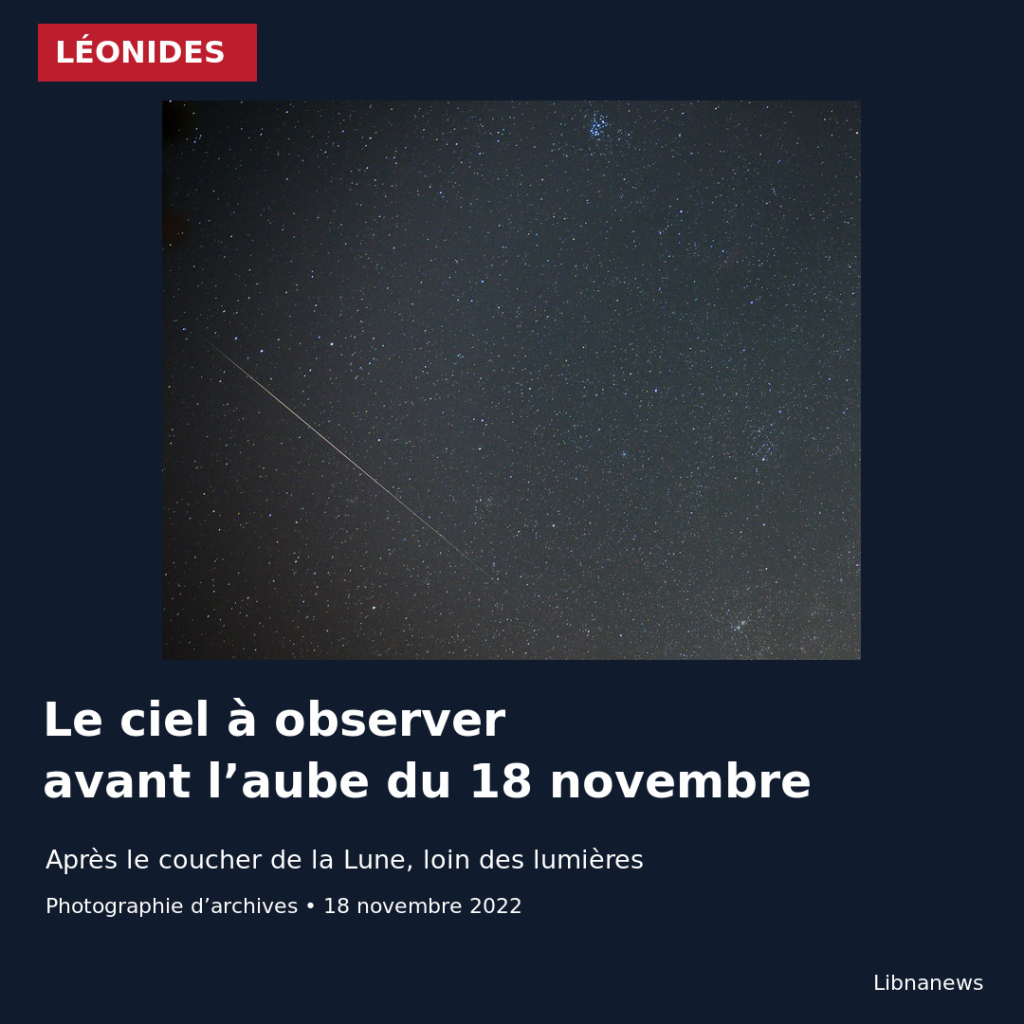
The Léonides offer an appointment for night sky enthusiasts before dawn on 18 November 2026. In its November bulletin, NASA advises on the first hours of the 17th and 18th, after sunset. However, we must wait for a modest activity, not a continuous rain of shooting stars.
NASA reports about 15 meteors per hour in ideal conditions, while noting that most observers will see less. This number is neither a guarantee for each place nor a regular rate. Clouds, urban lights and the visible portion of the sky can greatly reduce the spectacle.
Observe the Leonids before dawn, after the Moon
The American Meteor Society’s newsletter published on November 16 places the maximum around November 18. It indicates that the Moon, in the first quarter on the 17th, sets around midnight in local time. A darker window then opens before daybreak.
These indications do not set a universal time. The setting of the moon and the beginning of dusk depend on the observer’s position. The useful moment is after the disappearance of the lunar light, but before the sky begins to lighten.
To watch, NASA recommends a dark location and about thirty minutes of eye adaptation. Much of the sky must be embraced, rather than looking for a specific point. A blanket or reclining chair allows you to wait more comfortably in the night cold.
The Lion gives their name to the meteors
The trajectories of the Leonids seem to come from the constellation of the Lion. This apparent direction is called the radiant. It does not mean that particles actually come from this constellation. They belong to the debris trail left by comet 55P/Tempel-Tuttle.
When the Earth crosses this current, small particles enter the atmosphere and produce light traces. The Léonides are among the fast meteors, with an entry speed close to 70 kilometers per second.
The American Meteor Society reports that their radiant is better placed eastward at the end of the night. However, it recommends not to keep it in the centre of the eye: meteors also appear elsewhere in the sky. From the southern hemisphere, the swarm remains observable, but its position is less favourable.
Why not all forecasts give the same figure
The weekly bulletin of the American Meteor Society mentions about three Leonids per hour in the northern hemisphere. This figure corresponds to his estimates for the night of November 14-15, before the maximum. It should therefore not be compared directly with the 15 possible meteors in the ideal conditions quoted by NASA for the following mornings.
General calendars may also present dates different from those of recent observation bulletins. For that night, the information is from NASA’s monthly bulletin of November 2 and the weekly forecast published on November 16.
The most useful preparation remains local: check cloud cover, lunar schedules and safe access to the chosen location. In Lebanon as elsewhere, a favourable astronomical forecast does not guarantee a clear sky or the possibility of safely moving away from the lit areas.





Comments