

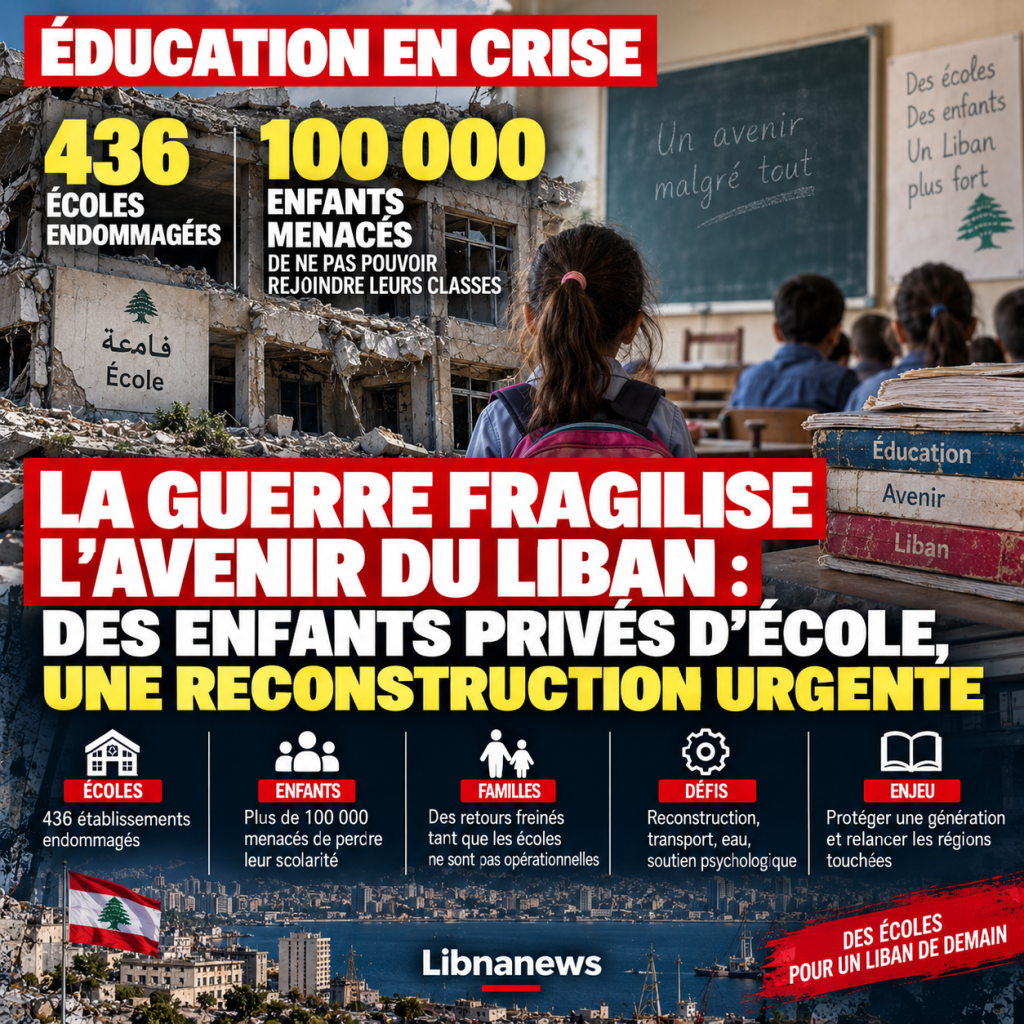
The consequences of the war in Lebanon are no longer limited to destruction of housing, displacement or economic losses. They now directly affect the ability of some children to pursue normal schooling. On October 1, 2026, President Joseph Aoun made a particularly worrying observation during his meeting at the Baabda Palace with the Executive Director of UNICEF, Catherine Russell. According to the data presented at the meeting, 436 schools had been damaged and more than 100,000 children were at risk of not being able to reach their classrooms and schools.
These figures place reconstruction in a different perspective. Repairing roads and buildings will not be enough to stabilize affected areas unless families are able to enrol their children in school. Several households are already reluctant to bring the youngest to their villages until schools and essential services are operational. Some families remain separated. The school issue becomes both an educational, social and territorial problem. It conditions the return of displaced persons and could leave consequences for several years if school interruptions continue.
436 damaged settlements and an uncertain return
The number of 436 schools damaged gives an initial measure of the extent of the problem. It does not mean that all these establishments are completely destroyed or permanently unusable. Available sources do not provide a breakdown to distinguish slightly affected schools from those requiring heavy reconstruction. This lack of detail prohibits the automatic assimilation of 436 schools into as many out-of-service schools. However, it shows the geographical and material extent of the damage that the education system is facing.
The second is even more directly related to children. More than 100,000 of them would be at risk of not being able to access their classes and schools. Again, a distinction must be made between risk and effective de-schooling. The figure does not mean that 100,000 pupils have already dropped out of school. It refers to a population whose educational continuity is weakened by destruction, displacement, transportation problems and the state of services in the affected areas.
This distinction does not lessen the seriousness of the problem. The longer a school break, the more difficult it becomes to return to a normal educational rhythm. Students must find schools, teachers, programmes and family stability. For younger people, several months of break-up can affect basic learning. For adolescents, interruptions can affect examinations, guidance and further education. The October 2 sources do not provide a detailed measurement of learning losses. However, they show that the authorities already consider access to education as one of the major challenges of the reconstruction period.
School becomes a condition for family return
The situation in the affected regions reveals above all a phenomenon that goes beyond the Ministry of Education. Families who left their communities during the hostilities do not necessarily return together. Some adults can return to their village to check the condition of their home, resume activity or rebuild. Children sometimes stay elsewhere when the local school is unable to accommodate them.
Discussions with international organizations have highlighted this family fragmentation. Parents are reluctant to bring their children back before they know that an institution is functioning and that essential services are available. The rehabilitation of schools thus becomes a condition for population stabilization. Without it, return may be temporary or incomplete, even when security conditions improve.
This situation changes the way reconstruction is defined. A repaired house is not enough to allow a family to return in a sustainable way. Water, electricity, care, transportation and a school are also needed. The rehabilitation of schools must therefore be considered with other local infrastructures. A school without water or safe access cannot normally resume its activity. Similarly, the reopening of an establishment does not solve the problem if families still live away from their village or if daily travel remains difficult.
This is why discussions with the United Nations now link school rehabilitation with programmes of return and early recovery. Education no longer appears as a case to be dealt with after material reconstruction. She becomes one of her instruments.
The South concentrates an essential part of the difficulties
The regions affected by military operations, particularly in the South, have several obstacles. Infrastructure had been damaged, some families had been displaced and several localities continued to suffer the direct consequences of the security situation. President Joseph Aoun stressed the need for special attention to children and families living in the most vulnerable areas and for programmes to ensure access to education, protection and essential services.
This approach shows that not all students face the same level of difficulty. A child whose school has been slightly damaged in a re-accessible area is not in the same situation as another living in a locality where basic infrastructure remains out of service. The reconstruction will therefore have to set priorities rather than apply an identical response to the entire territory.
The rehabilitation of settlements can also help to establish populations. A school that reopens does not only provide an educational service. She reports that a locality is starting to function again. It allows parents to resume an activity without having to keep their children in another area. It can also reduce the pressure on schools in areas where displaced persons have been accommodated.
Conversely, a school that remains closed prolongs the effects of displacement. Families must choose between returning home and maintaining the continuity of their children’s education. This tension can last long after the fighting is over.
Poverty turns a school break into a risk of drop-out
Joseph Aoun also warned against the long-term consequences of poverty and the interruption of schooling. This association is essential. A child temporarily deprived of his or her institution may theoretically resume his or her studies when the latter reopens. But the situation becomes more difficult when the family has lost its housing, economic activity or part of its income.
Financial pressure can change home priorities. School transport costs are becoming more difficult to bear. The cost of supplies and travel is higher. In the most fragile cases, the child can be pushed to gainful activity. The President specifically mentioned the risk of an increase in child labour among the possible consequences of the crisis.
Available sources do not provide figures to measure the current trends in child labour in the affected regions. It would therefore not be justified to deduct an already quantified increase. The alert is about risk. However, it becomes more important when several factors combine: poverty, damaged school, displacement and loss of family income.
Educational reconstruction must therefore integrate household economic constraints. Returning a building to condition does not guarantee that all students will return. The most vulnerable families may need support to keep children in the school system.
Mental health, second crisis behind destroyed buildings
The psychological dimension is also important in the Baabda concerns. Children living in the affected areas suffered the direct and indirect effects of the war on their family and social stability. The Chair referred to the consequences on mental health and warned of the risk of lasting effects if difficulties are not dealt with quickly and methodically.
The reconstruction of schools cannot therefore only be real estate. An institution can reopen its doors while welcoming students marked by displacement, destruction of their daily environment or separation from their families. Teachers themselves may have experienced the same events. Resuming the courses is not automatically enough to find the previous conditions.
The sources of the corpus do not provide a clinical assessment of the mental health of the Lebanese children concerned. Therefore, it is not possible to establish a precise prevalence or quantify disorders. However, they show that this issue is now integrated into the official diagnosis. It is associated with the risks of poverty, school interruption and family disruption.
The issue is all the more important as the school can be one of the main areas of return to a routine. Regular schedules, the presence of teachers and contact with other students can help to restore a daily framework. But to fulfil this role, settlements must have the necessary human and material resources.
Reconstruction faces decline in humanitarian funding
The financial difficulty is not limited to families. International agencies themselves face reduced resources for humanitarian and development programmes. This issue was explicitly addressed in discussions with Catherine Russell. The President called for the needs of Lebanon and its children to remain among the priorities of international donors.
This decrease in resources occurs at a time when requirements are increasing. It is necessary to repair facilities, support families, restore water and health services, treat psychological consequences and accompany the return of displaced persons. The same donors are asked for housing, infrastructure, health, agriculture and municipalities.
Education is therefore in competition with other emergencies which are themselves essential for the operation of schools. Rehabilitating a facility in a private water village is not enough. Restoring the pumps without repairing the school does not allow families to return with their children. Investments must be coordinated.
This is one of the main challenges of the current phase. Reconstruction can no longer be organised in completely separate sectors. Needs are interdependent and resources limited. The choice of priorities must therefore take into account the ability of an investment to simultaneously facilitate the return, education and recovery of local life.
Municipalities and local services become essential
Discussions on the recovery of affected areas also show that municipalities play a central role. They must manage waste, local roads, certain services and the immediate needs of the inhabitants. Several requests were made to strengthen their capacity, including through the independent municipal fund and the provision of equipment.
For the school, this local dimension is decisive. Daily operation depends on the immediate environment: access, water, sanitation, electricity and transportation. Even when the building is under another administration, the condition of the municipality directly influences its capacity to accommodate students.
The United Nations has conducted field assessments in many municipalities to identify needs. The priority given to water, schools and health centres shows that the stabilization of villages is based on a set of services rather than on a single infrastructure.
Coordination therefore becomes a problem in itself. National institutions, municipalities, international agencies and donor countries operate in the same territories. Without a clear division of responsibilities, some localities may receive several interventions while others remain insufficiently covered.
More than 100,000 children are also an issue for human capital
Joseph Aoun presented the protection of children as a protection of the country’s human capital. The formula takes on a particular meaning in a Lebanon already faced with a prolonged economic crisis and strong migratory pressure. A significant interruption of schooling can produce consequences that only become visible several years later.
The risk first concerns the skills acquired. Students who accumulate delays may find it more difficult to continue their studies. It then concerns inequalities. Families with resources can more easily find alternative solutions, finance travel or change institutions. The poorest households have fewer options.
The educational crisis can therefore increase existing gaps. Two children affected by the same destruction will not necessarily experience the same trajectory. A person whose family can move or finance a temporary solution will more easily maintain his or her school continuity. The person whose household has lost his income is more likely to stay out of school.
This is precisely why the 100,000 children mentioned should not be seen as merely an administrative indicator. They represent a risk of social fragmentation. The longer the period of uncertainty, the more difficult the consequences become to correct.
Repair quickly without temporarily rebuilding for years
Immediate response may require temporary solutions. Temporary educational spaces, reassignments of schools or suitable arrangements may allow students to remain in the system during work. But the provisional itself poses a danger: to become permanent for lack of funding.
Lebanon must therefore manage two calendars. The first is emergency. Children should be prevented from losing a school year because their school has not yet been repaired. The second is sustainable reconstruction. The damaged schools must be rehabilitated and the services necessary for their normal functioning restored.
The Executive Director of UNICEF emphasized child protection while referring to support for recovery and strengthening systems to deliver essential services, including education, health, water and sanitation. This approach responds directly to the current problem: emergency and reconstruction can no longer be treated as two totally separate periods.
Every month now counts for families who hesitate to return. A school that is back in service can allow tens or hundreds of children to return and stabilize their homes. On the other hand, a prolonged closure can transform a temporary move into a sustainable installation elsewhere.
School becomes one of the first indicators of a true return to normal
The 436 schools damaged give a material picture of the crisis. The more than 100,000 children at risk of losing normal access to their classes give them the human dimension. But the stakes go beyond these two figures. The operation of the facilities is becoming one of the best indicators of the ability of the affected regions to return to normal life.
When schools reopen, families have an additional reason to come back. Parents can reorganize their activity. Kids are back to a routine. Villages are starting to function as communities and not just as repaired buildings.
When schools remain closed, reconstruction remains incomplete. Families continue to divide between their home communities and where children can study. Expenditure is increasing. The risk of stalling settles. Poverty and child labour can exacerbate this breakdown, while the psychological consequences remain unanswered.
Lebanon’s educational challenge is no longer simply to restore 436 buildings. It is to prevent a war-induced crisis from becoming a lasting break for more than 100,000 children. The speed with which schools, water, health services and local infrastructure will be restored will largely determine whether families will be able to return to their homes and whether children will return to stable education.





Comments