

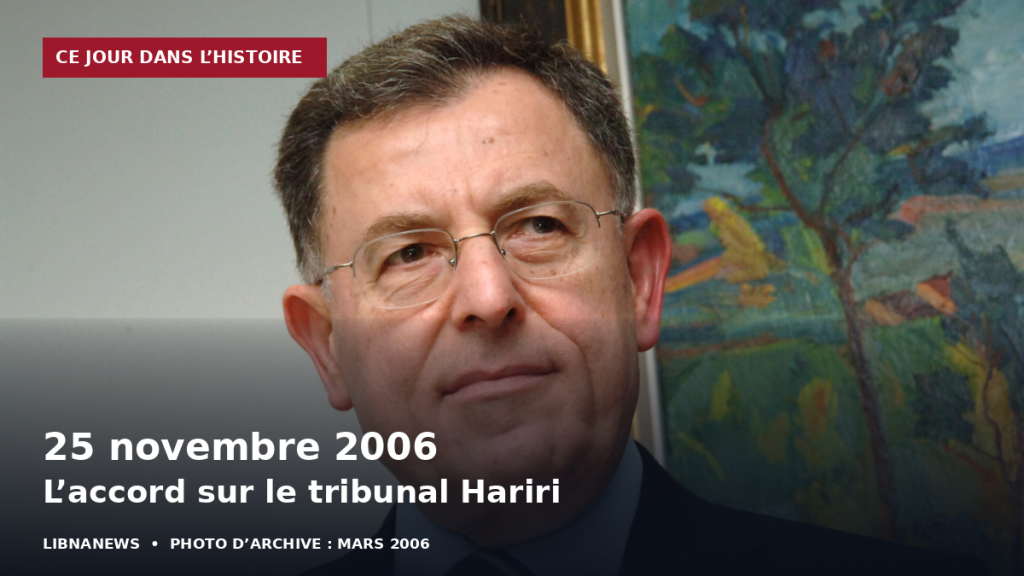
On 25 November 2006, the ministers who remained in the government of Fouad Siniora approved the final text of the agreement on the court responsible for the murder of Rafic Hariri. But the decision is not enough to bring the agreement into force. The political blockage in Beirut ended up bringing the matter before the Security Council.
A decision taken by a divided government
On 25 November 2006, the ministers who remained in Fouad Siniora’s government approved the final text negotiated with the United Nations to establish an international tribunal. According to the UN Secretary-General’s chronology, the Council of Ministers had already approved a draft on 13 November. The decision of the 25th concerns the final text, not the opening of the court or the indictment of suspects.
Meanwhile, Lebanon has experienced a new political assassination. On 21 November, Minister of Industry Pierre Gemayel was killed. The Security Council condemns the assassination. At the judicial level, however, the future court was first designed for the 14 February 2005 bombing in Beirut, in which Rafic Hariri and 21 others lost their lives. Its status extends its competence to other attacks under certain conditions, including the existence of a link with that of 14 February.
Why the agreement could not yet enter into force
Consultations among Lebanese leaders had begun on 6 November. After their failure, the Shiite ministers resigned on the 11th, and another minister followed them on the 13th. President Émile Lahoud, Amal, Hezbollah and the Free Patriotic Movement therefore contest the constitutional legitimacy of the government. The Siniora team continues to meet: it invokes the support of the parliamentary majority and considers that resignations, which the Prime Minister did not formally accept, are invalid. The UN report records these two positions without making a judgement on the Lebanese Constitution.
Disagreement soon emerged from the institutions. On 1 December, supporters of the main opposition groups began a sit-in near the government headquarters in central Beirut. Majority MPs petition for a meeting to ratify the agreement. In the following spring, the UN noted that Parliament had not met since the end of its autumn session because of a lack of convening. On 10 April 2007, Siniora wrote to the Secretary General asking the Security Council to consider another way to establish the court.
Security Council resolves the question of entry into force
On 30 May 2007, the Security Council adopted Resolution 1757 under Chapter VII of the Charter of the United Nations. The Resolution fixes 10 June as the entry into force of the annexed Agreement and Statute, unless Lebanon previously notifies the completion of its internal procedures. It is therefore not the approval of 25 November that brings the agreement into force legally. This is the mechanism set six months later by the Security Council.
The court is based in the Netherlands and applies Lebanese criminal law in particular to offences within its jurisdiction. Its decisions concern the criminal liability of persons tried, not that of a party or a State. In the main case, Salim Jamil Ayyash was convicted at first instance in 2020. Hassan Habib Merhi and Hussein Hassan Oneissi, acquitted at first instance, were found guilty on appeal in 2022. The court closed on 31 December 2023.
Three dates sum up the course of the case: on 25 November 2006, the Lebanese government approved the final text; on 30 May 2007, the Security Council shall determine the conditions for its entry into force; on 10 June 2007, the Agreement shall take effect. Confounding them erases what was played out in Beirut between the two decisions: an agreement approved by the government could not follow the envisaged internal procedure to the end.





Comments