

In Lebanon, about 2.15 million people are in phase 2 of acute food insecurity between September 2026 and February 2027, according to the CPI analysis published on 5 November. That doesn’t mean they all jumped meals. Their households still manage to feed at least, but struggle to cover other essential expenses without changing their way of life. The price of the reference basket and the price of housing allow to understand why.
What Phase 2 measures in Lebanon
Phase 2, known as stress, is pre-crisis. At this level, the Integrated Framework for Food Security Classification, or IPC, describes households with just enough food consumption. To cover certain other essential expenses, however, these households need adaptation strategies. The crisis phase, at the next level, refers to food shortages or the maintenance of minimum food at the cost of more serious strategies, which, in particular, affect livelihoods.
The 2.15 million are an estimate of persons belonging to the households concerned, not a count of families who have made a specific decision. The figure covers the population analysed in Lebanon, including Lebanese residents, Syrian and Palestinian refugees and persons who arrived from Syria after December 2024. It is not confused with persons classified in phase 3 or more. Neither the income of a household nor the price of its last basket can be used alone to assign it to a phase: analysts bring together consumption, food-related strategies, livelihoods and assistance received.
How much is the reference basket?
For August 2026, the World Food Programme estimates the national cost of the minimum survival basket at $556 for a household of five. Its food component is $43.60 per person, or $218 per five. The non-food component represents $338 per household. The larger minimum basket of expenses is $713 for a household of the same size. These two baskets should not be added: these are two different references.
These amounts, taken from the CPI analysis, are neither a family bill nor a minimum income paid. Nor do they describe cash prizes in November. They give an August marker for a given household size. The food component of the survival basket costs 11% more than in August 2025. However, the household that still manages to fill its basket has not finished paying for housing, travel or treatment.
The rent may rise while the feeding falls
The central statistical office measures something else: the evolution of consumer prices, not the cost in dollars of the survival basket. In September, at the national level, its food and non-alcoholic beverage index fell by 0.23% in one month. However, 10.04% remained above September 2025. In the same year, the real rent index increased by 16.79 per cent and that of transport by 35.23 per cent.
To visualize the difference, if each of these three indices is worth 100 in September 2025, it reaches a year later about 110 for food, 117 for rent and 135 for transport. These are not three expenses of the same weight or amounts to be added. The exercise does not mention a family’s salary, lease, or the cost of the journey. The statisticians further report that in Nabatiyah, much of the price could not be recorded on the spot and had to be estimated.
What goes on in the budget
The CPI indicates that rent, energy, travel, care and repair costs compete with food. To continue eating, households can pay back an essential expense, borrow or choose a less varied diet. The report also notes that a return to the home municipality does not necessarily eliminate the cost of accommodation elsewhere: it is sometimes necessary to repair the housing or pay for additional travel. These are documented mechanisms, not a list of sacrifices that each person in phase 2 would have made.
The report shows why surveys do not stop at the base. Of the Lebanese households described in its consumption data, 88% had an acceptable food score in 2026. At the same time, the use of the most severe food strategies increased from 11% in 2025 to 19% in 2026. These two indicators relate to the group studied, not only to households classified in phase 2; They do not necessarily identify the same people. They nevertheless shed light on the question that the consumption figure alone leaves open: how long can a household still maintain this diet when other expenses cannot wait?
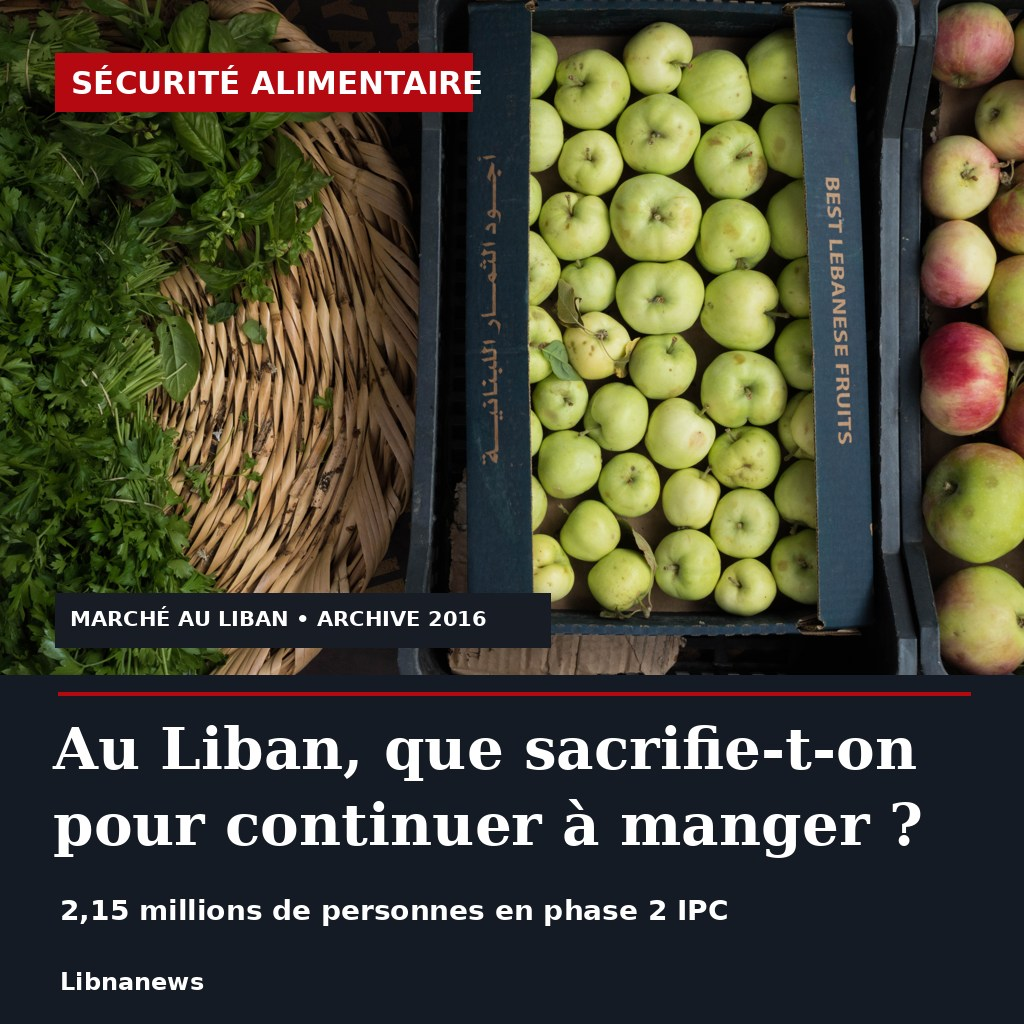
Cover: fruit and vegetable stall in Lebanon, July 2016 archival photograph. It represents neither a family surveyed nor the prices observed in 2026. Peter Feghali / Unsplash via Wikimedia Commons, CC0 1.0. Boxing and dressing Libnanews.





Comments