

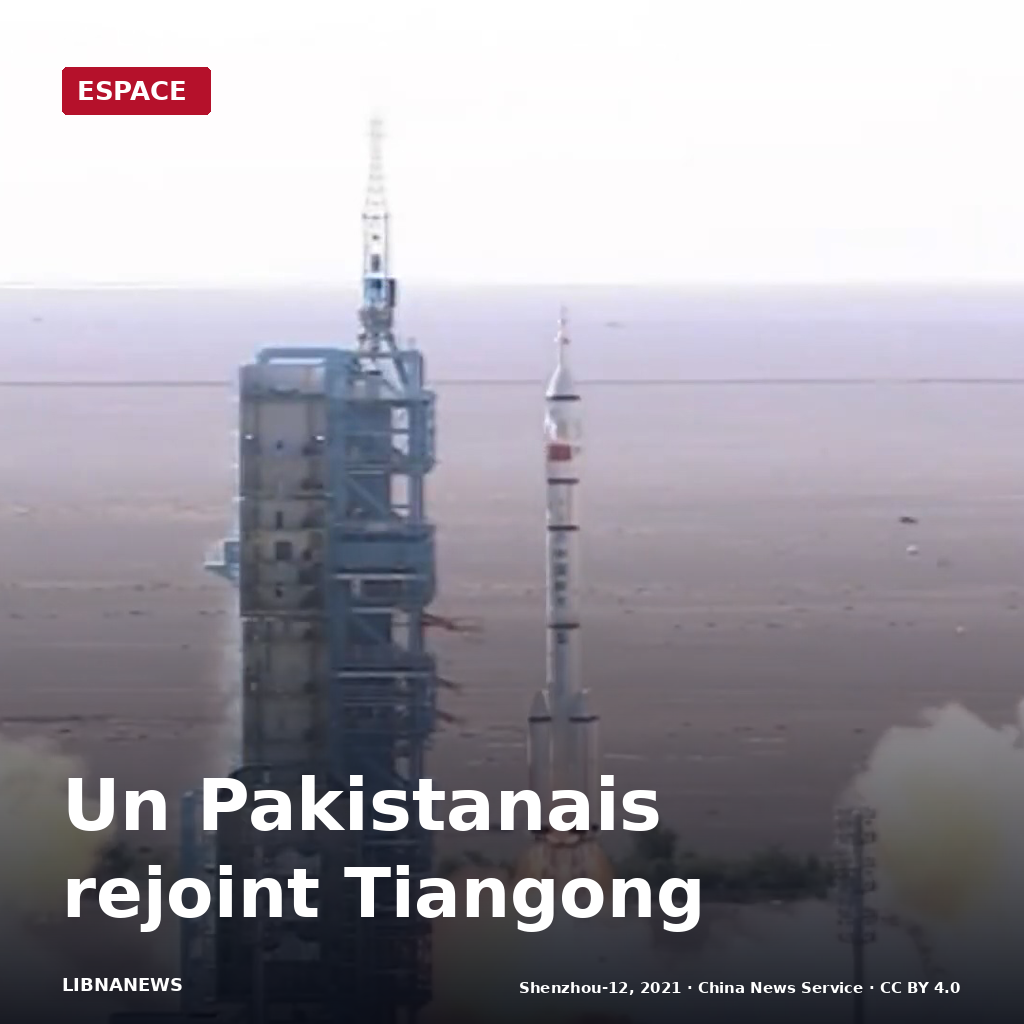
Chinese ship Shenzhou-24 docked at Tiangong station on Wednesday, November 25. On board, Muhammad Zeeshan Ali is the first Pakistani to fly an orbital flight and the first foreign astronaut to join the Chinese station. His stay will be shorter than that of the two Chinese astronauts who accompany him.
The Long March 2F rocket took off at 0818 Beijing time (018 UTC) from the Jiuquan space centre in northwestern China. The ship is separated about ten minutes later. At 1156 hours, Beijing time (356 UTC) it stowed at the forward port of Tianhe, the central module of Tiangong, according to the Chinese manned flight agency. The Commission confirmed that the reconciliation and mooring took place automatically. The mooring precedes the opening of hatches and the passage of astronauts from one vehicle to another.
Experience specialist, not a passenger
Muhammad Zeeshan Ali teamed up with Commander Tang Hongbo and the flight engineer Wu Yi. The Chinese agency has selected as a payload specialist, i.e. on board experiments and scientific equipment. It’s his first space flight, like Wu Yi’s. Tang Hongbo has already flown on Shenzhou-12 and Shenzhou-17.
The mission responds to an agreement between China and Pakistan in February 2025. Two Pakistani candidates prepared for this first flight, prior to the appointment of Ali. The Pakistani space agency SUPARCO participates in the programme. Pakistan’s Planning Minister Ahsan Iqbal attended the launch in Jiuquan, according to the Pakistani government.
A go on Shenzhou-24, a return on Shenzhou-23
The crew leaving Shenzhou-23, who had been on board for more than 180 days, prepared the reception of new arrivals. The two ships will not carry exactly the same crews on departure and return. The Chinese programme foresees that Ali will return after a short stay on Shenzhou-23 with two outgoing occupants. An outgoing crew member must remain to extend his mission for up to one year in orbit. These are flight targets; the return and actual length of stay remain to be confirmed.
Tiangong is not the International Space Station. It is operated by China, around Tianhe, where the inhabited vessels arrive. The presence of a Pakistani astronaut marks the opening of this mission to another country. It does not change the operation of the station or the usual duration of Chinese rotation. For Pakistan, the first is the orbital flight of one of its nationals, carried out on board a Chinese ship.





Comments