





A small town in the heart of a much larger file
The visit of U.S. Ambassador Michel Issa to Zawtar al-Gharbiyah and Qaaqaiyat al-Jisr hardly resembles, in the light of information published by the Lebanese press, a mere tour of the South. His calendar gives him another scope. The trip came after President Joseph Aoun’s visit to the Nabatiyeh region, as negotiations between Lebanon and Israel struggled to produce visible results. It also coincides with preparations for the Paris meeting on support for the Lebanese army and the continuation of diplomatic contacts in Washington.
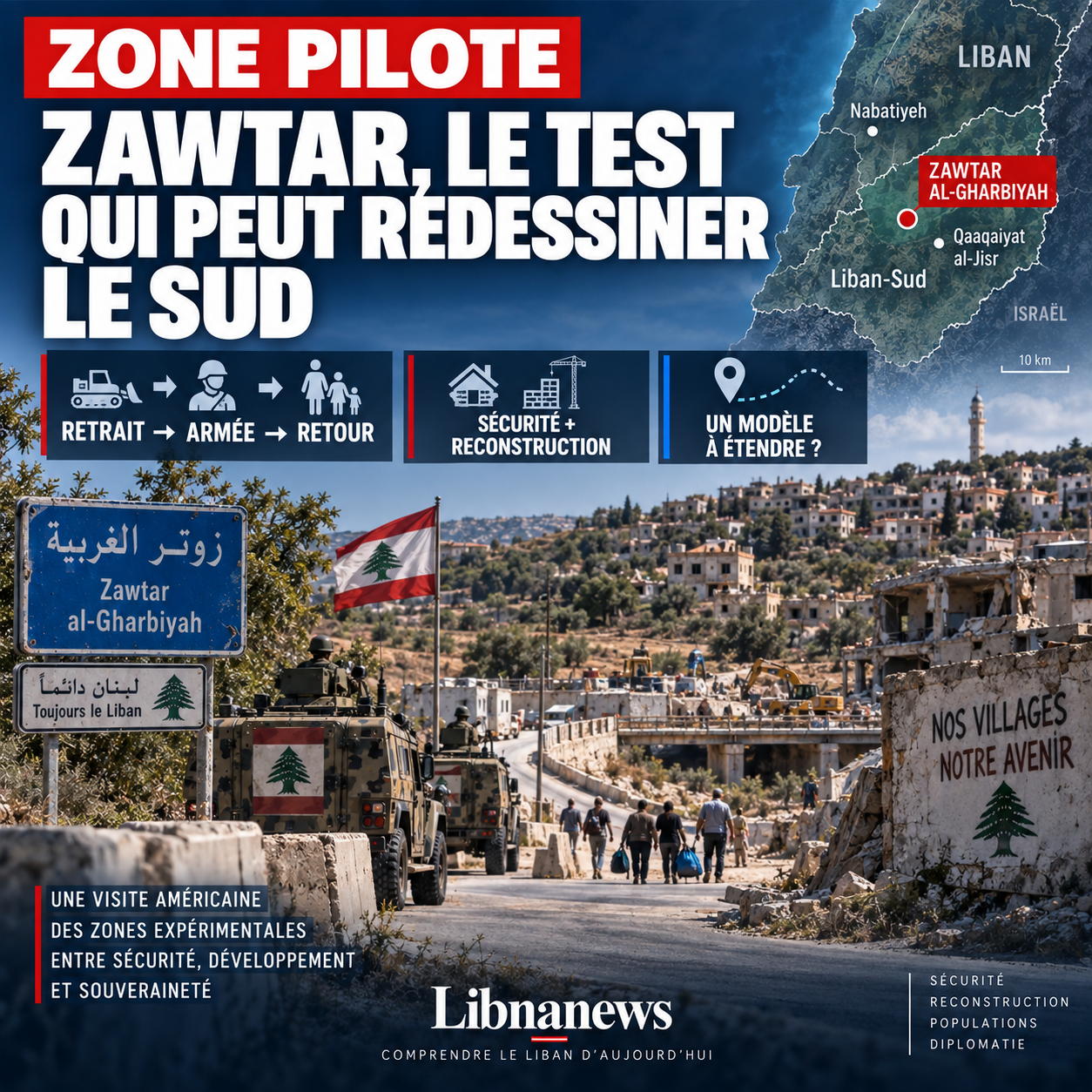
Ad Diyar of September 17, 2026 places precisely the visit in this sequence. According to sources following the US Ambassador’s travels, Washington would seek to test on the ground the operation of the framework agreement after the difficulties encountered in the negotiation process. Zawtar al-Gharbiyah thus becomes a privileged observation point. The aim is to measure what is produced, in a real locality, by the combination of the army’s presence, the return of the inhabitants, the absence of Hezbollah military structures and the gradual resumption of civilian life.
This experiment could take on considerable importance. The negotiations no longer focus solely on a comprehensive settlement of the South. A gradual method appears. It consists of treating certain areas separately, installing conditions for a return from the state, and then using the results obtained to prepare the next steps.
President Joseph Aoun openly follows this logic. Ad Diyar of 17 September 2026 reports that he is calling for the transition to new experimental areas in the South. For him, the sequence must begin with the Israeli withdrawal. The Lebanese army must then deploy to the territories concerned. The inhabitants must be able to return. This progress must also enable the State to resume its role without causing internal confrontation on the issue of arms.
Zawtar becomes a test. But behind this security experiment is a broader ambition: to determine whether a village can serve as a model for a new Southern organization.
From global negotiations to the pilot zone method
The idea of experimental zones responds first to the blockage of general negotiations. Al Akhbar of 17 September 2026 reports that the meeting held in Washington between the Lebanese representative and the Israeli representative lasted about two hours without leading to an announced breakthrough. Discussions focused on the implementation of the Framework Agreement, Lebanese demand for the cessation of Israeli operations and withdrawal, and the possibility of expanding the experimental areas.
Much of the disagreement relates to the order of measures. Beirut calls for concrete Israeli actions, including the cessation of operations and withdrawal, before taking further steps. On the contrary, Israel links its own movements to the progress made on Hezbollah’s weapons and the extension of State authority. Washington seeks to maintain the process despite these conflicting priorities.
The experimental zone temporarily reduces the extent of the dispute. Instead of simultaneously settling the whole of South Lebanon, the parties can work in a limited territory. The army takes more responsibility. The locals are coming back. The security situation is being observed. Israel assesses what it considers to be the disappearance or not of the presence of Hezbollah. The United States can then try to turn this experience into a precedent.
The method seems simple. Its application is much less.
Because each part does not give the same definition to success. For Beirut, the return of the army and the inhabitants must be a step towards the restoration of sovereignty. For Israel, the criterion also appears to include the State’s ability to prevent any reconstruction of the Hezbollah presence. The latter concept can be interpreted very broadly.
This is precisely what Zawtar’s case reveals.
An old idea returns to the negotiations
The interest in Zawtar al-Gharbiyah would not date from Michel Issa’s visit. Ad Diyar of 17 September 2026 dates him back to the pre-war meetings of the mechanism on 2 March. A proposal emerged: turning Zawtar into a model area and accompanying the safe experience of an industrial project.
According to daily news reports, the idea was to create an industrial area in the locality that would be financed by an Arab country. Israel should help convince that State to participate in the project. Beirut would initially have welcomed the proposal with astonishment.
Interest in Zawtar would have been linked to the composition of the locality. Ad Diyar presents it as an example of coexistence between several communities. This feature would give him particular value for an experience that would no longer be just military. The aim would be to test the ability to rebuild simultaneously security, economic activity and collective life.
The presence of an industrial component profoundly alters the reading of the project. The model would no longer be simply to bring the army into an area and then verify the absence of weapons. It would seek to create conditions that would allow the inhabitants to stay on site for a long time.
The reasoning is particularly important in a South affected by destruction, displacement and the weakening of economic activity. Military security is not enough if the return of the inhabitants is not accompanied by housing, services and income. An industrial zone could then become a stabilization instrument as much as an economic project.
This approach reveals a new dimension of the discussions on the South. Reconstruction could be used as one of the levers of the new security order. Investments would monitor progress on the ground. Ultimately, development and security could become the two components of the same mechanism.
The return of the inhabitants raises the first disagreement
However, Zawtar quickly shows the limits of this logic.
According to Ad Diyar of September 17, 2026, the locality was not occupied when it was integrated into this experimental reflection. The Lebanese army assumed its responsibilities there and the inhabitants returned to their homes. No visible military deployment of Hezbollah was reported.
Yet Israeli objections would not have disappeared.
Sources cited by Ad Diyar report that Israel has transmitted to the Americans reservations about what was happening in the locality. The Lebanese army was reportedly accused of allowing for an indirect return of Hezbollah. Critics reportedly targeted, inter alia, the activities of the Islamic Health Association and the presence of some residents considered to be close or sympathetic to the party.
The dispute then changes in nature.
It is no longer just a matter of searching for weapons depots, combatants or military installations. The boundary between military presence, political influence, social network and local population becomes one of the challenges of the mechanism.
For the Lebanese State, this distinction is essential. The army can control weapons and search for military installations. It can prevent the installation of armed formations. On the other hand, the return of inhabitants to their villages is a matter of civil law. Their political orientation cannot become an ordinary criterion for resettlement.
The presence of associations close to a party poses the same difficulty. Hezbollah is not a military organization. It has a political, social, medical and associative apparatus which is deeply established in certain regions. The removal of military infrastructure and the elimination of social influence are two very different objectives.
So Zawtar puts the negotiators before a question they cannot avoid: what exactly does Israel mean when he asks for the absence of Hezbollah in an area returned to state authority?
The army faced with increasingly broad criteria
This question joins Israeli critics directly targeting the Lebanese army.
Al Akhbar of 17 September 2026 reports that Israeli Chief of Staff Eyal Zamir considers the Lebanese army to be insufficiently willing or unable to disarm Hezbollah. Ad Diyar of the same day also refers to an Israeli campaign against the military institution and reports sent to Washington criticizing his behaviour.
These criticisms come as Paris is precisely preparing an international mobilization to strengthen the army. Their calendar is therefore not neutral.
Ad Diyar believes that the Israeli objective would be to impose increasingly demanding security criteria on Lebanon before withdrawal. In this reading, the army would face a mission whose limits are gradually changing. The disappearance of weapons would no longer be enough. The return of social organizations or persons considered to be related to Hezbollah should also be prevented.
Such an extension would profoundly transform the function of the army.
Joseph Aoun defends another logic. In his statements published on September 17, 2026, he presented the army as the central tool for the restoration of the state. He claims that Lebanon wants to concentrate arms in the hands of legal institutions, but refuses to provoke an internal confrontation. The restoration of public authority must involve dialogue and institution-building.
This difference is at the heart of the case. For Beirut, the deployment of the army must allow for the gradual reconstruction of sovereignty. For Israel, withdrawal appears to be linked to a much broader assessment of the local political and security environment.
Zawtar thus becomes the place where these two conceptions meet.
Michel Issa closest to the mechanism
Michel Issa’s visit came precisely at that time.
Ad Diyar of 17 September 2026 reports that the American ambassador visited Zawtar al-Gharbiyah and Qaaqaiyat al-Jisr in a particularly dense diplomatic context. Its program included local meetings and development issues. But the sources cited by the newspaper give the displacement a more political scope.
The ambassador would have wanted to examine directly the situation, the role of the army and the needs of the population. The visit would also allow Washington to evaluate the results of the first experiment before considering its extension.
Three dimensions appear thus. The first one is safe. It concerns the control of the territory and the work of the army. The second is social and economic. It concerns the return of the inhabitants and their needs. The third is diplomatic: keeping the framework agreement alive despite the difficulties of negotiations.
The combination of these three elements explains the American interest in a locality that would otherwise not be at the centre of trade between Washington, Beirut and Israel.
The approach also allows the United States to move part of the negotiation to the field. Diplomatic meetings can continue without spectacular results, while limited experiences produce concrete facts. A withdrawal, an army deployment or a return of population then become as many steps that can be used in the next negotiation.
Michel Issa appears in this sequence as one of the relays of this gradual method.
From Safe Model to Economic Model
The idea of an industrial zone, however, reveals that Washington and other stakeholders could seek more than military stabilization.
South Lebanon suffers from a problem that cannot be solved by security arrangements alone: how can people be persuaded to return to destroyed or weakened localities in a sustainable manner when the local economy no longer offers them opportunities?
The reconstruction of houses is a first response. It’s not enough. A population needs income, commerce, schools, care and infrastructure. Without these elements, return may remain temporary.
Zawtar’s hypothesis as a model zone would allow this dimension to be integrated. The territory would be secured by the army. The inhabitants would come back. Investments would follow. Local economic activity would be created. The model could then be presented as reproducible.
But this logic in turn raises a political question. If investments are conditional on security outcomes, reconstruction may become a negotiating instrument. Villages considered to meet the criteria would benefit more quickly from projects. The others could stay waiting.
The border between reconstruction aid and political incitement would then become very narrow.
Lebanon will therefore have to determine how far it agrees to link reconstruction and security arrangements. The need to attract financing is real. However, it cannot lead to external actors alone deciding the conditions for the return or development of each locality.
Zawtar could determine the continuation of the process
Joseph Aoun now wants to expand the experimental areas. If this is confirmed, Zawtar’s experience will have a direct influence on the next steps.
The scenario envisaged is progressive. Israel is withdrawing from a given area. The army deploys. The locals are coming back. The situation is under control. Reconstruction and development projects can follow. Once experience has been found to be successful, the mechanism is applied elsewhere.
This method can produce results without waiting for a comprehensive settlement. It can also produce the opposite effect if each new area gives rise to additional requirements.
The danger would then be that a map of the South would appear divided into sectors subject to different regimes. Some localities would be returned to the Lebanese authority. Others would remain busy. Still others would expect a safe validation. The provisional nature of the mechanism would be likely to settle over time.
The decisive question therefore becomes that of criteria.
Who decides that an area is secure? The Lebanese army? The United States? Israel? An international mechanism? What exactly does the absence of Hezbollah mean? Is it the absence of weapons and combatants, or also social structures and sympathizers? When does the return of the inhabitants become irreversible? And what guarantees accompany the Israeli withdrawal?
Zawtar al-Gharbiyah already concentrates all these questions.
Behind Michel Issa’s visit thus appears a laboratory much more ambitious than just a security operation. Washington seems to be looking for a method capable of articulating Israeli withdrawal, army deployment, population return and economic development. Beirut sees the possibility of gradually restoring State authority. Israel wants to ensure that the territories concerned do not permit a reconstruction of the Hizbullah presence.
Zawtar’s success or failure will probably not remain a local affair. If the experimental zone method becomes the main means of unlocking negotiation, this small locality could serve as a matrix for processing part of the South Lebanon. And today’s battle around the very definition of security could determine the conditions imposed tomorrow on the villages called to follow the same path.