






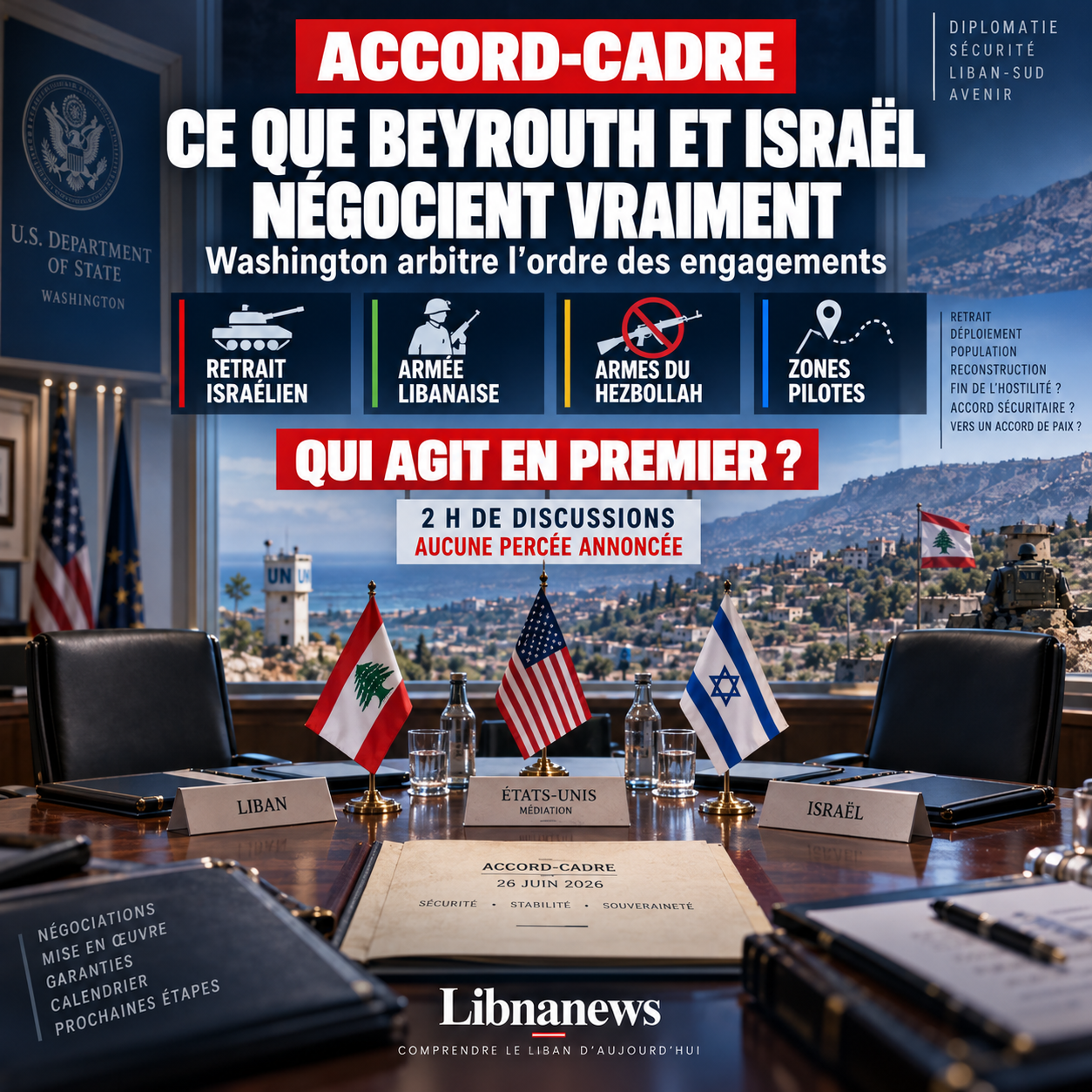
Two hours of discussions, but no breakthrough announced
The meeting held in Washington between the Lebanese representative and the Israeli ambassador resulted in neither an agreed nor an immediate action on the ground. Yet, behind this lack of visible outcome, the content of the discussions shows that negotiations have already gone beyond the mere handling of incidents in South Lebanon. Israeli withdrawal, cessation of operations, Hezbollah weapons, army deployment, experimental zones and future security architecture are now in a similar process.
Al Akhbar of 17 September 2026 reports that the meeting between the Lebanese Ambassador in Washington, Nada Hamada Moawad, and the Israeli Ambassador Yehiel Leiter was held in the US State Department and lasted about two hours. The participants discussed the modalities for the implementation of the framework agreement, the Lebanese demand for the cessation of Israeli operations and withdrawal, and the possibility of extending the experimental zones. The conclusions should be forwarded to policy-makers before a new negotiating session is scheduled at the beginning of the following month.
The daily describes a meeting aimed more at keeping the channel open and preparing the next step than at producing an immediate transaction. This function is important. The negotiations continue even as Lebanese and Israeli positions remain distant in the sequence of commitments.
Al Quds of 17 September 2026 also reports the end of this meeting after about two hours, without joint communiqué or announcement of a new compromise. The absence of a public outcome therefore does not mean that the process is stopped. Rather, it shows that the discussions have entered a phase in which the parties negotiate the order of the measures as well as their content.
This is now the central question: who must act first?
Beirut calls for withdrawal before further steps
The Lebanese position is based on a logic of reciprocity. Beirut calls for concrete Israeli measures before agreeing to take the next steps.
Al Akhbar of 17 September 2026 states that Lebanon places the cessation of Israeli operations and withdrawal at the top of its priorities. Israel defends a reverse or, at least, conditional sequence. It links its own measures to progress on Hezbollah weapons and state deployment.
The disagreement is therefore not only about the final objectives. It’s about their calendar.
Prime Minister Nawaf Salam defended the agreement before Parliament. Al Jumhuriyat of 17 September 2026 reports that he explained that the framework agreement provides for Israeli withdrawal in stages and calls for the restoration of the exclusive authority of the Lebanese State in its territory. He rejected the idea that the process would remove Lebanon from its political and international references.
However, Nawaf Salam acknowledged that the expected results had not yet been achieved. Israeli operations continued. Israel has not withdrawn from all the territories concerned. Prisoners remain in detention and residents are still unable to return to their localities.
This recognition gives an indication of the governmental position. Beirut does not present the framework agreement as a complete success. The Government regards it as an instrument still in use.
The question then becomes that of its effectiveness. If the results remain limited, how far can Lebanon continue to expand the issues negotiated without first obtaining the measures it demands?
Disarmament becomes the main counterpart requested in Lebanon
On the Israeli side, Hezbollah’s weapons file occupies a central place.
Al Akhbar of 17 September 2026 reports the statement of the Israeli Chief of Staff, Eyal Zamir, that the Lebanese army does not appear ready or capable of disarming Hezbollah. This statement comes precisely at a time when Washington is trying to maintain the negotiating process.
It reveals the nature of the main obstacle. Israel does not consider its withdrawal to be an isolated measure. He wants to be part of a lasting change in the security balance in the South.
The Lebanese government itself has taken a position in favour of the state monopoly on arms. Joseph Aoun reiterated that the decision had been taken, but refused to allow its implementation to provoke an internal confrontation. It favours a gradual and negotiated method.
It is on the pace of this transition that the two parties diverge.
Israel is seeking observable guarantees on the ground. Beirut wants to avoid the Israeli withdrawal being postponed until the completion of a complex internal process whose timetable cannot be determined solely by military considerations.
The negotiation thus faces a circular risk. Israel can maintain its presence in the absence of sufficient progress on weapons. This presence and the continuation of operations can, in turn, complicate the Lebanese internal disarmament debate by enabling Hezbollah to highlight the persistence of an external threat.
Breaking this circle is probably one of the objectives of the experimental zones.
Pilot zones become the preferred tool for unlocking the process
The negotiations are now trying to produce results on limited territories before approaching the whole South.
The principle is to obtain withdrawal or modification of the Israeli system in a particular area. The Lebanese army is deploying. The locals are coming back. The security situation is then assessed before moving to a new area.
Joseph Aoun openly supports this approach. Ad Diyar of 17 September 2026 reports that he wants to extend the experiments to new sectors. For the president, the army must be able to take possession of the evacuated areas in order for the population to return.
This method theoretically allows for progressive reciprocity. Lebanon does not need to wait for a complete Israeli withdrawal to strengthen the authority of the State. Israel, for its part, can observe the behaviour of the army before taking further action.
But the first experiments already show the difficulty of agreeing on the criteria.
Ad Diyar reports Israeli objections to Zawtar al-Gharbiyah. According to daily reports, Israel estimated that Hezbollah was returning indirectly to the locality after the return of the inhabitants. Criticisms have reportedly included social structures close to the party and residents considered its supporters.
The problem then becomes political as well as military. If the absence of Hezbollah means the absence of weapons and combatants, the army can intervene. While it also means the absence of social, political and associative networks, conditions become much more difficult to meet.
The definition of the success of an experimental zone can therefore determine the full rate of withdrawal.
Washington tries to prevent the collapse of the canal
The United States is at the centre of this divergence.
Al Akhbar of 17 September 2026 describes Washington as primarily seeking to prevent the collapse of the framework agreement. The meeting between the Lebanese and Israeli representatives should maintain communication and prepare for the next meeting.
The pressure of the calendar also appears in the daily news. American sources point to a limited time to produce results as the Israeli electoral deadline approaches.
This electoral dimension adds a constraint. The more Israel moves towards elections, the more internal political considerations can influence territorial or security decisions. A withdrawal can become politically more difficult. Conversely, a demonstration of firmness against Hezbollah can be valued in electoral competition.
Washington therefore seeks to preserve the mechanism before this window closes again.
The American method seems to favour progressive results. One area is treated, and another. The parties thus accumulate limited measures which can eventually constitute a broader architecture.
But the United States is not an outside mediator. American policy towards Israel and its military support remain direct elements of the equation.
Al Akhbar of 17 September 2026 highlights this contradiction by bringing the Washington negotiations closer to an American arms sale project to Israel valued at about $2.8 billion, including heavy ammunition. The newspaper sees it as a dual American function: political mediator on one side, Israel’s main military support on the other.
For Beirut, this asymmetry reinforces the importance of the guarantees obtained at the negotiating table.
The agreement begins to go beyond the simple ceasefire
The most important development, however, appears in Joseph Aoun’s statements.
The president is no longer just talking about enforcing an end to the fighting. In several interviews reported on 17 September 2026, he explained that Lebanon was seeking a security agreement with Israel to end the state of hostility and allow the army to deploy on the border.
Al Bina He pointed out, however, that Lebanon could not proceed directly to the latter stage and that progress must be made gradually.
Ad Diyar also reproduces this orientation. The President links the negotiations to a sequence including withdrawal, deployment of the army, return of the inhabitants and settlement of the question of prisoners.
The political scope of the process thus changes considerably.
An agreement initially intended to organize the security of the South could become the starting point for a reflection on the end of the state of hostility. This is not yet a peace treaty. Joseph Aoun himself established this distinction. But the vocabulary used shows that the Lebanese authorities are looking at a broader perspective than the management of border incidents alone.
This development also explains the intensity of the internal debate.
In Parliament, negotiation becomes a matter of national confrontation
The challenge session of the government showed how divided the agreement is.
Al Joumhouriyat of 17 September 2026 reports the criticisms of several MPs about its implementation and the results achieved. The discussions quickly went beyond the technical assessment of negotiations to touch upon Hezbollah’s sovereignty, weapons and national strategy.
Nawaf Salam defended the choice of diplomacy. He explained that Lebanon had been repeatedly drawn into wars that he had not chosen and whose consequences the State had subsequently had to bear. He asked the critics of the negotiation to propose a way to stop the attacks, to recover the prisoners and to bring the inhabitants back to their villages at a lower cost.
This defence puts the question on the ground of the relationship between objectives and means.
The government considers that the military power ratio requires negotiation. His opponents accuse him, according to different arguments, either of not getting enough counterpart, or of bringing into the negotiation issues that affect the Lebanese internal balance.
The disarmament debate focuses on these tensions. For some of the political forces, the state monopoly of arms is a sovereign decision that must be implemented independently of Israel. For Hezbollah and its allies, the continuation of Israeli operations and presence makes the issue inseparable from the external conflict.
The framework agreement thus becomes the meeting place for two issues that Lebanon has long struggled to separate: its relationship with Israel and the organization of the armed force within the country.
The post-Final stage of negotiations
Another development further expands the scope of the process: the announced end of the Finul mission in December 2026.
Joseph Aoun refuses an international vacuum in the South. It claims to be open to a new force provided that it has a legal framework respecting Lebanese sovereignty and assists the army without replacing it.
At the same time, Al Akhbar of 17 September 2026 reports that European states are working on several post-Final scenarios. A three-year European civilian and military mission is under study. Paris and Rome also reflect on the maintenance of a form of international presence.
The reference to this future presence is already in conflict.
According to Al Akhbar, Hezbollah has reportedly told European interlocutors that it refuses to use the framework agreement as a reference to a new international force. The party would remain committed to resolution 1701 and the agreement of 27 November 2024.
This position shows how the framework agreement has changed its scope. If it were to become the reference point of the international post-Final arrangement, it would no longer govern only the security relations between Lebanon and Israel. It would help to determine the foreign presence on Lebanese territory.
The choice of reference text therefore becomes a sovereign issue.
A negotiation whose true scope remains under construction
The content of the discussions finally shows a much more ambitious process than the conservative communiqués issued after the meetings suggest.
The Israeli withdrawal was negotiated with the deployment of the army. The deployment is linked to Hezbollah’s weapons. Weapons are evaluated in experimental areas. These areas could receive reconstruction and development projects. After Finul begins to fit into the same architecture. Joseph Aoun finally mentioned a security agreement capable of ending the state of hostility.
Each step thus opens the next.
This mechanism, however, poses a risk to Beirut. The greater the number of topics included in the process, the greater the amount of consideration sought in Lebanon. The question will be whether Israeli commitments are moving at the same pace.
For the time being, full withdrawal has not taken place and operations continue. Nawaf Salam recognizes him himself. The Lebanese authorities therefore rely on continued negotiations to gradually transform the framework into concrete results.
The next sitting will be decisive less by the possible announcement of a great agreement than by the sequence that it will manage to fix. If a new Israeli withdrawal accompanies a Lebanese deployment in an additional area, the gradual method will gain credibility. If conditions continue to accumulate without territorial compensation, domestic criticism will strengthen.
Behind the Washington meetings is thus negotiating much more than a security mechanism. Lebanon and Israel are beginning to define, under American mediation, the rules that could organize the South after the war, the future role of the army and perhaps, in the longer term, the very nature of their relationship.