





A diplomatic battle is already taking place behind the December deadline
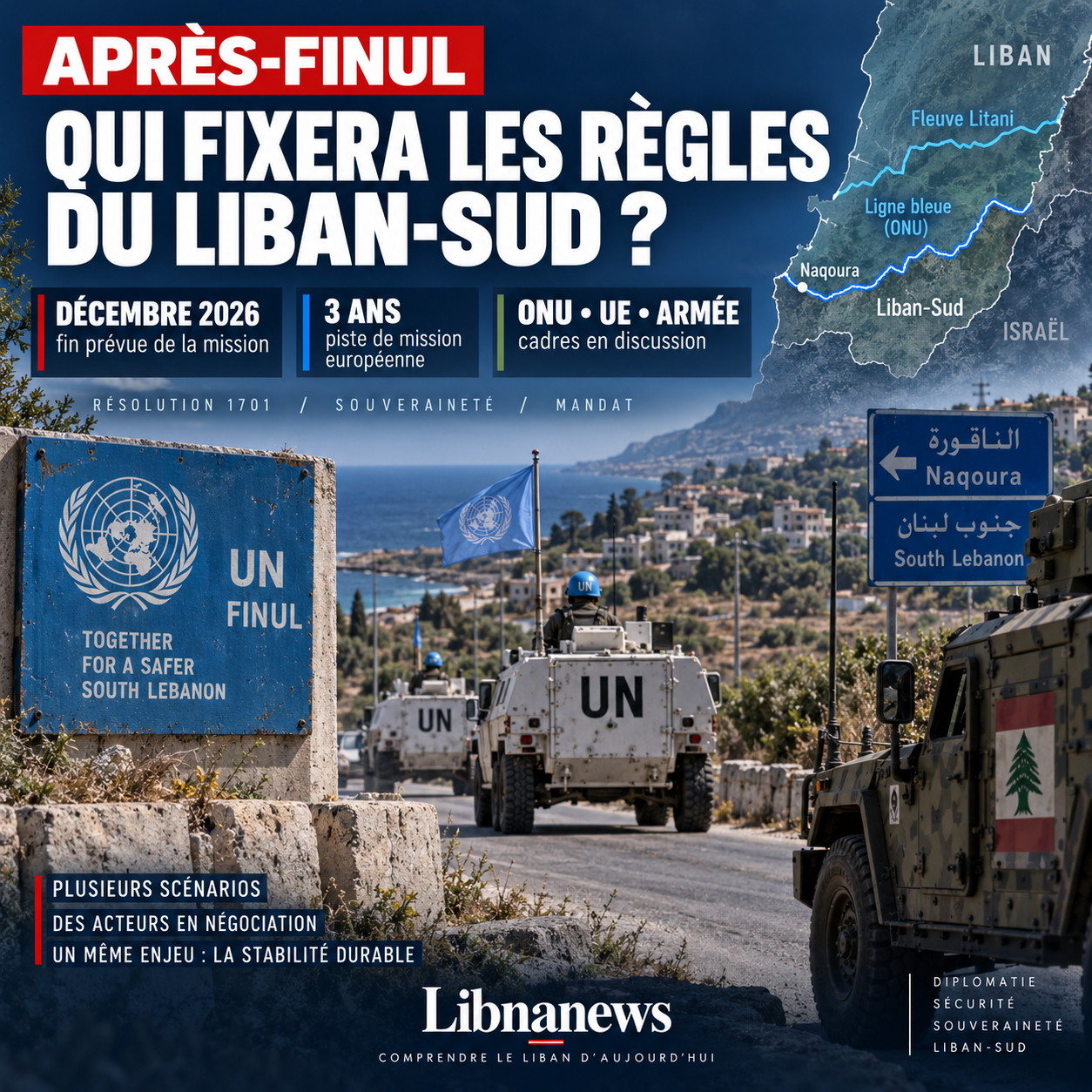
The future of South Lebanon is no longer only negotiating around Israeli withdrawal, the deployment of the Lebanese army and Hezbollah weapons. A fourth issue was highlighted in the discussions: that of the international mechanism to accompany the army after the end of the Finul mission, scheduled for December 2026. The information published by several newspapers on 17 September 2026 shows that consultations are already under way. They take place at several levels. Paris and Rome are working on their own tracks. The European Union is preparing a civilian and military mission. Beirut is trying to avoid a vacuum. Washington defends a different architecture. At the same time, according to Al Akhbar of 17 September 2026, European representatives engaged in discreet exchanges with Hezbollah in order to know its red lines.
Joseph Aoun’s public position provides a first framework for these discussions. Ad Diyar of 17 September 2026 reports that the President of the Republic refuses a vacuum to succeed the Finul. It claims to be open to another force, whatever its name, but lays down a condition: its existence must be based on a legal framework. For Joseph Aoun, the essential principle of this framework must remain state sovereignty. The mission of an international presence would be to help the army and strengthen the state, not to replace it.
This formulation is important. It shows that the Lebanese presidency does not close the door to a radically different architecture from the one that currently exists. The question is no longer just to save the Finul. Beirut is already considering its replacement scenario.
However, Lebanon continues to formally defend the United Nations presence. Al Bina, of 17 September 2026, reports that a group of 86 deputies who signed a petition in favour of maintaining the Finul must transmit this position to the ambassadors of the States members of the Security Council. Two steps are therefore taken simultaneously. The first seeks to preserve what exists. The second prepares the case where this attempt fails.
This double approach reflects the urgency. December is no longer a distant deadline. To create a new mission, it is necessary to determine its mandate, composition, funding, chain of command and relations with the army. Political agreement is also needed for its deployment. However, on almost every one of these points, the actors concerned do not yet defend the same solution.
Europeans would have discreetly probed Hezbollah
The most sensitive information is published by Al Akhbar on 17 September 2026. According to the newspaper, the institutions of the European Union and some States currently engaged in the Finul have opened discussions in recent months away from the spotlight with several Lebanese parties. These contacts cover the period following the end of the international mission.
Al Akhbar claims that a dialogue was held with Hizbullah. This information is not presented as coming from an official European announcement or a party statement. It is based on the sources of the newspaper. It should therefore be regarded as information attributed to Al Akhbar and not as an independently confirmed fact.
According to the same information, the European interlocutors received three specific messages from Hizbullah. The first would be the refusal of any military or security force in South Lebanon that would not be dependent on the United Nations and would not work under Resolution 1701. The second would concern the political reference of future security arrangements. The party would consider the agreement of 27 November 2024 as the frame of reference for discussing the future of the South and the international presence. Finally, it would refuse the subsequent negotiated framework agreement to become the legal reference for a new force.
If this information is accurate, it gives a different dimension to European consultations. Europeans would not only seek to determine what the Lebanese government would accept. They would also attempt to identify the conditions for a future international presence to operate on the ground without encountering direct opposition from Hezbollah.
This would not mean that Europeans accept party conditions. Rather, it would show that they seek to measure obstacles before stopping a formula.
Al Akhbar adds another element. The dossier would also have given rise to consultations between certain European States, Russia and China, in particular with a view to a possible approach in the Security Council. Again, no other publication of the corpus makes it possible to establish independently the reality or the content of these exchanges. But this information sheds light on one of the main difficulties of the case: replacing the Finul with another UN presence would require the reconstruction of an international consensus.
A three-year European mission takes shape
A second case is much more concrete. Al Akhbar of 17 September 2026 reveals the existence of a proposal to establish a three-year European civilian and military mission in Lebanon. The government must review a submission from the Department of Foreign Affairs regarding this project.
According to information published by the newspaper, the proposal originated in a note by the European Union delegation to Prime Minister Nawaf Salam on 5 August 2026. It takes up an initiative of the High Representative of the European Union for Foreign Affairs and Security Policy. The scheme would form part of the European Union’s common security and defence policy.
The stated objective would be to contribute to the full implementation of resolution 1701 and to assist the Government in strengthening State institutions and its authority. The project includes support to the Lebanese Army and the Internal Security Forces.
Al Akhbar reports that European military and civilian teams visited Lebanon in May and August 2026. They would have assessed the needs of security institutions. The principle includes strengthening the Internal Security Forces to enable them to undertake more missions in the Territory. The army would then have additional capabilities to focus on borders.
The content envisaged goes beyond general training. The project cited by Al Akhbar mentions the development of surveillance and intelligence capabilities. It also concerns maritime security, borders and ports. These areas show that a possible European mission would not be limited to the South. It would participate in a broader reorganization of the security functions of the State.
However, it remains impossible, on the basis of published documents, to speak of an already constituted European force. The number of advisers is not stopped. Nor is its structure. Its budget remains to be determined. Above all, Al Akhbar states that this mission is not officially presented as the replacement of the Finul.
This nuance is essential. A European mission could exist alongside another international arrangement. It could also be one of the bricks of a larger architecture after December. The discussions are sufficiently advanced for a draft to be submitted to the Lebanese authorities, but they do not yet allow for its final form.
Paris and Rome seek their place in the South of tomorrow
France and Italy occupy a particular position. Both have a long experience in South Lebanon. They also have an interest in preventing the departure of the Finul from leading to the disappearance of any European presence.
In an interview published by Nahar on 17 September 2026, the Chief of Staff of the French Armed Forces, Fabien Mandon, confirmed that he was working with his Italian counterpart on tracks for the post-Finul period. However, he refused to detail the results. It stresses that a solution cannot depend solely on Paris and Rome and will require the involvement of the parties concerned.
French caution indicates that the scenario is not stopped. It also shows that Paris now considers the post-Final as an operational dossier and not a theoretical reflection.
The meeting in Paris is part of this logic. Officially, it aims first to assess the needs of the Lebanese army. Fabien Mandon also insists in Nahar of 17 September 2026 that it is not a donor conference. The aim is to determine what the army will need in a deeply transformed regional environment and when the mission of the Finul must end.
Support for the army and the future of the international presence thus become the two sides of the same file. As the role of the army expands, its needs increase. And the less important the future international presence will be, the heavier the burden borne by the Lebanese military.
Al Arabi Al Jadid of 17 September 2026 also points out that the discussions on the post-Final period accompany preparations to support the army. The newspaper does not mention any definitive agreement on the force that could succeed it. However, several States would be willing to participate in a future formula.
Washington, Paris and Beirut don’t talk about the same framework yet
Perhaps the major challenge is not the number of troops to deploy. It concerns the legal and political reference of the future system.
For Beirut, Joseph Aoun insists on state sovereignty and the need for a legal framework. For Hezbollah, according to the information attributed to Al Akhbar of 17 September 2026, the presence should remain linked to the United Nations and resolution 1701. At the same time, Europeans are preparing a mission under their own defence and security mechanisms.
Al Akhbar also describes a different American approach. According to the newspaper, Washington refuses a formula that would maintain resolution 1701 as the only reference for a long time and seeks, with Israel, to give more weight to the framework agreement in the political and security organization of the South. This reading is part of the analysis and information of the newspaper. It cannot be presented as an American position formally formulated in the corpus documents.
However, it allows us to understand why the mandate issue is so conflicting. A UN force would be linked to a Security Council decision. A European mission would operate on a different basis, with the agreement of the Lebanese government. A mechanism built around the framework agreement would place the new security arrangements in the continuity of negotiations between Lebanon and Israel under American mediation.
These solutions can sometimes be complementary. They can also compete.
The selection of the framework will determine the authorized missions, monitoring mechanisms and interlocutors for the future international presence. In particular, it will determine whether the mechanism is perceived as the continuation of an existing international mandate or as the product of the new political balance resulting from war and negotiations.
The Lebanese Army becomes the central part of the device
On one point, however, the various actors seem to be converging: the future system must give more prominence to the Lebanese army.
Joseph Aoun repeats this in the statements reported by Ad Diyar of 17 September 2026. An international force must not replace the State. It must help the army and allow the public authority to expand.
This logic explains the importance of the Paris meeting. The military’s needs are no longer limited to maintaining its current missions. It must consider enhanced deployment in the South, control of new areas, border surveillance and possibly some of the functions now supported by the international presence.
The problem of Hezbollah’s weapons is directly linked to this transformation. Joseph Aoun claims that the state has taken the decision to concentrate weapons in the hands of legal institutions. He pointed out, however, that this process should not cause internal confrontation. The Presidency therefore seeks to reconcile two objectives: gradually strengthening the state monopoly and preventing its implementation from triggering an internal crisis.
This equation also explains why discussions on so-called experimental areas are of interest to foreign partners. The principle is to test, on limited spaces, an army surge accompanied by an Israeli withdrawal and a return of the population. If this method produces results, it could provide a model for other sectors of the South.
But it remains fragile. The 17 September newspapers show that Lebanese, Israeli and American assessments already differ on the results obtained in these areas.
The real issue: who will set the rules for South Lebanon?
The post-Final period thus reveals a much wider negotiation than replacing one quota with another. The discussions concern simultaneously the role of the army, the European presence, resolution 1701, the agreement of 27 November 2024, the framework agreement, the Israeli withdrawal and the weapons of Hezbollah.
Al Akhbar’s information of 17 September 2026 on European contacts with Hezbollah remains the most sensitive. They must be confirmed before they are considered established. But they are consistent with a fact more widely documented by the corpus: Europeans are actively preparing for the December deadline and are looking for a formula that can work in an environment where no actor controls all the parameters alone.
The three-year European mission is already a structured path. Franco-Italian work is another. The Lebanese attempt to preserve a United Nations presence remains open. To this is added the mechanism resulting from the negotiations with Israel.
None of the newspapers of 17 September 2026 can say that a successor to the Finul has already been chosen. On the contrary, the information available shows several competing projects and still incompatible conditions.
This is where the real challenge of the coming months lies. The departure of the Finul will not only release military positions. It risks eliminating the international framework that has organized a part of South security for years. The diplomatic battle is now about who will replace him, the text that will give him his legitimacy and the powers that will be granted to him.
Behind the public meetings in Paris, the European consultations and the exchanges reported with Hezbollah, a new security architecture is already under discussion. It will have to answer a decisive question: after December 2026, will the security of the South Lebanon be organised around the UN, a European presence, the framework agreement negotiated with Israel, or a combination still to be invented of these different mechanisms?