

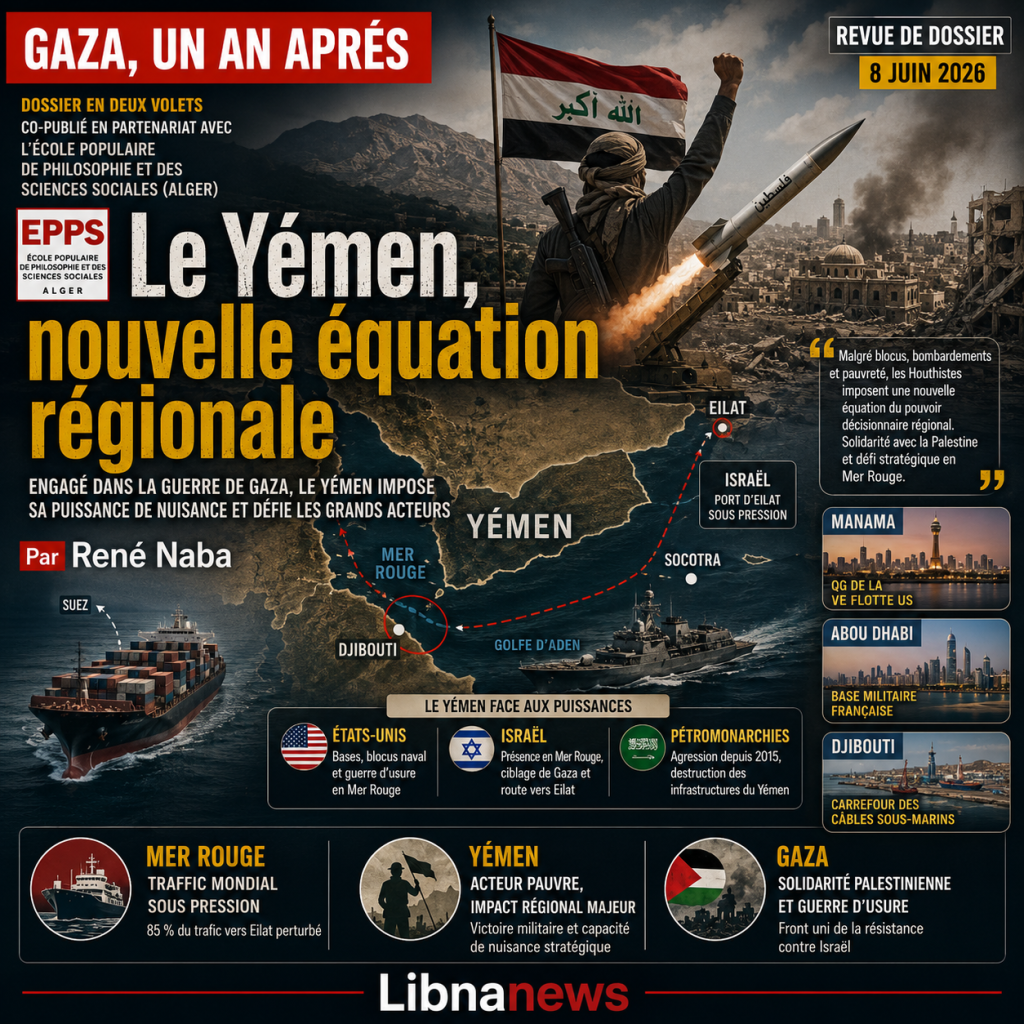
One year later, Gaza was co-published in partnership with the Popular School of Philosophy and Social Sciences (Alger)
https://www.madaniya.info/devotes a two-pronged dossier to two countries in the Middle East, to the opposite of each other in the Israeli war in Gaza,
– Turkey, which has NATO’s largest land army, reduced to a role of comparison because of its duplicity.
Yemen, the poorest Arab country, winner of a Petro Monarchic coalition and now an inevitable equation of regional decision-making power because of its active engagement in the anti-Israeli war in solidarity with the Palestinians.
Yemen, an inescapable equation of regional decision-making power because of its involvement in the Gaza war.
Yemen, a miniature reproduction of Gaza; A general pre-term rehearsal of the Gaza War.
Confronted with a petro-monarchic aggression since 2015, in superimposition to a blockade, both land by the petro-monarchies, and naval by the Vth American fleet whose anchor is in Manama, Yemen has been a miniature reproduction of Gaza. The general pre-term repetition of the Gaza War of 2023-2024
Despite the considerable disproportion of forces and the systematic destruction of Yemen’s infrastructure by Saudi aircraft, like the Israelis in Gaza, the Houthists held the dread high to their adversaries, inflicting damage to the vital economic centers of their adversaries, Saudi ARAMCO and Abu Dhabi’s oil installations, like Hamas against Israel.
While against Gaza, the Americans sent a task force of 2,000 soldiers to Israel to protect the perimeter of the Dimona nuclear centre and the Ourim espionage centre, the British set up an important espionage centre in Yemen for the decryption of Houthist communications following a series of setbacks by pro-monarchic forces in August and September 2021, culminating in the fall of the Al Qaeda fief in Yemen, in the district of Al Bayda, usually designated as Yemeni Tora Bora.
The British spy centre was built in the district of Al-Mahra, south of the Arabian Peninsula at the border of Dhofar (Sultanat of Oman). Al-Mahra is an area coveted by Saudi Arabia and the Sultanate of Oman. The British built this centre in September 2021 following the attack on the Israeli tanker Mercer Street in the Oman Sea. Tanker run by Israeli billionaire Eyal Ofer. The mission of the centre is to decrypt not only the communications of the Houthists, but also the maritime communications of this highly strategic area at the intersection of the Red Sea, the Gulf of Aden of the Indian Ocean and the Persian Gulf.
The British set up a security perimeter around this base along the coasts of the district, banning fishing for the residents, causing the discontent of the private population with a source of income.
The development of this British base complements the western Djibouti device, which constitutes a real crossroads of submarine cables, the « undersea cable drop point of interconnection between Europe, the Middle East, Asia and Africa ». With 8 submarine cables, Djibouti is the fourth most connected state in Africa. Since 2013, it has hosted the first Data Center in the region. Today, the country dreams of being a regional digital hub.
The Huthists, victorious of their coalition opponents, have nevertheless engaged since the « Al Aqsa Flood » operation in October 2023, in a war against Israel in solidarity with Palestinian Hamas, disrupting international maritime traffic in an area that constitutes a jugular vein of the world energy system.
A health walk that turns into a nightmare
Yemen usually serves as a security beacon for Saudi Arabia on its southern flank, a function identical to Bahrain’s on its northern flank, to the point that to secure its throne, the Wahhabi dynasty intervened militarily in these two countries with the first lights of the Arab spring, to watch, in February 2011, Manama’s popular uprising and to reverse the Arab popular uprising towards the republican countries on the Mediterranean shore (Libya, Syria), then against Yemen in order to terrace the Huthist hydra of Yemen with the help of its monarchic petro syndicate and its satellite countries.
For thirty-five years from 1960 to 1995, Saudi Arabia thus exercised complete control over the political life of Yemen, both under the mandate of Ali Abdallah Saleh and his predecessors, including Colonel Ibrahim Al Hamdi, whom it would assassinate, to the point of opposing the formation of a defence ministry in order to be able to make direct subsidies to both the Yemeni armed forces and the major tribal confederations.
The baptism of fire of King Salman Ben Abdel Aziz in Yemen on 25 March 2015, two months after his accession to the throne, was intended to demonstrate the strength and strength of the monarch, after ten years of lethargy induced by his predecessor, the non-year-old Abdullah.
His son’s work, Crown Prince Mohammad Ben Salmane, the punitive expedition of this octogenary monarch, also suffering from a handicaping disease (Alzheimer), against the poorest Arab country, turned into a nightmare. The health walk turned the trip to hell.
The sovereign, careful, had taken all precautions: For the first frontal war of the Wahhabi dynasty since the foundation of the Kingdom almost a century ago, a coalition of seven countries had been set up aligning 150. 1,000 soldiers and 1,500 aircraft. A task force supported by mercenaries of private military companies of the type Blackwater of sinister memory and the tacit connivance of the « Great Western Democracies ».
The punishment should be exemplary and deter anyone who would stand up against Saudi hegemony in the area, especially the Houthists, the schismatic sect of Sunni Orthodox Islam, especially as the Wahhabi dynasty considers its absolute hunting, its security lock, Yemen, this country located on the right (Yamine) on the way to Mecca, according to its etymological significance.
From 2015 to 2023, the number of Yemeni casualties is heavy: 150,000 people killed, more than 227,000 Yemenis also died as a result of famine and lack of health care during the war. The humanitarian crisis continues today.
The petro-monarchic punitive expedition – « The storm of firmness » – has yet proved catastrophic, despite the naval blockade of the Fifth American fleet of the area (Persica Gulf-Indian Ocean), despite the powerful help of France to a mini-landing of loyalist troops in Aden, from the French military base in Djibouti. Despite the French leadership of Saudi troops provided by the contingent of the Foreign Legion stationed on the French base of Abu Dhabi, « Zayed Military City ». Despite the development of a Saudi rear base in the port city of Assab (Eritrea), on the Red Sea, for the recruitment and training of the cadres of the pro-Saudi Loyalist army.
But solidarity with the Palestinian struggle is not the sole motivation of the Houthists.
Strategic stakes in the Persian Arab Gulf and the Strait of Ormuz
At the same time, the Arab-Persian Gulf, one of the world’s main fuel-refuellers, serves as a huge floating military base of the American army, which supplies its petromonarchies with profusion, at home, at competitive prices. All, to varying degrees, pay their tribute to them, granting without soul states, facilities to their protector. The area is indeed covered by a network of Anglo-Saxon and French naval bases, the densest in the world
The Gulf is a stretch of a thousand km long and its width is close to 50 km in its narrowest part. It is a junction between the Arab World and the Persian World, between Sunism and Shiism, the two great branches of Islam.
It borders Iran, which is the spearhead of the Islamic Revolution, Iraq, which has long been portrayed as the forward sentinel of the eastern side of the Arab world, as well as six recent, sparsely populated and vulnerable oil monarchies, whose crude production comes first in the world.
It is also an intermediate area between Europe, of which it is the main supplier of oil, and Asia, which would be the first to be affected by a possible interruption of maritime traffic. Finally, according to Western strategists, the Gulf supports the famous « arc of Islam » of confrontation in the third world, which goes from Afghanistan to Angola and the Horn of Africa.
The strongest armada in the post-Vietnam period was concentrated in the Iraq-Iran war (1979-1989). No less than 70 ships, with a total of 30,000 men, belonging to the American, Soviet, French and British war fleets, crossed the Gulf waters, the Strait of Ormuz, the Arabian Sea and the northern Indian Ocean. To this armada were added the fleets dedicated to the coastal defence of the countries of the region.
During the extension of the Iraqi-Iranian conflict, following Iraq’s decision to decree a « sea exclusion zone », 540 vessels (oil tankers, cargo ships) were sunk or damaged – almost double the tonnage sunk during the Second World War (1939-1945), transforming this water track into a huge marine cemetery.
A total closure of the Strait of Ormuz, through which 90 per cent of the oil produced by the Gulf passes, would deprive the West of a quarter of its daily energy consumption. Twenty thousand ships take this maritime motorway each year, carrying one third of Europe’s energy supply.
The American fleet has installed in Manama, Bahrain, the headquarters of the Fifth Fleet, in charge of the Indian Ocean. It also has facilities on Masirah Island (Sultanat d’Oman), the African shore of the Indian Ocean, Berbera (Somalia), Mombasa (Kenya) and the British island of Diego Garcia.
A sign of the strategic importance of the area, the United Kingdom, of the time of the British protectorate on South Arabia had made the port of Aden, the great city of southern Yemen, the strong place of the British presence east of Suez for securing the road of India.
The militarization of sea lanes is also one of Washington’s objectives in this zone of absolute non-right which connects the Mediterranean with South-East Asia and the Far East via the Suez Canal, the Red Sea and the Gulf of Aden. Within this highly strategic perimeter, the United States has made the largest military deployment outside national territory in peacetime.
The Arab world includes three of the main transoceanic shipping routes, but none controls them. The Strait of Gibraltar, which provides the link between the Atlantic Ocean and the Mediterranean Sea, is subject to the observation of the English base on the promontory of Gibraltar, an enclave situated in the territory of Spain.
The Mediterranean-Red Sea junction is under the control of the English bases at the two ends of the Suez Canal (the bases of Dhekelia and Akrotiri (Cyprus) and Masirah base (Sultanat of Oman).
Finally, the Persian Arabian Gulf passage Indian Ocean is under close control of the NATO base rosary: the Franco-American Djibouti camp, the French naval base of Abu Dhabi, the Qatar CENTCOM HQ, and the American naval base of Diego Garcia.
Under the principle of freedom of navigation, all the transoceanic passageways, with the exception of the Bering Strait, are under Western control. From Gibraltar Strait to Bosphorus Strait, Dardanelles Strait, Malacca Strait, Ormuz Strait.
While China has managed to bypass this bottleneck by developing its « bead collar strategy » through the development of a rosary of friendly ports along its supply routes, from Sri Lanka to East Africa, to Europe with the Piraeus Free Zone, as well as Russia with Tartus and Banias, on the Syrian coast of the Mediterranean, this has not been the case for the Arab world. Beyond the fact that this country is recalcitrant to Western hegemony, the force test is a complement to an operation to bypass the Strait of Ormuz by replacing the land route with the sea route of the transport of hydrocarbons from the Gulf to Europe, via the Mediterranean ports of Turkey, through the TAP project, a trans-anatolic pipeline responsible for transporting the production of crude oil from the petromonarchies and Iraq to Europe.
The development of the capacity of the oil pipeline of the former IPC (Iraq Petroleum Cy) from the oil fields of northern Iraq to the Syrian terminal in Banias is also included in the oil projects, in the hypothesis of the fall of the Syrian regime, thus reducing the excessive dependence of Western Europe on the hydrocarbons of Algeria and Russia, two countries outside the sphere of the Atlantic Alliance. An imperative in the light of the evolution of world shipping traffic: of the twenty largest container ports in the world, thirteen are located in Asia, a continent that will, in the year 2020, provide more than half of the world’s production.
With a view to a force test, the United States has completed a new radar system in Qatar in addition to those already installed in Israel and Turkey to form a large regional missile defence arc.
Nearly 80 years after independence, Arab countries remained under control. Under the protection of the principle of freedom of navigation, the Arab world and its oil fields are subject to drastic supervision.
Both navigation and the Right to Self-Determination, which gives independence to Kosovo and South Sudan strangely, but not to Palestine or Western Sahara, reducing this principle to a cyclical adjustment variable.
The maritime empire of Abu Dhabi
Under the leadership of its president, Mohamad Ben Zayed, the United Arab Emirates has conducted for nearly ten years a diplomacy of the ports and cannonhole, from Yemen to the Horn of Africa, seeking to extend their grip to the Indian Ocean. If Abu Dhabi complains about Iran’s expansionist aims, denouncing in Tehran its annexation of the time of the Shah of Iran of three islands of the Arabian Gulf (the island of Abu Musa and the great and the little Tomb), he also did not hesitate to annex the Yemeni island of Socotra to the entrance of the Gulf of Aden.
Israeli presence in the Red Sea
But beyond solidarity with the Palestinians, the Houthists’ commitment to the war against Israel has a strategic objective: to loosen the grip of Yemen by both NATO and Israel.
Israel has considerably strengthened its presence in the Red Sea to counter Iran. The Israeli navy is present in the area in ports in Eritrea, and small naval units in the Dahlak archipelago and Massawa, and a listening post on Mount Amba Sawara. « Israel’s presence in Eritrea is very focused and precise, involving intelligence gathering in the Red Sea and monitoring Iranian activities, » says Stratfor, the US strategic consulting firm.
In superposition, Israel and the United Arab Emirates, which normalized their diplomatic relations in 2020, signed a « historical » free trade agreement, the first of its kind between the Hebrew state and an Arab country.
Dubai and Bahrain have also discreetly contributed to alleviating the maritime blockade that has struck Israel since the Yemeni Houthists decided to prevent the refuelling of the port of Eilat. Cargo ships to Israel unload their cargo in Manama and Dubai for truck transport to the Hebrew State.
And Dubai Port Authority (DPA), Dubai’s DP World Port Management Company, has partnered with an Israeli group to bid for one of Israel’s two main ports and study the opening of a direct navigation line between the two Middle East states. The public company of DP World, which operates Hong Kong ports in Buenos Aires, has signed a series of agreements with the Israeli Dover Tower, including a joint offer for the privatization of the Haifa port on the Mediterranean, one of Israel’s two main maritime terminals: Ashdod and Haifa ports are targeted. DPA is also present in Africa, particularly Senegal, and Abu Dhabi has begun a rampant economic colonization of Africa.
- To go further on this theme cf, this link :https://www.madaniya.info/2020/11/15/abou-dhabi-to-a-colonization-economic-lafrique/
Israel justified its presence in the Red Sea by the fact that the Houthists’ seizure of power would have the immediate effect of encouraging the arms trade in the Gaza Strip controlled by Hamas, via the Egyptian Sinai Peninsula. For years, Iranian weapons destined for this enclave, under Israeli blockade, have transited through the Sudan. But the Sudanese authorities, following several drone attacks attributed to Israel against arms convoys, refused to allow Iranians to open a permanent base on their territory.
The Houthists therefore have an old account to settle with Israel because of its repeated secret interventions in the civil war in Yemen, which dates back to the 1960s, because of the great importance this country has to the Israeli strategists as an outlet from Israel to the Indian Ocean and the Far East.
Vassality is so well internalized that Abu Dhabi even forced Yemen to normalize its relations with Israel long before the conclusion of the « Abraham Pact » in the first decade of the 21st century, during the time of President Ali Abdallah Saleh, to the point that the Petro Monarchic aggression against the poorest Arab country appeared retrospectively as an attempt to bring this recalcitrant country to a standstill, considered a major strategic crossroads of international maritime navigation.
Ali Abdallah Saleh, murdered on 4 December 2017, led Yemen for 34 years, first as President of the Arab Republic of Yemen from 1978 to 1990, then as President of unified Yemen from 1990 to 2012.
Saudi Arabia and the United Arab Emirates have used the same Israeli methods against Palestinians against Yemen: Eliminate defenceless civilians to sow terror and systematically destroy the country’s infrastructure with a view to undermining the foundations of cultural and societal life with the underlying objective of forcing Yemen to subscribe to the regional monarchy petro order. And normalize its relations with Israel. This is the main revelation contained in a document published by the Lebanese newspaper Al Akhbar on 9 October 2020. Israel brought its expertise to the Petro-Monarchic coalition in its war of aggression against Yemen, launched in 2015, and sought, as compensation, to obtain the restitution of Yemeni nationality to several tens of thousands of Yemeni Jews who had fled the country to Israel at the time of the proclamation of the independence of the Hebrew state, » adds the newspaper Yehya Sarih, spokesman for the Yemeni armed forces.
The rivalry between Abu Dhabi and Qatar
The Picrocholine war between Abu Dhabi and Qatar is primarily a war of the Gulf incendiary in order to clear others of the devastation of the planet that the oil tanker (Abou Dhabi) and the gas tanker (Qatar) inflicted on the rest of the world by the planned disintegration of the Arab world.
The promotion of the former corsairs of maritime piracy of the « Côte des Pirates », these « monarchic petro-nains », to the rank of Masters of the Arab World by the Atlantist camp, in the name of the « Carbon democracy » will pass to posterity as the symptom of a serious mental aberration, counterproductive, at the same time as an indelible moral defilement to be inscribed in the passive of the Western World.
Beyond this mutual aversion, Abu Dhabi manifests an unconstrained aggression towards Qatar for its role as an incubator for erratic jihadism during the so-called Arab spring sequence, particularly during the Syrian war (2011-2014). Abu Dhabi had accused the Muslim Brotherhood, whose Hamas is the Palestinian branch, of fomenting a coup d’état against the Ben Zayed dynasty. Taking the foothills of Doha, Abu Dhabi had at that time shown solidarity with Damascus, now operating with full consular powers, the Syrian embassy in the capital of the United Arab Emirates.
Since then, Abu Dhabi has suffered from the rehabilitation of the hideous image of Qatar in Western opinion, notably following Doha’s role in evacuating Western Afghan nationals after the fall of Kabul to the Taliban on 15 August 2021, and its role in the release of Israeli and Western hostages detained by Hamas in Gaza, November 2023
As the fourth largest producer of gas in the world (after the United States, Russia and Iran), a member of the Organization of Petroleum Exporting Countries (OPEC), Qatar refused to join the United Arab Emirates. He thus manages fabulous wealth on his own behalf.
As the patron of the Brotherhood of the Muslim Brotherhood, he is the financial leader of Gaza and Hamas.
Abu Dhabi was also involved in the restoration of the Palestinian Authority in order to replace this defied Hamas instance in Gaza at the end of the hostilities, in accordance with the wishes of the Israelis and Americans.
The United States Reactivates Yemeni War through Yemeni Tribes under Abu Dhabi’s Guardianship to Hold Attacks on Israel
The Houthists, anxious not to compromise their truce with Saudi Arabia, warned Ryad of their intention to carry out ballistic fire against Israel, in an approach that appeared to be a request for innocent passage of their projectiles. Caught by their Yemeni misadventure, the Saudis have taken a low profile in the face of this new regional crisis, simply calling for « retention », a polite form of disinterest.
This apparent neutrality, however, did not prevent Saudi Arabia from participating in a joint meeting of the Israeli Chief of Staff, Herzi Halévi, with its counterparts from five Arab countries (Egypt, Jordan, Saudi Arabia, United Arab Emirates and Bahrain) in mid-June 2024 in Manama. This secret meeting, held under the aegis of the Centcom, the US Central Command, aimed to coordinate the defence of these countries in the face of ballistic fire from the countries of the resistance axis (Yemen, Iraq, Lebanon) and to consider the following day in Gaza, including the participation of Arab forces in the maintenance of order in the enclave in substitution for Hamas.
Saudi Arabia is also indirectly exerting pressure on Sana
For the Arabic speaker;see this link.
But this ambivalent behaviour of the Saudis did not have the hurdle to please the Americans, who worked to reactivate the Yemeni war, via the Yemeni tribes under the tutelage of Abu Dhabi in order to restrain the attacks against Israel. Better, the South Yemeni leaders pro Abu Dhabi rushed to make their offers of service. Thus Aidarous Al Zoubeidi, President of the Transitional Council of South Yemen, mobilized in support of Israel, making offers of service to the Americans, even proposing to open a new front in North Yemen even in order to ease the pressure on the Hebrew state.
However, in an effort to prevent an extension of the conflict between Israel and Gaza to the ultra-sensitive perimeter of the Persian Arab Gulf, the Indian Ocean and the Red Sea, the Americans conditioned their agreement on the fact that the South Yemeni people were placed under the command of General Tarek Saleh, Chief of Staff of the South Yemeni government, whose forces were positioned near the Bab El Mandeb Strait, coordinating its operations with the command of the Fifth American Fleet based in Manama.
General Tarek Saleh was invested by Abu Dhabi in the defence of the Gulf of Aden.
In any event, Egypt was in charge of neutralizing the first Yemeni missiles fired towards Israel, leading the Houthists to change their trajectory.
Beyond its peace treaty with Israel, Cairo seems concerned that the tension in the Red Sea will hinder navigation on the Suez Canal, depriving Egypt of substantial revenues resulting from the right of passage via the water link between the Arab-Persian Gulf and the Mediterranean.
More than 68 vessels per day transit through the Suez Canal to deliver 12% of the world’s traded goods. Moreover, the diversion of maritime traffic via the Cape of Good Hope will considerably increase the costs of shipping and thereby boost inflation in Europe already affected by the War of Ukraine.
Transit through the Black Sea was largely disrupted after Russia’s invasion of Ukraine; drought has reduced water flows in the Panama Canal, limiting shipping and increasing costs.
In all respects, the war of Israeli destruction of Gaza, by its twists, seems calamiteous, both for the image of Israel strongly degraded in Western opinion, and for the credit of the United States which fail to break the vindictive impulses of its Israeli foal, as well as for the European economy and the West in general.
By initiating « the most successful military incursion of the 21st century », according to the expression of William Scott Ritter, a former inspector of the United Nations Special Commission in Iraq between 1991 and 1998, Hamas was rehabilitated in the eyes of the Arab opinion of its deviance from the beginning of the Arab spring, by joining, in 2011, the Islamic-Atlanticist coalition, against its brothers and sisters in Syria and Lebanese Hezbollah.
By defending the Al-Aqsa Mosque, the Palestinian Islamist movement is now perceived by a large fraction of Palestinians as the genuine representative of the Palestinian national struggle against a deconceived Palestinian Authority. The same is true of Qatar Al Jazeera’s Arab-speaking cross-border channel, which has paid a heavy price for the freedom of information of a war intended by Israel to take place behind closed doors.
Since the outbreak of the Israeli response to Gaza on 8 October 2023, Houthists have launched more than a hundred attacks on ships crossing the Red Sea. They’re pulling drones made by them for $2,000 apiece. In response, the U.S. Navy tried to shoot them down with missiles costing between $1 million and $4 million a unit.
Finally, it was the poorest and least armed resistance movement that created the main surprise of the end of 2023: the Houthists who began selectively targeting ships to Israel or affiliated with the country. The net result of this action is the 85% reduction in the traffic of the Israeli port of Eilat.
Yemeni fighters apply their own version of the Western Double Standard policy, in that all other ships are free to pass. Russian, Chinese and Iranian ships, as well as ships registered in the rest of the world, pass through the Bab al-Mandeb Strait in the direction of the Suez Canal.
The Battle of Radfan
In memory, the Anglo-American bombings on Yemen coincided with the 60th anniversary of the so-called Radfan revolt in 1964. A fact fallen into the oblivion of history in the memory of the Anglo-Saxons, but not in the memory of the Houthists
Radfan is a mountainous region about 50 kilometres north of Aden, the main port in southern Yemen. In the early 1960s, it was part of a British colonial creation – the Federation of South Arabia, a group of Sheikh doms and Sultanates established by London.
The United Kingdom was prepared to grant independence to South Arabia under certain conditions. Sir Kennedy Trevaskis, the High Commissioner in Aden, noted that independence must ensure that full powers pass decisively into friendly hands. The territory would thus remain dependent and subject to our influence.
A large part of the population refused to cooperate with British plans. In January 1964, Radfan tribes launched raids against Federation targets and British convoys in the area.
In the living memory of peoples, wounds never heal. The struggle against Western colonialism remains alive in Yemen, which explains the Houthists’ ardour.
Notably, the maritime traffic of the « global South » countries (Asia, Latin America, Africa) was not affected by this test of force between the poorest Arab country and the most powerful country in the world.
By recognizing the regional nuisance capacity of a movement confined so far in the very complex Yemeni theatre, the United States is playing the role of Houthist power. In the face of new conflicts in Europe (Ukraine) and the Middle East (Israel-Palestine), and tensions in the Indo-Pacific, Washington must mobilize its forces on all fronts, which exacerbates the vulnerabilities of its military apparatus at a pivotal political period.
Houthists, the major challenge to the American navy of the contemporary era
The Houthist battle of the Red Sea is the major challenge to the contemporary American navy in challenging the primacy of the American Navy in this sensitive zone through which two thirds of Israel’s strategic supply flows.
In application of the « searing theory », the United States sought, in fact, to contain China and Russia, already perceived as the two major competitors of the United States of the 21st century.
In the 6th month of the Israeli-Palestinian conflict, a joint naval manoeuvre of the BRICS countries (Russia, China, South Africa) in addition to Iran, Pakistan, Kazakhstan and Azerbaijan took place in the Houthist confrontation zone with the Western Navy (United States, United Kingdom France), on 12 March 2024, in the Red Sea-Golfe sector of Aden, in a subliminal approach designed to challenge the navy of the three NATO countries’ free disposition of this highly strategic perimeter.
In superimposition to these manoeuvres, the Houthists bombed the Socotra Archipelago, precisely the Ilot Abd al Kuri, which houses a joint base of Abu Dhabi and Americans, in a demonstration of the intervention capabilities of Yemeni militias. The bombing of Socotra was also aimed at preventing the transformation of the American-Emirat base into a navigational guidance platform towards the Israeli port of Eilat (Um Al Rashrah in its Palestinian designation).
Socotra is the largest island in the Socotra Archipelago composed, besides Socotra, of Abd al Kuri, Darshas, and of the rocky islands of Sabuniyah and Kal Firawn. Socotra is 133 kilometres long and about 40 kilometres wide for an area of 3,579 km 2. Located 1000 kms from Sana.
As a reminder: Since the end of the Second World War, the Americans carried out their geostrategic deployment according to the configuration of the map of Admiral William Harrison, designed in 1942 by the United States Navy, with a view to taking the entire Eurasian world, articulating their presence on an axis based on three hinge positions: The Behring Strait, the Arab-Persic Gulf and the Strait of Gibraltar.
With the aim of bringing about total marginalization of Africa, a relative marginalization of Europe and confining into a security cord a « unsanitary perimeter » consisting of Moscow-Pekin-Delhi-Islamabad, containing half of humanity, three billion people, but also the highest density of human misery and the highest concentration of drugs on the planet
85 years later, the Houthists held the high dragage to the western fleet, while the Iranian navy controlled all of the two banks of the Persian Arab Gulf and China, which had a base in Djibouti, was also economically present in Ethiopia, and was also a sponsor of the agreement to normalize relations between the two regional powers of the oil Gulf, the two antagonistic leaders of the Muslim World, Saudi Arabia and Iran.
To go further on this case, see this linkhttps://www.madaniya.info/2023/06/01/accord-iran-arabie-saudite-sous-legide-de-la-chine/
The new version of the Gaza war confirms this: At the ends of the Arab world, the stealth fighters of the Yemeni plateaus, in the Gulf zone, and the Hezbollah fighters, in the Mediterranean Sea, by their involvement, now pose themselves as an inevitable equation of regional decision-making power; a clear indication of the beginning of the deoccidentalisation of the Planet.
About Hezbollah’s war of wear and tear against Israel, see this linkhttps://www.madaniya.info/2023/12/12/france-gaza-un-plan-abracadabrantesque-francais-for-cessation-des-hostilites-a-gaza/
TO GO MORE OVER THE THEME OF THE YEMEN, CF, THOSE LINKS FOR THE ARABOPHONE LOCUTOR:
The United States reactivates the Yemeni war, via Yemeni tribes under the supervision of Abu Dhabi, in order to restrain the Houthist attacks on Israel,to read on this link.
South Yemeni leaders pro-Abou Dhabi rush to make their offers of service, to readon this link.
The large international shipping companies turn away from the Red Sea for fear of the Huthist ballistics.
Egypt and Saudi Arabia shot down the first Yemeni missiles fired towards Israel, leading the Houthists to change their trajectory.
The Houthists have previously informed Saudi Arabia of their commitment to the Gaza war in support of Hamas, to be readon this link.
On the problem of the petromonarchies facing Yemen, see these links:




