

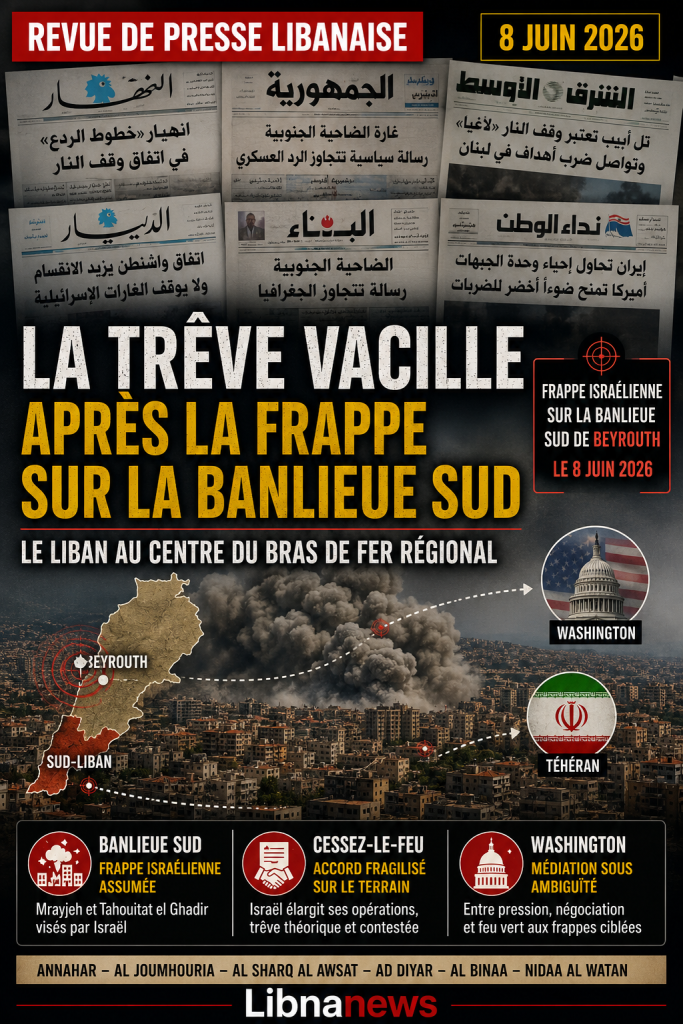
A ceasefire already emptied of its scope
The press of 8 June 2026 places the Israeli strike against the southern suburbs of Beirut in the centre of the news.Annahar8 June 2026, title on the fall of the deterrent lines in the ceasefire. The paper describes a sequence in which the cessation of hostilities, announced in the framework of the Washington agreement, remains mainly theoretical. According toAnnaharIsrael took advantage of Hezbollah’s refusal to join the agreement to expand its operations in depth. The newspaper also mentions attempts to advance to the Nabatiyah region and an Israeli desire to push its plan up to thirty kilometres inside the South. In this reading, the ceasefire is no longer a stable framework. It becomes a pressure ground. Each party is trying to improve its position before the next round of negotiations scheduled for June 22 in Washington.
Al JumhouriaOn 8 June 2026, insists on the political significance of the strike. The newspaper reports that the raid targeted the areas of Mrayjeh and Tahuitat el Ghadir, following the Hezbollah’s announcement of gunfire to northern Israel. According to the Israeli version quoted byAl JumhouriaThe operation was reportedly conducted on direct orders from Israeli Prime Minister Benjamin Netanyahu and Israel’s Defense Minister, Israel Katz. But the daily notes that the message goes beyond the mere military response. Israeli media quoted byAl Jumhouriastress that the importance of the operation lies more with the target location, the southern suburbs, than with the nature of the target itself. Israel would thus seek to impose a new equation. Any attack by Hezbollah would be followed by a direct strike against the southern suburbs of Beirut.
Same day,Al Sharq Al Awsaton 8 June 2026, reports that sources in Tel Aviv regard the ceasefire as null and void. According to these sources, the Israeli attack, described as limited but targeted, was justified by Hezbollah’s refusal and its attacks on the Israeli army and communities. According to the newspaper, Israeli officials claimed to have informed Washington in advance of the operation, while indicating that Israel was not seeking escalation. This formulation gives the strike a double function. It indicates a visible Israeli autonomy. It also shows that the American channel remains present, even when the terrain contradicts the discourse of de-escalation.
Washington between mediation, pressure and ambiguity
The American position appears as one of the driving threads of the cover.Ad Diyar8 June 2026, describes a day of intense tension between the Israeli army and Hezbollah fighters. The newspaper reports that the Israeli army announced the interception of two projectiles fired from Lebanon to the north of Israel. He also pointed out that the southern suburbs of Beirut had become the heart of an arm of iron between Iran and Israel. In this reading, official Lebanon continues to seek stabilization through diplomatic channels. But Tel Aviv maintains a freedom of military action. The ceasefire thus becomes a disputed framework, subject to opposing interpretations.
Al Quds Al ArabiJune 8, 2026, highlights Donald Trump’s comments on the need for more precise strikes against Hezbollah. The newspaper recalls that two planes allegedly participated in the attack on the southern suburbs and dropped ten missiles, according to an Israeli media report quoted in the article.Al Quds Al Arabiit also reports that Hizbullah has intensified its attacks on Israeli soldiers, tanks and positions in the south and northern settlements, with approximately forty operations in 24 hours according to Hizbullah ‘ s press releases. In this context, Trump’s statement appears to be a form of political acceptance of continued strikes, provided they are more targeted. The American formula does not condemn the operation. Rather, it guides the method. This point feeds questions about Washington’s real role in managing the Lebanese front.
Al JumhouriaOn 8 June 2026, this ambiguity was more broadly formulated. The newspaper writes that the strike does not only have a military dimension. It is part of a scene where Washington, Tehran and Tel Aviv each advance with their own calculations. The daily observed that Trump was optimistic about a possible deal with Iran, while Pakistani mediation strengthened that climate. But he adds that the two sides, American and Iranian, also play over time. Lebanon then appears to be a space suspended between negotiation and risk of explosion. This reading gives the strike against the southern suburbs the value of a regional message. It makes the Lebanese terrain an instrument of pressure in the broader negotiations between Washington and Tehran.
Lebanon caught between the Washington Agreement and the Islamabad Canal
Annaharon 8 June 2026, describes the Lebanese State as subject to conflicting pressures. The newspaper states that Beirut is seeking a cessation of hostilities in order to bring Lebanon out of the regional conflict and prevent it from being turned into a negotiating map. The official objective remains the gradual restoration of sovereignty. ButAnnaharnotes two major obstacles. The first is Hezbollah’s refusal to negotiate directly. The second is the conflict between the United States and Israel on one side, and Iran on the other. According to the newspaper, Lebanese diplomacy blames the United States for not supporting the Lebanese state clearly enough. Washington seeks to separate Lebanon from Iran, but continues to link the Lebanese issue to the negotiations with Tehran.
In the same register,AnnaharJune 8, 2026, quotes American researcher Kenneth Katzman. He believes that Israel wanted to harden the Lebanese front before a possible agreement between Washington and Tehran. According to him, the aim would be to strengthen Israel’s margin against Hezbollah before Trump asked Netanyahu to stop the offensive against Lebanon. Katzman adds that the Israeli army could seek to disarm Hezbollah by force, even if an agreement with Iran provided for a ceasefire in Lebanon. This analysis confirms the difficulty of separating the Lebanese file from the Iranian file. The United States wants to present Lebanon as a separate subject. Iran tends to maintain the link between the fronts. Israel, for its part, seeks to change the facts before any diplomatic stabilization takes place.
Al Araby Al Jadeedon 8 June 2026, also stresses the link between Iran and the Lebanese front. The newspaper recalls that Israel struck the southern suburbs without warning, while conducting an earthly attack near Nabatiah. He also states that an Iranian official threatened a painful response after the raid. In the same set of information,Al Araby Al Jadeedreports that Donald Trump refuses to integrate Lebanon into the deal with Iran, while claiming to want more targeted strikes against Hezbollah. This position reinforces the blur between diplomatic separation and military liaison of files. It places Lebanon in a zone of tension where each actor refuses to take full responsibility for the enlargement of the conflict, while acting as if it were already enlarged.
An inner scene under political tension
The crisis is not limited to the confrontation between Israel and Hezbollah. It directly affects the Lebanese State and its institutions.Al Sharq Al AwsatOn 8 June 2026, the US Ambassador to Beirut, Michel Issa, is to probe the positions of President Joseph Aoun, Speaker Nabih Berri and Prime Minister Nawaf Salam on the Washington agreement. The newspaper reports that Berri wishes to ask a series of questions about experimental areas, in particular the meaning given to this concept. He wanted to know whether Israel was trying to test the Lebanese army, whereas the leadership of that army was under the Council of Ministers. In this reading, the military issue also becomes institutional. It covers the role of the army, the sovereignty of the State and Israel’s place in assessing Lebanon’s ability to control its territory.
Al Quds Al Arabion 8 June 2026, gives another indicator of this pressure on the military institution. The newspaper reports that Israel killed twenty-five Lebanese military personnel and injured twenty-one more since the intensification of its attacks on the south and east of Lebanon on 2 March. According to the article, these losses result from 26 attacks carried out in ninety-two days. The geographical distribution cited covers several southern cazas, including Nabatieh, Tyre, Bint Jbeil and Saida, as well as eastern areas such as Baalbeck, Hermel and Western Bekaa. This data gives an institutional depth to the crisis. The Lebanese army is no longer only mentioned as a force to deploy. It is already paying the price for land where the ceasefire does not protect state structures.
Al Jumhouriaon 8 June 2026, goes further in the analysis of this risk. The newspaper writes that international circles are considering a resumption of military heat in Lebanon. It refers to a possible Israeli movement towards Ali el Taher, Jabal el Rihane and the western Bekaa areas. The daily also mentions the killing of high-ranking officers as a strong message, after more limited fire messages targeting vehicles and army positions. This reading puts the idea of direct pressure on the state at the very moment when its role is supposed to be reinforced by the Washington agreement. The more the diplomatic discourse speaks of restoring Lebanese authority, the more the terrain seems to weaken the instruments of that authority.
Southern suburbs as a regional signal
Al BinaaOn 8 June 2026, the attack on the southern suburbs was interpreted as a more complex step. According to the newspaper, the main event is not only the Israeli raid or even the Iranian response that would have followed. The most important would be the political context surrounding these two moments.Al Binaaconsiders that Israel has attempted to impose new rules of engagement by striking the southern suburbs. The newspaper adds that Iran wanted to show that it kept its promise of response. This sequence would place Washington and Tel-Aviv before a double challenge. The first concerns the ability to contain the response. The second concerns the preservation of the negotiation process with Iran and the ceasefire.
Al Akhbaron 8 June 2026, adopted a clearly regional reading. The newspaper claims that Iran places the ceasefire on the Lebanese front at the top of its priorities. According to this reading, the discussion would not only focus on a one-time stop at the shots. It would aim at ending the war in Lebanon, with a clear timetable for Israeli withdrawal from Lebanese territories.Al Akhbaralso presents the sequence as an Israeli attempt to return the American-Iranian negotiating table. The daily describes a scene where the strike on the southern suburbs cannot be isolated from the rest of the conflict. It becomes a piece of the arm on the conditions of regional de-escalation.
The coverage of 8 June 2026 thus shows a strong convergence between the newspapers, despite different political angles.Annaharinsists on the actual postponement of the ceasefire and on the israeli attempt to impose facts before the next negotiation.Al Jumhouriasee in the strike a risk of regional explosion.Al Sharq Al Awsathighlights the role of the American ambassador and the questions of Nabih Berri.Ad Diyarstresses the face-to-face between Israel, Hezbollah and Iran.Al Quds Al Arabiinsists on Trump’s words and on the intensity of Hezbollah’s operations.Al BinaaandAl Akhbarplace the sequence in the confrontation between Iran, Israel and the United States. In total, the ceasefire still exists in the texts. But, in the facts described by the sources of 8 June 2026, he appears already weakened, challenged and subjected to a test that threatens his content, his timetable and his credibility.
Local policy: the Lebanese state between military pressure, debate on sovereignty and revival of public projects
The three Presidencies against the Army Test
Lebanese political life on 8 June 2026 is dominated by the state’s place in front of the new Israeli military thrust.Al Quds Al Arabi8 June 2026, reports that the President of the Republic,Joseph Aoundenounced the targeting of a Lebanese army military vehicle. It has seen a flagrant violation of Lebanese sovereignty, international laws and practices. The same article states that the President has put the attack back in the context of a continuous escalation that threatens security in the South, even though Lebanon is participating in the Washington negotiations. This reaction places the army at the centre of political discourse. It is no longer just a defence. It becomes a symbol of the sovereignty that the authorities seek to assert in a context where military decisions often escape the institutional framework.
In the same sequence,Al Quds Al Arabi8 June 2026, reports that the Prime MinisterNawaf Salamcalled the attack a crime characterized and targeted Lebanon as well as all Lebanese. The President of Parliament,Nabih Berrirejected the idea of error or confusion, depending on the same source. These three reactions give a rare picture of institutional alignment. The Presidency, the Government and Parliament speak of the same scene. But this unit remains primarily defensive. It concerns the condemnation of the attack, less a clear strategy to impose a new balance of power. The Lebanese Government is therefore seeking to establish a common political line. However, it must do so as the military terrain deteriorates and the Washington negotiations progress under pressure.
Al Quds Al Arabion 8 June 2026, states that the army lost two officers and one soldier in an Israeli strike against a military car on the Kfar Tebnit-Khardali road in the Nabatiyah area. The army command presented these deaths as the result of a brutal and repeated attack on Lebanon, its people and its army. He also claimed that these attacks were intended to undermine efforts towards a solution that would restore stability, a comprehensive ceasefire and Israeli withdrawal from the occupied Lebanese territories. This formulation shows that the army is not merely a victim. It is defined as part of a political and security process that involves the entire state.
The Washington accord as an inner fracture
The most sensitive political issue remains the agreement discussed in Washington.Al Sharq Al AwsatOn 8 June 2026, the American diplomat Michel Issa was to probe the positions of President Joseph Aoun, Nabih Berri and Nawaf Salam. The newspaper states that the ambassador also seeks to understand the meaning of the visit of the army commander, the generalRodolphe HaykalPakistan, a country that plays a role in the Washington-Theran trade. This shows that Lebanese institutions are being closely monitored. Washington wants to know if Beirut can produce a coherent position. But Lebanon remains caught between two constraints. He must negotiate with powerful mediators. It must also prevent the discussion on the South from turning into an internal trial of the army, Hezbollah or political authority.
Al Sharq Al Awsaton 8 June 2026, stresses that the future round of negotiations should require Lebanese responses on the handing over of Hezbollah weapons in stages, first south of the Litani river and then north of the river. The newspaper links this logic to the concept of « experimental zones », where the Lebanese army would be called upon to deploy in areas close to the front line. In this presentation, Israel uses the advance towards Nabatieh to push Lebanon towards a difficult option: to get Hezbollah removed from certain spaces or to accept stronger military pressure. Local politics is therefore constrained by external mechanics. The debate is not just between Lebanese parties. It is supervised by Israeli force, American mediation and Iranian positions.
Al JumhouriaOn 8 June 2026, a more precise reading of the army’s reserves was given. The newspaper reports that General Rodolphe Haykal, present in Baabda with the negotiating support team, has expressed his rejection of the idea of experimental zones under current conditions. According to the newspaper, it believes that such a mechanism is impossible in burning areas and that a comprehensive and stable ceasefire must precede any discussion. He also made reservations about the choice of areas such as Zawtar, Beaufort Castle or areas where Israeli forces are already present or under pressure. In this sense, the army could be seen as a force that complements the Israeli military project, rather than being the sovereign instrument of an Israeli withdrawal.
Nabih Berri, Rodolphe Haykal and the Battle of Interpretation
General Rodolphe Haykal’s visit to Pakistan itself became a subject of political reading.Al Quds Al Arabion 8 June 2026, reports that there is some information that precludes any link between the visit and the negotiations. According to these elements, the displacement responds to an invitation from his Pakistani counterpart and forms part of bilateral military relations, with joint formations and Pakistani support to the Lebanese army. The newspaper adds that Haykal’s meetings would be limited to its military counterpart and would not include meetings with Pakistani or Iranian officials. He also stated that the information giving Nabih Berri a role in the visit would be unfounded, as the negotiation was conducted by the Lebanese State in Washington.
AnnaharOn 8 June 2026, however, reports that some circles close to Hezbollah link this displacement to recent military events, in particular the targeting of the army in the South. According to this approach, the Israeli strike that killed two officers and one soldier cannot be separated from the increasing Israeli pressure on the Lebanese State and its institutions.Annaharalso recalls the position of Nabih Berri, for whom what happened is neither an error nor a suspicion, but an operation carrying messages. This difference in reading reveals a wider tension. Part of the political field wants to keep the army in a normal institutional setting. Another party sees each move, attack and mediation as an element of a regional arm.
In this climate,AnnaharJune 8, 2026, quotes Jean-Yves Le Drian, who says he appreciates Nabih Berri and shares many points with him. He stressed the need for a ceasefire and said that the matter would be followed up at the next round of negotiations scheduled for 22 June. The same article points out that Paris salutes the current Lebanese executive authority, both the President and the Government, stating that Lebanon has not known a similar one in a long time. France also confirms its intention to hold a conference in support of the army, while linking the date with developments on the ground. This French look gives political support to Joseph Aoun, Nawaf Salam and the military institution. But it also recalls that any aid schedule depends on security stability.
Criticisms against the official line
The local debate is not limited to institutional positions. It also crosses newspapers and political camps.Al AkhbarOn 8 June 2026, the official line was harshly criticized. The newspaper believes that direct negotiations with Israel grant a free concession and pave the way for a discussion on a peace agreement. It also considers that the sending of a group of six officers to a meeting with Israel was done without compensation. According to this reading, the State’s disengagement from resistance would remove one of its main maps of force in Lebanon. The newspaper further believes that Hezbollah’s weapons record should remain an internal sovereign issue and not become a pressure card in negotiations with Israel.
Al Akhbaron 8 June 2026, continued this criticism by targeting the presidency. The newspaper claims that the communiqué issued after the fourth round of negotiations legitimizes the American proposal, putting an end to Israeli attacks on the southern suburbs against the halt of Hezbollah attacks. The newspaper believes that this formulation creates a new equation between the southern suburbs and the northern communities of Israel, while making the ceasefire vulnerable by the idea of a gradual withdrawal. This position reflects the refusal of part of the political landscape to dissociate state sovereignty from Hezbollah force. It also shows that the Washington Agreement does not only produce a diplomatic discussion. It revives the debate on the very identity of the national decision.
Al Binaa, June 8, 2026, relayed a nearby critic. The newspaper states that Israel’s targeting of the army carries signs that go beyond military ground, especially after the blockade of the last round of negotiations and Lebanese refusal to enter into security arrangements or direct coordination with Israel prior to a comprehensive ceasefire. According to the sources cited, the official Lebanese response remains limited to statements of condemnation, while some circles believe that the « announcement of principles » gives Israel security and political advantages to the detriment of Lebanese sovereignty. This criticism puts the political class before a simple question. Can we continue to negotiate under military pressure without appearing to be a weak part of the process?
The government is trying to show civil action capacity
In the midst of the security crisis, the government is also trying to highlight public service decisions.Al Liwaon 8 June 2026, reports the launch ceremony of the executive phase of the development and operation project of René Moawad Airport in Qleiaat, under the patronage and in the presence of Prime Minister Nawaf Salam. The newspaper states that the Ministry of Public Works and Transport has launched the project according to the rules of the Public Procurement Act, and that the operation must be carried out by a company which has won the tender. This sequence offers the government another political register. It allows us to talk about state, infrastructure, regional development and territorial balance, at a time when the national debate is saturated with war and arms.
Al Liwaon 8 June 2026, reports that Nawaf Salam presented the Qleiaat project as a step connected with the spirit of the Taif Agreement, the State in charge of its decisions, reform and balanced development. It also stated that Qleiaat Airport is not an alternative to Rafic Hariri International Airport in Beirut, but a complement. According to the newspaper, the Prime Minister stressed the need for a modern and integrated air infrastructure capable of linking regions to the national economy. In a country marked by the concentration of services in Beirut and the fragility of infrastructure, this setting gives the government a tool of legitimacy. It answers the question of war by another language, that of administration and planning.
But the project does not escape divisions.Al Quds Al ArabiOn 8 June 2026, it was reported that the opening of a second civilian airport in Lebanon took place after many years of waiting and despite objections. The newspaper also mentions a criticism published by a Hezbollah activist that the preparation of the airport in Qleiaat would be used to hit Beirut airport. This reaction shows that even an infrastructure project can be read through the war. The government wants to talk about development. Its opponents or critics see it as a possible strategic move. Thus, the local politics of 8 June 2026 are played on two linked scenes. The first is sovereignty and ceasefire. The second is the Civil State, which tries to prove that it can still decide, build and allocate resources.
Quote and speech by political figures: sovereignty, ceasefire and battle of words about the role of the State
Joseph Aoun, Nawaf Salam and Nabih Berri facing military targeting
The political sequence of 8 June 2026 is marked by a high density of public statements. The words of Lebanese officials are first focused on the army.Al Quds Al Arabi8 June 2026, reports that the President of the Republic,Joseph Aoundenounced the targeting of a Lebanese military vehicle by Israel. He sees this as a direct violation of Lebanon ‘ s sovereignty, but also of the norms of law and international practices. This statement establishes an institutional framework. The president is not just talking about a military incident. It enshrines the attack in a conflict on the legitimacy of the State. By focusing on sovereignty, he sought to place the army at the centre of the national narrative, while discussions about the ceasefire, Hezbollah and foreign pressures dominated public space.
According toAl Quds Al Arabi8 June 2026, the Prime MinisterNawaf Salamadopt a more frontal formula. It describes the attack as a crime characterized and targeted by Lebanon and all Lebanese. The President of Parliament,Nabih Berrirejects the idea of error or confusion. Convergence between the three leaders gives the official response a political significance. Joseph Aoun speaks in the name of sovereignty. Nawaf Salam speaks on behalf of the national assembly. Nabih Berri closes the door to any extenuating reading of the Israeli act. Thus, the three Presidencies are building the same message: the army is not a peripheral target, but a pillar of the state. This common tone also reflects concern. Lebanon is entering the negotiations while one of its main stabilization instruments, the army, is itself struck.
The military statement, quoted byAl Quds Al Arabijune 8, 2026, adds a solemn dimension to this sequence. The military command affirms that the continued Israeli aggression against Lebanon, its people and its army reinforces its firmness and determination. It also presents these attacks as attempts to undermine efforts to achieve a solution, a return to stability, a comprehensive ceasefire and Israeli withdrawal from the occupied Lebanese territories. The wording is important. It places the army not only in a defence posture, but also in a political logic. The army is the guarantor of a path to stability. It thus becomes an actor of language in the debate on peace, even without leaving its institutional framework.
Nawaf Salam and the State Speech Restored in Qleiaat
The speech ofNawaf Salamis not limited to the condemnation of the israeli attack.Al Quds Al ArabiOn 8 June 2026, he reported on the opening of the René Moawad airport yard in Qleiaat. The Prime Minister says that the airport is no longer a deferred idea, but a route that is beginning to materialize. He adds that this site must open up new opportunities in work, transport and commerce, while stating that it is not a replacement for Beirut airport. The message is very political. In a country absorbed by war and debates on weapons, Nawaf Salam tries to show that the state can still build, plan and distribute public facilities.
The same speech, quoted byAl Quds Al Arabijune 8, 2026, connects Qleiaat with the Taif agreement. Nawaf Salam recalls that the region is associated with the birth of the formula for national reconciliation and the election of René Moawad. It considers that the reactivation of the airport is also a restoration of the meaning of the State and the meaning of Taif. But it does not reduce Taif to spatial planning. It states that its implementation also requires that the State extend its authority throughout the territory by its own forces, as provided for in the agreement, and that arms be limited to the State alone. This sentence gives the speech a central scope. Development becomes a means of talking about sovereignty. The airport becomes a symbol of the civil status, but also of the State holding the security decision.
Al Liwaon 8 June 2026, reports another part of Nawaf Salam’s speech. The Prime Minister insists on three lines: the path to the state, the path to reform and the path to balanced development. He states that this heading is included in the ministerial declaration and that the government will not retreat. At the end of his speech, he sent a message to the inhabitants of Akkar. He said that forgotten regions must no longer exist, that development must no longer be postponed and that there must be one nation, equal opportunities and the same future for all Lebanese. These formulas contrast with the military statements of the day. They show an attempt to shift attention to reform, while keeping the theme of public authority.
Jean-Yves Le Drian and French prudence
The French word occupies a distinct place in the corpus.Annaharon 8 june 2026, publishes an interview withJean-Yves Le Drian, special envoy of French President Emmanuel Macron. The newspaper held that Lebanon itself would decide in the negotiations. This formula is central. It aims to recall that France officially defends the sovereignty and unity of Lebanon. It also responds to a French concern. According toAnnaharParis believes that official Lebanon has not always given France the attention and coordination hoped for, especially since Washington took a dominant place in the process. The French discourse is therefore intended to be united and reserved. He supports the Lebanese State, but also reports that the diplomatic game has moved.
In the same interview,AnnaharJune 8, 2026, reports that Jean-Yves Le Drian says he greatly appreciates Nabih Berri and shares several points with him. It stresses the need for a ceasefire, which it presents as a mandatory path. He also indicated that this issue would be followed up in the next round of negotiations scheduled for 22 June. This statement shows the function of the French discourse. Paris not only seeks to comment on events. It tries to maintain a political link with key Lebanese officials, especially those with a capacity to mediate with Hezbollah. In this context, Le Drian’s speech appears to be a call to preserve the political channel, despite pressure from the ground.
AnnaharOn 8 June 2026, he added that Jean-Yves Le Drian greeted the current Lebanese executive authority, including the President and Government, considering that Lebanon had not experienced such a configuration for a long time. It also confirms France’s intention to hold a conference in support of the Lebanese army. He refuses to speak of repeated adjournments and asserts that the date depends on developments. This caution reveals the actual status of the file. France wants to support the army, but it cannot separate this support from the security conditions. The French speech therefore gives Lebanon political recognition, but not yet an immediate operational guarantee.
Donald Trump between support for strikes and promise of a better life for Lebanon
The most commented statement comes fromDonald TrumpPresident of the United States.Al Quds Al ArabiOn 8 June 2026, he reports that he called on Israel to be more precise in the strikes presented as targeting Hezbollah in Lebanon. In an interview with an American channel, he said he wanted Lebanon to enjoy a better life and hoped that the attacks against Hezbollah would be more accurate. He also expressed the idea that these operations should be more surgical. The formula is ambivalent. It does not condemn the principle of strikes. She called for them to be more targeted. For Lebanon, this language is very meaningful, because it treats military precision as a sufficient condition, while the Lebanese question also concerns sovereignty, civilians, institutions and the ceasefire.
Al Binaaon 8 June 2026, reports a more complete version of this position. Donald Trump says he supports more Israeli strikes than he calls surgery against Hezbollah. At the same time, he affirms that he is seeking a better life for Lebanon. He adds that he has a very good relationship with Benjamin Netanyahu, while saying that he does not agree with him on certain points. He even mentioned the possibility of US aid or recourse to Syria, saying that Ahmad al Sharaa would be happy to help. This sentence introduces a very sensitive element. It suggests that Lebanon could be treated in a wider regional geometry, where Syria would become a possible instrument of pressure or settlement.
According toAl BinaaOn 8 June 2026, Donald Trump also stated that he did not ask for Lebanon to be part of a short-term agreement with Iran. But it confirms its support for Israeli operations against Hezbollah. This distinction illustrates all American ambiguity. At the diplomatic level, Washington claims to want to separate the Lebanese file from the Iranian file. Military support for the strikes against Hezbollah keeps Lebanon at the heart of the confrontation. Trump’s speech therefore has a double effect. It promises Lebanon an improvement in its future, while accepting that its territory remains an Israeli military space.
Benjamin Netanyahu, Israel Katz and the language of deterrence
The Israeli discourse reported by the sources is based on a logic of response and deterrence.Al Binaaon 8 June 2026, states that, after the strike on the southern suburbs of Beirut, a press release byBenjamin NetanyahuandIsrael Katzannounces raids on Hezbollah sites. Israel Katz describes the targeting of the southern suburbs as a response to Hezbollah rocket fire to Israel. This formulation aims to make the operation appear as a framed reaction. But the same article says that Israeli media see it primarily as a deterrent message. The geographic target, the southern suburbs, therefore counts as much as the military objective itself.
Al BinaaOn 8 June 2026, Israeli sources also reported that there was a risk that the military response might be expanded if Hezbollah escalated. The Israeli channel quoted indicates that the strike would not have targeted the murder of a specific personality, but that it would have been thought of as a message. This Israeli word shows a willingness to set new rules. The implicit message is clear: the southern suburbs are no longer protected by the old deterrent threshold. However, this logic increases political risk. It places Beirut and its neighbourhoods in a set of cross-responses where the distinction between military target and political message becomes increasingly blurred.
Iran and the Response by Force
Iranian officials are holding a speech of rupture.Al BinaaOn 8 June 2026, Iran reports that it condemns the Israeli attack on Mrayjeh in the southern suburbs of Beirut. The adviser to the Iranian Supreme Guide,Mohammad Mokhberclaims that the enemy set fire to the negotiating table for the third time by striking Lebanon while a mediator was in Iran. He adds that the authors of ruptures of engagements must be addressed in the language of force, and that the axis of resistance is one body. This declaration directly links Lebanon to the Iran-US negotiation. She refuses any clear separation between the fronts.
In the same article,Al Binaa8 June 2026, quotes the President of the Iranian Parliament,Mohammad Baqer Qalibaf. He claims that the maritime blockade imposed on Iran and Israeli violations of the Lebanon-related agreements prove that Washington and Tel Aviv are not respecting the dialogue and ceasefire. He adds that they do not believe in dialogue and understand only the language of force. The Iranian slogan is therefore clear. He opposes force to a diplomacy deemed misleading. On the Lebanese level, this speech reinforces the idea that the southern suburbs are not just a hit neighbourhood. It becomes a test place for regional balances.
Bechara Boutros Rai and the Reminder to Wisdom
In a different register,Annahar, june 8, 2026, highlights a quote from the maronite patriarchBechara Boutros Rai. He expressed the hope that the negotiations under way would produce tangible results leading to stability, and that the language of wisdom would prevail over that of escalation, since people no longer bore more suffering. This sentence contrasts with military or geopolitical statements. It puts the population at the centre of the debate. The patriarch does not speak in terms of fronts, weapons or power relations. He speaks in terms of collective fatigue and the need for stability.
Ad Diyar, June 8, 2026, resumed the same axis by stating that war did not make peace and did not build nations. The newspaper also reports the patriarch’s call to see the negotiations yield concrete results. In the climate of 8 June, this religious speech has a political function. It does not propose a detailed plan. But it imposes a moral reminder in the face of statements of force. She says that the logic of escalation has a human cost that political and military actors often tend to reduce to a strategic calculation.
Michel Issa, Michel Moawad and the battle of meaning around the state
Statements around Qleiaat prolong the battle of political vocabulary.Al Quds Al Arabi8 June 2026, reports that the US Ambassador to Beirut,Michel Issasee the new airport as a new hope and a stronger economy for Lebanon. He also claims that this is the first time that Lebanon alone decides its destiny without external intervention. He added that the Washington negotiations were very important and thatNaim Kassemdecide as he pleases, while Lebanese officials also decide. This sentence introduces a direct opposition between the decision of the State and the Hezbollah decision. It summarizes the American axis of the moment: encouraging the Lebanese authority to distinguish itself clearly from the party’s decision.
In the same context,Al Quds Al Arabion 8 june 2026, reports that the deputyMichel Moawaddescribed the opening of the airport in Qleiaat as a victory of the state and sovereignty. He claims that this sequence honours the martyrs of the State and not those who placed him under guardianship. The formula is loaded. It makes infrastructure an act of political memory. It contrasts two narratives: that of a sovereign State that returns to life, and that of a country that has long been subject to external or parallel powers. On this day dominated by the strike against the southern suburbs, Moawad’s speech joins that of Nawaf Salam on one essential point: sovereignty is played not only at the front, but also in the ability of the state to act, build and decide.
Diplomacy: Washington, Paris and Islamabad try to frame a de-escalation that the Lebanese terrain weakens
American mediation against Lebanese reserves
Diplomacy around Lebanon focuses, in the sources of 8 June 2026, on the Washington Agreement and on the difficulties of its implementation.Al Sharq Al Awsaton 8 June 2026, states that the US Ambassador to Beirut,Michel Issathe three Lebanese Presidencies. His tour must lead him to the President of the Republic,Joseph Aounthe President of Parliament,Nabih Berriand the Prime Minister,Nawaf Salamin order to assess the Lebanese position against the Washington Agreement. This approach gives American diplomacy a central role. It also shows that Washington does not consider the agreement to be acquired. The text exists, but its political acceptance remains under discussion. The Lebanese remarks, especially those of Nabih Berri, thus become a diplomatic subject in their own right.
According toAl Sharq Al AwsatOn 8 June 2026, Michel Issa mainly sought to understand the reasons for the reservations made by Nabih Berri on certain points of the agreement. The newspaper reports that these reservations are perceived by the ambassador as close to a refusal, especially since Berri would have described certain elements of the text as hybrids and traps. This formulation speaks a lot of the diplomatic climate. The problem is not just about technical details. It touches trust. For Washington, the agreement represents a possible path towards a calm return to the South and Israeli withdrawal. According to Berri, according to the newspaper’s reading, certain clauses may introduce ambiguous mechanisms, which could expose the Lebanese State to an externally imposed logic.
In this sequence, the role of the Lebanese army becomes a point of diplomatic friction.Al Sharq Al Awsat8 June 2026, writes that Michel Issa also wants to explore the meaning of the visit of the army commander, the GeneralRodolphe HaykalPakistan. Islamabad then played a role in the negotiations between the United States and Iran. The displacement of the Lebanese Army leader therefore takes on a particular dimension. It can be read as a bilateral military visit. It can also be interpreted as an indirect signal in wider regional negotiations. This ambiguity explains the American interest. It also reveals Lebanon’s difficulty in preserving strictly national diplomacy when each institutional movement is placed in the confrontation between Washington, Tehran and Tel Aviv.
Paris defends Lebanese sovereignty, but notes its setback in the process
France appears to be a present partner, but less central than the United States in the diplomatic sequence.Annaharon 8 june 2026, publishes an interview withJean-Yves Le DrianSpecial Envoy of the French President. The title chosen by the newspaper insists on the idea that Lebanon will control itself in the negotiations. Drian reiterates that France emphasizes the sovereignty and unity of Lebanon. However, the article reveals a form of French reservation. According toAnnaharParis believes that official Lebanon has not always responded to French attention through equivalent coordination, since Washington took control of the case. French diplomacy supports the Lebanese state, but it also observes that its space for action is shrinking.
This situation places Paris in a delicate position. France does not want to contest the American role in front of it. However, it seeks to retain a place in the follow-up to the Lebanese case.AnnaharJune 8, 2026, reports that Drian appreciates Nabih Berri and claims to share several points with him. He stressed the necessity of the ceasefire and said that the issue would be followed up in the next round of negotiations scheduled for 22 June. The French message is therefore twofold. On one side, Paris confirms the need for a negotiating framework. On the other hand, it recalls that the ceasefire must remain the political condition of any lasting arrangement. Without a real cessation of hostilities, the agreement may become a text empty of its scope.
The question of support for the Lebanese army extends this French position.AnnaharOn 8 June 2026, Le Drian confirmed the French intention to hold a conference in support of the army. He rejected the idea of repeated adjournments and said that the date depended on developments. This caution is significant. France wants to help the military institution, but it cannot separate this aid from the security context. If the terrain deteriorates, the conference becomes more difficult to hold. If the ceasefire stabilizes, it can become a tool for consolidating the state. Thus, Paris treats the army as a pillar of sovereignty, but also as an indicator of the viability of the diplomatic process.
Islamabad becomes a sensitive channel between Tehran and Washington
Pakistan’s diplomacy is one of the most important points in regional coverage.Al Quds Al Arabion 8 June 2026, reports that the Pakistani Minister of the Interior,Mohsen Naqviwent to Tehran. He met his Iranian counterpart there,Eskandar Momenithen the Iranian Foreign Minister,Abbas Araghchi. The newspaper also states that Naqvi was to deliver an important message from the leader of the Pakistani army,Asim Munirto the iranian guide,Mojtaba Khamenei. The mission aims to reconcile positions between the United States and Iran. It is part of a time when war, the closure of the Strait of Ormuz and tensions on several fronts make any agreement more complex.
According toAl Quds Al ArabiOn 8 June 2026, Islamabad acted with the support of regional countries, including Qatar, Turkey and Egypt, in order to promote a reduction in tensions and ensure the reopening of the Strait of Ormuz. This detail is essential. It shows that mediation is not limited to bilateral dialogue between Washington and Tehran. It is based on a regional network that seeks to avoid a wider economic and military shock. For Lebanon, this dynamic has a direct consequence. The more Iran links the Lebanese front to regional negotiations, the more the mediations around Tehran influence the rate of the ceasefire in the South. Lebanon is therefore indirectly affected by diplomacy in Tehran, Islamabad, Washington and the capitals of regional mediators.
Annaharon 8 June 2026, highlights this link between Lebanon and Iran. Journal reports analysis of American researcherKenneth Katzmanaccording to which Israel wanted to increase pressure in Lebanon before a possible agreement between Washington and Tehran. The aim would be to strengthen the Israeli position against Hezbollah before Donald Trump asked Benjamin Netanyahu to stop the offensive against Lebanon. Katzman also believes that the Israeli army could seek to disarm Hezbollah by force, even if an agreement with Iran imposed a ceasefire in Lebanon. This analysis sheds light on the core of the diplomatic dilemma. Washington wants to separate the files. Tehran tends to bind them. Israel is trying to impose facts before any agreement is reached.
The displacement of Rodolphe Haykal between military reading and diplomatic suspicion
General Rodolphe Haykal’s visit to Pakistan illustrates the difficulty of distinguishing military diplomacy from regional diplomacy.Al Quds Al Arabion 8 June 2026, reports that the visit would have no direct or indirect link to the negotiations. It would respond to an invitation from its Pakistani counterpart and would be a continuation of mutual visits, shared formations and Pakistani support to the Lebanese army. The newspaper states that Haykal’s meetings should be limited to its military counterpart, without including other Pakistani or Iranian officials. This version aims to maintain displacement in a traditional institutional setting.
The same source reports that the information referring to Nabih Berri’s role in organizing the visit is denied, on the ground that the Lebanese State is negotiating in Washington. This precision is important. It protects, at least in the speech, the unity of the Lebanese official representation. It recalls that Lebanon cannot multiply the channels without weakening its position. Yet the mere fact that this visit arouses so many readings shows that Lebanese diplomacy evolves in a space saturated with suspicions. A normal military visit can be interpreted as a message to Iran. Bilateral contact can be read as a manoeuvre around the Washington Agreement. The Lebanese State is therefore trying to maintain an institutional language, as regional actors read every gesture through the prism of war.
In this context, Lebanese diplomacy seeks to avoid two pitfalls. The first would be to give the impression that the army is entering a regional arrangement that goes beyond national political authority. The second would be to suggest that Lebanon no longer has its own margin and that all its decisions are dictated by Washington, Tehran or Tel Aviv.Annaharon 8 June 2026, notes that the ceasefire announced in Washington remains on the ground, as Israel attempts to impose new military facts and Hizbullah continues its operations with Iranian support. The newspaper adds that the next negotiating session in Washington, D.C., scheduled for June 22, will have to deal with the issues made more difficult by this development.
Gaza, Cairo and Disarmament Diplomacy
Regional diplomacy is not limited to Lebanon. It also concerns Gaza, where the theme of disarmament becomes the first point of discussion.Al Sharq Al Awsaton 8 June 2026, reports that representatives of eight Palestinian factions are meeting in Cairo to discuss a proposal by the mediators. The newspaper states that the issue of arms limitation in Gaza is now the first point in the text, unlike some previous sequences. The main mediators are Egypt, Qatar and Turkey. These developments show that negotiations around Gaza and Lebanon are responding. In both cases, the issue of weapons outside the State framework becomes the focus of discussion.
According toAl Sharq Al AwsatOn 8 June 2026, Palestinian factions discussed a formula that would combine arms limitation, implementation of the first phase, entry of a committee of technocrats into Gaza, dissolution of armed bands and deployment of an international stability force. The same article states that the factions decided to continue their consultations and present a common position at a subsequent meeting with the mediators. This method contrasts with military pressure on the ground. It seeks to make a political compromise before the war resumes. But it also shows that mediators want a collective response that can link the security, humanitarian and institutional components.
Al AkhbarOn 8 June 2026, this negotiation was presented in a more critical light. The newspaper writes that the discussions on Gaza have returned to their point of departure, after a consensus by the mediators on the priority given to the handing over of arms, under threat of a resumption of war by Israel. According to Egyptian sources quoted by the daily newspaper, a meeting in Cairo brought together Egyptian and Turkish intelligence officials and the Qatari Prime Minister, with a focus on the weapons in Gaza and the mechanisms for their treatment. This approach shows the pressure on factions. It also reveals a crisis diplomacy where mediators seek to avoid a new war, but where their proposal is perceived by some actors as a constraint imposed under threat.
A regional diplomacy structured by the same question: who holds the decision of war?
The various files dealt with by the sources of 8 June 2026 converge on the same question. In Lebanon, the Washington agreement raises the problem of the role of the army, Israeli withdrawal and Hezbollah weapons. In Gaza, the mediators place arms control at the top of their proposal. In Iran, Pakistani mediation attempts to frame an agreement with the United States, while the war and the Strait of Ormuz weigh on the calculations.Al Araby Al JadeedOn 8 June 2026, Donald Trump reported that he was imposing strict conditions in Tehran, requiring Iran not only not to develop nuclear weapons, but also not to buy them. The newspaper adds that Washington does not want to lift the freeze on Iranian assets or sanctions before an agreement is reached.
This diplomacy therefore operates in concentric circles. The first circle is Lebanese, with the three presidencies, Michel Issa, the army and the Washington agreement. The second is regional, with Pakistani mediation, the role of Qatar, Turkey and Egypt, and the attempt to contain the American-Iranian confrontation. The third is Palestinian, with the Cairo negotiations on Gaza. In each circle, words change, but the structure remains close. The mediators seek to transform a military power relationship into a political arrangement. Armed actors want to preserve their maps. Israel is seeking maximum security guarantees. States seek to restore a central authority, but without always having the necessary means to impose it.
International policy: Gaza, Iran, Ukraine and Sudan under pressure from open fronts
Gaza between Cairo negotiations and arms debate
The international policy of 8 June 2026 was first marked by the Palestinian issue.Al Sharq Al Awsaton 8 June 2026, reports that representatives of several Palestinian factions are meeting in Cairo to prepare a joint response to the proposal of the mediators on Gaza. The newspaper states that the issue of arms limitation in the Territory is now at the top of the agenda. This change is notable. In previous sequences, discussions focused on the implementation of the first phase, the Israeli withdrawal from the occupied sectors, the entry of aid and the resumption of civilian mechanisms. This time, the mediators make the security case the first lock to be lifted.
According toAl Sharq Al AwsatOn 8 June 2026, Israel continued to violate the fragile ceasefire announced in October, while more than nine hundred and fifty Palestinians had been killed since that date. This data places negotiations within a paradoxical framework. The factions are called upon to discuss the future of weapons in Gaza, while the ground remains dominated by strikes, violations and lack of confidence. The Palestinian side highlights the obligations of the first phase, in particular the Israeli withdrawal and the entry of aid. Israel, for its part, is pushing towards the disarmament of factions as a condition of the second phase. The negotiations are therefore proceeding on two incompatible tracks. One is humanitarian and territorial. The other is security and political.
Al Sharq Al Awsaton 8 June 2026, also details the proposal considered by the factions. It provides for the entry of a committee of technocrats into Gaza, the dissolution of armed gangs, the intervention of an international stability force and a formula to be defined on arms limitation. The newspaper reports that the factions decided to continue their consultations and to present a joint response at a subsequent meeting with the mediators. This choice shows a desire to avoid immediate rupture. But it also reveals the difficulty of speaking of Palestinian unity in the absence of some major actors. The subject goes beyond Gaza. It concerns Palestinian representation, the place of factions, the role of mediators and the capacity of a civilian apparatus to exist in a territory still under war.
Cairo facing the risk of a return to war
Al AkhbarJune 8, 2026, gives a more tense reading of the same sequence. The newspaper writes that negotiations on Gaza have returned to their point of departure, as the mediators have reportedly placed the handing over of arms at the top of their priorities, under threat of a resumption of war by Israel. According to Egyptian sources cited byAl Akhbara meeting was held in Cairo with Egyptian and Turkish intelligence officials and the Qatari Prime Minister. Exchanges focused on the weapons in Gaza and the mechanisms to be adopted to deal with them in the coming period. This presentation highlights the weight of constraint. It shows that mediators are not only seeking technical agreement, but rather preventing a further collapse of the ceasefire.
Al Quds Al ArabiOn 8 June 2026, for its part, reports that meetings in Egypt bring together several Palestinian factions with Egyptian, Qatari and Turkish mediators. The newspaper quotes a participant saying that the discussions focused on the development of the truce and the complications of the ground, due to the Israeli escalation and the conditions imposed by the Tel Aviv government. This formulation puts the talks in an unstable dynamic. The mediators want to transform a weak truce into a sustainable framework. But Israel imposes its demands, factions want to preserve their margins, and the civilian population remains caught in between.
The debate on the future management of Gaza is also fuelling political criticism.Al Quds Al Arabion 8 June 2026, mentions the reserves around a project attributed to Mohammad Dahlan for the administration of the territory. The newspaper reports that some see this as a risk of lasting separation between Gaza and the rest of the Palestinian territories. Therefore, the issue is not just about weapons. It also addresses the future political framework of Gaza. If management is entrusted to a separate structure, without clear integration with a common national authority, the truce could freeze a division. Thus, the Cairo talks are not just about a ceasefire. They already raise the question of Palestinian power, legitimacy and unity.
Tensions between Washington and Tel Aviv around spying
The press of 8 June 2026 also gave an important place to the relationship between the United States and Israel.Al Quds Al Arabion 8 June 2026, reports that American media have highlighted the growing concerns of American security institutions in the face of Israeli attempts to gather information about senior United States officials dealing with Middle East issues, in particular the Iranian case. The newspaper reports that the US Ministry of Defence has raised the level of alert related to Israeli espionage, based on an assessment by the Defence Intelligence Agency. This case is sensitive because it affects a major ally of Washington at the very moment when the United States is trying to negotiate with Iran.
Al Sharq Al AwsatOn 8 June 2026, reports in the same vein that US reports raised concerns about Israeli listening to US negotiators working on an agreement with Iran. Among the officials cited were Steve Witkoff, Donald Trump’s negotiator, and Elbridge Colby, a senior Pentagon official. The newspaper notes that the file has been monitored by the Pentagon’s intelligence services since Joe Biden’s time. The question therefore goes beyond the Trump administration alone. It reveals an older distrust at the heart of a relationship based on close military cooperation.
Al JumhouriaOn 8 June 2026, he stressed the paradox of this crisis. The newspaper recalls that the United States and Israel jointly waged the war against Iran with a high level of military coordination. Israeli officers work with their American counterparts in the United States Central Command, and the armies share large amounts of tactical and operational information. Yet American officials believe that Israel is seeking to know Donald Trump’s strategy and changing positions on peace talks. This situation could complicate military integration between the two countries. It adds a discreet tension to an alliance already tested by differences in the pace of war and negotiation.
Iran and the United States between mediation and harsh conditions
The Iranian case remains one of the main axes of the international sequence.Al Araby Al JadeedOn 8 June 2026, Donald Trump reported that he had imposed strict conditions for reaching a ceasefire agreement with Iran. The US president asks Iranian officials not only to acknowledge that they will not develop nuclear weapons, but also that they will not buy them. The newspaper adds that Washington will not lift the freeze on Iranian assets or sanctions until an agreement is reached. This firm American position reduces the space for compromise. It aims to obtain maximum guarantee, but it also complicates the task of mediators trying to preserve a political channel.
Al Quds Al ArabiOn 8 June 2026, Pakistan reported that it was trying to mediate. Pakistani Interior Minister Mohsen Naqvi visited Tehran, where he met with his Iranian counterpart and the Iranian Foreign Minister. The newspaper reports that he delivered a message from Pakistani army leader Asim Munir to Iranian leader Mojtaba Khamenei. Islamabad acts with the support of regional countries such as Qatar, Turkey and Egypt to bring Washington and Tehran closer together, reduce tensions and ensure the reopening of the Strait of Ormuz. This mediation confirms that the Iranian case is no longer just nuclear. It is also energy, maritime and regional.
This situation places Iran at the centre of a vast crisis system. The United States is seeking an agreement that limits Tehran’s capabilities. Israel wants to prevent this agreement from reducing its freedom of action. The mediators want to avoid an extension of the war. Markets and States bordering the Gulf fear the effect of a sustainable closure of the Strait of Ormuz. In this configuration, diplomacy does not replace force. She’s trying to contain it. The 8 June newspapers show a scene where opening statements and military threats coexist. It is precisely this coexistence that makes the period unstable.
Ukraine again facing nuclear risk
The war in Ukraine has a strong place in international coverage.Al Sharq Al Awsaton 8 June 2026, reports that the Ukrainian authorities announced at least four deaths in Russian strikes. One attack targeted a nuclear waste storage site near Chernobyl. The newspaper states that these strikes took place before a meeting in London between Ukrainian President Volodymyr Zelensky, French President Emmanuel Macron, British Prime Minister Keir Starmer and German Chancellor Friedrich Merz. The association between an attack near a nuclear site and a high-level diplomatic meeting gives the event a strategic reach.
According toAl Sharq Al AwsatOn 8 June 2026, Moscow launched two hundred and thirty-six drones during the night of Saturday to Sunday, of which two hundred and fifteen were reportedly intercepted by the Ukrainian air force. Russia claims to have hit sites linked to the Ukrainian army. These figures show the extent of the war of wear and tear. Massive attacks are aimed at saturating Ukrainian defence. They also exert psychological pressure on civilians and leaders. When sensitive sites such as Chernobyl or Zaporijjia are mentioned, the conflict takes on a dimension that goes beyond Ukrainian borders. Nuclear risk acts as a permanent reminder of European vulnerability.
Al Quds Al Arabion 8 June 2026, reports that the French, British and German leaders must assess with Zelensky the efforts towards a just and lasting peace. The newspaper also states that Zelensky proposed a direct meeting with Vladimir Putin, but that the Russian president refused this idea before a final agreement was reached to end the war. This sequence shows two opposite realities. On the one hand, Ukraine and its European partners maintain the language of just peace. On the other hand, Russia continues to strike and refuses a political face-to-face without prior agreement. The diplomatic field therefore remains blocked by the military field.
Sudan sinks into institutional division
The Sudanese crisis appears from an institutional and social perspective.Al Sharq Al AwsatJune 8, 2026, reports the launch of parallel baccalaureate examinations in areas controlled by the Rapid Support Forces. These are the first such examinations in Darfur since the beginning of the war in April 2023. The newspaper points out that this initiative raises concerns about the consolidation of the country’s political and administrative division. The Chief of the Rapid Support Forces, Mohammad Hamdan Daglo, signalled the beginning of the reviews in Nyala, capital of South Darfur.
Al Sharq Al AwsatOn 8 June 2026, it was reported that approximately two hundred and eighty thousand students from Darfur, Kordofan and other areas under the control of the Rapid Support Forces were deprived of examinations for three years as a result of the war. This figure explains why the de facto authorities are seeking to organize their own school system. But it also reveals the danger of lasting separation. When a conflict produces its own administrations, schools, examinations and standards, reunification becomes more difficult. Sudan is no longer just undergoing armed war. It suffers from a fragmentation of institutions that directly affects younger generations.
Al Quds Al Arabion 8 June 2026, gives another side to the Sudanese case through the discussions on the truce initiatives. The newspaper reports that political and civil forces are calling for a political operation leading to comprehensive social reconciliation and a new social contract based on justice, equal citizenship and the treatment of regional marginalization. However, he added that meetings with structures linked to the Rapid Support Forces had been strongly criticized, some of which were seen as an attempt to give them political legitimacy. The Sudanese dilemma is therefore profound. We need to talk to the actors who control the field, but this dialogue risks devoting their parallel power.
Secondary crises that prolong the same fragmentation logic
Other international issues confirm this dynamic of state fragmentation and balance.Al Sharq Al Awsaton 8 June 2026, reports protests in the Syrian region of Jazira against the deterioration of living conditions, with calls to protest in Hasakah, Qamishli, Shaddadi and other localities. The newspaper also refers to the rejection of a process of integration that would give advantages to the Syrian Democratic Forces to the detriment of other components. Syria therefore remains an area where military integration, resources and local representation form a single political node.
Al Araby Al JadeedOn 8 June 2026, Albania reported that it was experiencing protests against a real estate project carried by Jared Kushner and Ivanka Trump on the coast. The newspaper states that the project raises criticisms about heritage, transparency and the role of foreign private interests in spatial planning. This file is less military than the others. But it also affects sovereignty. It raises the question of control over resources, the coastline, public decisions and the influence of networks linked to American power.
Thus, the sources of 8 June 2026 describe a fragmented international order. In Gaza, the arms and territorial administration block the truce. Between Washington and Tel Aviv, suspected spying weakens a strategic alliance. Between Washington and Tehran, Pakistani mediation attempts to reduce tension in the Gulf and the Strait of Ormuz. In Ukraine, Russian strikes revive nuclear fears. In Sudan, even school exams become the sign of an institutional partition. In Syria and Albania, local crises show that sovereignty is also played out in services, resources and spatial planning.
Economy: Lebanese finances between law on financial loophole, productive recovery and regional energy pressure
The financial consolidation project to address the issue of applicants
Al Sharq Al AwsatOn 8 June 2026, the issue of financial consolidation was placed at the heart of the Lebanese economy. The newspaper notes that the government’s financial order project does not explicitly fix the volume of the financial flaw, unlike previous versions that were valued at about $73 billion. This lack of a final figure has a major difficulty. The debate is not just about accounting. It covers the distribution of losses, the actual capacity to repay and the confidence between the State, the Bank of Lebanon, banks and depositors. According to the newspaper, the government economic team defends the text by putting forward a central promise: the proposed mechanisms would make it possible to refund the fees of about 85 per cent of all applicants over a four-year period. ButAl Sharq Al Awsatpoints out that this presentation remains incomplete, as the State contribution remains conditional on the achievement of budgetary surpluses. Nor is the project finalizing the cash amounts, valued at between $16 billion and $20 billion, or the audited means of honouring them.
This architecture reveals a deep tension. The government is looking for a way out after years of banking crisis. But the text still seems to avoid several decisive arbitrations. Repayment of deposits can only be credible if the sources of financing are clear. OrAl Sharq Al AwsatOn 8 June 2026, it was stated that payment obligations, whether paid in cash in instalments or in the form of deferred securities, would be placed mainly on the Bank of Lebanon and, by ricochet, on banks. This approach can reassure some of the applicants in the short term, as it gives a promise of timing. But it also raises a question of sustainability. If the State fails to specify its share, and if budgetary surpluses remain hypothetical, the system may postpone the burden rather than resolve it. The core of the problem therefore remains political as well as financial: who pays, according to what order, with which assets, and within what period?
Banks seek to show their absorption capacity
In this context, the data published byAl Akhbaron 8 june 2026, onBank Audigive an overview of how some banks are trying to show their strength. The published document indicates that Bank Audi’s consolidated net profits reached $83 million in 2025. According to the data provided by the newspaper, these profits come almost equally from units operating in Lebanon and those located abroad. The text also states that the bank has allocated all the profits made in bank dollars and part of the operating profits made in fresh dollars to the strengthening of the provisions, in order to meet the risks and expenses. This communication is important. It shows that the bank seeks to link its results with the restructuring of the banking sector and the Financial Gap Act.
Al Akhbar, June 8, 2026, also reports that Bank Audi presents its profit and supply policy as a means of strengthening its capital base. In this way, the bank estimates that it will increase its ability to absorb potential losses resulting from restructuring the banking sector and the application of the Financial Gap Act. The same data set shows a fully paid-up capital of £992.878 billion and consolidated equity of £103,700 billion. These figures should be read with caution, as the document itself specifies that the data meet the requirements for regulatory publication and should not be used alone to make a decision. But their presence in the press confirms that banks know that the battle of trust also involves the display of ratios, provisions and results.
Detailed financial data published byAl Akhbaron 8 June 2026, also show the evolution of several balance sheet items. Client deposits and accounts payable increased from £1,152,575,994 million at the end of 2024 to $1,107,716,259 million at the end of 2025. Total assets increased from 1,353,435,432 million to 1,499,041,044 million Lebanese pounds. Net customer loans at amortized cost decreased from $101,870,641 million to $85,796,399 million. These movements reflect an activity still very constrained. The bank has profits, but customer credit remains low. This limits the ability of the banking sector to become again a financing engine for the real economy.
Credit, digital services and real economy
Al AkhbarHowever, on 8 June 2026, Bank Audi points out that it is making a contribution to economic recovery by financing new needs. The bank claims to have provided new loans to approximately 4,700 clients, individuals and institutions in Lebanon. It also highlights the continuation of its digital services, with a digital banking platform, credit cards and nearly 200,000 digital service users. This exceeds the case of a bank. It shows a wider orientation of the sector: restoring a share of the activity through payment tools, remote services and a gradual reduction of the cash economy.
This transition is important in the Lebanese context. Since the crisis, the cash economy has developed strongly. It complicates tax collection, reduces the traceability of transactions and weakens monetary policy. Digital services can therefore help rebuild a more controlled form of financial circulation. But their impact remains limited if productive credit does not return to a normal level. The publicationBank Audias repeated byAl Akhbarjune 8, 2026, thus gives two messages at a time. The first is reassuring: some banks generate profits, strengthen their provisions and maintain services. The second is more cautious: the sector remains in a defence phase, focusing more on consolidation and risk management than on a real stimulus to financing.
Al Jumhouriaon 8 June 2026, published financial data on 31 March 2026 and 31 December 2025. These include a decrease in the cash and issuing institutions from Pound869,316,542 million to Pound826,334,737 million, and an increase in deposits with banks and financial institutions from Pound152,280,288 million to £176,441,223 million. Net customer loans also decreased from 101,870,641 million to 97,812,108 million. This quarterly photograph confirms a close trend. Banks still have large volumes on the balance sheet, but lending activity remains limited. The Lebanese economy needs credit, but the financial sector remains absorbed by prudence, provision and expectation of a definitive restructuring framework.
Qleiaat, Akkar and infrastructure recovery
Economic recovery is not limited to banks.Al Quds Al ArabiOn 8 June 2026, the project for the development and operation of René Moawad Airport in Qleiaat, Akkar was launched. The newspaper recalls that the project comes after many years of waiting and after successive governments fail to launch it. It also reports that local and political officials present the opening of the airport as a break with a period of blockade. The project has obvious economic value. It can strengthen the north of the country, create service activity, improve mobility, attract investment and provide a logistical support point for a long-marginalized region.
But this issue also remains very political.Al Quds Al Arabion 8 June 2026, reports that the opening of a second civilian airport has long been contested by Hezbollah, according to officials quoted by the newspaper. The economic issue is therefore inseparable from the question of State authority and the distribution of infrastructure. For the Government ofNawaf SalamQleiaat makes it possible to talk about balanced development, public services and integration of regions. For its supporters, the project can become a sign of the return of the state in a concrete area. However, economic utility will depend on several conditions: security, transparent management, operating capacity, complementarity with Beirut airport and connection with the road and commercial networks of the North.
This reading joins the coverage ofAl Liwaon 8 June 2026, which presents the launch of the project as a stage of balanced development and public action. The newspaper reports that Nawaf Salam insists that Qleiaat is not an alternative to Beirut airport, but a complement. This precision is central. It aims to avoid a reading of competition between regions or between communities. It places the issue on the economic front: Lebanon needs additional infrastructure, better distribution of services and wider access to trade. The airport can become a stimulus if its operation meets clear rules and the project escapes the logic of rent or political sharing.
Agriculture, industry and demand for public support
The local productive fabric also appears inAl Liwaon 8 June 2026, through an article on an economic meeting organized by Dar Al Fatwa in Bekaa. The newspaper reports that the meeting, chaired by the mufti of the Bekaa, the SheikhAli Ghazzawibrought together the Director General of the Ministry of Economy and Trade,Mohammad Abu Haidar, wheat growers, pasta factory owners, mpYassin Yassin, the former member of parliamentAssem Araji, as well as religious leaders and farmers. The central message is clear: agriculture and industry must be seen as national priorities. Mufti Ghazzawi claims that these two sectors form the backbone of the national economy, both in Bekaa and in other regions.
This meeting highlights another side of the economic crisis. Lebanon cannot base its recovery solely on banks, services or external flows. It must also protect sectors that produce locally. Wheat and pasta are not secondary subjects. They affect food security, rural employment, the cost of living and the country’s ability to reduce its dependence.Al LiwaOn 8 June 2026, Ghazzawi reported that he welcomed the State ‘ s approach to citizens and monitored administrative cases on the ground. This sentence reflects a strong expectation. Producers are not just asking for speeches. They demand support decisions, practical rules, a presence of administration and responses to production costs.
The agricultural and industrial dossier therefore complements that of the banks. In both cases, the Lebanese economy is looking for a crossing point. Banks need a legal framework to deal with losses. Producers need a state that supports costs, protects chains and improves market access. The airport in Qleiaat can offer an infrastructure perspective. But the recovery will remain fragile unless accompanied by a plan for the productive regions. Bekaa, the North and rural areas cannot be treated as economic margins. On the contrary, they are spaces where the State can show that recovery is not limited to central Beirut.
Regional energy shock weighs on balance
The sources of 8 June 2026 also place the Lebanese economy in a very unstable regional context.Al Quds Al ArabiOn 8 June 2026, it was reported that seven members of the OPEC Plus decided to increase their production targets by around 188,000 barrels per day from July. The newspaper points out that, since the beginning of the Middle East war, the alliance has been struggling to compensate for the deficit caused by the closure of the Strait of Ormuz. He pointed out that this passage normally saw about one fifth of the world’s oil production, or nearly twenty million barrels per day. This is essential for Lebanon, even if the country is not a producer. Any sustained increase in energy prices affects import costs, transport, private electricity, food prices and company margins.
Al Sharq Al Awsat, June 8, 2026, also describes a decisive week for world markets, with the expectation of the May US inflation figures and the US Federal Reserve meeting on June 17. The newspaper reports that the employment report, which was stronger than expected, has ruled out the hypothesis of a fall in rates. He added that markets were concerned about the transmission of high energy prices to the rest of the economy. This tension is not abstract for Lebanon. A strong dollar, high rates and expensive energy reduce the margins of an importing country, dependent on external flows and still deprived of a fully restored banking system.
The crisis also affects transport.Al Sharq Al Awsaton 8 June 2026, reports that the International Air Transport Association estimates that companies in the region could suffer $4.3 billion in losses, even if the crisis is presented as temporary. The newspaper adds that global air traffic could reach 5.1 billion passengers in 2026, but that geopolitical tensions and fuel price shocks are re-designing the sector’s financial map. For Lebanon, this context makes the Qleiaat project both more necessary and more difficult. Air infrastructure is a stimulus. But their viability depends on a regional environment where companies, roads, insurance and fuel remain subject to war.
Justice: municipal corruption, alleged war crimes and recourse to international courts
Beirut municipality in the centre of a corruption case
The judicial section of 8 June 2026 is dominated by the file of the municipality of Beirut.Al AkhbarOn 8 June 2026, an investigation was published stating that municipal employees, whose salaries would not exceed $800, own real estate, yachts and millions of dollars. The newspaper presents this dossier as a sign of the internal functioning of a local government where suspicions of unlawful diversion and enrichment are mixed with the question of political protection. The case does not therefore concern only a few agents. It questions the control of public money, the ability of financial justice to continue its investigations and the possibility of going back beyond the apparent performers.
According toAl AkhbarOn 8 June 2026, investigations are conducted by a special inquiry body within the Court of Auditors, at the request of the Public Prosecutor ‘ s Office. They reportedly started about seven months earlier, after the arrest of an employee who has since been released. The newspaper states that the investigation takes place through unannounced visits to the municipality’s headquarters, in coordination with the governor of Beirut,Marwan Abboud. Investigators hear employees, review files and audit accounts. This method indicates that the file is not based solely on general denunciations. It includes administrative, accounting and heritage review work.
The elements cited byAl AkhbarJune 8, 2026, are heavy. The newspaper mentions contradictions in depositions, manipulations in some files and suspicions against employees in the finance, engineering and construction services. It also states that measures have been taken to prevent nine employees from disposing of their movable and immovable property. This precautionary measure is a central point. It means that the investigation seeks to preserve assets that may be linked to acts of corruption or unjustified enrichment. But she’s not worth a sentence. It marks a stage in a procedure where evidence is still to be established.
Hard to justify fortunes
The investigationAl Akhbaron 8 June 2026, gives several specific examples. The newspaper writes that an employee would own fifteen properties in Beirut, between apartments and buildings. He also reports that another one would have transferred a million dollars to an account abroad at the beginning of the financial crisis, before buying a house in Paris. The most striking case, according to the newspaper, concerns the bank account of the minor son of another employee, where there would be five million dollars. These figures, if confirmed by the procedure, raise the question of the link between declared income, family property and access to municipal decision-making channels.
This type of case is particularly sensitive in Lebanon, as it affects the credibility of the local state. The municipality of Beirut manages significant resources and operates in areas with high rent risks: permits, markets, works, revenues, contracts and urban control.Al Akhbaron 8 June 2026, describes the municipality as a place where scandals of waste and theft of public funds arise regularly, without always leading to solid judicial records. The newspaper uses a very hard formula when talking about a kind of cave d-Ali Baba. This image reflects a political and moral accusation. However, at the judicial level, the difficulty remains the same: to move from public suspicion to a trial case capable of holding before the competent courts.
The article also stresses the risk of scapegoat.Al AkhbarOn 8 June 2026, it was reported that only one case would have resulted in an arrest, before the employee concerned appeared as a mere scapegoat. According to that reading, he was punished alone, without the other alleged members of wider networks being affected. This criticism refers to a common problem in corruption cases. The procedures can reach subordinate agents, but stop before the protection circuits, the principals or the more powerful beneficiaries. Financial justice is then under pressure. It must establish the facts, identify the responsibilities and avoid closing the case to an isolated responsibility.
Political pressure as a judicial obstacle
The most worrying point in the case is the pressure raised around the Court of Auditors.Al AkhbarOn 8 June 2026, claims that political pressure from several sides had begun to exert pressure on this court in order to deter it from continuing its investigations. The newspaper also states that there would be steps to lift the ban on the nine employees concerned from disposal of their property. This dimension transforms the case. It is no longer just a matter of suspicious enrichment. It becomes a test for the independence of control institutions, in a country where the border between administration, politics and clientelism is often porous.
According toAl AkhbarOn 8 June 2026, however, officials concerned assured that the investigation was continuing and that the members of the proceeding continued to go to the municipality to hear employees. The newspaper adds that the file has not been frozen, contrary to what is circulating. But he also reports the skepticism of some people close to the case, who do not expect the arrest of those involved in the theft of public funds. This tension is at the heart of Lebanese justice. The procedure is moving forward, but confidence in its outcome remains weak. The public sees the investigations begin. He sees fewer established responsibilities and recovered assets.
The central question therefore becomes that of the future. A financial investigation can only have a real effect if it establishes a complete flow of funds, administrative decisions, signatures, beneficiaries, protections and bank movements. In the case of Beirut, the case seems to involve key services, including finance, engineering and construction. This opens up several avenues. Irregularities may concern public procurement, permits, taxes, expenditure or urban interventions. The newspaper does not yet close these points. However, there is an accumulation of patrimonial signs which requires a broader examination than that of a single employee.
The attack on the Lebanese army as a political and judicial crime
The second judicial axis of the day concerns the qualification of Israeli attacks against the Lebanese army.Al Quds Al Arabi8 june 2026, reports that the army command announced the death of the generalWissam Sabra, the captainEli Khouryand the soldierHussein Abdel Aal Ghazalin an Israeli strike against a military vehicle on the Kfar Tebnit-Khardali road in the Nabatiyah area. The army describes the attack as brutal, intentional and repeated. It believes that these attacks are designed to undermine efforts to achieve a solution, a comprehensive ceasefire and Israeli withdrawal from the occupied Lebanese territories.
The judicial qualification of these facts is not yet established by an independent body in the evidence provided. But the terms used by Lebanese officials give the case a criminal and international dimension. A strike against an identifiable military vehicle can be considered under the law of armed conflict, especially if it intervenes in a context of negotiations and an announced ceasefire.Al Quds Al Arabi8 june 2026, also reports that the presidentJoseph Aoundenounced an infringement of Lebanese sovereignty and international rules, while the Prime MinisterNawaf Salamspoke of a serious crime against Lebanon and all Lebanese. The President of Parliament,Nabih Berrirefused to speak of error or suspicion.
Al Binaaon 8 June 2026, also relayed several partisan reactions calling the attack on the criminal army added to the register of Israeli aggressions against Lebanon, its sovereignty and its institutions. The newspaper cites among other things the Progressive Socialist Party and the Tachnag party, which speak of a targeting of the military institution, a symbol of national sovereignty and the unity of the state. These positions do not replace an investigation. However, they show the construction of a political dossier around a demand for responsibility. The problem is that no immediate judicial mechanism seems to be mentioned by the sources to turn these charges into international or national proceedings.
Army between military target and object of pressure
The judicial dimension of the attack on the army is coupled with an institutional reading.Al BinaaOn 8 June 2026, it was reported that the gravity of the event was not only the targeting of a Lebanese military vehicle, but the precedent it created for the authority and national role of the military institution. The newspaper believes that when the army itself becomes the recipient of Israeli fire messages, under American cover and in a political silence deemed worrying, the risk goes beyond the fate of a patrol or a group of soldiers. It affects the very structure of the institution and the independence of its decision.
This is important for justice, as it raises the question of intent. A strike can be presented as a targeting error, a war operation or a political message. Distinction is essential. If the act is intended to put pressure on a state institution called upon to play a role in the implementation of an agreement, it leaves the strictly military register. It becomes a means of coercion against a public authority.Al Binaaon 8 June 2026, reports that political sources link the targeting of the army to the blocking of the last negotiating rounds and the Lebanese refusal to enter into security arrangements or direct coordination with Israel before a comprehensive ceasefire. This reading makes the attack a matter of sovereignty as much as a military file.
The difficulty remains that of proof. Lebanese officials can denounce an intention. Newspapers can show the clues. But a judicial record would require specific elements: the trajectory of the strike, the nature of the target, the identification of the vehicle, communications, chains of command, information available at the time of the attack and possible knowledge of the presence of Lebanese soldiers. Without these elements, political language may remain without legal action. It is precisely this lack of a visible mechanism that reinforces the feeling of impunity.
International remedies around Gaza and « Astoul Al Sumoud »
The judicial record goes beyond Lebanon with the appeals announced about the violations committed against militants of theAstoul Al Soumoud.Al Araby Al Jadeedon 8 june 2026, reports that the legal centreAdalahprovided testimony on sexual crimes against female activistsAstoul Al Soumoudin 2025, after the interception of ships heading towards Gaza. The newspaper reports that lawyers are trying to bring Israeli crimes before the International Criminal Court. He also quotes the lawyerAlessandra Annoniaccording to which the attack on ships and subsequent measures constitute a violation of the rules of international law.
Al Araby Al Jadeedon 8 june 2026, states that the centreAdalahrequested the initiation of a criminal investigation into charges of rape and sexual assault committed by israeli prison officials against a german journalist detained after the interception of theAstoul Al Soumoudoctober 2025. The newspaper adds that the complaint was made earlier this month to the Government Legal Counsel, the Prison Legal Counsel, the Prison Custody Investigation Unit and the Givon Prison Administration. This approach demonstrates a multi-level judicial strategy. The complainants first apply to the competent Israeli authorities, while preparing an international remedy.
According toAl Araby Al Jadeedon 8 june 2026, certain vessels of theAstoul Al Soumoudheld the flag of States parties to the Rome Statute. The lawyer cited by the newspaper believes that this could provide the International Criminal Court with a basis for examining the facts. It also emphasizes that the responsibility to investigate international crimes lies not only with the International Criminal Court, but also with States having jurisdiction to prosecute such cases. This precision is important. It broadens the scope of justice. The alleged violations can be examined through several channels, depending on the location, nationality of the victims, flag of ships and legal status.
Criminal cases between security and ordinary law
The press of 8 June 2026 also provides information on criminal cases outside Lebanon, which illustrate the link between security and ordinary law.Al Araby Al Jadeedon 8 June 2026, reports that a Palestinian with Israeli nationality conducted a shooting operation in several locations in central Israel, killing a settler and wounding five people. The operation targeted the areas of Kokhav Yair and Tsur Yitzhak, near the separation wall south of Qalqilya. The Israeli army announced that it had neutralized the attacker. The handling of this issue varies between security qualification, police investigation and political reading related to the Israeli-Palestinian conflict.
Al LiwaOn 8 June 2026, Israeli police reported that they had deployed large forces to a gas station in Kokhav Yair after reports of fire. The chief of police,Dani Levystated that the author was an Arab from the city of Taybeh, who had Israeli nationality and a criminal record. Benjamin Netanyahu’s office reported that he was holding a special security meeting and following the attack. The reference to criminal record introduces a common law dimension. But the location, nationality of the author and the Israeli security reaction immediately turned the case into a political framework.
These cases show that the judicial section of 8 June 2026 is not only made up of courts. It crosses three fields. The first is local corruption, with the municipality of Beirut and the Court of Auditors. The second is the alleged war crimes, with the targeting of the Lebanese army and the violations reported in Gaza. The third is armed violence, where police procedures are involved in political conflicts. In all three cases, the same question arises: can the facts be transformed into established responsibilities, or will they remain in the register of charges, statements and impunity?




