

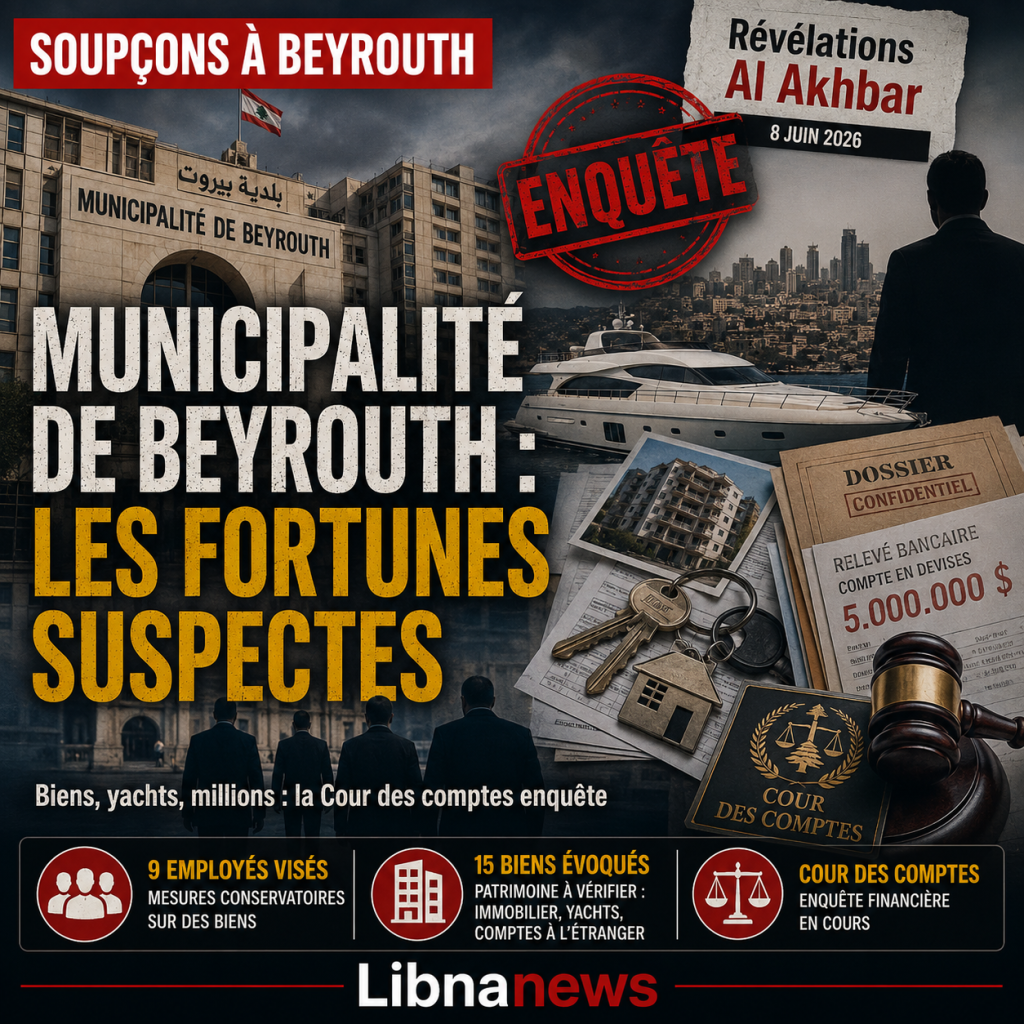
The municipality of Beirut is at the centre of a sensitive judicial case, following the publication on 8 June 2026 of an investigation by Al Akhbar into suspicions of corruption, illicit enrichment and political protections within the local administration. The Lebanese newspaper claims that employees whose salaries would not exceed $800 would own real estate, yachts and millions of dollars. These elements, at this stage, remain subject to judicial verification. However, they place the municipality of Beirut in the face of a central question: how could such important assets be built around public services supposed to operate under financial control?
The article by Al Akhbar, signed by Lina Fakhr al-Din, presents the file as one of the most revealing of the internal functioning of the municipality. This is not just an individual case. The investigations mentioned by the newspaper would affect several sensitive services, including finance, engineering and construction. These three sectors focus on decisions with high economic value: municipal revenues, payments, permits, technical files, construction projects, contracts and relationships with entrepreneurs. In a capital with a high rent, each signature can produce a significant material benefit.
Legal prudence remains necessary. The persons mentioned in the investigation are not convicted. Provisional measures do not constitute evidence of guilt. They are intended to preserve assets while the auditors verify the facts. But the nature of the examples reported requires a thorough examination. When an employee with limited income is associated with fifteen real estate assets, when another would have transferred a million dollars abroad before buying a house in Paris, and when the account of a minor son would show five million dollars, the file exceeds the ordinary suspicion.
An investigation part of the Court of Auditors
According to Al Akhbar, investigations are carried out by a special investigative body within the Court of Auditors, at the request of the Public Prosecutor ‘ s Office. They reportedly started about seven months before the article was published, after an employee of the municipality had been arrested and released. This chronology gives the file a procedural depth. The case is not based solely on media reporting. It is based, according to the newspaper, on audit visits, hearings, examination of administrative files and audit.
The daily reports that the investigators are unexpectedly visiting the municipality headquarters, in coordination with Beirut Governor Marwan Abboud. This method counts. An announced visit may allow time to move parts, order folders or adjust responses. An unexpected visit allows you to capture the administration in its actual functioning. It also helps to compare employee statements with available documents, internal records and accounting movements.
The role of the Court of Auditors is decisive. This institution controls the use of public funds and may intervene in municipal accounts. In the case of Beirut, it must establish whether administrative irregularities correspond to personal enrichment. Work is difficult. A municipal act must be linked to a financial flow, and then to a wealth. There is also a need to distinguish between legitimate income, inheritances, donations, declared private activities and property that may be placed on behalf of relatives.
The specific examples cited by Al Akhbar
Al Akhbar first reports the case of an employee who would own fifteen properties in Beirut, between apartments and buildings. This figure is one of the most striking in the file. It still needs to be verified by the procedure, including land registers, purchase documents, acquisition dates and sources of financing. But when compared to a salary that would not exceed $800, he raises a clear question: what origin can explain such a wealth accumulation?
The newspaper then quotes an employee who allegedly transferred a million dollars to an account abroad at the beginning of the financial crisis. He then reportedly bought a house in Paris. This is particularly sensitive in Lebanon. Since 2019, many depositors no longer have free access to their economies, while some outbound transfers have fuelled lasting public anger. A move of one million dollars, if confirmed, must therefore be examined from several angles: origin of funds, date of transfer, bank used, authorizations obtained and possible connection with a municipal function.
The third example concerns the bank account of the minor son of another employee. Al Akhbar claims that the account would be worth $5 million. This case, if confirmed, could point investigators to the hypothesis of a family name or an attempt to conceal property. Again, caution is required. A high bank account does not in itself prove a hijacking. However, it requires that the exact origin of the funds be identified, the persons who provided the account and the transactions that made it possible to establish it.
The survey also refers to yachts and millions of dollars associated with some municipal employees. These elements belong to the register of the visible lifestyle. They are not sufficient to establish an offence. However, they can complement a cluster of indices, especially when adding to real estate, bank transfers and modest official income. In illicit enrichment cases, investigators are specifically seeking to measure the gap between apparent and reported resources.
High-risk municipal services
Finance, engineering and construction services are not ordinary services in a municipality such as Beirut. Finance manages revenues, payments, fees, taxes, refunds and any advances. Manipulation in this sector can result in direct losses to the municipal caisse. It may also mask misappropriation, double payments, abandoned receivables or unrecovered revenues.
Engineering concentrates another type of power. It deals with technical records, verifies permits, reviews plans and intervenes in land and construction decisions. In Beirut, where every square metre can be expensive, a derogation, delay, regularisation or favourable reading of a file can have considerable economic value. This administrative power, when not controlled, can become a source of rent.
The work department is exposed to different risks. Maintenance contracts, roadworks, emergency interventions and maintenance costs create many points of contact with private companies. Amounts may be split. The work can be overbilled. Benefits may be incomplete. Specifications may be drafted to favour a supplier. There is no evidence at this stage that these specific mechanisms are being established in the current case. But these are the leads that any serious control must examine.
The measure targeting nine employees
Al Akhbar reported that measures had been taken to prevent nine employees from disposing of their movable and immovable property. This information is central. Such a decision is intended to prevent the disappearance of assets during the investigation. In principle, it prevents a quick sale, donation, transfer or shelter. It protects the possibility of future restitution if the courts establish that certain property comes from misappropriated public funds or from unjustified enrichment.
However, the exact scope of this measure should be recalled. She doesn’t condemn anyone. She doesn’t say the nine employees are guilty. It means that investigators have sufficient evidence to seek provisional protection of a heritage. This is a strong but not definitive step. The persons concerned must be able to present their evidence, produce documents, explain their acquisitions and challenge the measures before the competent authorities.
The main risk would be to reduce the case to these nine names. In municipal corruption cases, visible agents are sometimes only the executioners of a larger system. Important decisions require signatures, validations, silences and sometimes political interventions. If the procedure stops at the least protected employees, it will not change the functioning of the administration. It will produce one more scandal, then another frustration.
The specter of the scapegoat
Al Akhbar insists on a precedent that feeds this fear. The newspaper recalls that a case would have already led to the arrest of an employee, before he was released and presented, in the readback, as a possible scapegoat. This point deserves attention. Administrative corruption rarely works on a single actor. It involves circuits, habits, complicity or lack of control. An isolated agent can handle a file. It is difficult to build a sustainable system on its own, especially in an institution as supervised in theory as a capital municipality.
The investigators will have to go up the chain. Who signed? Who authorized it? Who checked it? Who validated the payments? Who closed their eyes? Which private beneficiaries return to the files? Which employees appear repeatedly around the same operations? These issues are as important as the review of bank accounts. Without them, the heritage survey may remain disconnected from the actual functioning of the municipality.
The concept of scapegoat is also political. It allows a system to protect itself by offering a limited official to public opinion. An employee is arrested. A press release is issued. Some measures are announced. Then the networks remain in place. The credibility of the current investigation will therefore depend on its ability to overcome this scenario. It is not enough to establish that an employee has too much property. It is necessary to understand how he would have obtained them, with which signatures and for whose benefit.
Political pressures reported
The most worrying aspect concerns the political pressures mentioned by Al Akhbar. The newspaper states that pressure from several sides would try to deter the Court of Auditors from continuing its investigations. He also mentioned steps to lift the prohibitions imposed on the nine employees concerned. This information, if confirmed, transforms the file. The question no longer concerns only suspicious fortunes. It concerns the ability of the financial judicial institution to work without interference.
In Lebanon, local governments do not live outside the political system. Appointments, careers, markets, protections and arbitrations are often linked to partisan or community balance. The municipality of Beirut does not escape this reality. When a case involves employees, it may also involve sponsors, elected officials, contractors or networks that have an interest in limiting the investigation. This is why pressure on the Court of Auditors is becoming a major indicator.
The officials quoted by the newspaper assure however that the investigation is not frozen. The members of the proceeding would continue to travel to the municipality to hear employees and review the files. This continuity is indispensable. It helps to preserve the effect of surprise, to avoid exhaustion of the procedure and to show that precautionary measures are not an isolated gesture. But the very existence of rumours about a freeze on the file reveals the level of public distrust of corruption investigations.
A case beyond the municipality
The issue is about trust in the local state. The municipality of Beirut administers a capital damaged by the financial crisis, the explosion of the port, the deterioration of services and the fall in public revenues. Every day, residents see weaknesses in urban management: deteriorating roads, impassable sidewalks, neglected public spaces, slow procedures and irregular services. In this context, the idea that employees can accumulate assets and millions while the city lacks resources causes understandable anger.
The banking crisis further reinforces this anger. Many Lebanese have seen their deposits blocked or devalued. Public wages have collapsed. Families have reduced their essential expenses. In this social landscape, the examples cited by Al Akhbar take on particular strength. They give a concrete face to the suspicion of injustice. They suggest that some would have benefited from privileged access to money or rent channels, while the majority were in crisis.
The case can also become a test of reform. If the Court of Auditors is able to establish facts, protect evidence, identify responsibilities and preserve assets, the case could set a precedent. It would show that public and private assets linked to municipal functions can be controlled. He would remind us that the capital is not a non-accountable space. Conversely, if pressure prevails, the message will be disastrous: revelations can be spectacular, but networks remain intact.
What the future will have to establish
The next step must answer specific questions. Were the fifteen real estate assets mentioned acquired by the employee cited or by relatives? On what dates? With what funds? Was the transfer of $1 million authorized? Which bank? Under what circumstances? Was the house in Paris purchased directly after this transfer? Does the minor’s account contain five million dollars? Who fed it? These answers will determine the strength of the file.
The municipality must cooperate fully. It must preserve documents, secure archives, prevent the alteration of records and facilitate hearings. It must also avoid two mistakes. The first would be to minimize the case in the name of continuity of service. The second would be to cripple the entire administration for fear of scandal. Citizens need a functioning municipality, but also a accountable municipality.
Political power must finally choose between protection and transparency. It can let the Court of Auditors work to the end. It can also seek to close the file behind the scenes, by lifting the precautionary measures or by insulating a few employees. This choice will be observed. The names mentioned are not enough. The figures reported are not sufficient. The challenge is now the proof, the chain of responsibility and the possible recovery of public funds, while the investigators continue their visits to the municipality of Beirut.




