


Child care, travel and hours determine what a job actually brings to the household. In Lebanon, the new transportation allowance is part of this invoice. But the available surveys show a wider constraint: having a post is not enough when it is necessary to pay to go there, organise a guard and cover the hours when the services close. The data explain the mechanisms, without inventing a national average cost for November 2026.
The starting point must be the income actually received, after deduction, including allowances. The additional expenses required to work must then be removed. The balance thus obtained does not constitute a rest to live: housing, food, health and other needs remain to be paid. It only measures what the activity adds to the budget after its access costs.
Observed constraint, not only theoretical calculation
The International Labour Organization interviewed 2,485 private sector workers in May 2026. The report, published on 7 July, notes that 27.3 per cent of those leaving the labour force cite family responsibilities as an obstacle, compared with 1.6 per cent of men. Women also mentioned the impossibility of financing transport and other work-related costs.
This investigation involves persons who worked before March 2026. It is not fully representative of the Lebanese labour market. Thus, it does not allow for the calculation of a national proportion of women who are prevented from working by the cost of travel, nor does it allow for a causal effect on the cost of childcare. However, it establishes that these obstacles appear in the responses collected during the crisis.
An analysis by the Central Statistical Office published on 4 October 2026 provides a further step backwards. In the 2018-2019 and 2022 surveys, 32 per cent of women who wanted to work but did not seek employment claimed family or domestic responsibilities, compared with 2 per cent of men. The date of publication does not transform these old observations into 2026. The populations interviewed also differ from those of ILO: percentages should not be placed in the same time series.
Minimum wage is not confused with available money
The CNSS communiqué of 1 August 2025 confirms a minimum of 28 million pounds per month and 1.3 million pounds per day, pursuant to Decree 699 of 18 July 2025. These are two regulatory references: arbitrarily multiply the daily minimum by 22 does not reconstitute the monthly minimum. The monthly minimum is also not a guaranteed net income after all deductions.
In order to analyse an offer of employment, three amounts must be separated: contractual salary, allowances due and actual payment. An allowance already included in the amount announced must not be added a second time. Conversely, compare a basic salary to transport costs without checking the allowance underestimates the resources of the employee concerned.
The same caution applies to an independent person or a worker at daytime. Revenue is not disposable income. Non-activity days, professional expenses and late payment affect the result. The calculation must be based on actual working conditions, not on the assumption that all assets receive the same wage protection.
Transport: what changes the decree of October
Decree 4021 of 14 October 2026, published in the Official Gazette of 22 October, fixes the allowance at the equivalent of five litres of petrol per day of actual presence. It is framed by a floor of 500,000 pounds and a ceiling of 800,000. The legislation concerns employees subject to the Labour Code, including in the public establishments concerned. Its final article provides for the application as soon as published.
For 22 days of presence, these terminals correspond to 11 million and 17.6 million pounds. They do not constitute a range of transport tariffs. The legal calculation is based on the official average price of gasoline according to the mechanism envisaged with the Ministry of Energy, not on the last price at the arbitrarily chosen pump. The amount actually paid must be checked on the payroll.
Indexation amortises a specific risk: an increase in fuel can change the allowance between its terminals. It does not automatically reimburse each employee’s journey. The distance, connections, parking and wear of a vehicle are not identical from one home to another. Beyond the ceiling, the mechanism ceases to accompany a further increase in the indicator.
For a car, count only gasoline minus the full cost. It is necessary to add maintenance, tyres, insurance and depreciation related to use, distinguishing between expenditure already incurred and expenditure caused by employment. For public transport, the price of a direct journey does not necessarily cover the correspondence or the last segment to the workplace.
Guard: documented deviations, but prices to date
Table 8 of the World Bank’s study on guarding in Lebanon provides a precise historical benchmark. In January-February 2023, average monthly charges were $94 for 192 private entities surveyed, $20 for 15 semi-private entities and $2 for 21 public entities. The private median was $70. Current amounts cannot be deducted from these figures.
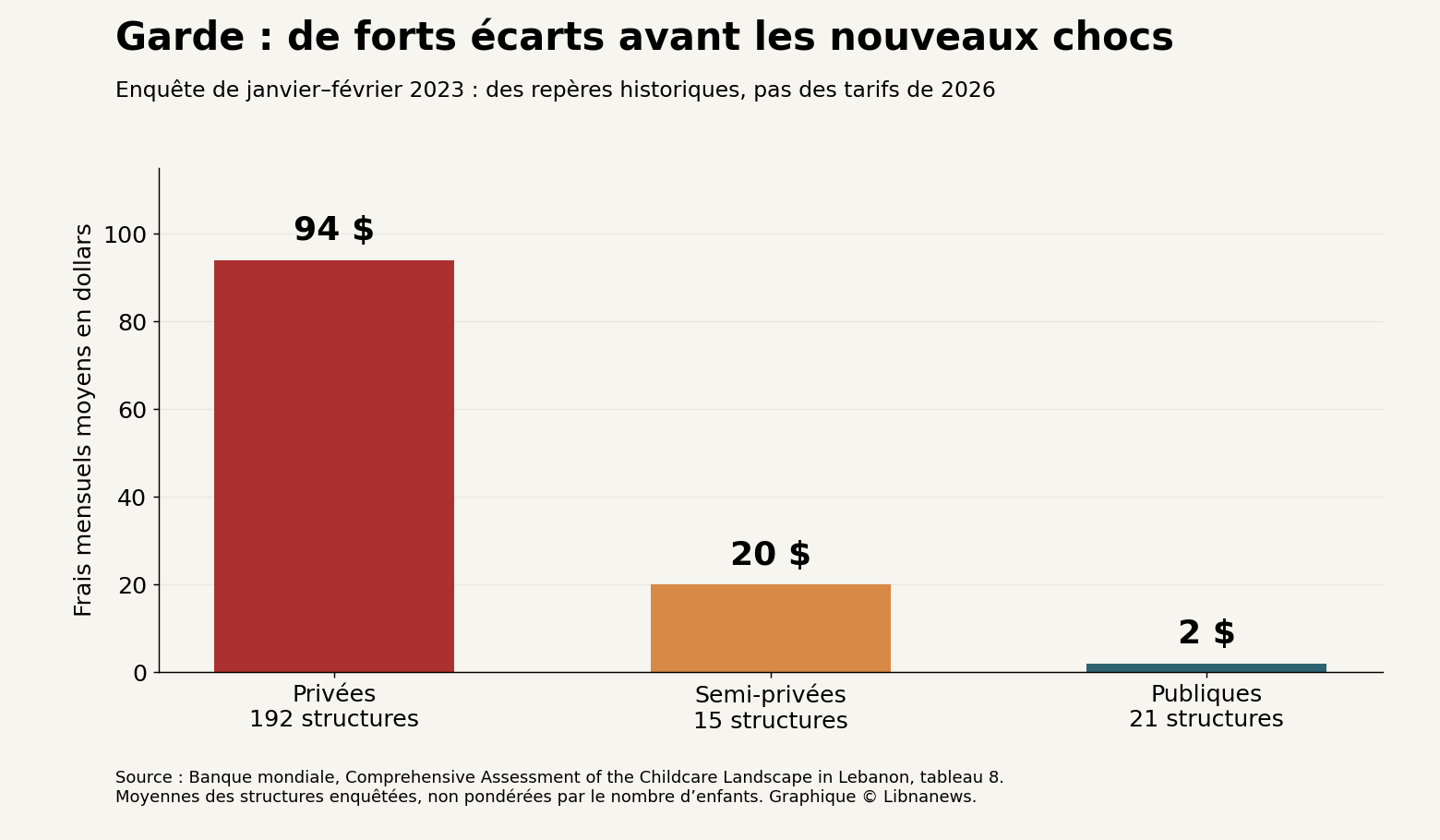
The report also noted an incompatibility between certain shift schedules and the needs of the private sector, confirmed in the follow-up to 2023. An available place does not necessarily regulate the entire day. These historical observations illuminate the mechanism, without establishing the currently open offer in each neighbourhood.
A lower public rate does not mean that a family can get a place at that price. The child’s age, location, admission criteria and hours condition access. Comparing prices alone, without checking these four elements, amounts to comparing solutions that are not necessarily substitutable.
The relevant invoice is the one added due to the activity. If custody were already funded prior to taking up the position, it would be excessive to re-deduct all of it to measure the gain in that job. On the other hand, overtime, registration or a backup solution may create an expense absent from the posted monthly rate.
Three budgets to understand the access threshold
An explicit simulation allows these effects to be tested without presenting assumptions as recorded prices. Let’s keep $500 net cash each month, including all allowances, and 22 round trips each cost $5. The move absorbs $110. The following amounts are calculation assumptions established on 11 November 2026, not observations from Lebanese households.
Without additional pay attention, $390 remains after travel. With an additional $150 in custody, this amount falls to $240. With $250, it reaches $140. Access costs represent 22 per cent, 52 per cent and 72 per cent of income received, respectively. None of these percentages measure a national average.
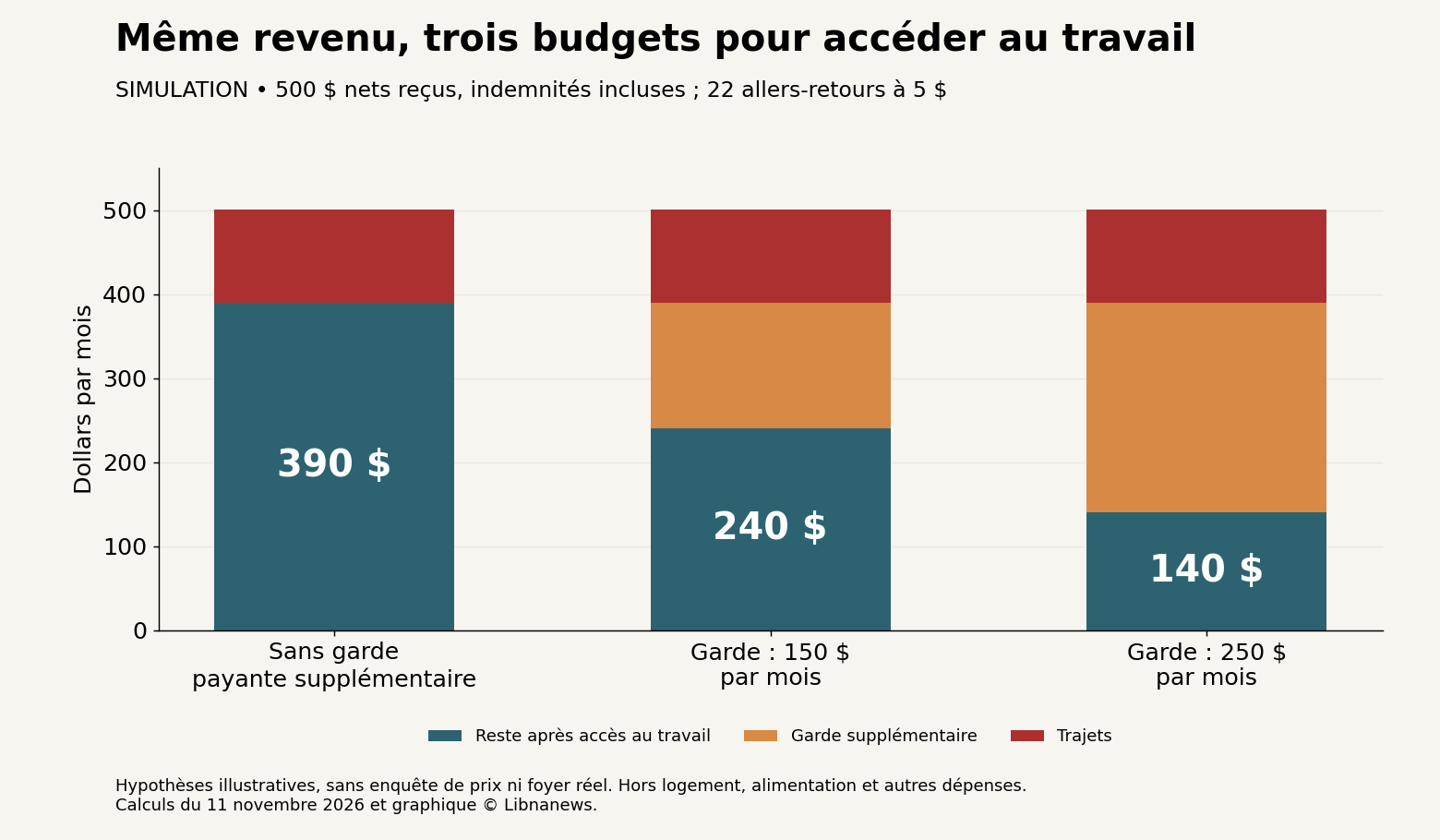
In the central scenario, reducing the daily journey from $5 to $3 saves $44 per month. The balance rose from $240 to $284, an increase of 18.3 per cent, without any increase in salary. Reducing custody from $150 to $100 brings it to $290. The two measures combined amount to $334, or 39.2% more than the initial scenario.
This result describes the household budget, not a free economy for the community. A grant transfers an expense to its financier. A better organization can reduce a detour, a wait or an hour on call. To choose a policy, it is necessary to compare its cost with the number of jobs actually made accessible and sustainable.
Schedules may cancel the benefit of a higher wage
Time is a second constraint, distinct from the invoice. With eight hours of work and two hours of travel over 22 days, the employment involves 220 hours per month, compared with 176 hours worked. In our central scenario, the $240 remaining after transportation and custody represents approximately $1.09 per hour mobilized. This analytical ratio is neither a statutory hourly wage nor a productivity measure.
A comparison between two offers can therefore change the ranking. Suppose a first offer leaving 240 dollars after expenses, for 220 hours mobilized. A second payment of $450 net, but only requires $66 in travel and $100 in custody, leaving $284. Under the same conditions of protection and stability, its lower monthly payment results in a higher budgetary gain of $44.
Time availability can even be an obstacle before any calculation of profitability. If a guard closes at 3 p.m. and the parent ends at 5 p.m., to which is added the return, a solution is missing. A reduction in the rate for this guard does not cover the hours absent. You need a relay, an extension or a work arrangement.
Schedules announced early enough make it possible to organise journeys and family sharing. Late changes may, on the contrary, impose a more costly solution or an absence. The issue therefore exceeds the number of hours provided for in the contract: their predictability and articulation with services also matter.
Family care moves the cost without always removing it
A relative’s help can reduce the parent’s additional monetary expense to zero. It nevertheless mobilises the time of this close friend. If the extended household reduces its own activity, it may lose another income. If no paid activity is abandoned, there remains a constraint of availability that cannot be converted into dollars without explicit agreement.
It would therefore be misleading to automatically allocate all childcare costs to the mother’s income alone. The organisation is part of the family budget and can allow the activity of two parents. Statistical findings on women show an uneven distribution of constraints; they do not justify treating it as a natural accounting rule.
Conversely, reducing the decision to the first month’s balance would be incomplete. Employment can open up social rights, preserve skills and improve future income. However, these profits do not pay the advance immediately necessary for a subscription, registration or first journeys. A positive monthly budget may remain inaccessible due to lack of cash at the outset.
What needs to be measured to improve access
The diagnosis requires three additional checks. The first concerns payments: net salary, compensation, regularity and delay. The second relates to the actual additional requirements, with guard estimates and possible routes. The third concerns the whole day: departure, correspondence, work, return and family relay.
A transport policy must therefore be assessed on the full journey and its timetables. Care must be provided to verify the availability of suitable places. An employment measure must follow the persons who actually retain their activity, rather than counting only the registrations or grants granted. Without these approximations, useful devices may miss the decisive constraint.
The data examined established financial and family barriers and a recent regulatory response on transport. They do not provide an updated national bill on access to work. The defensible conclusion is more precise: the advertised salary must be faced with the additional costs and time involved. It is on this condition that one can distinguish an offer available from a job actually accessible.
Cover photograph: traffic at Nahr el-Kalb, March 2021. Libnanews archive, all rights reserved. Real illustration photo, unrelated to traffic conditions of November 2026.





Comments