






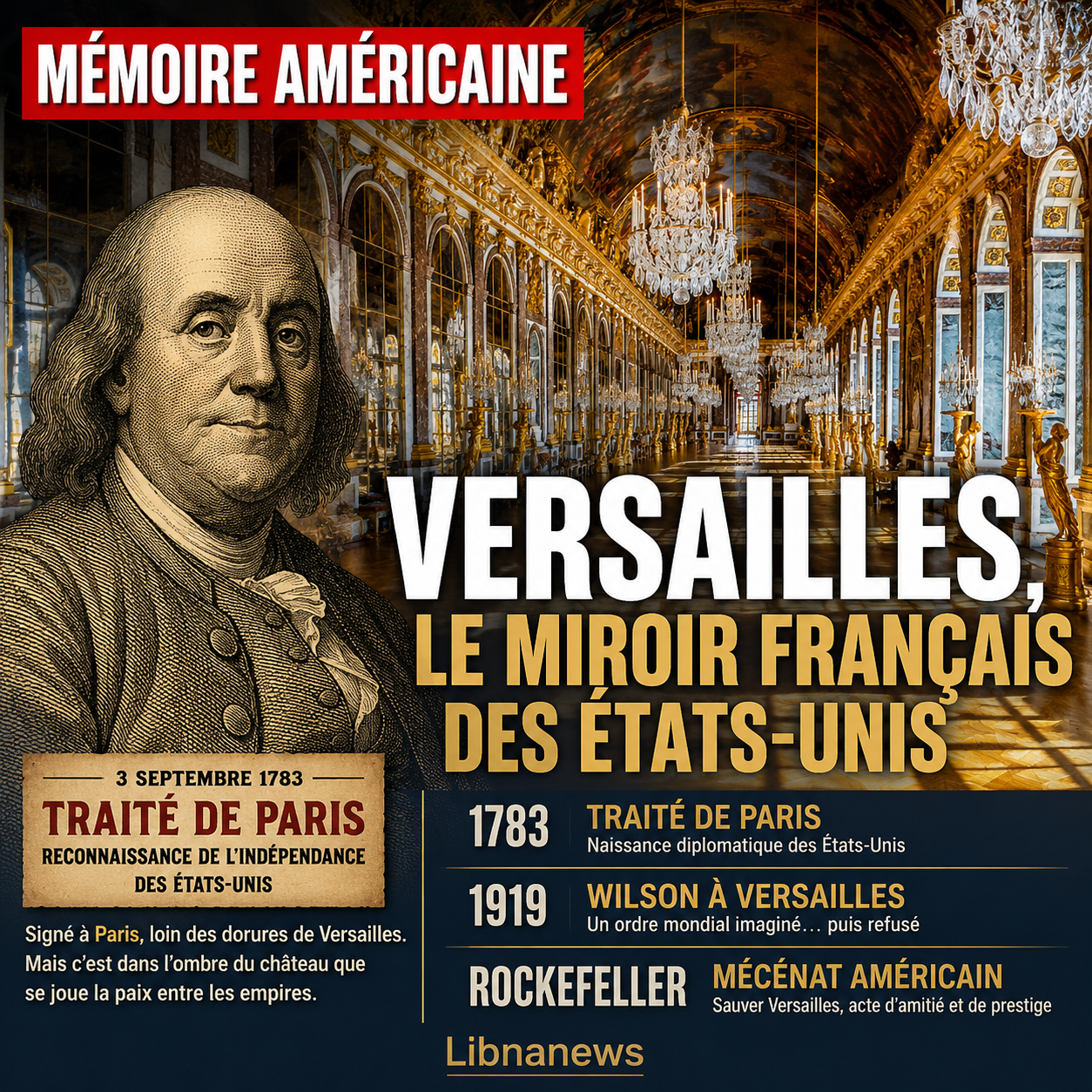
In American history, Versailles occupies a singular place. The castle is not the place where representatives of the United States and Great Britain signed the treaty that recognizes American independence. This decisive text was signed in Paris on 3 September 1783 in a mansion on Rue Jacob. But Versailles remains inseparable from this diplomatic birth. On the same day, in the political orbit of the French court, other treaties settled peace between Great Britain, France and Spain. Together formed the peace of Paris. In the eyes of the Americans, Versailles thus embodies less of a legal address than a theatre of power, that of a monarchy France that had helped a nascent republic to impose against London.
This nuance is essential. It avoids frequent confusion. The Treaty of Paris of 1783 recognized the United States as a free, sovereign and independent State. The Treaties of Versailles, concluded in the same diplomatic movement, concern the European powers engaged in the war of American independence. Together, these texts close the conflict and redistribute part of the Atlantic balance. Versailles then becomes the symbolic setting for a wider shift: the former monarchical Europe devotes, sometimes against its immediate interest, the entry of a new power into the international system.
Versailles and the United States, a symbol more than an address
The strength of Versailles lies first of all in this ambiguity. The castle cannot claim the diplomatic birth of the United States alone. However, he can claim political proximity at this time. The court of Louis XVI provided the American insurgents with decisive financial, naval, military and diplomatic assistance. She welcomed their envoys. She recognized their cause before London refused. It has engaged France in a costly but decisive war for the outcome of the conflict.
Benjamin Franklin, John Adams and John Jay negotiate with the British in Paris, away from the ceremonial of the Glaces Gallery. Their objective is clear. They want recognition of independence, favourable borders and fishing rights. They also want to preserve the freedom of action of the new US against their own European allies. American diplomacy is thus born into a mixture of boldness, prudence and mistrust. Paris offers the place of signature. Versailles offers the political environment that makes signature possible.
The castle symbolizes French power when this power chooses to weaken its British rival. Since the Seven Years’ War, France has sought revenge. The revolt of the American colonies gave him a strategic opportunity. Helping American independence is not only an idealistic gesture. It responds to geopolitical interests. It allows Paris to challenge British maritime and commercial domination. It also gives the French monarchy an image of protecting freedoms, despite its own internal contradictions.
For the United States, this memory remains structuring. It recalls that independence was not only won in Yorktown, Saratoga or colonial assemblies. It was also obtained through diplomatic networks, credits, fleets and alliances. Versailles embodies this international dimension of the American Revolution. The young republic was born in war, but also in European salons, ministries and chanceries.
The Treaty of Paris, the legal heart of independence
The Treaty of Paris of 3 September 1783 constitutes the legal heart of this sequence. Britain recognizes the United States as free, sovereign and independent States. The formula has an immense scope. It turns an insurrection into a matter of international law. It put an end to the colonial status of the thirteen former colonies. It paves the way for the ratification and establishment of a normal diplomatic relationship between London and Washington.
The exact location of the signature is important. The treaty between the Americans and the British was signed at the York Hotel, located in the current Jacob Street in Paris. The American signatories are John Adams, Benjamin Franklin and John Jay. On the British side, David Hartley signed the text. This discreet frame contrasts with the monumental image of Versailles. It recalls that the large historical swings often play in narrow spaces, away from the most famous scenery.
But the event is not limited to a Parisian table. On the same day, Britain concluded separate treaties with France and Spain at Versailles. These texts are the result of European and imperial war. They deal with territorial, colonial and maritime issues. They confirm that the American War of Independence was also a world war, waged on several seas and continents.
This is where Versailles regains its importance. The castle recalls that the United States does not emerge in a diplomatic vacuum. Their independence is part of a global confrontation between empires. American victory becomes possible because London must face a broader coalition. France, Spain and the United Provinces each play a distinct role. The North American front is only one element of a wider confrontation.
The French alliance, military and diplomatic engine
The Franco-American alliance of 1778 preceded the peace of 1783. It is one of the keys to American success. After Saratoga’s American victory, Paris agreed to cross a threshold. France recognizes the United States and concludes treaties of friendship, commerce and alliance with them. This decision places the French monarchy in open war against Britain. It changes the nature of the conflict. The insurgents are no longer alone. They have a major European ally.
The French role was seen in Yorktown in 1781. The American forces of George Washington and the French troops of Rochambeau surrounded the British army of Cornwallis. The French fleet, commanded by Admiral de Grasse, prevented British rescue by sea. This land and naval combination led to British surrender. It paves the way for peace negotiations. Without this intervention, the outcome would have been slower, more uncertain and perhaps less favourable to the Americans.
Versailles represents this strategic French choice. It is the place of power that decides the alliance, finances the effort, mobilizes the navy and supports the negotiations. The castle thus embodies a political reality: American independence was built with the support of an absolute monarchy. This contradiction has fed many comments. She doesn’t remove anything from the strength of the bond. Rather, it shows that diplomacy often involves more complex interests than the values displayed.
French aid also has a cost. It worsens the finances of the kingdom. It contributed to the budgetary crisis that preceded the French Revolution. The paradox is famous. By helping American independence, the French monarchy supports a republican cause abroad and weakens its own internal balance. Versailles then became a double place in American and French history. It symbolizes the power that supports the United States, but also a political world that will soon collapse.
An American mirror in the Ice Gallery
Versailles returns to American history through another treaty, that of 1919. This time, the United States is no longer a young power recognised by Europeans. They became a central player in the exit from war. President Woodrow Wilson arrives in France with the ambition to rebuild the international order. Its fourteen points propose diplomatic transparency, freedom of the seas, reduction of armaments, the right of peoples to self-determination and a League of Nations.
The signing of the Treaty of Versailles on 28 June 1919 in the Glaces Gallery does not directly concern the birth of the United States. However, it marks another stage in the American report to Versailles. The castle becomes the place where Washington tries to convert its military and economic power into a global political project. Wilson wants to put the United States at the centre of a peace organized by law. It meets a Europe that is exhausted, but also concerned with security, reparation and revenge.
The rest is more contrasted. The American Senate refused to ratify the Treaty of Versailles. The United States is not part of the League of Nations. This refusal reveals a lasting tension in American politics. The country can influence the world order, but it is reluctant to follow up with permanent institutions. Versailles then becomes the place for a missed appointment. America affirms its international ambition, and then partially withdraws from the scheme it has helped to design.
This sequence reinforces the importance of the castle in American memory. In 1783 the United States was recognized in an order dominated by Europe. In 1919, they claimed to reorganize this order. Between these two dates, Versailles serves as a mirror. It shows the transition from a fragile republic to a world power. It also reveals the limits of this power, especially when it comes to American domestic policy.
Rockefellers, patrons of a fragile Versailles
The link between Versailles and the United States is not limited to treaties. It also involves private money, philanthropy and heritage. In the 20th century, John D. Rockefeller Jr. played a major role in the restoration of the castle. Son of the founder of Standard Oil, heir to an immense industrial fortune, he became one of the great American patrons in Europe. His intervention in Versailles illustrates another form of American power: no longer the military or diplomatic power, but the private capacity to finance the conservation of a foreign heritage.
After the First World War, France must rebuild devastated areas, help victims, support widows, orphans and veterans. Historical monuments are not always at the forefront of emergencies. Versailles, Fontainebleau and the Cathedral of Reims suffer from significant deterioration. Roofs, decorations, parquet floors, statues and structures require costly work. The French state lacks resources. American patrons then appear to be valuable partners.
John D. Rockefeller Jr. visited Versailles in 1923 with his wife Abby. He discovers an area in bad condition. The following year, he offered substantial financial assistance to the French government. His donations contribute to the restoration of Versailles, Fontainebleau and Reims. The gesture goes beyond mere generosity. He inscribed the great American fortune in a cultural diplomacy. He pointed out that the United States, which had become a major economic power, could now participate in safeguarding European symbols.
This philanthropy is not without ambiguity. It combines prestige, influence and moral reparation. The Rockefellers seek to give a civic image to a fortune born of oil capitalism. They fund universities, museums, parks, medical institutions and heritage programs. In France, their name attaches to monuments that embody national history. Versailles thus became a place where American private wealth met French public memory.
A cultural diplomacy before the hour
The Rockefeller intervention announces a practice later called cultural diplomacy. It does not go through treaties, but through restorations, foundations, exhibitions, academic exchanges and friendly societies. It creates a lasting relationship between elites, institutions and public opinion. In Versailles, this diplomacy acts by stone, gardens, ceilings, gilding and galleries. It gives concrete visibility to Franco-American friendship.
American patronage also has a narrative effect. It allows the United States to present itself as heirs and protectors of a common Western civilization. After 1918, this idea grew. Europe is getting weakened. America seems richer, younger, more able to finance the future. By saving part of Versailles, the Rockefellers did not simply restore a castle. They claim an American place in the conservation of European history.
This relationship continues with initiatives of Franco-American friendships around the field. Associations, donors and institutions maintain a transatlantic link with Versailles. The castle becomes a place where American presidents, diplomats, patrons and visitors find several layers of their own history. It recalls the 1778 alliance, the peace of 1783, the 1919 conference and the philanthropy of the twentieth century.
However, too smooth a reading should be avoided. Sponsorship does not replace public responsibilities. He did not turn Versailles into an American monument. Rather, it emphasizes interdependence. France maintains the site, the administrator and the interpreter. U.S. private funds helped save him at a critical time. This heritage cooperation reveals the density of a relationship that has often mixed admiration, interest, rivalry and gratitude.
Why this place is still talking in Washington
Versailles remains important to the United States because it condenses three dimensions of its history. The first is recognition. Although the Treaty of Paris was signed in Paris, Versailles symbolizes the French and European framework that makes independence possible. The second is ambition. In 1919 Wilson carried out a world order project, although the United States then refused to fully assume the constraints. The third is the cultural projection. With the Rockefellers, America finances the restoration of a monument that belongs to French history, but also to Western diplomatic imagination.
The castle also speaks in Washington because it recalls a often forgotten truth. The United States was born against the British Empire, but with the support of a French monarchy. Their national narrative celebrates autonomy, freedom and colonial rupture. Yet their diplomatic history shows an initial dependence on foreign allies. Versailles is putting this dependency on stage. He recalls that even a nation based on independence needed recognition, credit and naval support.
This memory has a contemporary utility. Every time an American president comes to France, whenever a state dinner or ceremony mobilizes Versailles, the place activates an ancient grammar. He speaks of greatness, covenant, power and continuity. It allows French leaders to recall that the Franco-American relationship does not begin with NATO, nor with the Second World War, but with the war of independence. It allows Americans to measure that their international birth was also played in the French language, in the circuits of the former European diplomacy.
Versailles thus remains an American place by resonance, not by historical property. It is not the legal cradle of the United States. It is one of the sets of their entry into the world. Its value lies in this overlap between accurate facts and political memory. The Treaty of Paris gives the certificate of diplomatic birth. The Versailles Treaties complement imperial peace. Wilson plans a new order. Rockefeller leaves the imprint of a fortune that has become an instrument of cultural prestige. It is this accumulation that gives the castle a special strength in the American imagination, whenever diplomacy seeks a setting capable of speaking to the past as well as to the present.