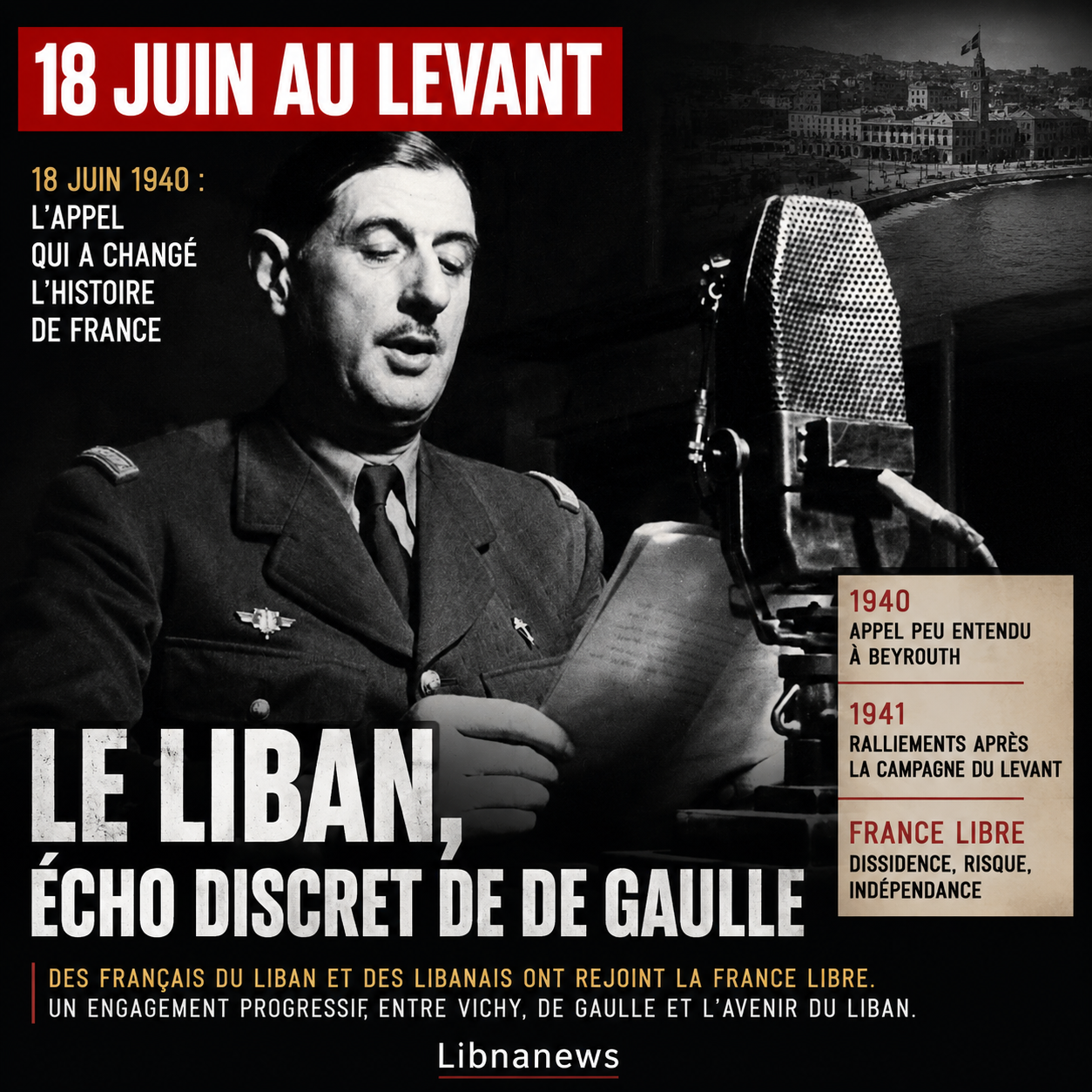
On 18 June 1940, Charles de Gaulle issued an appeal from London to continue the war while the government of Marshal Pétain had just called for armistice. In Lebanon, then under French mandate with Syria, this voice does not provoke a visible uprising. It is not even widely heard. Le Levant lives under administrative and radio control of the French High Commission, soon aligned with Vichy. Yet Lebanon will become, within a few months, one of the most sensitive land in free France. French in Beirut, Levant officers, intellectuals, then Lebanese and Syrians, gradually joined the Gaullist camp. Their commitment is not always a direct response to the 18 June radio speech. It is part of a slower, more risky dissidence, where fidelity to France’s combatant mixes with the decisive question of Lebanese independence.
Unheard of in Lebanon under mandate
The first fact requires correction of the official brief. The appeal of 18 June does not seem to have been heard directly in the Levant States under French mandate. Lebanon and Syria then have closely monitored information relays. Radio-Levant, controlled by the French authorities, retains the monopoly of the local broadcast. The BBC operates from London and has regional capabilities, particularly in Cairo, but this is not enough to make the Gaullist message a public event in Beirut.
Information flows differently. It goes through dispatches, conversations, officers, diplomats, French circles, British networks in Palestine and Egypt, or through word of mouth. On 18 June, therefore, Lebanon is not an already acquired land for the rebel general. It is a territory administered by a defeated France, where obedience to hierarchy weighs heavily.
This reality does not diminish the gaulian gesture. She puts it in context. Even in metropolitan France, few French people hear the call that night. Its importance is then built, through reruns, posters, texts, war stories and political memory. In Lebanon, this process is even clearer. The call becomes less a wave received live than a diffuse moral landmark, known in stages, then reinterpreted in the light of the events of the Levant.
The country is then in a special situation. The French mandate, established after the First World War, still governs political life. Lebanese elites are demanding more autonomy. Some want rapid independence. Others fear that a brutal French withdrawal will undermine local balances. The 1940 shock thus opened a period of uncertainty. France seems defeated, but its administration remains. De Gaulle speaks of resistance, but he still has no territory or complete state apparatus.
The first French dissidents of the Levant
In this confused period, the first response to Gaullism comes mainly from French Levant. It does not take the form of a massive movement. It is manifested by individual refusals and attempts to rally. Several officers are planning to continue fighting from British Palestine. This neighbouring region becomes a possible exit space for those who refuse Vichy.
Colonel Edgard de Larminat occupies a central position in this first dissent. He tries to maintain the idea of a war continued since the Levant. His gesture remains a minority, but he feeds a local Gaullist legend. Some historians speak of a « call from the Levant », as the sequence constitutes a regional translation of June 18. This is not just an echo. It is a local initiative, taken in a hostile military environment, faced with a hierarchy that chooses obedience to the Armistice.
Captain Paul Jourdier, with elements of spahis, also illustrates this rupture. His departure to Palestine shows that the refusal to defeat did not remain an abstraction. It involved men, weapons, routes, disciplinary risks and personal choices. Those who leave agree to become dissident in the eyes of the French legal authority. In 1940, this choice was not obvious. De Gaulle is still isolated. London supports it, but with caution. Vichy has most administrative and military resources.
The majority of the French forces of the Levant do not change. The general commanding the area eventually remained within the framework of Vichy. The Levant troops, made up of French and local soldiers, remain committed to institutional fidelity. Discipline, pay, fear of disorder and uncertainty about the future explain this restraint. The Gaullism of the Levant was thus born as a minority dissent, not as an insurrection.
Beirut, crossroads of intellectuals and civil servants
The rallying to free France is not limited to barracks. Beirut and Damascus are home to administrations, schools, institutes, religious missions and cultural networks where the debate on the French defeat takes on a moral dimension. Some French settled in Lebanon refused the Vichy regime because of their attachment to a certain idea of France. They’re not always military. They are teachers, archaeologists, cultural leaders or civil servants.
Gabriel Bounoure, a major actor of French works in the Levant, is part of this milieu. Henri Seyrig, a figure of archaeology and antiquities, also plays an important role in the intellectual environment of free France in the Levant. Jean Gaulmier, Arabist and writer, joined free France in 1941 after a trajectory already linked to Beirut and teaching. These names show that Lebanese Gaullism was not only a matter of uniforms.
These men evolve in an ambiguous setting. They belong to the world of the mandate, therefore to a disputed French presence. But their refusal by Vichy often leads them to defend a less authoritarian France, more faithful to its proclaimed principles. Many understand that the relationship with Lebanon cannot survive if it remains locked in the proxy logic. Free France must promise something other than the return to old order.
Their role is not that of a crowd. He’s the relay guy. They maintain contacts, form networks, disseminate ideas, maintain a separate French cultural presence from Vichy. They helped create an area of sympathy for de Gaulle in Beirut’s Francophone society. This sympathy does not mean total adherence. It means that part of the cultivated Lebanon sees free France as a more honourable outcome than submission to Pétain.
Lebanese facing a war that is not only French
The Lebanese response on 18 June is more difficult to grasp. It cannot be a yes or a no. Lebanese have joined the Free French Forces. Lebanese have fought or served in the Gaullist structures. But clearly documented commitments developed especially after 1941, when free British and French forces took control of the Levant at the end of the Syrian and Lebanese campaign.
Before that date, Lebanese officials observed the situation with caution. They see several logics facing each other. Vichy retains the administration of the mandate. The British want to prevent the strategic use of the Levant by the Axis. De Gaulle wants to impose free France as the only fighter France. The Lebanese nationalists want the French crisis to pave the way for independence. Their priority is not only to choose between Pétain and de Gaulle. She’s getting out of the warrant.
This caution explains the absence of massive public rallying in 1940. It would be anachronistic to imagine a Lebanese society that is determined solely by French domestic policy. Lebanese assess power relations, promises, community risks, British position and possible consequences for their national future. Gaullism is attractive only if it is accompanied by a commitment to the emancipation of the country.
Free France gradually understands this constraint. To mobilize in the Levant, it must speak of independence. The promise becomes a political instrument as well as a principle. It makes it possible to distinguish de Gaulle de Vichy. It also seeks to neutralize British suspicions and to seduce local elites. But the promise remains monitored. The Lebanese know that the great powers often announce independence before delaying its implementation.
1941, the military and political turning point
The Syrian and Lebanese campaign, launched in June 1941, marks the real shift. The Allied forces, together with the British and the Free French, attacked the remaining troops loyal to Vichy. Fighting is tough. They sometimes oppose French to other French, in a territory where local populations suffer the effects of a war decided elsewhere. Beirut enters the new sequence after the allied progression and the end of the vichyst control.
General Georges Catroux, representative of Free France in the Levant, then played a decisive role. It proclaims the independence of the Levant States on behalf of free France. This statement does not remove all the ambiguities of the mandate. However, it gives Gaullism a powerful political argument. De Gaulle is no longer only the man of London. He became, in the region, the leader of a France that promised sovereignty to those she still administered.
It is after this turning point that the Lebanese and Syrian commitments multiply. According to the work on the French Forces libres du Levant, about a thousand Syrians and Lebanese then joined the FFL to participate in the liberation of France. Several of them come from the Special Troops of the Levant, training to provide the cadres of future Syrian and Lebanese national armies. To fight outside their territory, they must sign an amendment to their contract.
This administrative detail is revealing. These men are not mere auxiliaries driven by events. Their commitment requires formalization. It means they agree to leave the local cadre to participate in a free French world war. Their motivations may vary. Some fight Axis. Others seize a military opportunity. Still others want to put their journey in a new political relationship with France.
Names, but fragmentary memory
Free France lists identify commitments from Lebanon or related to the Levant. They sometimes remain incomplete, with varying spellings, approximate dates or administrative statements difficult to use. However, they show that Lebanese, Syrians, Armenians from the Levant and French settled in the region joined the FFL.
The case of Jean Gaulmier illustrates the commitment of a Frenchman who is deeply linked to Lebanon. Set up in the Levant before the war, familiar with Beirut, he joined free France in 1941 and then took part in the narrative of de Gaulle’s trip to Syria and Lebanon. Its trajectory shows how Gaullism also feeds on cultural intermediaries, able to speak to both France, the Arab world and the institutions of the mandate.
Other routes are more anonymous. Local soldiers from the Levant Special Troops rarely left published memoirs. Their presence appears in registers, units, lists or subscriptions. They do not always occupy the foreground of the Gaullist narrative. Yet their commitment deserves attention. He recalls that free France was not only composed of metropolitan French exiles. It was also carried by Africans, Antillese, Polynesians, Maghrebians, Syrians and Lebanese.
This fragmentary memory is also due to post-war political tensions. Independent Lebanon does not necessarily have an interest in celebrating commitments under French flag too strongly. France, for its part, has long favoured a memory centered on London, French Equatorial Africa, Bir Hakeim, the Inner Resistance and the Liberation of Paris. The Levant occupies a more delicate place because it combines free France, war between French, colonial mandate and independence.
18 June and Lebanese independence
Perhaps the strongest link between June 18 and Lebanon is there. The call of de Gaulle affirms that military defeat does not end the war or the legitimacy of a fighting France. In Lebanon, this idea faces another demand: the legitimacy of the peoples to self-determination. Free France wants to restore French honor. The Lebanese want to turn the crisis into real sovereignty. The two objectives can be joined, but they do not overlap.
By proclaiming the independence of Lebanon and Syria, Catroux gives Gaullism a regional reach. But this independence remains to be realized. Tensions reappear quickly. In 1943, the free French authorities suspended the Lebanese Assembly and arrested government officials after constitutional decisions affirming the country’s sovereignty. The crisis comes under local and international pressure. It becomes a founding moment of Lebanese independence.
This sequence shows the limits of the heroic narrative. Free France has promised independence. It has also resisted, at times, its full application. The Lebanese who had supported de Gaulle or joined the FFL could therefore find themselves facing a contradiction. They had fought with free France against Vichy and Axis. They then had to defend their own state against French control reflexes.
The 18th of June then appears as a disputed legacy. For the Gaullists, it represents the refusal of abandonment. For Lebanese, it can also mean the right not to accept incomplete sovereignty. The spirit of resistance changes subject. It no longer concerns only defeated France. It also concerns a country that wants promises made in times of war to become acts.
A discreet but real echo
Can it be said that Lebanese or French people from Lebanon responded to the 18 June appeal? In journalistic form, the answer is in a cautious formula: not immediately as a collective mobilization, but as a real progressive dissent. French from Lebanon joined free France from the first period or after the turn of 1941. Lebanese entered the FFL, especially after the Allied forces captured the Levant. Intellectuals, military personnel and notables gave Gaullism a local settlement.
This story is nothing unanimist. Part of the French from the Levant remains faithful to Vichy. A part of the Lebanese remain suspicious of any proxy power, even if it is renamed free France. The British pursued their own interests. Lebanese nationalists use rivalry among powers to advance towards independence. Lebanon is therefore not simply a Gaullist epic decor. He is an actor, with his calculations, fractures and priorities.
The appeal of 18 June did not sound in Beirut as it will then sound in the ceremonies. He arrived in fragments. He was relayed, discussed, transformed. He found in the Levant officers ready to disobey, French capable of breaking with Vichy, Lebanese willing to serve the FFL, but also a company determined not to remain under guardianship. It is this tension that gives the episode its depth.
Lebanon therefore responded on 18 June, but in its own way. Not by a massive listening by the BBC, or by an immediate rallying of an entire country. He responded by individual trajectories, by a fratricidal war in the Levant, by military commitments from the Special Troops, by francophone intellectual networks and by a political demand which will eventually dominate all the rest: the effective independence of the country, proclaimed, contested, then torn up in the crises of 1943 and in the definitive departure of foreign troops a few years later.