

Lebanon’s waste debate often focuses on facilities: building a factory, putting a centre back in service, finding a landfill. The case taken by Al Liwa on 11 November, attributed to Al Jazeera, nevertheless points to a wider difficulty. Between the household bin and the fate of the materials, each step depends on the previous and the next steps.
Saida provides in this file a starting point to discuss the functioning of the chain. However, a quantified diagnosis of its installation would require recent data on receipt, processing and releases. A theoretical capacity alone does not allow us to know how much is actually valued.
Three quantities not to be confused
The amount of waste generated describes what households and activities generate. The quantity collected measures what enters the service. The quantity treated according to a defined process corresponds to an additional step. The three digits may differ greatly without any necessarily being false.
The 6,200 tonnes per day mentioned in the press kit refer to an estimate of the waste produced, not a volume whose processing would be demonstrated. In the absence of a recent primary balance sheet to verify its methodology and scope, this figure cannot be used to calculate a national performance rate.
The same caution applies to a plant announced several hundred tons daily. It is important to know whether capacity requires continuous operation, some type of waste and regular maintenance. Judgments, refusals to enter and the composition of contributions alter the actual result.
Sorting starts before the machine
When particular organic materials, packaging and waste are mixed, their separation becomes more difficult. The quality of the material recovered is as important as its quantity. A soiled lot may not find an outlet under the same conditions as a properly separated material.
Therefore, a source sorting program is not limited to distributing containers. It is necessary to organize a collection that keeps separate flows, inform users and check what happens to the destination. If everything is then mixed in the same transport, the confidence and utility of the gesture deteriorate.
The treatment also produces residues. A credible assessment must explain what is being recycled, what is being treated biologically, what remains to be eliminated and where these releases result. Presenting all the inputs of a plant as waste recovered would mask the latter part of the chain.
A legal framework and operating obligations
Law 80 of 2018 provides the framework for integrated solid waste management. The Ministry of the Environment recalls, in a press release on a 2024 government circular, the rules concerning collection, transport, sorting, composting, other treatments and final disposal. This coverage of the entire chain is precisely what distinguishes a management policy from a simple inventory of works.
The Ministry also presents a integrated national strategy on a page dated 1 june 2026. The existence of a strategic document must be distinguished from the financing, markets and equipment actually implemented. A date quoted by the press is not sufficient to establish that a new plan was adopted or fully implemented this month.
In order to assess a project, it is necessary to examine its operating responsibilities: who pays for consumables, maintains the machines, controls discharges and ensures continuity when installation stops? An initial investment may remain unproductive if it is not covered.
Transparency useful to the inhabitants
A local monitoring table should approximate incoming tonnages, operating days, outgoing materials and the destination of refusals. Contracts, payments and environmental controls would provide a second level of reading. This data would allow the costs to be discussed without confusing prices per tonne received with prices per tonne actually valued.
The case of Saida must be evaluated on these elements, without assigning here an undocumented performance or fault. At the national level, the question remains concrete: do waste enter a financed and controlled chain to its final destination? The number of installations alone does not give the answer.
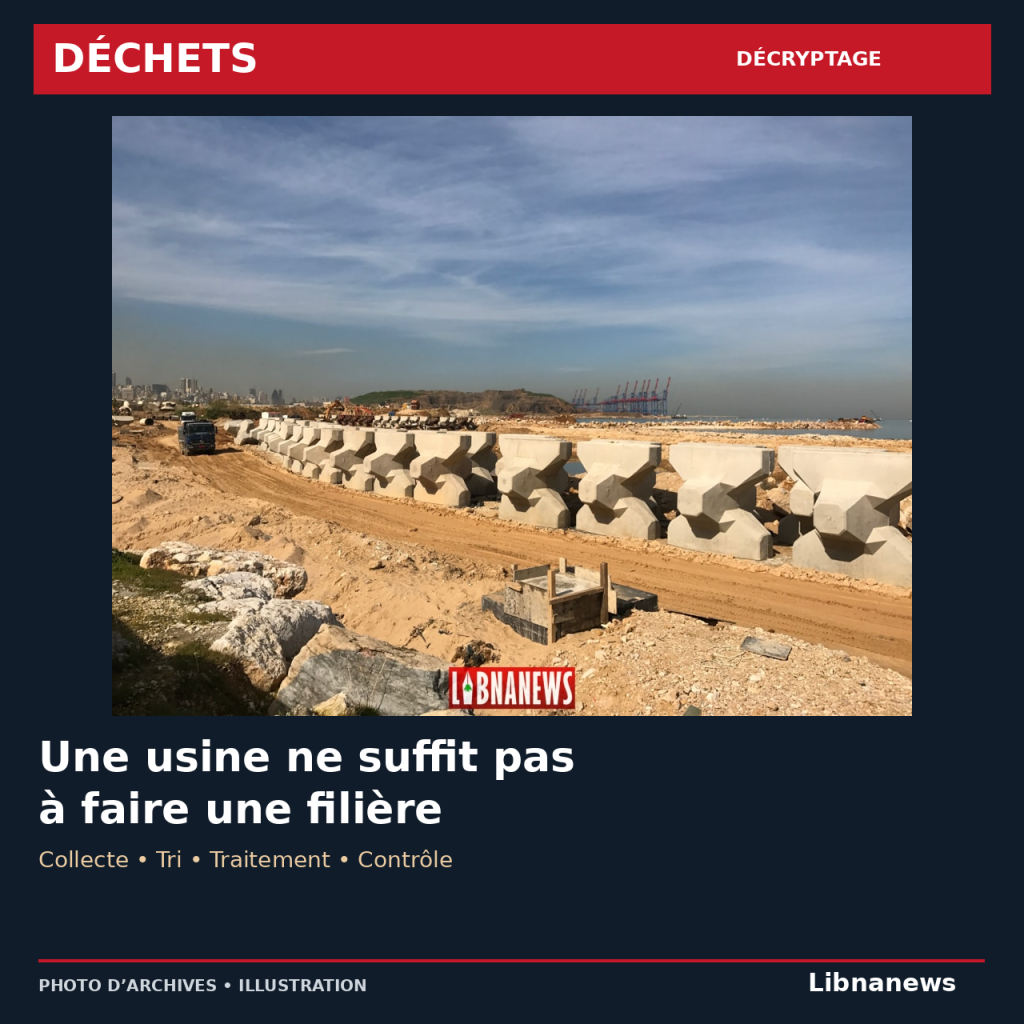
Discharge of Jdeideh and, in the distance, Bourj Hammoud, 2019 archival photograph. This illustration does not show the installation of Saida or their condition in 2026. Whole photo preserved, editorial dress Libnanews. © Libnanews.com.





Comments