

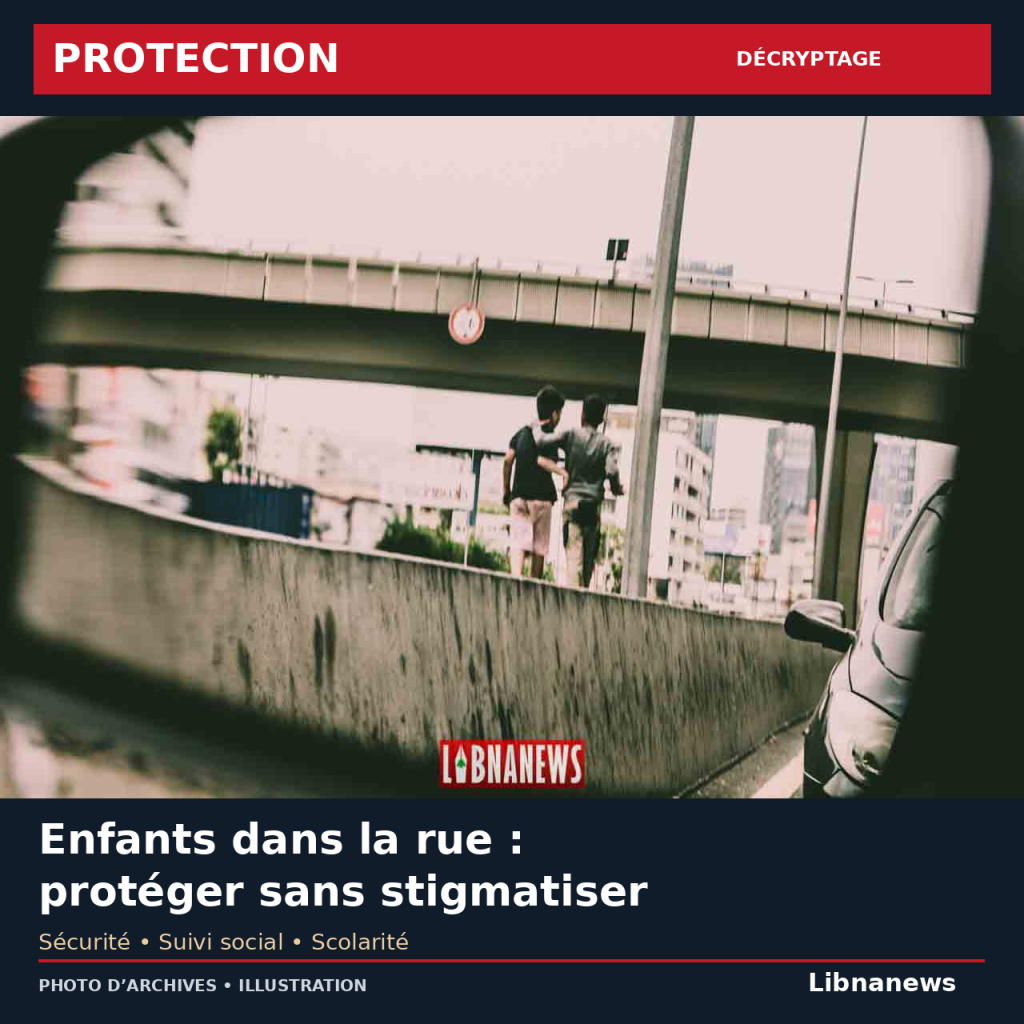
A child seen between cars is first a child exposed to danger. The presence of an adult in the vicinity, his nationality or the sums he requests are not sufficient to establish an operating network. The November 11 issue of An-Nahar highlights the child begging and the limitations of responses focused solely on the occupation of public space.
The challenge is to meet two requirements together: to intervene when a minor is at risk of injury or exploitation, and to understand what brings him back to the street. An operation that moves children from one crossroads to another can change the landscape without improving their safety.
A situation to be assessed, not a guilt to be presumed
Lebanese law 422 of 2002 concerns minors in conflict with the law and those at risk. UNICEF’s protection resources recall the importance of reporting and a child-friendly response. The assessment must distinguish between immediate needs, family environment and possible signs of constraint.
A street narrative alone does not provide all these elements. A child may depend on an adult, have left school or contribute to family income. These situations require professional evaluation. They do not make it possible to publicly appoint an official without verification or to apply the same solution to all families.
UNICEF describes a response combining social services, legal protection, psychosocial support and family support. His approach also aims to prevent unnecessary family separations. Protection is therefore not limited to temporarily removing the child from the place where he was seen.
Monitoring counts as much as intervention
A care path must be able to answer concrete questions: where will the child spend the night, who will ensure his safety, what care is needed, and how to resume school? The transmission to a competent department does not end these matters. It must be possible to verify that the service has received the alert and that follow-up continues.
The UNHCR directory of assistance in Lebanon mentions protection services, social workers and opportunities for psychosocial support, with providers working with street and working children. However, their presence in a directory does not guarantee an immediate place or the same support in all regions.
For local authorities, the operational challenge is therefore coordination. Municipal action can signal a risk and facilitate intervention. Investigation of a farm and protection decisions fall under other jurisdictions. Consolidating these steps would place a mission on a patrol that it cannot carry out alone.
Supporting families without eliminating abuses
Economic difficulties can lead a family to reduce its health or education costs. UNICEF describes these mechanisms as one of the risks that undermine children in Lebanon. But a social explanation does not exempt the investigation of suspected violence or coercion.
The distinction changes the possible responses. Food aid, a school solution or parent support can address some of the needs. An adult who exercises violence requires specific child protection and investigation. None of these situations can be inferred from a national origin.
Do not turn reporting into public exposure
Filming an identifiable minor and disseminating its location can increase its vulnerability. The relevant report shall convey specific facts to the competent authorities, without publishing the child’s face, name or intimate narrative. A moving image does not replace a social assessment or judicial evidence.
The outcome of a policy should be measured by sustainable safety, return to school and continuity of care. The number of people away from one street is not sufficient to establish that the exploitation has receded or that families have another solution.





Comments