





The figure of $1.38 billion advanced for the destruction of buildings in southern Lebanon does not summarize the cost of the war. He gives a partial, useful and severe photograph, but limited by his method. It measures direct damage to vessels identified by satellite imagery and rapid analysis in the south of the country at a given date. It does not measure the entire Lebanese bill. It does not account for all infrastructure, loss of activity, destroyed income, travel costs, agricultural losses, rehabilitation of public services, health spending, or the lasting effect on an already weakened economy.
This distinction is essential. The amount of $1.38 billion has been circulating for several days, while previous estimates referred to $10 billion or even $20 billion. The contradiction is only apparent. The numbers do not speak of the same object. An estimate of direct damage to buildings is not an estimate of total economic cost. A photo taken before the last weeks of fighting is not worth the final result. An assessment of South Lebanon does not cover the effects on Beirut, Bekaa, trade, tourism, agriculture, public finances and trust. Lebanon must therefore avoid two symmetric errors: minimizing war by retaining only the identified buildings, or inflating the bill without distinguishing between verified losses, reconstruction needs and indirect economic damage.
A precise figure, but deliberately restricted
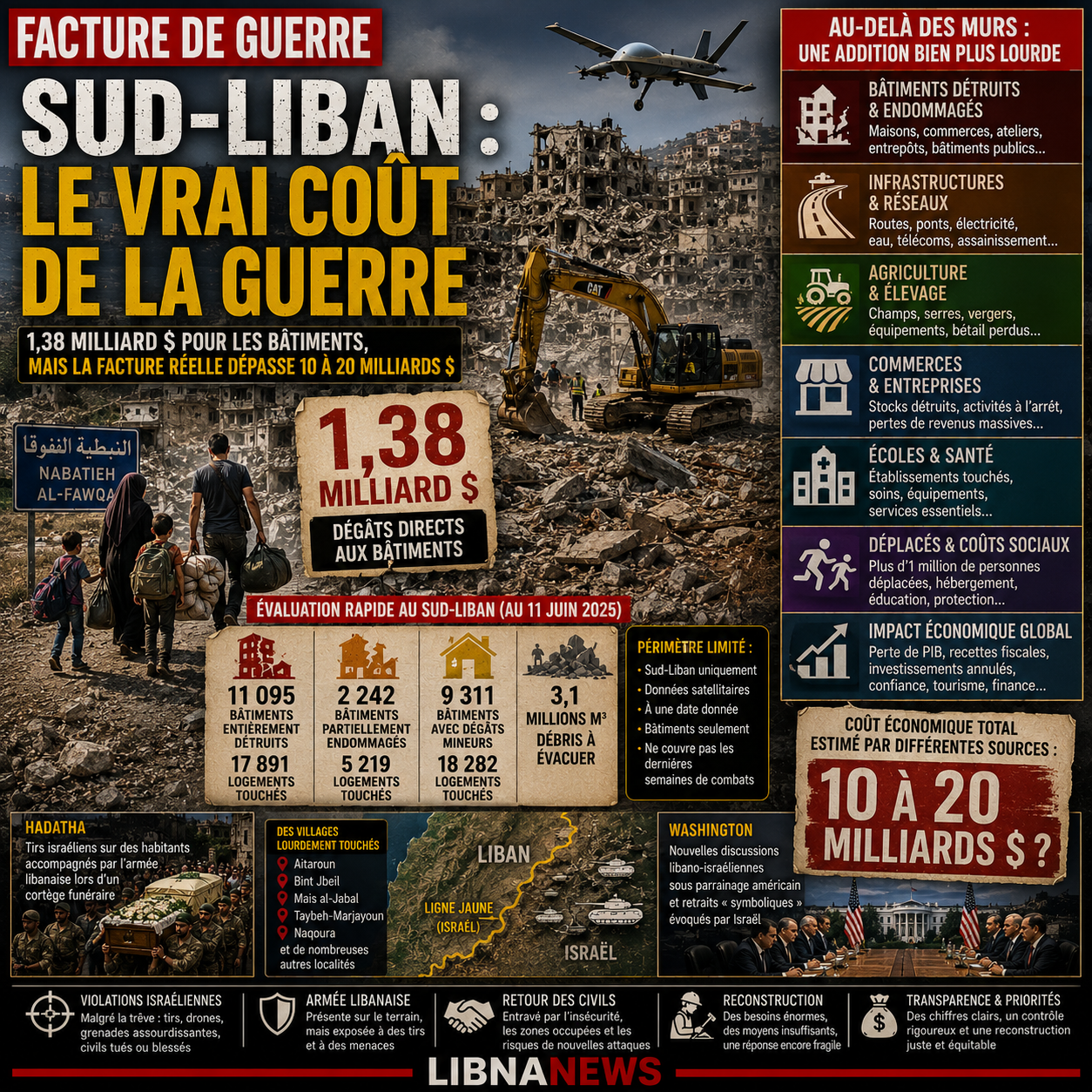
The evaluation published by a United Nations agency and a Lebanese State-related research centre focuses on direct damage to buildings in southern Lebanon. It contains 11,095 fully destroyed buildings, affecting 17,891 dwellings. It also identifies 2,242 partially damaged buildings, consisting of 5,219 dwellings, and 9,311 minor damaged buildings, covering 18,282 dwellings. The direct cost of damaged or destroyed buildings is estimated at $1.38 billion. The debris volume is estimated at approximately 3.1 million cubic metres.
These figures provide a serious basis. They allow us to get out of the fog of political statements. They offer the authorities a first mapping of destruction. They help prioritize clearances, organize aid, identify the most affected communities and prepare applications for funding. They also compare the levels of destruction between villages. Aitarun, Bint Jbeil, But al-Jabal, Taybeh-Marjayoun, Burj al-Shemali and Naqurah are among the sectors heavily affected according to available data.
But this precision must not mask the boundary of the perimeter. The report is based on a rapid analysis at the building level. It compares previous and post-period satellite images. It does not cover the last weeks of the conflict. It does not purport to measure overall economic losses. It does not replace a comprehensive assessment of reconstruction needs, such as those that international institutions carry out after wars or major disasters. It is a base, not a final balance.
This nuance explains why the figure appears to be lower than the broader assessments advanced in the public debate. A destroyed building has a reconstruction cost. But around this building are roads, electrical networks, water pipes, schools, shops, agricultural land, stocks, equipment, vehicles, workshops and incomes. The cost of a war is never limited to the collapsed wall. It includes what this wall allowed to live.
Why is 1.38 billion not 10 billion
The amount of $10 billion generally refers to a broader approach. It may include physical damage, reconstruction needs, infrastructure rehabilitation, production losses and emergency costs. In some cases, it also serves as a provisional political figure, intended to give an order of magnitude before data consolidation. The figure of 1.38 billion is of another kind. It is sectoral and geographical. It concerns buildings in southern Lebanon evaluated by imaging.
The difference lies first in the field. The $1.38 billion does not cover all sectors. They do not include losses from closed businesses, abandoned crops, interrupted supply chains, unpaid wages, lost tax revenues, falling tourist bookings or additional transportation costs. A war can destroy a building, but it can also destroy an entire economic cycle. Traders don’t just lose their windows. They lose months of activity, customers, inventory and sometimes credit capacity.
The difference then lies in time. An assessment decided on a given date cannot include subsequent destruction. The fighting continued, with shelling, ground operations, demolitions and ceasefire violations. The longer the war lasts, the bigger the bill. Damage also accumulates indirectly. A slightly affected house may become uninhabitable if it remains exposed to weather, if the networks are cut off, if the roads are blocked or if the population cannot return.
The difference finally lies in the method. Direct damage measures the value of an asset destroyed or damaged. The need for reconstruction can be greater, because rebuilding costs more than replacing identical. We need to clear debris, secure sites, demine certain sectors, re-establish networks, take inflation into account, import materials, pay skilled labour and rebuild according to sometimes stricter standards. The cost of reconstruction is therefore not always equal to the cost of the observed damage.
Why 20 billion can also be defended
The estimate of $20 billion is an even broader logic. It can include material destruction, economic losses, social costs, massive displacement, impact on public finances, loss of investment and deterioration of growth. In a normal economy, these elements are already heavy. In the Lebanese case, they are more so, as the war adds to a financial, banking, monetary and institutional crisis opened since 2019.
Lebanon did not start from a solid balance. Banks remain paralyzed by the deposit file. The State has limited budgetary capacity. Public infrastructure was already fragile. Households had exhausted part of their savings. Companies operated with reduced margins, often in cash, without normal access to credit. In this context, each destruction has a multiplier effect. A cut-off road is not just a village. She’s blocking suppliers. A damaged school does not only affect a building. She disorganizes families. An abandoned field not only destroys a crop. It reduces the income of a season and sometimes the ability to replant.
The figure of $20 billion can therefore reflect a macroeconomic reading. It adds losses that are not visible in satellite images. It takes into account the displacement of more than one million people, accommodation expenses, rent losses, cessation of activities, care, emergency aid, administrative costs and future losses. It may also include the risk premium imposed on the country. After a war, investors hesitate, insurers increase their conditions, banks remain cautious, tourists cancel, expatriates delay and lenders demand guarantees.
However, this figure should be handled with caution. The larger an estimate, the more sensitive it becomes to assumptions. It depends on the rate of growth lost, the duration of the interruption, the number of displaced persons, the value of unobserved assets, reconstruction prices and side effects. It can be useful in measuring the national scale of war. It should not be confused with an inventory checked house by house.
Comparison table of the main orders of magnitude
| Figure | What it measures | What it doesn’t measure |
|---|---|---|
| $1.38 billion | Direct damage to buildings in southern Lebanon | Economic losses, complete infrastructure, last weeks, social cost |
| About $8.5 to $10 billion | Physical damage and economic loss in broader estimates | Comprehensive final assessment, uncertain future losses |
| Up to $20 billion | Broad macroeconomic cost, including indirect and social effects | Verified technical inventory of each asset destroyed |
| Over 1 million internally displaced persons | Human shock and war logistics | Total value of loss of income and assets |
This table shows that the figures do not cancel. They fit together. The lowest figure corresponds to the narrowest perimeter. The higher figures correspond to additional loss layers. A serious public policy must maintain this hierarchy. It cannot use $1.38 billion to claim that the war cost little. Nor can it use $20 billion without specifying what is involved in reconstruction, compensation, loss of GDP or the budget bill.
Buildings, the first visible emergency
The destroyed buildings are the most visible part of the disaster. They structure the return of the inhabitants. A family cannot resume its life if its housing has disappeared. A trade cannot reopen if its premises are destroyed. A municipality cannot restore normality if the streets remain crowded with rubble. The 3.1 million cubic metres of debris measure this challenge. Deblayer becomes a full public policy.
Clearing is expensive. It requires equipment, fuel, teams, storage sites, safety checks and sometimes clean-up procedures. He also raised the issue of unexploded ordnance. In several border localities, the hasty return may expose residents to physical hazards. The Lebanese army also called on some residents to delay their return to the most exposed villages. This caution reduces human risk, but delays economic recovery.
The entirely destroyed dwellings pose another question: who will pay? Affected families will be waiting for compensation. Hezbollah could promise assistance to its social base. The State will seek international funding. Donors will request monitoring mechanisms. Municipalities will demand quick envelopes. But the capacity to pay remains limited. Without a national plan, reconstruction may be uneven, dependent on political networks and external financing.
Partial damage is sometimes more complex. A cracked house, a damaged roof or a damaged façade can give the impression of a limited disaster. But technical expertise can reveal problems of structure, watertightness or safety. Lump sum compensation may then underestimate needs. Poorly financed reconstruction produces precarious housing, vulnerable to the next shock.
Local economy beyond walls
South Lebanon is not just about its housing stock. It includes cultures, small industries, workshops, shops, schools, clinics, rural roads and cross-border or diasporic family networks. When war strikes, these structures cease to function. Farm losses can be considerable, even if they are not included in the building valuation. Unharvested fields, burned trees, mined or inaccessible land, destroyed greenhouses and lost herds weigh on incomes.
Shops suffer a double loss. They lose physical assets, but also their clientele. Displaced inhabitants consume elsewhere. Suppliers are reluctant to deliver. Stockpiles may be destroyed or expired. Insurance rarely covers such war, especially in a country where formal coverage remains limited. Traders are therefore faced with debts, without cash and without normal bank credit.
Education and health are also included in the bill. Schools closed for weeks or months produce learning losses, transportation costs, alternative expenses and pressure on the host institutions. Health structures must treat the injured, manage trauma, replace equipment, secure access and maintain staff under pressure. These costs do not appear in the walls alone.
Massive displacement adds a national weight. Housing, feeding, caring and schooling displaced families costs the State, NGOs, municipalities and host households. Some of these expenses never appear in the official accounts. It is supported by families, the diaspora or community networks. The actual cost therefore exceeds the visible public bill.
Impact on the country’s economic trajectory
The war struck an economy that was trying to stabilize fragilely. The pound was relatively stable after years of depreciation. Tourism, diaspora transfers and cash activity had given some oxygen. But this recovery remained partial, uneven and vulnerable. War destroys precisely this kind of recovery. It touches trust before even touching the accounts.
Companies postpone their investments. Households keep their cash. Expatriates hesitate to come back. Tourists cancel. Importers increase their safety margins. Transport prices are rising. Municipalities are shifting their meagre resources to emergency. The government is losing revenue and earning expenses. Even if physical destruction were limited, the effect on growth would be heavy.
Estimates of economic contraction illustrate this vulnerability. A multi-point decline in gross domestic product represents billions of dollars of unproduced wealth. This loss is not seen in satellite images. It appears in uncreated jobs, lost wages, uncollected taxes, cancelled investments and silent bankruptcies. This is why the total cost of a war almost always exceeds the material damage observed.
Implicit reconstruction debt also exacerbates the banking problem. Deposits remain blocked. Commercial banks do not normally finance the economy. Households cannot rely on their old accounts to rebuild. Companies cannot easily obtain long loans. Reconstruction will therefore have to involve public aid, external funds, Community channels or direct payments. This constraint will slow the return to normal.
The political cost of figures
The debate on the cost of war is not neutral. Each actor can use the numbers to his advantage. Those who want to minimize the responsibility for climbing will retain the lowest amount. Those who want to denounce the scale of the disaster will retain the highest amount. Donors will request verifiable assessments. Families will demand quick compensation. The parties will seek to control the distribution of aid.
This battle of numbers can weaken the public response. If the estimates are confused, the population loses confidence. If the government announces too low a bill, the victims feel abandoned. If he announces a bill too high without a method, the external partners doubt. The solution is to publish several levels of balance sheet. First level: Direct damage verified to buildings. Second level: damage to infrastructure. Third level: sectoral economic losses. Fourth level: reconstruction needs. Fifth level: macroeconomic and social costs.
This would clarify the debate. It would avoid false contradictions between 1,38, 10 and 20 billion. It would also help to organize priorities. Totally destroyed housing must be treated urgently. Water, electricity and road networks must be restored to allow return. Schools and health centres must reopen quickly. Farmers and traders must receive targeted support to boost activity. Compensation must be traceable.
Transparency will be crucial. Lebanon has already undergone reconstructions marked by politicization, slowness, inequality and unfulfilled promises. This time, the financial crisis makes the margin narrower. Donors will not finance massively without guarantees. Households cannot pre-finance their reconstruction. Banks no longer play their part. The state must therefore build a credible, controlled, localized and auditable mechanism.
An invoice that will also depend on the truce
The final cost now depends on the actual duration of the truce. If the fighting resumes, the figure of 1.38 billion will be quickly exceeded within its own perimeter. Already fragile buildings can collapse. Areas not yet assessed may be affected. Returns will be delayed. Accommodation costs will increase. The clearing work will have to be stopped. Each military violation therefore has an economic cost, even when it does not cause further major destruction.
The Israeli presence in a strip of territory in southern Lebanon also complicates reconstruction. As long as areas remain inaccessible, assessment remains incomplete. Until the inhabitants can return, the real needs are not consolidated. Until technical teams can inspect the buildings, compensation remains approximate. Effective and verifiable withdrawal is therefore not only a sovereign issue. It is a condition of economic calculation.
The Lebanese Government will have to defend this point in any negotiations. Reconstruction cannot begin seriously if violations continue, drones fly over cities, border towns remain under threat and roads are not safe. Symbolic gestures will not suffice. Donors will want to know if the rebuilt houses are likely to be destroyed again in a few weeks. The families will ask the same question before they come back.
The cost of the war for Lebanon should therefore be read as an ongoing addition. The figure of 1.38 billion is the first line of a material balance sheet. Estimates of 10 billion add the broader economic and physical strata. The 20 billion express a macroeconomic and social reading of the shock, in a country already in crisis. Between these amounts, there is not necessarily contradiction. There is a difference in perimeter, method and timing. The next satellite survey, ground inspections and the evolution of the truce will tell if the invoice remains contained or if it reaches the heaviest orders of magnitude.