





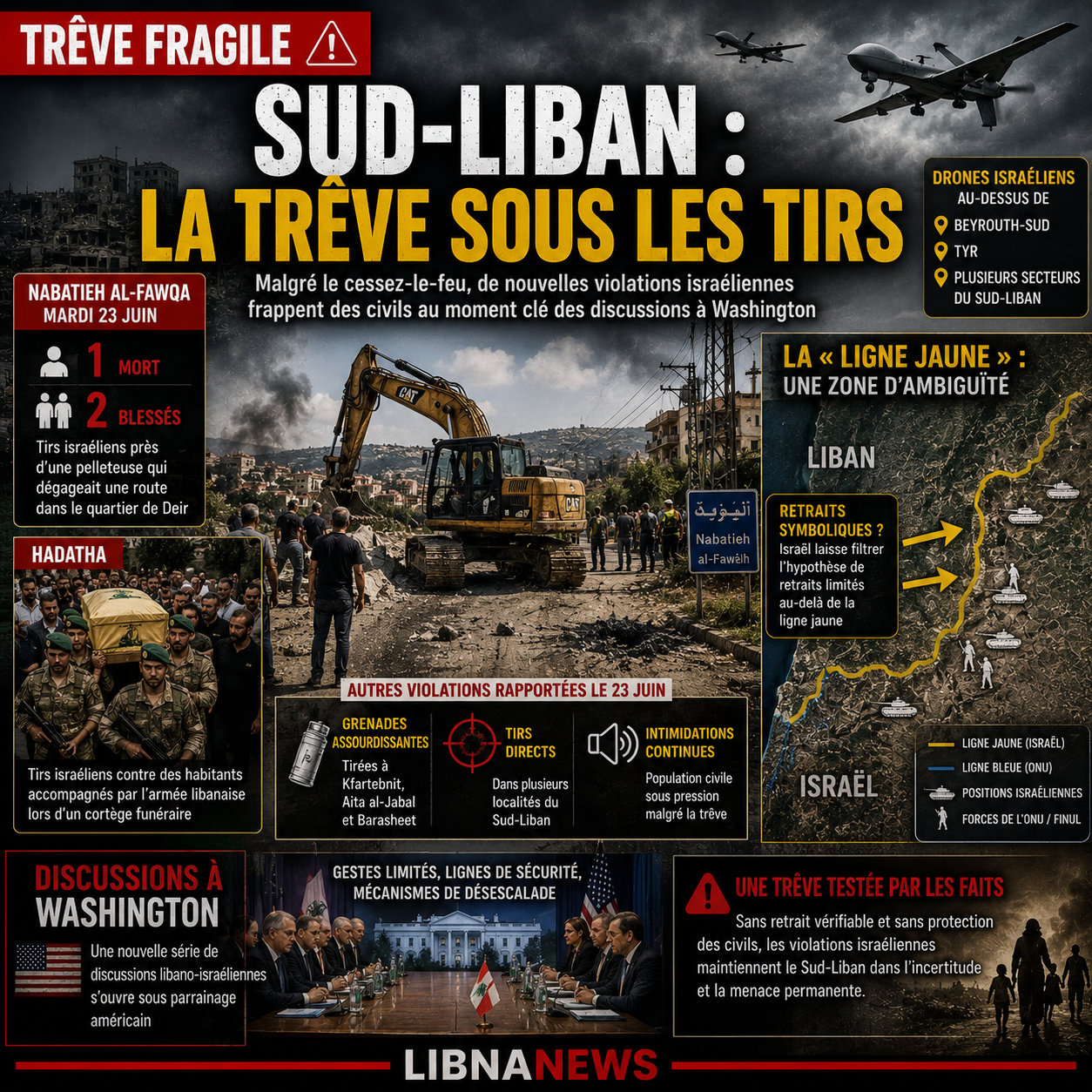
The ceasefire announced in southern Lebanon did not prevent further Israeli violence against civilians. On Tuesday 23 June, a man was killed and two others wounded in Nabatiyah al-Fawqa, according to the Lebanese national news agency, which was taken over by several media outlets. The victims were near a excavator mobilized to clear a road in the Deir neighbourhood when Israeli soldiers opened fire on the machine gun. On the same day, shooting also targeted residents accompanied by the Lebanese army during a funeral procession in Hadatha. Stunning grenades were fired at several locations, while Israeli drones overflew South Beirut, Tyre and several southern areas.
These incidents occur at the most sensitive moment. A new series of Lebanese-Israeli discussions opened in Washington, under American sponsorship, while Israel allowed the hypothesis of so-called « symbolic » withdrawals from certain occupied areas beyond the « yellow line ». The contrast is brutal. On the ground, civilians continue to be killed or threatened. In capitals, diplomacy discusses limited gestures, security lines and de-escalation mechanisms. This simultaneity raises a central question: can a symbolic withdrawal have meaning when Israeli violations continue, including during a truce presented as active?
Nabatieh al-Fawqa, an incident that summarizes the fragility of the truce
The attack on Nabatiyah al-Fawqa does not resemble an isolated episode in an empty area. It touches a scene of return and clearing, that is, a moment when the inhabitants are trying to regain possession of their environment. The presence of a shoveller indicates a civil operation. Roads must be cleared, access restored, houses evaluated, damage identified. In southern Lebanon, these ordinary actions become risky when military lines remain blurred and Israeli forces retain a direct firing capability.
The fact that the persons concerned were close to a clearance device reinforces the political dimension of the incident. After each truce, the issue is not just about stopping the strikes. It also addresses the right of return, movement, the resumption of services and the capacity of civilians to rebuild without being treated as threats. If the population cannot approach a destroyed road without risking fire, the truce remains formal. It may suspend some of the heavy operations. She’s not restoring security.
Hadatha adds another element. Israeli fire reportedly targeted residents accompanied by the Lebanese army during a funeral procession near the town. The presence of Lebanese military personnel should have reduced the risk. It shows that civilians were not travelling alone in an uncertain area. It also indicates that the State was trying to frame a sensitive moment. The fact that the incident occurred despite this accompaniment illustrates the weakness of the State guarantee against an Israeli army that maintains its own reading of the terrain.
The truce is thus emptied of part of its contents. It cannot be limited to the absence of a general offensive. It must protect civilians, allow humanitarian access, secure burials, allow reparations and prevent intimidation. The deafening grenades fired at Kfartebnit, Aita al-Jabal and Barasheet are part of this same pressure logic. They do not always produce heavy balances. Yet they set a clear message: civilian space remains under threat.
The « yellow line », new ambiguous tool
The concept of « yellow line » has become one of the most sensitive points in the file. Israel presented as an operational line linked to its security arrangements in southern Lebanon. Beirut sees this as a unilateral line, without an international legal basis, distinct from the Blue Line recognized by the United Nations as a withdrawal line since 2000. This distinction is not technical. It determines who defines the space of Lebanese sovereignty.
The Blue Line is already a withdrawal line, not a definitive border. It remains contested in some areas. But it has an international framework. The « yellow line » is an Israeli initiative. It materializes a de facto zone, resulting from military operations and positions held by the Israeli army after the previous ceasefires. By agreeing to discuss it as a practical benchmark, negotiators risk normalizing partial occupation of Lebanese territory.
It is in this context that the idea of « symbolic » withdrawals takes its full weight. According to media reports, Israel would consider withdrawing certain forces from minor areas beyond this line, in order to address the Lebanese government and provide space for diplomacy. But a symbolic withdrawal is not a complete withdrawal. It can be used to create a motion impression without changing the essentials of the device. It can also divide the file into microgestes, while Lebanon calls for a clear timetable for the withdrawal of all occupied positions.
The risk is therefore twofold. On the one hand, Israel maintains a safe area by presenting it as necessary for the protection of its northern communities. On the other hand, it proposes small corrections that could be sold as diplomatic advances. Sovereignty is not restored by fragments of communication. It requires a verifiable withdrawal, effective control of the Lebanese army and an international guarantee. Without this, the « yellow line » will become a new reality imposed, comparable to buffer zones that prolonged conflicts eventually trivialize.
Washington between negotiation and field pressure
Discussions in Washington are taking place in a wider regional sequence. The US is seeking to consolidate a de-escalation including Iran, Israel, Lebanon and associated fronts. Lebanon comes with a clear priority: to secure an Israeli withdrawal and restore state authority over the South. Israel, for its part, makes sustainable security normalization conditional on the decline of Hezbollah and the maintenance of operational safeguards. The positions therefore remain distant, even if American diplomacy wants to display a movement.
The new Israeli violations weaken the Lebanese position. They show that the ground can contradict the negotiating table. They also recall that a ceasefire without a robust verification mechanism remains vulnerable to unilateral interpretations. Israel can claim that it acts against threats. Lebanon can denounce attacks on civilians and a violation of its sovereignty. In between, the population of the South bears uncertainty.
The calendar is not trivial. Shooting civilians, hitting a locality near the yellow line or flying over Beirut-south as delegations discuss Washington sends a signal. This signal can be read as a pressure. Israel shows that it retains the military initiative and that it will not be locked up by the truce. He also indicated that any concessions would remain limited. The message to Lebanon is clear: negotiation does not suspend Israeli freedom of action.
This freedom of action is precisely what Beirut is challenging. A ceasefire involves reciprocal obligations. It cannot become an arrangement in which a party reduces certain operations while retaining the right to strike, fly, shoot and maintain positions. American diplomacy must therefore decide a question of methodology. It can encourage symbolic gestures. Or it may require verification logic, with political consequences in case of violation.
The Lebanese Army on the front line
The Hadatha incident highlights a major difficulty for the Lebanese army. Since the beginning of the crisis, international partners have presented the army as the institution called upon to regain control of the South. This option implies that it can deploy, accompany civilians, secure the axes and engage with international forces. But she also assumes that her presence is respected. If civilians accompanied by the army can be targeted or intimidated, the credibility of the deployment is affected.
The Lebanese army cannot fulfil an impossible mission on its own. It lacks resources, relies on external aid and operates in an environment dominated by more powerful actors. It must deal with Hezbollah, Israeli demands, American pressure and the expectations of the inhabitants. Its role cannot be reduced to a symbolic presence in destroyed villages. To be credible, it must have a clear mandate, resources, domestic political support and an international framework that also requires Israel.
The issue is all the more sensitive as the discussions on the disarmament of Hezbollah return in each diplomatic sequence. Israel and the United States consider that the control of the Lebanese state over the South requires the reduction of Hezbollah’s arsenal. Hezbollah responds that this arsenal remains necessary as long as Israel occupies positions, strikes the territory and violates airspace. The incidents of Nabatieh al-Fawqa, Hadatha and Kfartebnit thus fuel his argument. Every Israeli violation weakens those who advocate a strict state security transition.
This mechanism is dangerous for Lebanon. The more Israel expands operations, the more Hezbollah can justify maintaining its weapons. The more Hezbollah retains its weapons, the more Israel justifies its security arrangements. The country finds itself trapped in a circle where state sovereignty is claimed by all but made impossible by the practices of each. The truce was to reduce this circle. Recent incidents show that she hasn’t broken it yet.
Civilians caught in suspended sovereignty
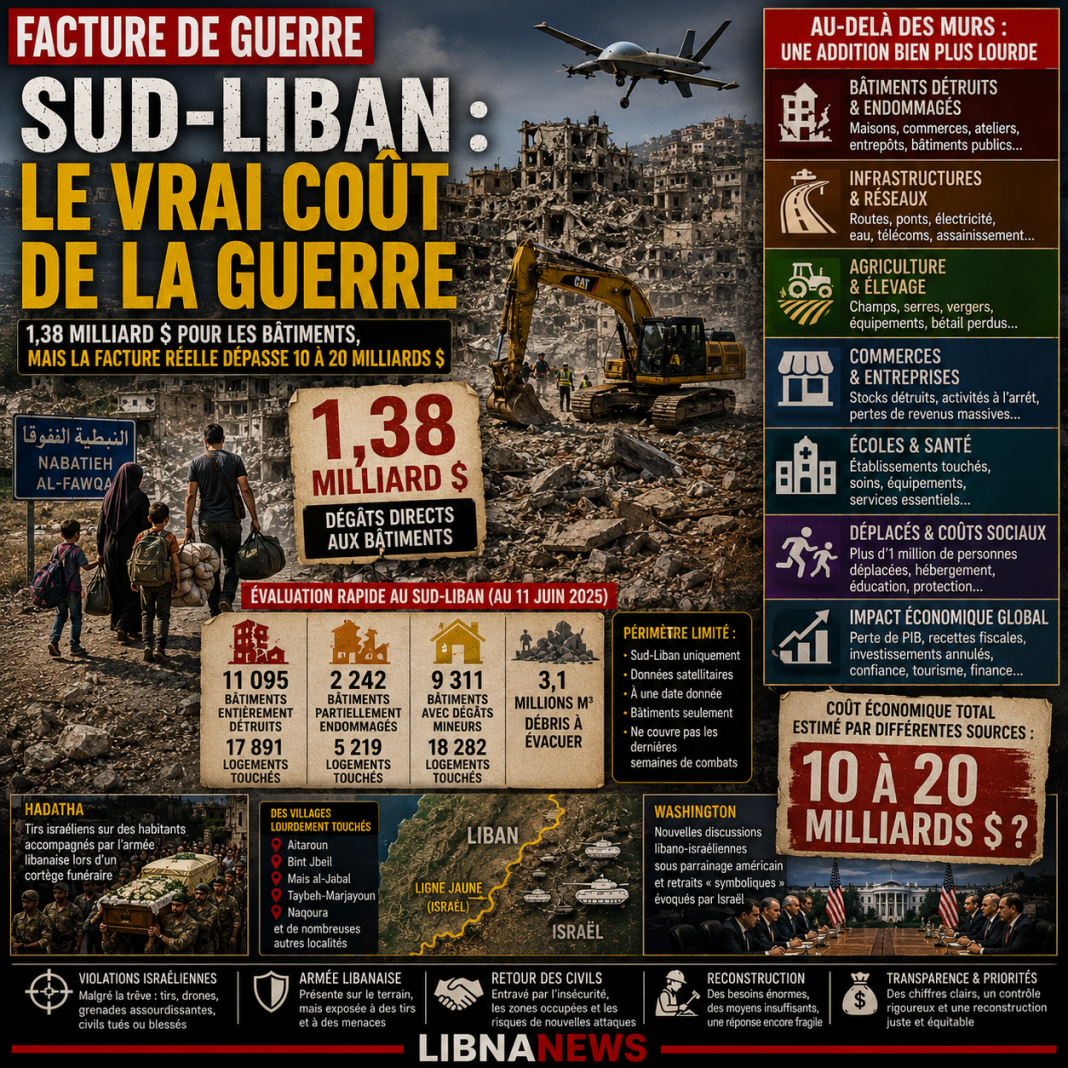
For the people of South Lebanon, the debates on lines, guarantees and symbolic withdrawals translate into very concrete choices. Can we go home? Can we bury a loved one? Can we clear a road? Can we fix a house? Can we grow a field? Can we send kids to school? Each response depends on the proximity of an Israeli position, a drone, a prohibited area or a risk of strike.
This reality creates suspended sovereignty. The territory belongs to Lebanon by law. But some of its inhabitants cannot live there normally. The State affirms its authority. But it cannot always protect civilian displacement. The mediators speak of truce. But the shots continue. The gap between diplomatic vocabulary and daily experience has a profound distrust.
Drone overflights over southern Beirut add a psychological dimension. They recall that the conflict is not limited to border villages. They maintain pressure on the neighbourhoods associated with Hezbollah and on a population already marked by strikes, displacement and uncertainty. Even without immediate strike, a drone is a message. It means that monitoring continues and climbing remains possible.
In this context, Israeli violations are not only military incidents. They form a policy of presence. They maintain a balance of power. They prevent normalization of return. They weigh on the negotiation by recalling that control over the ground takes precedence over declarations. For Lebanon, documenting such violations becomes a diplomatic necessity. Each incident must be dated, located, qualified and transmitted to the relevant authorities. Without precise documentation, the political complaint dilutes in the routine of crises.
Symbolic withdrawals are not enough
The idea of a symbolic withdrawal can meet a logic of negotiation. In some processes, limited actions can test trust. They open a channel, reduce tension and give a visible result to mediators. But in southern Lebanon, this method has obvious limits. Violations continue. The lines are contested. Civilians are affected. The Israeli positions remain presented by Tel Aviv as a sustainable security zone. Under these conditions, a partial gesture may be perceived as a manoeuvre.
To be credible, a withdrawal must meet several criteria. It must be public, mapped and checked. It must concern significant positions, not secondary locations without strategic value. It must be accompanied by a halt to the shooting, strikes and overflights. It is intended to enable the effective deployment of the Lebanese army. It must finally be included in a calendar. Without these elements, it will not change the lives of the inhabitants or the political balance.
Lebanon must therefore avoid the trap of implicit recognition. Accepting a discussion of withdrawals beyond the « yellow line » should not mean accepting this line as a legitimate reference. The only lasting basis remains the withdrawal of any Israeli presence from recognized Lebanese territory, within a verifiable international framework. Any other temporary arrangement must be presented as provisional, not as an accepted security border.
American diplomacy can play a useful role if it turns actions into obligations. It can impose a follow-up matrix: incidents, responsibilities, corrective measures, civilian access, return of internally displaced persons, and military disengagement. It can also link withdrawals to an upsurge in the Lebanese army and internal commitments to security in the South. But if Washington simply dress up an Israeli hold with a few symbolic withdrawals, the truce will remain fragile.
A Truce Tested by the Facts
South Lebanon is entering a phase where facts on the ground will count more than announcements. The death of a civilian in Nabatiyah al-Fawqa, the wounded, the shooting in Hadatha, the deafening grenades and the overflights of drones will be read in Beirut as ceasefire violations. Israel may present them as security measures. The difference between these two accounts cannot be determined by the press releases alone. It must be achieved through a verification mechanism and through real political pressure.
The Lebanese government arrives in Washington with a difficult responsibility. It must denounce violations without appearing hostile to negotiation. He must demand withdrawal without giving the impression that he ignores the question of Hezbollah. He must support the army without asking him the impossible. Finally, he must speak on behalf of the people of the South, whose immediate security cannot wait for the conclusion of a regional agreement.
The Israeli position also remains exposed to a contradiction. Tel Aviv claims to want to secure its north and prevent the return of an armed threat. But firing at civilians, operations close to funeral convoys and overflights of densely populated areas fuel the idea of coercive occupation rather than mere defence. The more Israel insists on an unrecognized security zone, the more difficult it is to build a lasting arrangement.
The next step will therefore not only be in the American meeting rooms. It will be played on the roads of Nabatiyah, in the villages of Hadatha, Kfartebnit, Aita al-Jabal and Barasheet, and in the ability of the inhabitants to resume normal life. If the truce does not protect civilians, it will only be a tactical pause. If withdrawals remain symbolic, they will only move the confrontation line. If Israeli violations continue, the case of southern Lebanon will remain open, with a constant risk of a return to escalation.