

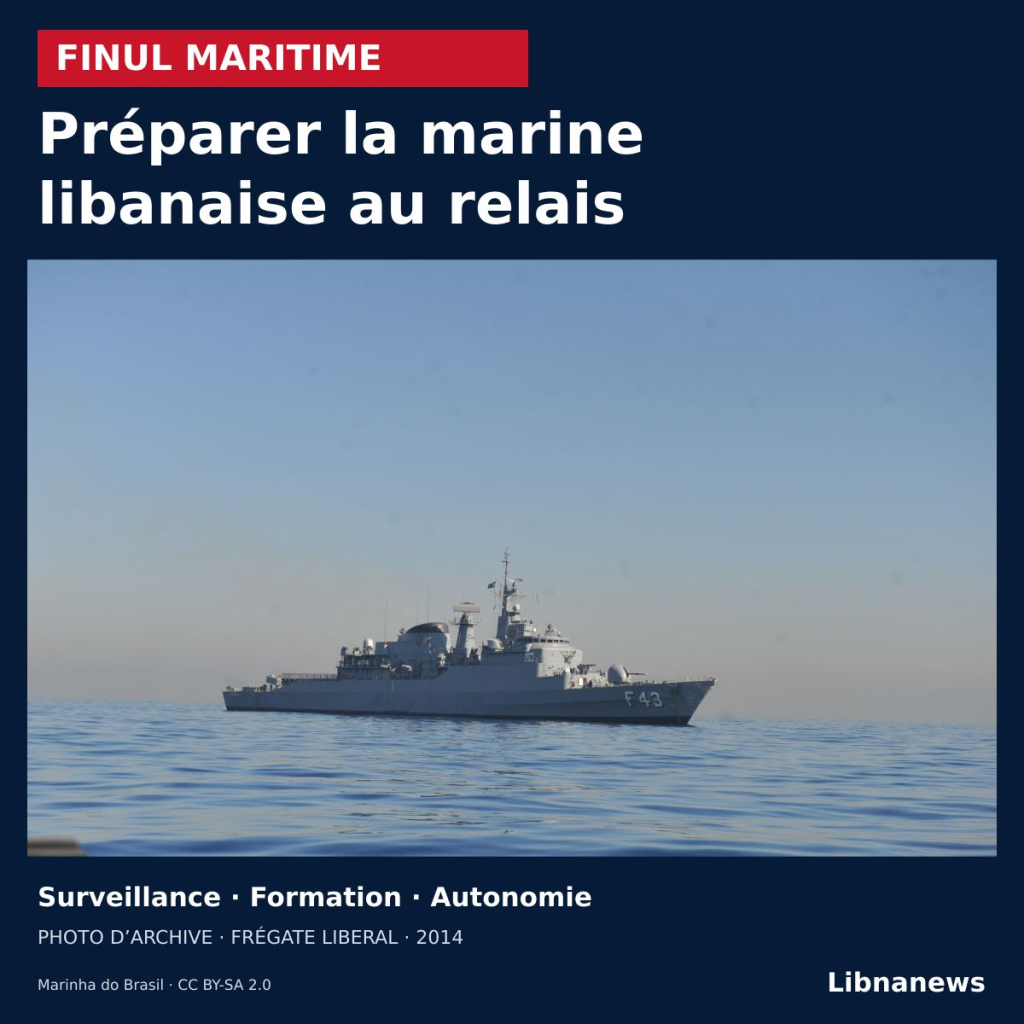
UNIFIL and the Lebanese Navy continue to cooperate to prevent the entry of weapons not authorized by the sea. In a reminder issued on 9 November 2026, the mission also highlights its training and technical assistance work. The objective remains to allow Lebanese naval forces to assume these responsibilities independently. The message is not the announcement of a new transfer. It describes a progressive preparation, already under the umbrella of an operational agreement signed in December 2025.
The maritime component of the United Nations Interim Force in Lebanon, known as MTF, has been operating since October 2006. Its deployment responded to a request from the Lebanese Government. Twenty years later, UNIFIL recalls the two components of this commitment: contributing to maritime security and strengthening the capabilities of the national navy.
The 9 November text does not indicate any interception, seizure or new exercise. Nor does it announce that the Lebanese navy can now perform all the missions concerned on its own. It focuses on the cooperation, technical assistance and training needed to achieve this autonomy over time.
UNIFIL and the Lebanese Navy: monitoring the country ‘ s approaches
The maritime force assists the Lebanese authorities in monitoring their territorial waters and securing their coastline. It helps prevent the arrival of arms and related materials without authorization by sea. This mission is part of the implementation of Security Council resolution 1701, adopted in 2006.
The MTF is the first naval force integrated into a United Nations peacekeeping operation. Its scope covers the entire Lebanese coastline. The Mission’s presentation sheet contains a length of 110 nautical miles to patrol, approximately 204 kilometres.
This cooperation combines offshore operations with the development of national resources. International ships provide support while Lebanese crews consolidate their skills. The objective remains to enable the naval and security forces of the country to carry out these tasks themselves.
The composition of this force evolves with the contributions of States. In its update on 29 October 2026, UNIFIL identified two vessels, provided by Bangladesh and Germany. This statement describes the means then present, without prejudice to their individual withdrawal schedule.
A framework signed in Beirut in December 2025
The preparation of the relay is based on provisions prior to the 9 November reminder. On 23 December 2025, the two forces signed a new operational framework at the Beirut naval base. Rear Admiral Stephan Plath represented the MTF. Rear Admiral Mustapha El Aly represented the Lebanese Navy.
This document organizes their cooperation for 2026. It provides for increased responsibility of Lebanese forces for the security of territorial waters. Its procedures cover the monitoring of these waters and the performance of maritime safety missions.
The framework also envisages a changing international role. The MTF must gradually shift from active participation in security tasks to advisory, coaching and observation. The training of Lebanese sailors remains a component of this transition.
The agreement provides for greater integration of Lebanese units into the structures common to both forces. However, this progress depends on the operational readiness of the units concerned. The signing of the framework therefore does not mean that autonomy has already been acquired. It sets out a work organisation for capacity building in 2026.
From coastal radars to operations
On 13 February 2026, the Lebanese Navy Commander detailed several results of this cooperation. Mustapha El Aly cited the development of knowledge of maritime space. It is based on a network of advanced radars, extending north from Arida to Naqurah in the south.
This network is one of the ways in which naval forces can monitor their operational environment. The Commander also referred to improved building preparation and management of operations. It linked this progress to a more accurate assessment of marine risks.
Training is not limited to the prevention of arms trafficking. It also concerns search and rescue. The Lebanese official described capacity-building as another outcome of international support. Safety at sea thus includes surveillance, navigation and assistance skills for people in difficulty.
Training crews, in the room and at sea
Staff preparation is central to this process. The Lebanese Navy uses a navigation simulator at the Naval Force School. Specialized German Navy teams participate in the training of officers and non-commissioned officers.
These sessions focus on safe navigation and manoeuvres at sea. They aim to enhance crew skills and reduce the risk of accidents. They complement the practical activities carried out with the vessels of the maritime force.
On 17 June 2026, UNIFIL described the continuation of a sustained training programme, both in the classroom and at sea. These activities were integrated into the framework signed in December. It presented them as preparation for greater Lebanese responsibilities in territorial waters.
The Chief of UNIFIL, General Diodato Abagnara, then stressed the gradual improvement in staff preparation. He also stressed coordination, mutual understanding and trust in joint operations. These elements inform the meaning of the November reminder: technical assistance accompanies continuous operational learning.
A mandate deadline without automatic autonomy
This preparation takes place as the UNIFIL mandate closes. Resolution 2790 provides for the cessation of operations on 31 December 2026. An orderly and secure withdrawal must then take place within one year.
This general timetable alone does not constitute a certification of the capabilities of the Lebanese navy. The 9 November recall does not provide any new detailed marine transfer schedule. Nor does it publish final evaluation of unit autonomy. The CCF retains one concrete criterion: their operational readiness to assume more responsibilities at sea.





Comments