





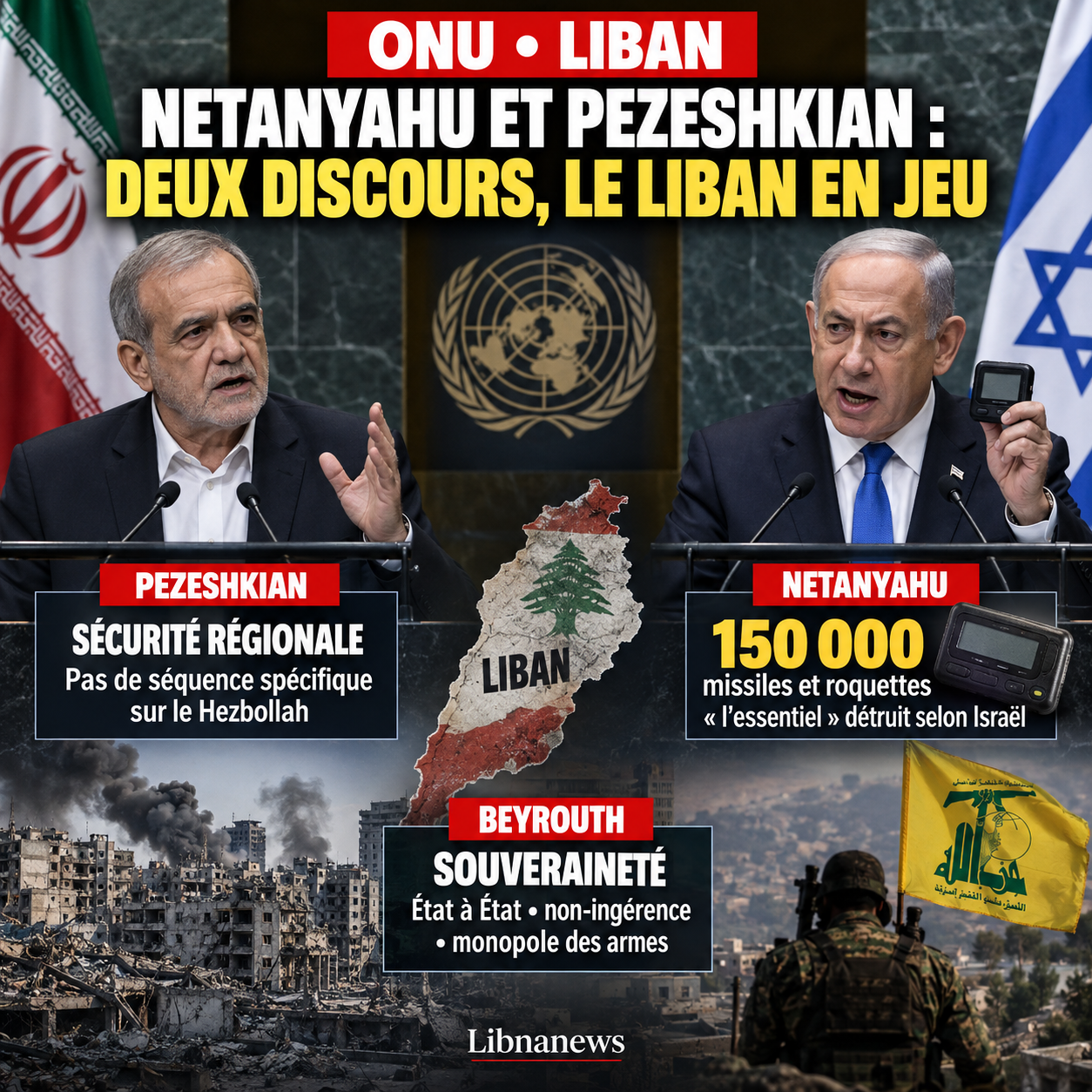
In New York, Iranian President Massoud Pezeshkian and Israeli Prime Minister Benjamin Netanyahu spoke 24 hours apart in front of the UN General Assembly. The former defended the Iranian position against the United States and Israel on Wednesday, 23 September, and called for collective regional security, without any specific passage to Lebanon or Hezbollah. The second directly referred to the Lebanese Shiite movement on Thursday, 24 September, which he included among the « seven fronts » fought by Israel. Netanyahu claimed that the bulk of a Hezbollah arsenal estimated by Israel at 150,000 missiles and rockets had disappeared. These speeches take place as Lebanon remains caught between the continuation of Israeli operations, Hizbullah’s report to Iran and Beirut’s willingness to restore the state monopoly on weapons.
The two speeches have neither the same object nor the same place for Lebanon. Massoud Pezeshkian was mainly addressed to the United States and Israel. His intervention concerned war, nuclear power, sanctions, the Strait of Ormuz and the conditions for a resumption of diplomacy with Washington. Benjamin Netanyahu, for his part, took stock of the wars led by Israel since 7 October 2023. Hezbollah appears directly in this assessment, alongside Hamas, Iran and other armed groups in the region.
For Lebanon, this difference is important. Netanyahu’s comments contain specific statements about Hezbollah, its leaders and its arsenal. Pezeshkian did not develop the Lebanese file in the gallery. The subject, however, came to the fore the day after his speech, when he met Prime Minister Nawaf Salam in New York. Beirut then sent a message focusing on sovereignty, non-interference and the refusal to see Lebanon continue to serve as a ground for regional conflicts.
Pezeshkian responds to Washington and defends Iranian position
Massoud Pezeshkian appeared before the General Assembly on Wednesday, 23 September, in a very different context from previous sessions. Iran has now been engaged for several months in direct military confrontation with the United States and Israel. The Iranian President therefore devoted much of his speech to challenging the American story of the conflict and presenting his country as the attacked party.
In particular, he responded to the accusations made by Donald Trump, who spoke the previous day in the same rostrum. Pezeshkian rejected Iran’s qualification as a terrorist actor and claimed that Iranians were the victims of terrorism. He showed photographs of Iranian victims and referred to civilians killed during military operations. The Iranian president also referred to the former supreme guide Ali Khamenei, who was killed at the beginning of the war during an American-Israeli operation.
Pezeshkian’s central message was that military pressure had not forced Iran to surrender. He argued that his country had resisted the strikes and refused to « fold the knee ». However, this firmness was accompanied by diplomatic openness. The Iranian president did not close the door to negotiations with Washington. On the contrary, he stated that Iran remained willing to engage in dialogue, but refused to negotiate under threat or intended to impose American conditions on Iran.
This dual discourse, military resistance and conditional openness to diplomacy, comes at a time when the General Assembly also serves as a framework for multiple diplomatic contacts. The question goes beyond the nuclear issue alone. The war with the United States and Israel, the sanctions, the movement in the Strait of Ormuz and Iran’s relations with its regional partners are now intertwined in the discussions.
Lebanon absent as separate file of Iranian discourse
TheLebanon at the UNhowever, there was no particular development in Pezeshkian’s speech. The Iranian President has not devoted any sequence to Hezbollah, its armament or Lebanese political debates on the arms monopoly. Nor did he expose to the General Assembly any new Iranian policy towards Beirut.
The passage that most directly affects the Lebanese context concerns its general understanding of security in the Middle East. Pezeshkian claimed that no country could secure its security independently of others and defended the idea of a collective regional architecture. In particular, he said that a peace that would not encompass all actors could not be a real peace.
This position takes on a particular dimension for Lebanon. For several years, clashes involving Israel and Hezbollah have shown how exposed the Lebanese internal situation remains to developments in the confrontation between Israel and Iran. This interdependence was further strengthened with the entry of Hezbollah into the regional war alongside Tehran in March 2026 and the subsequent Israeli military campaign in Lebanon.
However, this context must be distinguished from what Pezeshkian actually said on Wednesday. At the UN rostrum, the Iranian President did not formulate a specific position on the future of Hezbollah’s weapons or on the Lebanese government’s decisions. His speech was first that of a head of state engaged in direct war with the United States and Israel.
Netanyahu lists Hezbollah in a war on « seven fronts »
Lebanon appears much more directly in Benjamin Netanyahu’s intervention on Thursday 24 September. The Israeli Prime Minister devoted part of his speech to the military record of the past three years and to the various opponents faced by Israel since the Hamas attack of 7 October 2023.
Netanyahu spoke of a war on « seven fronts ». He cited Hamas, Hezbollah, the Houthis of Yemen, Iran, armed groups in Iraq and Syria, and Palestinian armed organizations in the West Bank. According to him, these various actors tried to put Israel under simultaneous military pressure, but failed to achieve their goal.
Hezbollah occupies a specific place in this account. Netanyahu did not present him as a separate file only on the Israeli-Lebanese border. It has included it in all the fronts that Israel has faced, several of which are directly or indirectly linked to Tehran.
The Israeli Prime Minister then listed the results claimed by his government. After mentioning the operations against Iran and Hamas, he claimed that Israel had hit Hezbollah hard. He used a particularly direct formula to present the magnitude of the blows to the Lebanese movement.
Pagers of September 2024 in the gallery
Netanyahu accompanied his speech with a spectacular reference to one of the most significant operations of the war in Lebanon. He put a pager in front of the General Assembly and asked his audience if he remembered the communication devices. He then added that Hezbollah certainly remembered it.
The reference refers to September 17 and 18, 2024. Thousands of pages and then other communications devices used by Hezbollah members, among others, had exploded almost simultaneously in Lebanon. The operation had caused dozens of deaths and several thousand injuries. It also revealed a significant penetration of the movement’s communication systems and preceded by a few days a major intensification of the Israeli military campaign.
The context is essential to understand why Netanyahu chose this object in New York. After nearly a year of cross-border clashes between Hezbollah and Israel, the second half of September 2024 marked a change of scale. Israel had intensified its strikes against the structures and cadres of the movement, while the bombings extended to several parts of Lebanon.
On 27 September 2024, Hassan Nasrallah was killed in a massive Israeli strike against Hezbollah headquarters in the southern suburbs of Beirut. Other senior military and political leaders of the movement had also been eliminated during that period. By brandishing the pager at the UN two years later, Netanyahu put this operation back in the broader picture of the Israeli campaign against Hezbollah.
Netanyahu’s central assertion of the 150,000 projectiles
However, the most substantial part of the speech about Hezbollah relates to its arsenal. Benjamin Netanyahu referred to a stock of 150,000 missiles and rockets, a figure that the Israeli authorities have advanced for several years to describe the capabilities accumulated by the Lebanese movement before the war.
According to Netanyahu, the « essential » of this arsenal has now disappeared. He also claimed that Hezbollah’s leaders had died and that the movement had suffered a breakdown in morale. In his speech, however, he did not provide an updated inventory of the remaining weapons or elements that would enable the current capabilities of the movement to be precisely established.
The distinction is important. The figure of 150,000 corresponds to an Israeli estimate of the pre-war arsenal. Netanyahu’s statement that most of its assets were destroyed is the balance sheet. The exact state of Hezbollah’s current stocks cannot be independently established from his speech.
The movement’s military capabilities have been affected by successive phases of fighting, the elimination of officials, attacks on its infrastructure and developments in Syria and throughout the region. However, Hezbollah retains weapons and so far refuses the principle of disarmament, which it considers to be separate from the Israeli military presence and operations in Lebanon.
From the 2024 ceasefire to the new 2026 war
Netanyahu’s comments must also be placed in the timeline of the Lebanese front. The clashes between Hezbollah and Israel began on 7 October 2023. For almost a year, they had remained mainly concentrated around the border, despite a gradual rise in violence and the displacement of tens of thousands of people from both sides.
The escalation of September 2024 had transformed the conflict. The explosions of the communications aircraft, the massive Israeli strikes and the elimination of Hassan Nasrallah had preceded an Israeli ground offensive in southern Lebanon. A ceasefire had finally entered into force on 27 November 2024, on the basis of an arrangement designed, inter alia, to allow the deployment of the Lebanese army in the South and to remove the fighters and weapons from Hezbollah from the border.
This agreement did not resolve the dispute. Israel continued to conduct operations in Lebanon by claiming to target Hezbollah members or infrastructure. Beirut denounced these strikes as violations of its sovereignty and called for Israeli withdrawal from the positions still occupied.
The situation changed again in March 2026 when Hezbollah entered the war alongside Iran. Israel responded with a new campaign in Lebanon. It is this succession of conflicts that constitutes the immediate background of Netanyahu’s discourse: when he claims to the UN that he destroyed most of Hezbollah’s arsenal, he takes stock of several military phases and not of a single campaign.
In New York, Beirut sends its own message to Tehran
The simultaneous presence of Massoud Pezeshkian and the Lebanese delegation in New York also led to a direct exchange on relations between the two countries. On Thursday 24 September, the Iranian President met with Prime Minister Nawaf Salam, in the presence of Lebanese Foreign Minister Youssef Raggi and his Iranian counterpart Abbas Araghchi.
This meeting was not part of Pezeshkian’s speech before the General Assembly. It is nevertheless important to understand the Lebanese position against Iran at the very moment when Netanyahu presented Hezbollah as one of the fronts of regional war.
Nawaf Salam said that Lebanon had paid a high price for security, stability and economy. He especially told the Iranian President that the country no longer wants to be a « battlefield for regional conflicts » or an arena for the exchange of messages between other actors. The Prime Minister called for a new page in relations between Beirut and Tehran.
The principle upheld by Salam is that of a « State to State » relationship. He stressed respect for the sovereignty and independence of both countries, non-interference in their internal affairs and the pursuit of common interests. He also asked Iran to appoint a new ambassador to Lebanon.
Hezbollah’s weapons behind the question of sovereignty
The subject of weapons was never far from this meeting. Nawaf Salam recalled that priority remained the complete withdrawal of Israel from Lebanese territory and the cessation of its attacks. At the same time, it reaffirmed the objective of extending State authority to the whole country and ensuring the monopoly of arms by Lebanese institutions.
This formulation summarizes the equation advocated by the government. Beirut regards Israeli operations and Israeli positions as violations of national sovereignty. But it also affirms that this sovereignty implies that the State is alone in the possession of arms and in the decision on war and peace.
Hezbollah defends a different reading. The movement considers its weapons necessary in the face of Israel and links their future to the end of Israeli operations, to the withdrawal of the remaining occupied Lebanese territories and, more broadly, to the security assurances granted to Lebanon. This divergence has become one of the main political and security issues in the country.
It also explains why the Salam-Pezeshkian meeting counts in the New York sequence. Iran remains the main external support of Hezbollah. When the Lebanese government asked Tehran for a strictly « state-to-state » relationship and insisted on non-interference, it placed Lebanese-Iranian relations within the institutional framework that Beirut now wished to favour.
Three messages about Lebanon from New York
This week’s speeches and meetings draw three distinct positions, without having been expressed in the same context. Pezeshkian used the UN rostrum to defend Iran in its confrontation with Washington and Israel. He called for collective regional security, but did not devote any particular development to Lebanon or Hezbollah.
Netanyahu directly placed Hezbollah at the heart of its military record. He recalled the operation of the pages, referred to the elimination of the leaders of the movement and claimed that the bulk of an arsenal estimated at 150,000 missiles and rockets had disappeared. However, his statements did not include any new Lebanon plan or specific diplomatic announcement concerning Beirut.
The Lebanese message was formulated elsewhere, during the meeting between Nawaf Salam and Massoud Pezeshkian. Beirut called for Iran to have a relationship based on sovereignty and non-interference, while recalling two parallel objectives: the end of Israeli attacks and presence, and the extension of State authority with the arms monopoly.
The sequence is scheduled to continue on Friday, 25 September with Nawaf Salam’s intervention in front of the General Assembly. After Iranian and Israeli speeches, the Lebanese Prime Minister will also have the UN rostrum to set out Beirut’s position on sovereignty, war with Israel and state authority.