





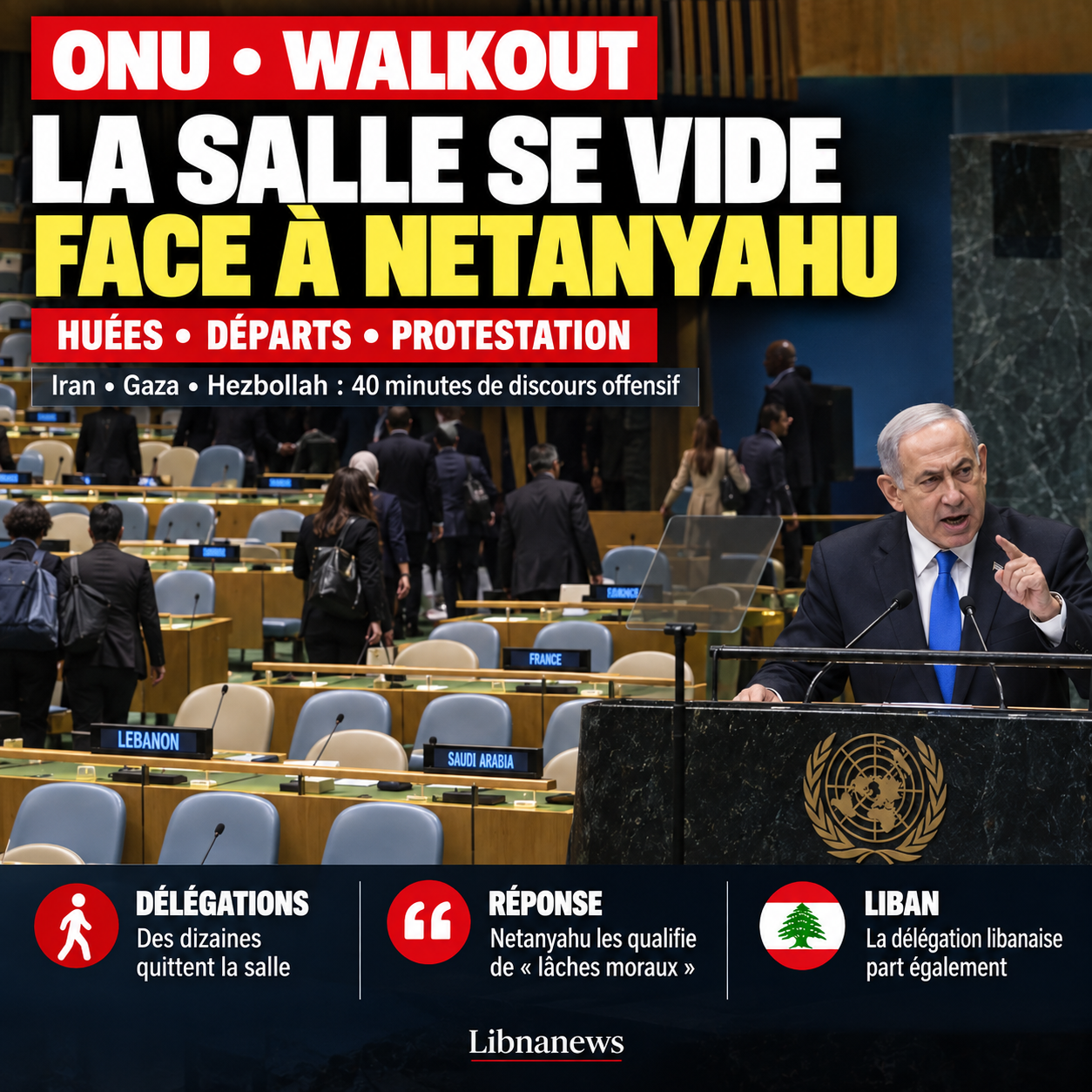
Dozens of delegations left the UN General Assembly Hall in New York on Thursday, 24 September, as Israeli Prime Minister Benjamin Netanyahu went up to the rostrum. Husbands accompanied this collective departure, while his supporters applauded. Netanyahu immediately described the diplomats as « moral cowards, » before defending Israel’s wars against Iran, Hamas and Hezbollah. For almost forty minutes, he also rejected the accusations of genocide in Gaza, attacked several Governments and claimed that Israeli operations had severely weakened their opponents in the region.
The scene preceded the first developments of the speech. When Benjamin Netanyahu moved to the rostrum of the General Assembly, diplomats rose and won the exits. Hue and protests were heard, to which the applause and slogans of members of the Israeli delegation and people in the galleries responded. The presiding officer, Khalilur Rahman, has repeatedly called for a return to calm. Much of the seats then remained empty during the Israeli Prime Minister’s speech.
The exact number of delegations participating in the movement was not uniformly established by the main international agencies in the early hours. Reuters and AFP reported dozens of delegations. Some media then advanced higher figures by counting delegations absent from the room, a fact that does not necessarily distinguish those who actually left their seats in protest from those who were not already present. Lebanon was among the delegations that left the room, as were several Arab and Muslim delegations.
Netanyahu responds to delegations leaving the room
Benjamin Netanyahu did not ignore the movement. He made it the first words of his speech.
» If there are other moral cowards who have not yet left this room, do so now, » the Israeli Prime Minister said.
The statement immediately set the tone for his speech. Netanyahu then argued that Israel was protecting, through its military operations, some of the countries whose representatives had just left the room. He claimed that several leaders had even privately thanked Israel for its operations against Iran’s nuclear programme.
The departure of delegations takes place in a particularly tense diplomatic climate around Israel. The war in Gaza, the situation in the occupied West Bank, the Israeli operations in several countries in the region and the confrontation with Iran have played an important role in the interventions of the leaders gathered in New York this week. Several European, Arab and Muslim officials had criticized Israel even before Netanyahu’s visit to the gallery.
The scene on Thursday was therefore not an isolated incident from the content of the debates. It was a public manifestation of these tensions within the General Assembly itself.
Iran at the centre of Netanyahu’s speech
After responding to delegations, Benjamin Netanyahu began his speech with Iran. He recalled having come to the same gallery fourteen years earlier with a drawing depicting a bomb in order to alert against the Iranian nuclear program.
This time he presented the Israeli and American military operations against Iran as achieving this objective. Netanyahu said the destruction of Iran’s nuclear facilities had been militaryly difficult, but it had been one of the easiest decisions to make as Prime Minister. He justified this decision by the threat he claims posed by Tehran’s acquisition of nuclear weapons.
Netanyahu particularly stressed cooperation with the United States. He thanked President Donald Trump and introduced Washington as Israel’s main partner in the regional confrontation.
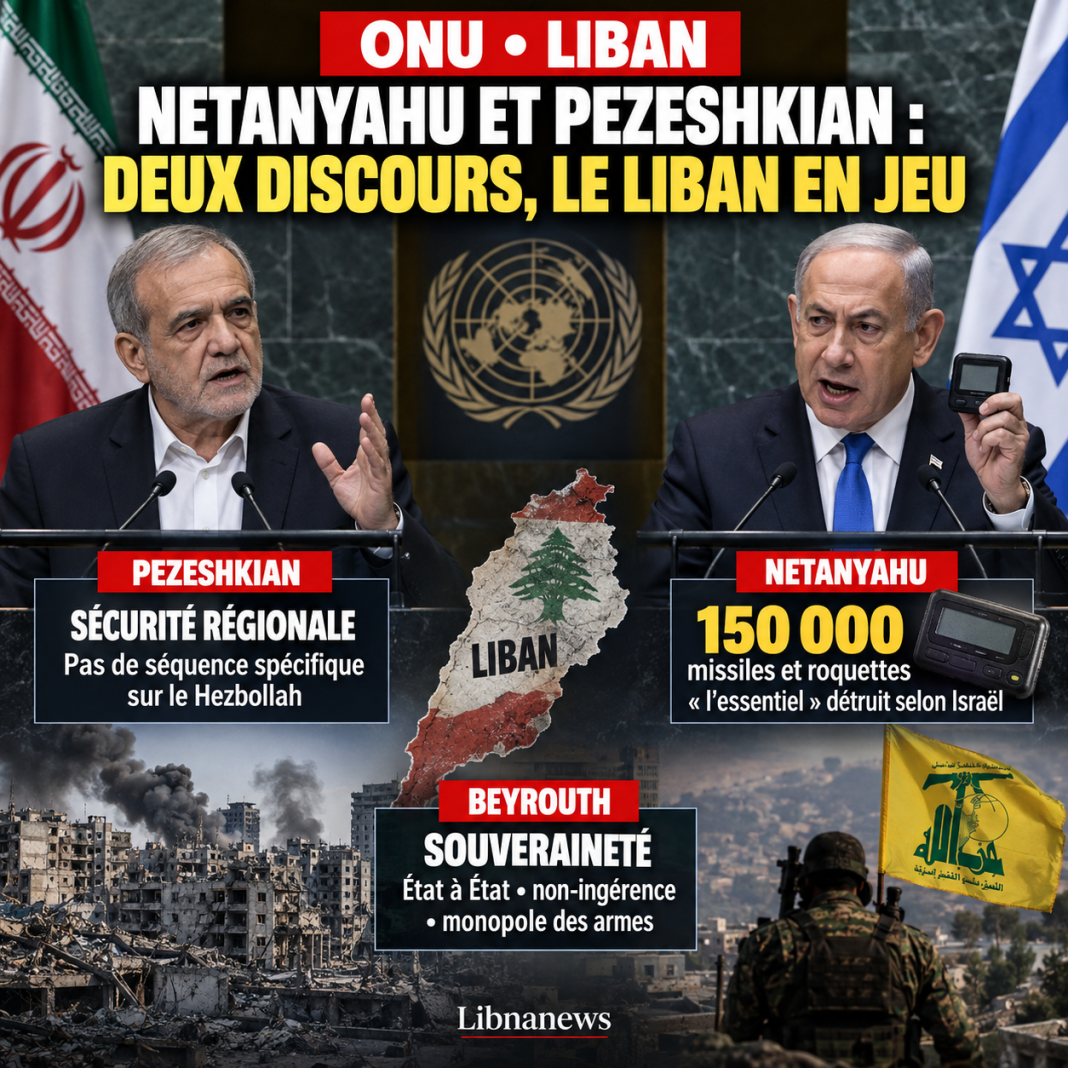
The Israeli Prime Minister also sent a message directly to the Iranian people. He predicted the fall of power in Tehran and presented the Iranian leaders as responsible for the situation in their country. This part of his speech responded directly to Iranian President Massoud Pezeshkian, who spoke the day before in the same rostrum and denounced the American and Israeli operations against Iran.
« Seven fronts »: Netanyahu takes stock of Israel’s wars
Netanyahu then put the war against Iran back into a broader whole. According to him, Israel had to fight for three years on « seven fronts. ».
He cited Hamas in Gaza, Hezbollah in Lebanon, the Houthis in Yemen, Iran, armed groups in Iraq and Syria, and armed Palestinian organizations in the occupied West Bank, a territory he designated by the biblical names of Judea and Samaria.
Netanyahu claimed that these various opponents had tried to cause Israel to collapse and that they had failed. He then listed the military results claimed by his government: the strikes against Iran, the operations against Hamas and those against Hezbollah.
This passage also allowed the Israeli Prime Minister to return directly to the war in Lebanon.
A pager waved to evoke Hezbollah
Benjamin Netanyahu released a pager and showed it to the General Assembly.
« Do you remember the beepers? He asked, before adding that Hezbollah remembered it.
He referred to the explosions of 17 and 18 September 2024 in Lebanon, when thousands of communication devices used by, inter alia, Hezbollah members had exploded almost simultaneously. The operation preceded the massive intensification of the war between Israel and the Lebanese Shia movement.
A few days later, on 27 September 2024, Hassan Nasrallah was killed in a massive Israeli strike on the southern suburbs of Beirut. Israel then continued its operations against Hezbollah’s military frameworks and infrastructure.
In New York City, Netanyahu integrated this whole sequence into his three-year war record.
He claimed that Hezbollah previously had an arsenal of some 150,000 missiles and rockets directed against Israel. According to him, « essential » of this arsenal has now disappeared. He also claimed that the leaders of the movement had died and that his morale had been broken. These statements constitute the assessment presented by the Israeli Prime Minister and do not allow the present size of the Hezbollah arsenal to be established independently.
Lebanon was thus present in two ways in the sequence. His delegation was among those who left the room, while Hizbullah occupied an important place in the military record presented by Netanyahu a few minutes later.
Gaza and the genocide charge
A large part of the intervention also covered Gaza. Netanyahu forcibly rejected the genocide charge against Israel and described it as a lie.
The Israeli Prime Minister claimed that the army had taken measures to limit civilian casualties and allow food and vaccines to enter the Palestinian territory. He presented the war as an operation against Hamas and not against the Palestinian population.
These statements are made at a time when the conduct of the war by Israel is the subject of international proceedings and accusations. The International Criminal Court issued arrest warrants in November 2024 against Benjamin Netanyahu and his former defence minister Yoav Gallant, considering that there were reasonable grounds to believe that they were responsible for crimes within its jurisdiction. Israel challenges the jurisdiction of the Court and rejects the charges.
Netanyahu used his intervention to respond directly to his critics. He defended the Israeli army and accused governments, politicians and activists who speak of genocide of spreading lies about his country.
The departure of dozens of diplomats at the beginning of his speech gave this part of the speech a particular dimension: several of the interlocutors to whom the Prime Minister replied were no longer present in the room.
France and the United Kingdom directly attacked
Benjamin Netanyahu did not limit his criticism to Israel’s declared opponents. It has also been targeted at several Western countries, including France and the United Kingdom.
Responding to the accusations of colonialism against Israel, he referred Paris and London back to their own colonial history. He challenged the use of this qualification to describe the Israeli presence in the Palestinian territories.
The dispute goes beyond rhetoric. Paris and London have tightened their position in the face of certain Israeli policies, including the West Bank and settlements. The Palestinian question has been an important part of the General Assembly’s discussions this week.
Netanyahu also attacked Turkey and Qatar. On the other hand, he has multiplied his thanks to Donald Trump and the United States, presented as Israel’s key partner in the war against Iran and in efforts to recover the hostages held in Gaza.
Netanyahu also responds to the Mayor of New York
The American dimension continued with an attack on the mayor of New York, Zohran Mamdani, who had strongly criticized Netanyahu and referred to his arrest because of the warrant issued by the International Criminal Court.
The Israeli Prime Minister addressed him directly from the rostrum.
He accused him of anti-Semitism and blamed him for trying to stop him from coming to New York. Mamdani then rejected these charges.
Netanyahu’s visit took place in a particularly tense setting. Demonstrations were held in New York against his presence and against the war waged by Israel. More than a hundred people were arrested during demonstrations around the UN sequence.
The departure of delegations marks the beginning and tone of the speech
However, the main image of this intervention will remain that of diplomats leaving their seats as Benjamin Netanyahu moved towards the rostrum.
The movement does not mean that all countries absent from the room had adopted an identical diplomatic position. States opposed to Israeli policy share neither the same relations with Israel nor the same positions on Iran, Hamas or Hezbollah. Some have no diplomatic relationship with Israel, while others have normalized their relations with the Hebrew State or maintain regular exchanges with it.
The first available information also calls for caution on the exact count. The main international agencies confirmed the departure of dozens of diplomats without immediately publishing an exhaustive and verified list of all States participating in the movement. Some sources reported a much higher number of delegations absent, but presence, absence and participation in a walkout are not necessarily synonymous.
On the other hand, one element is directly documented: the room was largely emptied at the beginning of the intervention, under competing hues and applause, and Netanyahu chose to respond immediately to the diplomats who were leaving rather than ignoring their gesture.
His speech followed the same register for almost forty minutes. He claimed the operations against Iran, presented the war on several fronts as a struggle for Israel’s survival, claimed to have inflicted decisive blows on Hamas and Hezbollah and rejected the accusations concerning Gaza. He also attacked several foreign governments and politicians, while reserving his main thanks to the United States and Donald Trump.
For Lebanon, the sequence is double. The Lebanese delegation participated in the departure movement of the room, while Netanyahu used a pager a few minutes later as a symbol of the Israeli campaign against Hezbollah and claimed the destruction of most of the arsenal that his Government attributed to the movement.
The passage from Netanyahu to New York ends with a confrontation that has been expressed as much in the seats left vacant as in his speech. The debates of the 81st General Assembly continue on Friday, 25 September, with the expected intervention of Lebanese Prime Minister Nawaf Salam.