






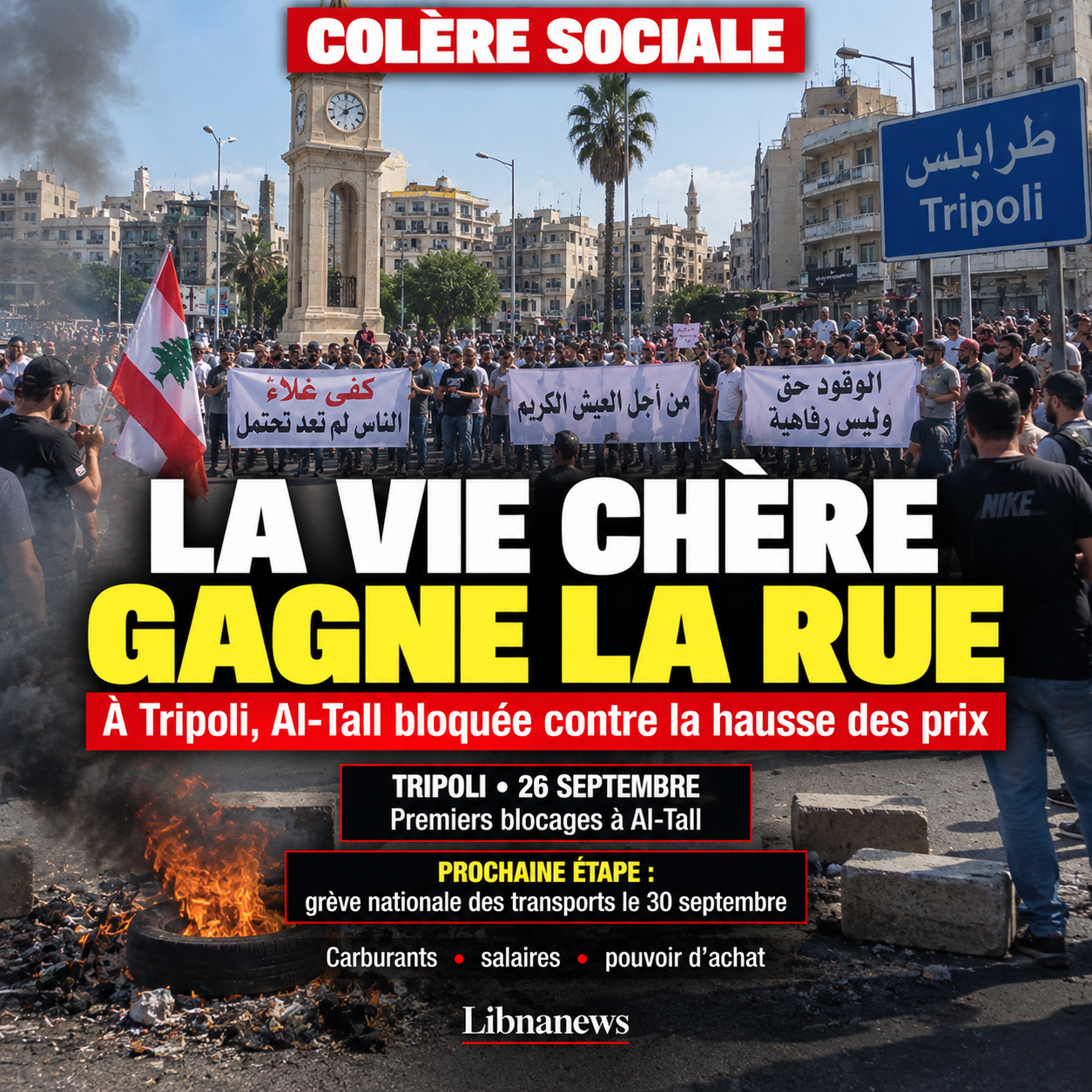
The first mobilizations announced against expensive living began Saturday, 26 September in Tripoli, where demonstrators blocked the road at Al-Tall Square to protest against the deterioration of living conditions and the rise in fuel prices. The gathering had been prepared by several trade unions and professional organizations in Northern Lebanon, in a climate of growing discontent at the rising cost of transportation, food and current expenses. The movement takes place a few days away from a national road transport strike scheduled for Wednesday 30 September and while the General Workers’ Union envisages a series of actions in several regions of the country.
The social challenge is beginning to take shape in Lebanon. On Saturday morning, several demonstrators cut off traffic at Al-Tall Square in the centre of Tripoli to denounce the deterioration of living conditions and the continued rise in fuel prices. The blockage, reported shortly before 11 a.m., is the first translation on the ground of a mobilisation prepared for several days by trade unions, workers and representatives of economic sectors in Northern Lebanon.
Tripoli’s choice is not fortuitous. The city had already experienced a first mobilization on 19 September, when bus and minibus drivers blocked access to Abdel Hamid Karamé Square, known as Al-Nour Square, to protest the increase in fuel. The organizers then presented their movement as a warning to the government and announced an escalation in the absence of measures to contain rising costs.
A week later, the mobilization went beyond the transport sector alone. Saturday’s gathering in Al-Tall was announced following a meeting of union representatives, employers, workers and student parent committees. The participants had decided to establish a common advocacy front around purchasing power, fuel, prices and economic difficulties faced by the people of Tripoli and Northern Lebanon.
In Tripoli, rising fuels triggers mobilization
The increase in fuel is the immediate factor in the challenge. On 22 September, a further increase had brought the price of 20 litres of petrol to 95 octanes at 2,834 million Lebanese pounds, compared with 2,718 million a week earlier. Gasoline at 98 octanes was £2.852 million, fuel oil at £2.823 million and gas can at 1.249 million.
Evolution is particularly rapid. On 15 September, the equivalent litre of a plate of 20 litres of 95 octanes gasoline was still costing 2,718 million pounds and the fuel oil 2,641 million. In one week, the price of fuel oil had increased by 182,000 pounds, while the price of petrol at 95 octanes had increased by 116,000 pounds.
For transport professionals, these increases directly affect the cost of their activities. Drivers of taxis, bus drivers, minibuses and trucks are seeing their spending increase while the revenues of users remain under pressure. An increase in transport tariffs would offset some of the cost of fuel, but would carry this burden over to households with fragile purchasing power.
This explains why drivers were among the first to get off the street. During the mobilization in Tripoli on 19 September, Shadi al-Sayyed, president of the Union of Workers’ and Employees’ Union of Northern Lebanon, warned that the movement could be followed by blockages on the main roads of the country.
Saturday’s rally shows that the protest did not extinguish after this first warning.
A mobilization prepared for several days
The action in Al-Tall was prepared on Friday at a union meeting in Mina, Tripoli. It had included the Union of Employers, chaired by Ahmad Fayçal al-Baqqar, the Union of Workers’ Unions and Employees of Northern Lebanon, headed by Shadi al-Sayyed, as well as representatives of workers and parents’ committees.
Participants called for a rally on Saturday at Jamal Abdel Nasser Square, better known in Tripoli as Al-Tall Square. Their claims are not limited to fuel. They also cover general price increases, taxes and levies, low wages and insufficient market controls.
The organizations meeting in Tripoli requested a review of certain taxes and charges and a strengthening of price monitoring. In particular, they denounce the increases which they consider unjustified and call on the authorities to intervene against speculative practices.
Trade representatives are also concerned about the impact of the crisis on local activity. When purchasing power declines, households reduce their spending, which directly affects businesses and small businesses. In Tripoli, where a significant part of the economy is based on these activities, the increase in energy costs thus produces effects that far exceed service stations.
The challenge against expensive life widens
The movement observed on Saturday in Tripoli takes place in a broader national context. Several trade union and professional organisations have increased the warnings during the week in response to price increases.
On 21 September, the General Workers’ Union called for the immediate proclamation of a « state of economic emergency ». His president, Béchara Asmar, had denounced what he described as price disruption, with particular reference to fuel and food.
The trade union organisation requests the convening of the Index Commission to review wages and transport allowances. She also called for increases, family allowances and school grants to be paid to workers in the public and private sectors.
The Union also calls for an evolving mechanism for electricity tariffs to take account of the situation of the poorest households and industrial enterprises. At the same time, it calls for more controls by the Ministry of Economy.
Its Executive Council is scheduled to meet on Saturday 26 September to determine the next forms of mobilization. The options announced include a warning strike, rallies and coordinated actions in different regions.
The Tripoli movement is therefore taking place at the very moment when the main trade union organizations are considering an expansion of the dispute.
Road transport calls for a national strike on 30 September
A first national deadline is already set. The road transport unions announced a general strike and mobilizations throughout the country for Wednesday, 30 September.
The decision was taken this week at an extraordinary meeting chaired by Bassam Tleis on the consequences of fuel growth. Several sectors of transport were represented: truck drivers, tanks, refrigerated vehicles, buses, minibuses and taxis.
The unions consider that the increase in fuel is making it increasingly difficult to maintain their activity under current conditions. They also denounce other structural problems in the sector, including the competition they consider to be irregular and the lack of sufficient protection for public transport professionals.
The precise modalities of the national mobilisation must be announced on Tuesday 29 September at a press conference at the headquarters of the General Workers’ Union.
This deadline gives an additional dimension to the Tripoli rally. Al-Tall’s blockage is not yet alone proof of a national street movement. However, it intervenes in a sequence of mobilisations already planned and coordinated between several sectors.
Wages and transport at the heart of the purchasing power crisis
The issue of fuels is particularly sensitive because it has a rapid impact on the economy as a whole. Transport is involved in the price of goods, food and services. A prolonged increase in diesel and gasoline therefore increases business costs and can be gradually transferred to consumers.
For employees, the impact is double. They must bear directly the higher cost of their travel to their place of work while facing the price increases caused by higher transport and energy costs.
It is precisely for this reason that trade union organisations are calling for a revision of the amount of transport allowances and wages. They consider that income cannot remain unchanged as the daily cost of getting to work increases rapidly.
Public administration employees have also taken action. In particular, their movement is motivated by the decrease in the real value of the transport allowance in the face of an increase in fuel prices. Threats of further protest measures have been made if wage claims are not taken into account.
The discontent thus gradually brings together different categories: drivers, private employees, civil servants, traders, industrialists and families faced with the increase in current expenditure.
Tripoli, the first visible focus of the movement
At this stage, however, the mobilisation observed in Tripoli should be distinguished from an already widespread national movement. On Saturday late in the morning, the blocking of Al-Tall Square is documented, while several other actions remain announced or in preparation.
However, the social dynamics are wider than the only tripolitan gathering. Trade union organisations discuss national coordination, road transport has already set a day of strike and trade associations have warned that they could join the protests.
The challenge could therefore evolve rapidly in the coming days depending on the decisions taken by the General Workers’ Union and the government’s response.
Tripoli plays a pioneering role in this sequence. The city had already experienced the blockade of Al-Nour Square by drivers on 19 September. A week later, the protest moved to Al-Tall and gathered wider demands about living conditions.
This evolution is significant: fuel remains the immediate trigger, but the organizers’ speech now focuses on the entire purchasing power.
The government under pressure before a social week
Claims to the authorities are now specific. Trade unions call for price intervention, revision of wages and transport allowances, better market surveillance and measures to reduce energy costs for households and businesses.
The question is how the government will respond to these requests while its financial margins remain limited. Any compensation measures on fuels, transport or wages entail a budgetary cost, while the absence of intervention exposes households to a further deterioration of their purchasing power.
Trade union organisations are seeking to increase pressure. The General Workers’ Union must take its next decisions, while the transport unions have already chosen the date of Wednesday 30 September for their national strike.
The situation therefore remains evolving. No national movement comparable to the large waves of demonstrations that Lebanon has experienced in the past can yet be seen Saturday at midday. But the blocking of Al-Tall comes after several days of trade union warnings and on the eve of a week in which several sectors have already announced their intention to mobilize.
In Tripoli, the first concrete translation of this rise in protest is now visible in the city centre: the road to Al-Tall was blocked on Saturday morning, with the words of order the expensive life, the deterioration of economic conditions and the rise of fuels.