





Prime Minister Nawaf Salam defended on Friday 25 September before the UN General Assembly a line articulated around two objectives which he presents as inseparable: to recover the entire Lebanese territory still occupied by Israel and to restore the exclusive authority of the State in the territory, weapons and the decision of war and peace. In New York, the head of government also called for the cessation of Israeli attacks, the release of Lebanese prisoners, the reconstruction of destroyed areas and increased support for the army. He stressed the need to prepare the post-FINUL without creating a security vacuum in South Lebanon, while presenting the economic and institutional reforms undertaken by his Government.
Nawaf Salam used the rostrum of the 81st UN General Assembly to present the situation in Lebanon as a question of sovereignty to be rebuilt on several fronts. The Prime Minister did not limit his intervention to the conflict with Israel. It has placed within the same architecture Israeli withdrawal, arms monopoly, reconstruction, state reforms, relations with Syria and Lebanon’s place in its Arab and international environment.
The key to his speech is a responsibility that the government claims directly. Lebanon, he explained in substance, cannot ask the international community to assume the obligations of the Lebanese State. But it is waiting in return for other actors to fulfil their own obligations, especially when it comes to Israeli occupation and operations.
« The Lebanon that stands before you today does not evade its responsibilities and does not ask others to do what it has to do, » said Nawaf Salam.
This formulation summarizes much of his intervention: Beirut claims to want to regain control over its territory and its national decision, but calls for this step to be accompanied by Israeli withdrawal and international support for reconstruction and State institutions.
Salam places sovereignty at the centre of his speech
The Prime Minister presented the recovery of the national decision as one of the key responsibilities of the state. For him, this sovereignty begins with the absence of arms and military authority beyond legal institutions.
Salam thus reaffirmed the principle that arms should be held exclusively by the State. The decision on war and peace must also rest with the Lebanese constitutional institutions alone.
This position is directly part of the debate on the Hezbollah arsenal, even when the movement is not systematically named. Since his arrival at the Grand Sérail, Nawaf Salam has been defending with President Joseph Aoun the principle of a State with legitimate armed force alone.
At the UN, however, the Prime Minister placed this issue in a broader view of sovereignty. Lebanon must recover its national decision, but also its entire territory.
The two objectives were presented in the same speech: no parallel military authority should compete with the state within it, and no foreign occupation should remain in the territory.
« Recovering our entire territory »
The Israeli side played an important role in the intervention. Nawaf Salam called for an immediate halt to Israeli attacks and Israel’s withdrawal from all Lebanese territory.
He also called for the release of Lebanese prisoners detained by Israel, claiming that they would not be « forgotten or abandoned ».
The Prime Minister called for the full implementation of Security Council resolution 1701. Adopted in August 2006, it has been one of the main international frameworks governing the situation in South Lebanon and the border with Israel for twenty years.
The situation has changed dramatically since the open war between Israel and Hezbollah. The ceasefire of 27 November 2024 provided for the withdrawal of Israeli forces and the further deployment of the Lebanese army to the south. However, Israeli hostilities and operations have not completely ceased.
Since then, Beirut has consistently called for Israeli withdrawal from the positions still occupied and denounced the attacks on Lebanese territory.
Salam has repositioned these requests internationally. His Government believed that the return to complete sovereignty could not only concern Hezbollah’s weapons; it must also lead to an end to the Israeli military presence and attacks on Lebanon.
Post-FINUL programme
The speech also addressed the future of the international presence in South Lebanon.
Nawaf Salam had already indicated in New York that his Government was preparing for the period following the end of the UNIFIL mandate. Before the General Assembly, he reaffirmed the importance of avoiding a security and institutional vacuum in the region.
The Government hopes that an international presence can continue to perform certain monitoring, reporting and communication functions under the authority of a Security Council resolution.
This issue becomes particularly sensitive as the Lebanese army assumes more responsibilities in the South. At the same time, Beirut calls for the strengthening of its military capabilities so that it can provide defence and territorial control alone in the long term.
Salam thus called on Lebanon ‘ s international partners to provide the armed forces with the means necessary to carry out their missions.
This request is in line with the statements of President Joseph Aoun. Former commander of the army, he again said this week that the weapons of the military institution were the only legitimate weapons in Lebanon.
Rebuilding destroyed villages
Sovereignty, however, is not limited in Salam’s speech to military control of the territory. The Prime Minister devoted an important part to reconstruction.
The destruction caused by Israeli operations has affected villages, homes and infrastructure in several areas, particularly in South Lebanon. The sustainable return of the inhabitants therefore depends on the reconstruction of housing and the restoration of essential services.
Salam called for international mobilization for this project.
For the government, reconstruction also fulfils a political function. The State must be able to return materially to border regions through its administrations, infrastructure, public services and army. The return of the population must accompany this process.
The Prime Minister therefore linked reconstruction, return of the inhabitants and restoration of public authority.
He recalled that Lebanon did not ask its partners to replace him. It calls on them, on the other hand, to contribute to the financial means necessary for a recovery whose cost exceeds the current capacity of a State still facing the consequences of several years of economic crisis.
Banking, justice and anti-money laundering reforms
Nawaf Salam also devoted a substantial part of his intervention to the internal situation.
He presented the measures undertaken to lift the country out of the financial crisis and restore confidence in institutions. The Prime Minister referred to the restructuring of the banking sector, financial consolidation, modernization of the administration and the fight against corruption.
He also stressed the independence of the judiciary and the strengthening of mechanisms to combat money-laundering and the financing of terrorism.
These issues are directly related to Lebanon’s discussions with its international partners and financial institutions. The Government seeks to show that the support requested from the international community is accompanied by domestic reforms.
Salam presented these transformations as a condition for restoring confidence between the Lebanese and their State, but also between Lebanon and its foreign partners.
His message here echoes that developed throughout his trip to New York: the government wants to emerge from a logic in which Lebanon seeks external assistance without changing the functioning of its institutions.
Syrian internally displaced persons also mentioned
Another aspect of the speech was the Syrian issue.
Nawaf Salam recalled the importance to Lebanon of the presence of a very large number of Syrian internally displaced persons in relation to its population. He defended continued work with the United Nations and with the new Syrian authorities to enable them to return.
The Prime Minister also referred to the direct discussions between Beirut and Damascus, as well as the mediation and accompanying Saudi Arabia on certain bilateral issues.
The stated objective is twofold: to enable Syrians in Lebanon to return to their country in secure conditions and to rebuild Lebanese-Syrian relations on a different basis from previous decades.
Salam wants to put these relations in a state to state logic. This formula joins the one he used the previous day in his meeting with Iranian President Massoud Pezeshkian.
After Iran, the reminder of the principle of non-interference
The day before his speech, Nawaf Salam had met Massoud Pezeshkian in New York. He had told him that Lebanon no longer wanted to be an arena for regional conflicts or a place used for the exchange of messages between powers.
Salam had also called for a Lebanese-Iranian relationship « from State to State », based on sovereignty, independence and non-interference.
His address to the General Assembly extended this line without turning the rostrum into a settlement of accounts with Tehran.
Priority remains the restoration of the Lebanese decision. The message therefore addresses both external actors and Lebanese political forces: choices concerning war, peace, security and international relations must be made by the institutions of the Republic.
This approach is of particular importance at a time when Iran is negotiating with the United States and includes Lebanon among the regional fronts that it is seeking to calm down.
On the contrary, Beirut seeks to ensure recognition that the Lebanese case must be dealt with first through State institutions.
Solidarity with Arab countries in the face of Iranian attacks
Salam also addressed the tensions caused by Iranian operations in the region.
The Prime Minister expressed Lebanon’s solidarity with the Gulf States and with Jordan in the face of Iranian attacks. He highlighted the risks they pose to regional security as well as to the freedom and security of maritime navigation.
This position is significant in the context of the confrontation between Washington and Tehran and the closure of the Strait of Ormuz.
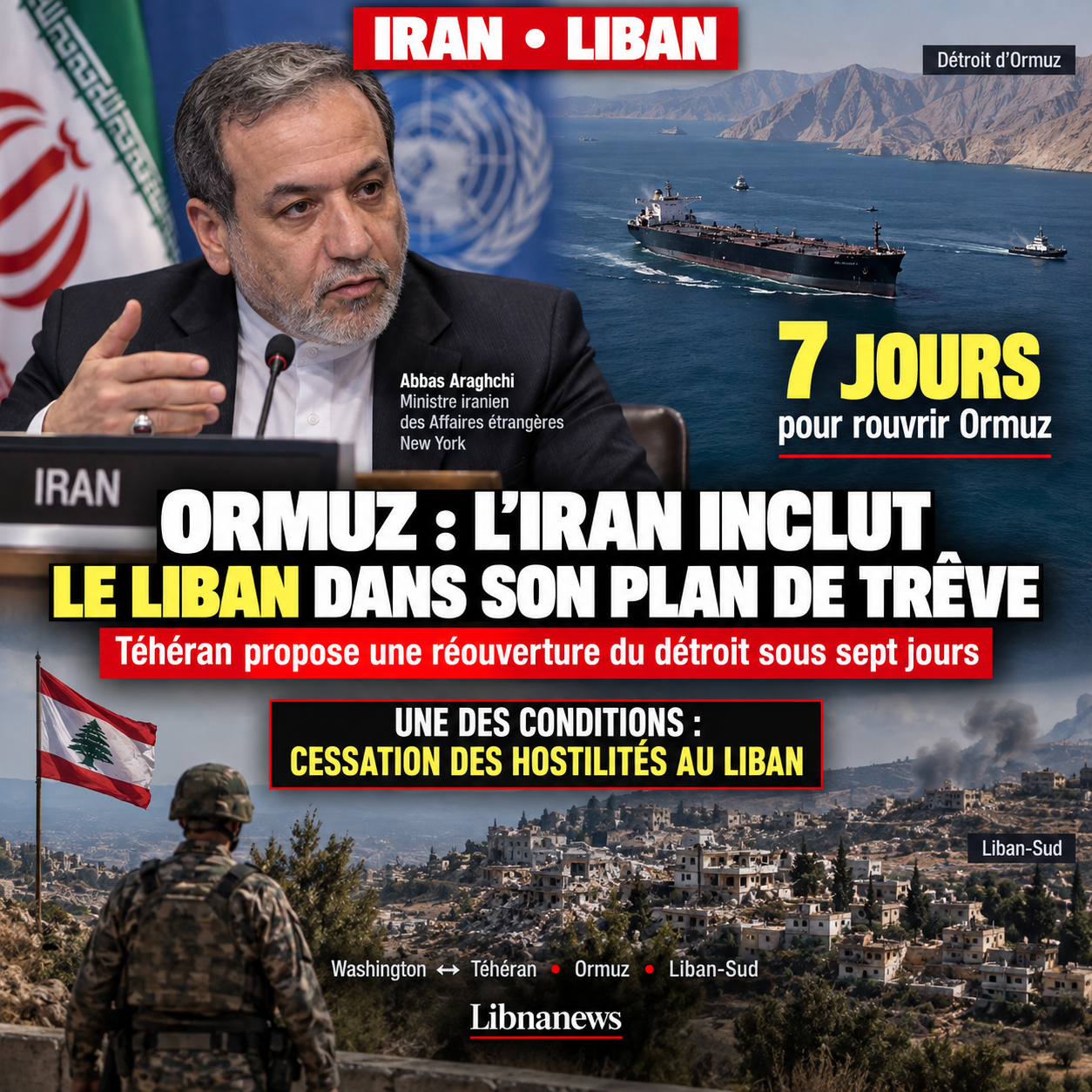
Iran has just proposed to the United States a road map to reopen Ormuz within seven days, including a cessation of hostilities in Lebanon.
The Salam government is also seeking to strengthen Lebanon’s relations with the Arab Gulf countries after several years of diplomatic and political tensions.
Palestine and the two-State solution
The Prime Minister also put the Israeli-Palestinian conflict in his speech.
He defended a lasting and just solution based on international resolutions and the two-State principle. Salam referred to the adoption of the New York Declaration and the majority obtained in the General Assembly in favour of that orientation.
The Head of Government has associated Lebanon’s stability with that of its regional environment. Therefore, a lasting settlement in the South cannot be completely isolated from the Palestinian question and the evolution of the Arab-Israeli conflict.
At the same time, Lebanon continues to reject any permanent settlement of Palestinian refugees in its territory.
« Don’t leave Lebanon »
Nawaf Salam finished his speech by going back to the contrast between the project defended by his government and the daily reality of a country still under war.
He recalled that he spoke of peace before the General Assembly as Lebanese continued to be killed and parts of the territory continued to be destroyed.
The Prime Minister presented the alternative in simple terms: either Lebanon regains its vocation as a country of life, freedom and pluralism, or it remains a field of wars and confrontations that transcend it.
His government, he said, has made his choice.
His last appeal addressed directly to the Member States of the United Nations: « Be with us. Don’t leave Lebanon. »
This request summarizes the political contract that Salam sought to present in New York: Lebanon asserts that it itself wants to take over the restoration of its state, its authority and its national decision, but calls in return for the international community to contribute to Israeli withdrawal, security in the South, the strengthening of the army and reconstruction.
Speech by Nawaf Salam: Comprehensive restitution
The following restitution reproduces the whole of the themes and the substantial progress of Nawaf Salam’s intervention before the General Assembly, without reproducing word for word the published text.
Nawaf Salam opened his speech with a reflection on trust. Without mutual trust, he explained, peace and security could not settle permanently between States and cooperation could not develop. It links this idea with the situation in Lebanon and the need to simultaneously rebuild trust between the State and the citizens, between the Lebanese themselves and between Lebanon and its international partners.
The Prime Minister then presents the responsibility of his government. Lebanon, which addressed the General Assembly, he explained, did not intend to evade its obligations or to ask other countries to do what was the responsibility of the Lebanese authorities. The State must recover its national decision and exercise its authority over the whole territory. Weapons, as well as the decision on war and peace, must be the exclusive responsibility of the State and its institutions.
Salam immediately associates this internal responsibility with an external requirement. Lebanon must recover its entire territory still under Israeli occupation. Israeli attacks must stop and Israel must withdraw from the positions it maintains on Lebanese territory. Lebanese prisoners detained by Israel must also be released. The Prime Minister assures that they will not be forgotten or abandoned.
He then called for the full implementation of Security Council resolution 1701 and addressed the role of UNIFIL. The international presence in the South has accompanied the army for a decisive period, but Beirut must now prepare for the next phase. Salam refused to allow a vacuum to appear after the end of the mandate of the international force. It therefore calls for a formula to maintain international monitoring, reporting and communication functions under the authority of the Security Council, alongside the strengthening of the responsibilities of the Lebanese army.
As such, the Head of Government calls for increased support for the armed forces. The army must have the material means to exercise control over the territory and to defend the country. This rise in power must accompany the extension of State authority and allow legal institutions to assume security and defence functions alone.
Then Salam goes to the reconstruction. Israeli operations have destroyed houses, villages and infrastructure that are essential for the return of the State and people to border areas. Reconstruction thus becomes a condition for the sustainable return of the inhabitants and the stabilization of the South. The Prime Minister calls on Lebanon’s partners to contribute to international initiatives and conferences to finance this reconstruction and to strengthen the armed forces.
He then extended his remarks to the internal situation. Lebanon, he said, had embarked on an economic and financial recovery programme. This requires greater transparency, restructuring of the banking sector, modernisation of the administration and the fight against corruption and organised crime. The government wants to restore the confidence of citizens in the state and that of international partners in Lebanon.
The Prime Minister also mentioned the strengthening of the independence of justice and the consolidation of institutions. For Nawaf Salam, the restoration of state authority is not limited to security issues or arms control. It also involves institutions capable of enforcing the law, guaranteeing the rights of citizens and restoring confidence deeply affected by successive crises. Economic recovery and institutional reconstruction are thus presented as two dimensions of the same project: rebuilding a State capable of fully exercising its responsibilities.
In this context, Salam stresses the need to continue the reforms undertaken by his Government. Lebanon is emerging from several years of financial, monetary and institutional crisis that have severely weakened public administration and essential services. The Head of Government presents economic and financial measures not as an isolated objective, but as a condition for the restoration of the State. The restructuring of the banking sector, financial transparency and the fight against corruption must, in particular, help to restore stronger relations with international institutions and partners that could accompany the country’s recovery.
Reconstruction of the South as a national priority
Nawaf Salam then goes back to the human and material consequences of the war. It refers to displaced populations, destroyed or damaged villages and affected infrastructure. For the Government, the reconstruction of the South Lebanon cannot be separated from the restoration of sovereignty. The sustainable return of the inhabitants requires their security, the restoration of public services and the exercise of State authority in border areas.
In this context, the Prime Minister calls on the international community to support Lebanon in its reconstruction effort. The needs exceed the state’s current financial capacity, already facing the consequences of a prolonged economic crisis. Salam therefore presents international aid as a necessary element to enable the affected populations to regain their villages and livelihoods, but also to prevent the destruction left by the war from becoming a new source of instability.
However, this reconstruction must be carried out under the authority of the State. The Government intends to retain ownership of projects, funding and priorities so that the recovery of the affected regions will accompany the return of public institutions. This approach joins the line defended by Salam since his arrival at the head of government: reconstruction must not lead to the restoration of structures parallel to those of the state.
Salam insists on the return of displaced persons
The question of the return of the inhabitants also occupies an important place in the Prime Minister’s speech. Many families from border areas have been displaced by fighting, bombing and destruction. Some have been able to return to their communities, while others remain confronted with the condition of their homes, the lack of essential services or a security situation that remains unstable.
For Salam, their return cannot be sustainable as long as the conditions that caused their displacement persist. It therefore directly associates this issue with the Israeli withdrawal, the cessation of military operations and the actual deployment of the Lebanese army. The government wants people to be able to return under the protection of national institutions, not in an environment where the risk of a new confrontation would remain permanent.
The Head of Government places the humanitarian issue at the centre of the security agenda. Behind the border negotiations, arms and international mechanisms are communities whose villages have suffered direct war. Their return is one of the criteria for measuring the success of a possible settlement in South Lebanon.
After FINUL should be prepared
Nawaf Salam also addresses the future of the international presence in South Lebanon. The planned withdrawal of the United Nations Interim Force in Lebanon opens a delicate period for Beirut. UNIFIL has been present in the South since 1978 and its role has been significantly strengthened after the 2006 war by Security Council resolution 1701.
The Prime Minister warns against creating a security vacuum after his departure. The Lebanese government wants the transition to be organized in such a way as to enable the army to gradually strengthen its control over the area while maintaining international support. Salam thus defends the maintenance of a United Nations presence in an appropriate form and under the authority of the Security Council.
The stated objective is to prevent a reduction in the international presence from weakening the border at the same time as the State seeks to extend its authority. The army must be able to resume the necessary missions, but this rise in power requires personnel, equipment, funding and external support. The government therefore asks its partners to continue to assist the military institution.
Army at the centre of the restoration of sovereignty
The role entrusted to the army is one of the driving threads of Nawaf Salam’s speech. The Prime Minister presents the military institution as the main tool of the state to restore its authority throughout the territory. Its deployment to the South must accompany the Israeli withdrawal and allow Beirut to assume direct responsibility for the security of the border areas.
This mission joins the position defended by President Joseph Aoun. The Head of State again said this week that military weapons were the only legitimate weapons. Aoun and Salam thus converge on the principle of a State having only the right to hold arms and decide on war and peace.
This orientation directly concerns Hezbollah, even when the movement is not systematically named. Its arsenal is the main organized military apparatus outside state control. The government wants to progressively end this duality, while saying that it wants to avoid an internal confrontation that could threaten civil peace.
Salam’s speech at the United Nations puts this issue in a broader context. The arms monopoly is not presented separately from the Israeli withdrawal, the cessation of attacks and the strengthening of the army. The Government defends these objectives as the various components of the restoration of Lebanese sovereignty.
Lebanon refuses to return to confrontation
The Prime Minister also returns to Lebanon’s place in regional conflicts. His message extends the message he had sent to Iranian President Massoud Pezeshkian during their meeting in New York: the country no longer wants to be used as a battlefield or as a space for outside powers to exchange messages.
This position is of particular importance as Lebanon appears again in the discussions between Iran and the United States. Tehran included a cessation of hostilities in Lebanon as one of the conditions presented in Washington in its plan to end the war and reopen the Strait of Ormuz.
For the Salam Government, sovereignty requires that decisions on Lebanon be taken by its institutions. Beirut seeks to prevent the southern or Hezbollah dossiers from becoming merely elements of wider negotiations between Washington, Tehran and Israel.
The Prime Minister therefore defends his own Lebanese diplomacy, based on international resolutions and the interests of the State. This line does not mean that Beirut can avoid regional power relations. Rather, it aims to prevent them from determining the country’s future alone.
Syria and the relationship between the two states
Nawaf Salam also addresses relations with Syria, another major issue for the Lebanese government. Beirut seeks to rebuild its relations with Damascus on a basis different from those which marked decades of relations between the two countries. The Government defends an institutional relationship between States based on respect for their respective sovereignty.
Several cases remain to be resolved. These include border, missing persons, detainees and security issues. Lebanon also wants to avoid the use of border areas for arms, drugs or other illegal activities that could undermine both countries.
The stabilization of Syria is also of direct interest to Lebanon. Since the beginning of the Syrian conflict in 2011, the country has hosted a very large number of refugees. Their presence has put additional pressure on infrastructure, public services and an already weakened economy.
Salam returns to the Syrian refugee issue
The Prime Minister reaffirms to the UN the need to move forward on the return of Syrian refugees. Beirut considers that developments in Syria now make it possible to address this issue in a context different from that of the war years.
The Government of Lebanon calls for the international community to accompany returns rather than focus its assistance on maintaining refugees in Lebanon on a sustainable basis. It hopes that funding can also support their resettlement to their regions of origin and contribute to the reconstruction of the necessary infrastructure in Syria.
Salam puts this in Lebanon’s limited capabilities. After several years of economic collapse, the state has limited resources to provide essential services to its own population. The long-term presence of a large refugee population So, according to Beirut, a burden that the country cannot assume indefinitely.
However, the issue remains framed by international requirements regarding the safety and voluntary nature of returns. In doing so, the government seeks to accelerate the process while securing international support to make it sustainable.
Palestine and the two-State solution
The Prime Minister also devotes part of his intervention to the Palestinian question. It reaffirmed Lebanon’s support for the right of Palestinians to have a state and a political solution based on international law and United Nations resolutions.
This position is part of the traditional diplomatic line of Beirut. Lebanon supported the establishment of an independent Palestinian State and rejected any solution that would lead to the final settlement of Palestinian refugees in its territory.
The issue is particularly sensitive in Lebanon because of the presence of Palestinian camps and several hundred thousand refugees registered over the past decades. Beirut therefore continues to link the establishment of a Palestinian State to the settlement of the refugee issue in accordance with international resolutions.
Salam also stressed the need to put an end to the wars that affected civilian populations in the region. Lebanon, directly affected by the consequences of successive Israeli-Palestinian conflicts, considers a lasting settlement of the Palestinian question to be a condition of regional stability.
Lebanon calls for concrete international support
Beyond the various crises, Nawaf Salam uses the UN rostrum to call on Lebanon’s partners to turn their political support into concrete aid. The needs concern simultaneously the army, reconstruction, public institutions and economic recovery.
In particular, the government is seeking additional resources for the army. Its deployment throughout the country requires equipment, infrastructure and human resources, the funding of which remains difficult in the current budgetary context.
Another major need is reconstruction. The destruction accumulated in the South exceeds the immediate possibilities of the Lebanese Treasury. Without external funding, the return of residents and the rehabilitation of villages could take several years.
Salam therefore seeks to convince international partners that support for Lebanon must not only respond to a humanitarian emergency. It is intended to strengthen State institutions so that they can gradually assume the functions now weakened by the economic crisis, war and political divisions.
Sovereignty declined on several fronts
The whole discourse is thus structured around the same notion: sovereignty. Nawaf Salam applies to the territory, arms, institutions, justice, borders and relations of Lebanon with foreign powers.
At the territorial level, it presupposes Israeli withdrawal and control of the whole country by Lebanese institutions. Militaryly, it implies a state monopoly on weapons. At the institutional level, it requires an administration, justice and a financial sector capable of operating according to clear rules.
At the diplomatic level, finally, Salam wants Lebanon to maintain State-to-State relations with its neighbours and regional powers. This approach had already been formulated the day before at his meeting with Massoud Pezeshkian, when he called for the opening of a new stage in relations with Iran based on sovereignty, independence and non-interference.
The Prime Minister does not present these various projects as completed. Several remain at the stage of political decisions or negotiations. The army has not yet exercised control alone of all the weapons in Lebanon, Israel maintains a presence and continues operations in the territory, the reconstruction of the South remains incomplete and the economic reforms have yet to be fully implemented.
It is precisely on these files that Salam seeks international support. His intervention in New York presents the return of the state as the common framework within which the government wants to treat security, reconstruction and economic recovery simultaneously.
The next step will be played mainly in the field. Beirut will have to achieve progress on the Israeli withdrawal, strengthen the deployment of the army to the South and clarify the modalities of the arms monopoly, while Hezbollah maintains its own conditions for any change in its military status. At the same time, the Government will have to find the necessary funding for reconstruction and continue the reforms promised to Lebanese and international partners.