





An American promise on two precisely identified sectors
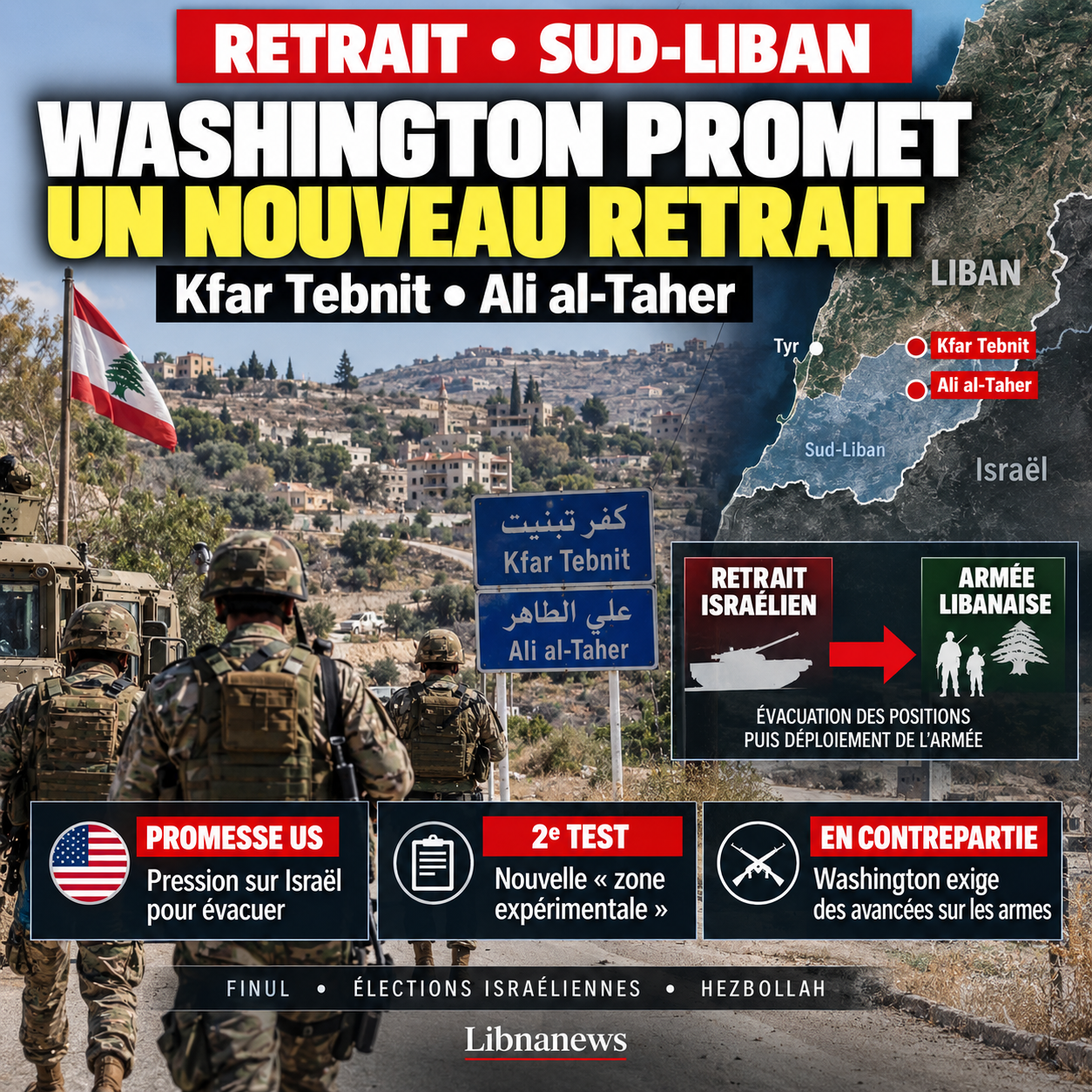
The southern issue is no longer limited to an abstract discussion of a possible Israeli withdrawal. Contacts were held with the United States on a new territorial operation involving Kfar Tebnit and Ali al-Taher. Washington would have promised to exert pressure and support for the Israeli forces to withdraw from this new area. The Lebanese army would then enter the evacuated areas to deploy and exercise State authority. The project is presented as a new « experimental zone », built on the model of the first negotiation experience.
This precision changes the nature of the information. This is not a general American declaration in favour of Lebanese sovereignty. Two locations are identified and an operational sequence is described. Israel should first evacuate the positions concerned. The Lebanese army would then take over. Washington would intervene to get this Israeli movement. The immediate issue is therefore whether this American promise will be followed by a concrete change in the military map.
The project comes at a time when the negotiation process is in a state of stagnation. The first experimental phase did not create the expected fast chain. Yet the Lebanese army has extended its control over vast areas of the Tyre Caza. The reasoning of the Lebanese authorities now consists in using this progression to claim a consideration. If the army assumes its responsibilities, Israel must in turn abandon new positions.
One point is particularly emphasized: the army does not need the permission of any party to enter Lebanese territory and deploy its authority there. This statement refers directly to the debate on the conditions for withdrawal. For Beirut, the deployment of the army on its own territory cannot be subject to Israeli authorization. The problem is the prior occupation of positions and not the legitimacy of the army to take them back.
Kfar Tebnit and Ali al-Taher thus become much more than two points on the map. They must determine whether the negotiated mechanism can still produce successive withdrawals or whether the first experiment will remain unextended.
The first experimental zone at the heart of the arm
The difficulty comes in particular from the totally opposite interpretation that Beirut and Israel give of the first experience. Israel sent Washington a negative assessment of its results. According to the Israeli version communicated to the Americans, several Hezbollah members and cadres reportedly returned to the first area after his evacuation. This charge is used to challenge the effectiveness of the scheme and to justify the reluctance to move quickly to a second experiment.
Lebanon rejects this version. He considered the Israeli accusations to be inaccurate and considered that they were intended to defeat the negotiating process, consolidate the occupation and possibly prepare a return to wider confrontation. The Lebanese Army itself provided a detailed response to challenge Israeli claims about what happened in the first area.
This dispute is fundamental to understanding Kfar Tebnit and Ali al-Taher’s case. The discussion is not just about Israel’s willingness to leave two new sectors. It deals with the very balance sheet of the mechanism already tested. If Washington accepts the Israeli argument that the first experiment did not work, it may require more guarantees before any further evacuation. If, on the contrary, it considers that the Lebanese army has properly fulfilled its mission, it has an argument to ask Israel to proceed to the next phase.
The new experimental zone would therefore be as much a Lebanese Army test as a US mediation test. It would help to ascertain whether Israeli accusations constituted a lasting obstacle or whether Washington was prepared to overcome them. This is where America’s promise of pressure makes sense. It suggests that contacts have not been interrupted despite the dispute over the first area and that a second sequence remains to be considered.
This version battle is also a battle on the calendar. Israel can use any challenge to the first experiment to delay the second. On the contrary, Beirut seeks to demonstrate that the device is working and that the delay is no longer justified. In between, Washington must decide what reading it takes and what additional guarantees it requires.
What Washington is really asking for in Lebanon
However, the American position seems more demanding than the promise of a new withdrawal would suggest. In Washington, questions are being asked about why the army is not heading more directly to some Hezbollah military depots and sites in the south. The American questions go beyond this region. They also concern the presence of weapons in the Beirut area, considered to have a more internal function than a function directly linked to confrontation with Israel.
This geographical extension is important. It shows that, for part of the US administration, the problem does not stop at the border or even south of the Litani. The issue is the effective state monopoly of weapons. Washington therefore does not only want the army to replace Israeli forces in the evacuated areas. It awaits measures to demonstrate that the State authority also extends to Hezbollah’s military infrastructure.
A particularly hard American line is reported in the discussions with Lebanese visitors: no significant aid to the State should be granted before concrete measures are taken on the ground. In this context, the Israeli withdrawal would be directly linked to the Lebanese State’s ability to impose its authority. The idea that Washington would pressure Israel to leave Lebanon without prior and decisive actions by the army is even described in these exchanges as an illusion.
This position creates a tension with the promise concerning Kfar Tebnit and Ali al-Taher. On the one hand, Washington would have agreed to push Israel for another evacuation. On the other hand, US officials are making progress conditional on additional Lebanese results. The negotiation is precisely about bringing these two logics together.
The American reading of regional security has also reportedly changed since 7 October. Previous patterns would no longer be considered sufficient in either Gaza or Lebanon. For Washington, security assurances must now be more concrete and more easily verifiable. This explains why the issue of weapons depots, military positions and the real authority of the army takes such a place in the discussions.
Israeli withdrawal becomes a political counterpart
For Beirut, accepting this logic without Israeli counterpart would be politically dangerous. The government has already affirmed its commitment to the arms monopoly and the deployment of the army. It must therefore be able to show that every progression in the state also leads to a decline in occupation.
This would be precisely what a withdrawal of Kfar Tebnit and Ali al-Taher would represent. It would allow the Lebanese government to present a tangible sequence: army progression, American negotiation, Israeli withdrawal, and new deployment. The operation would thus provide an argument to negotiating supporters against those who consider that the process imposes obligations on Lebanon without sufficiently altering the Israeli presence.
The problem is that Israeli demands remain high. The public position of Israeli leaders is to link a broader withdrawal to the treatment of Hezbollah’s military capabilities. The Israeli authorities also refuse to consider the framework agreement as an obligation automatically leading to the prompt evacuation of all positions.
This discrepancy explains why the application of the text slowed down after the first phase. Lebanon believes that it has fulfilled its commitments by deploying the army to the experimental zone. Israel believes that the security outcome is not satisfactory. Washington then tries to build a new limited stage to avoid the collapse of the process.
The Kfar Tebnit and Ali al-Taher projects should be included in this framework. It is not yet the second general phase of withdrawal. It is more like an attempt to demonstrate that the method remains viable despite Israeli accusations.
Eighth negotiating session suspended in Israeli elections
Another uncertainty concerns the next formal meeting. Nawaf Salam asked whether an eighth round of Lebanese-Israeli negotiations would be convened in October or whether it would be postponed until after the Israeli elections. This issue should be addressed directly with US Secretary of State Marco Rubio.
The calendar is not secondary. An idea had circulated around an eighth session, sometimes referred to as « Rome 3 », during the first week of October. In particular, the aim was to prevent the framework agreement from giving the impression of having entered a phase of diplomatic coma. But this possibility encounters obstacles related to the Israeli electoral campaign.
Benjamin Netanyahu has little incentive to make a withdrawal likely to be presented by his opponents as a concession a few weeks before the election. The Lebanese issue is therefore part of Israeli domestic policy calculations. A measure that could be negotiated in another period becomes more difficult when each territorial movement can be exploited in the campaign.
This situation also explains the tendency observed in several western capitals. The results of the elections are closely monitored. The hypothesis of a return from Netanyahu coexists with that of a recomposition around personalities like Gadi Eisenkot. But Lebanese officials are themselves encouraged not to overestimate these scenarios. A change of majority would not automatically guarantee a change of doctrine on the south.
For Lebanon, however, waiting for the vote is a cost. Military operations continue. Residents are prevented from returning normally to several areas. Reconstruction remains suspended from security. Each postponement of negotiations therefore extends a situation that is not merely diplomatic.
The framework agreement threatened by increasing conditions
The real danger is that the framework agreement will gradually change its nature. Designed to organize a crisis exit, it risks becoming a space where new conditions are added before each step. Negotiations do not disappear, but they cease to produce a regular movement.
The Lebanese side considers that the agreement should lead to Israel’s complete withdrawal. Some officials also assure that Donald Trump remains committed to this goal. But between the principle and the execution, several cases came to interpose: assessment of the first experimental zone, Hezbollah weapons, deployment of the army, Israeli elections, the future of the Final and international conditions of aid in Lebanon.
International support itself becomes conditional. The significant participation in the preparatory meeting dedicated to support the army in Paris confirmed that Lebanon remains monitored by its partners. But the lack of immediate financial results also sent a message: aid is no longer considered automatic. Foreign capitals want to see concrete measures before mobilizing more resources.
This logic directly affects the army. He is asked to extend his control even when its strengthening depends in part on international support conditional on the results it must produce. The mechanism can therefore become circular: more missions are requested from the army to unblock aid, while more assistance is needed to carry out these missions on a sustainable basis.
The terrain continues to deteriorate during the discussions
While negotiations are seeking a new experimental zone, Israel continues its operations. Strikes and destruction have affected several parts of the south. Kfar Tebnit herself appears in the geography of military operations. Other localities and sectors, including Kfar Shuba, Beit Yahoun, Qantara, Tallousa and Mansouri, remain under heavy pressure.
This reality is essential. It means that negotiations are not conducted in a stabilized ceasefire situation. The territory discussed by diplomats continues to undergo military transformation. Houses are being destroyed. Agricultural areas are affected. The displacement of the inhabitants continues. The army must prepare for its deployment in areas whose infrastructure has sometimes been severely damaged.
The issue of withdrawal is therefore not limited to the departure of Israeli soldiers. The Lebanese army can recover an area whose houses, roads and services have been destroyed. The return of the State then involves a much wider operation of demining, security, reconstruction and restoration of services.
This dimension explains why the government insists on the return of the inhabitants and the parallel reconstruction of the military negotiations. A withdrawal that does not allow families to return produces only incomplete sovereignty. The result must be measured through the resumption of civilian life.
Finul adds a second deadline to the file
The problem becomes more complex with the planned end of the Finul mission. After 48 years of international presence south of the Litani, Lebanon must now prepare for the post-Final period while trying to secure Israeli withdrawal.
The search for a replacement force has not yet been completed. A Franco-Italian initiative is being studied. Several European countries have shown interest. Other States, including Asian States, could participate in an expanded formula. But the discussions are about the mission of this future force, its area of intervention, its capabilities and the security guarantees granted to its military.
The disagreement is deep. A European concept favours a presence essentially intended to maintain stability and support the army. A more demanding approach would like to give the new force a wider role in the extension of state authority, with possible implications north of the Litani. Troop-contributing countries want to know exactly what they will be asked to do before joining.
A technical extension of the Final for six months was mentioned to give time to negotiations. This possibility, however, finds American reluctance. Another avenue is to strengthen the role of international observers of the truce. Again, no final decision is taken.
The consequence for the withdrawal file is direct. If Kfar Tebnit, Ali al-Taher and other sectors are evacuated before the international transition, the army will be able to gradually consolidate its arrangements. If Israel retains its positions as the Finul begins to reduce its presence, the south may enter a period when security architecture becomes even more fragile.
An American promise to be judged on three results
The real content of the American promise can ultimately be assessed through three specific criteria. The first is the actual evacuation of Kfar Tebnit and d’Ali al-Taher. Without an Israeli movement, the commitment will remain a diplomatic assurance without territorial translation.
The second is the deployment of the Lebanese army. If Israel withdraws, the regular forces will have to be able to enter the sectors concerned immediately and establish lasting control. This deployment will also have to respond to the accusations made after the first experiment. The aim will be to show that the army can prevent the return of military structures escaping the state.
The third criterion will be the most important: the existence of a next step. If the new experimental area works but no further withdrawal is prepared, the process will remain blocked in a logic of permanent testing. If, on the contrary, Kfar Tebnit and Ali al-Taher quickly pave the way for a further evacuation, the framework agreement will regain momentum.
American credibility is at this level. Washington must not only convince Beirut to take difficult steps. It must also demonstrate that it can obtain the intended counterpart from Israel. Without this balance, the agreement may be seen as a mechanism where Lebanese bonds are immediately verified while Israeli withdrawals remain negotiable at each stage.
For the Lebanese authorities, the issue is equally important. They chose to rely on the US army, negotiation and mediation to gradually recover the territory. Kfar Tebnit and Ali al-Taher are now a concrete test of this strategy. If the withdrawal occurs, the government will have a verifiable result. If it remains suspended, the question will no longer be just when Israel will withdraw. It will focus on the very capacity of the framework agreement to transform diplomatic commitments into effective sovereignty.