

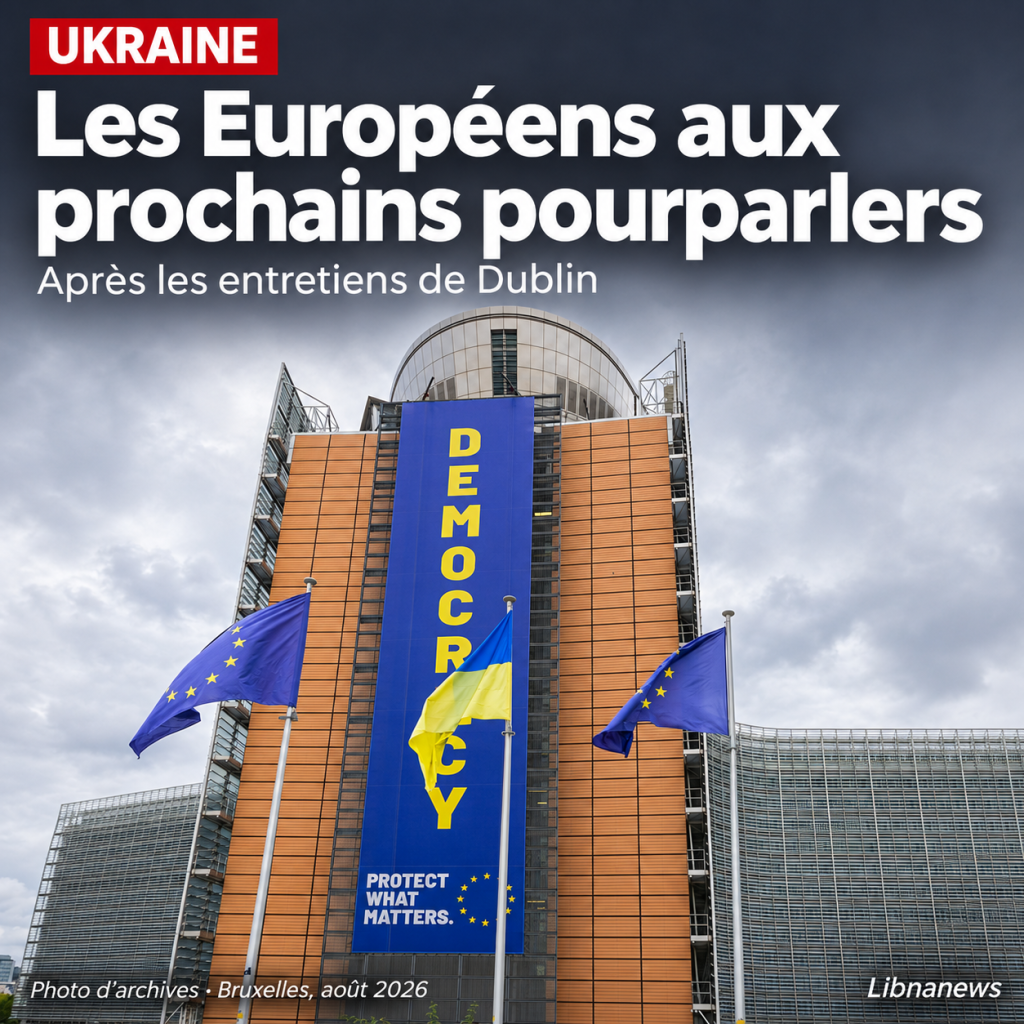
Europeans must participate more directly in the forthcoming talks on Ukraine. Volodymyr Zelensky announced this development after his meeting with US emissaries Steve Witkoff and Jared Kushner, Thursday, November 12, 2026 in Dublin. The Ukrainian President presented their increased presence at the negotiating table as one of the results of the meeting.
In a statement published on 13 November at 01:03 on the Ukrainian Presidency site, he also referred to an exchange of prisoners to come and the preparation of multilateral meetings. No precise timetable, definitive number of persons concerned or ceasefire agreement shall accompany this report. Thursday’s meetings are over; the commitments announced remain to be implemented.
Talks on Ukraine with an enlarged European place
Jared Kushner also claims that Russia and Ukraine have agreed to extend the next round to European countries. According to the American emissary, this development should address the post-war European security arrangements in parallel with the territorial issues between Kyiv and Moscow. This presentation sets out a negotiating agenda, not a compromise already reached on these issues.
The distinction with previous consultations is important. In his speech to the European Political Community on Thursday in Dublin, Zelensky described a further indirect European participation. According to him, Europeans were involved in the exchanges, but not yet present when the Russians were at the table. He then asked that they become regular participants.
The Ukrainian President also explained that US-Russian trade in guarantees exceeded Ukraine’s sole protection. They concerned, in its reading, a wider framework between Europe and Russia. He therefore invited the European capitals to follow these discussions closely. The announcement made after the meeting with the US emissaries responds to this request for participation; However, it does not yet specify the final composition of future delegations.
Coordination with four capitals and EU institutions
Before receiving Witkoff and Kushner, Zelensky met in Dublin with national security advisers from four countries: the United Kingdom, Germany, France and Italy. Representatives of the European Commission and the European Council were also involved in this preparation. The Ukrainian Presidency issued the report on Thursday at 11.44 p.m. without giving the exact time of the meeting.
Participants included Jonathan Powell for the British Prime Minister, Bertrand Buchwalter for the French Presidency, Günter Sautter for the German Chancellery and Fabrizio Saggio for the Italian Presidency. Bjoern Seibert and Simon Mordue represented the Commission; Anna-Maria Boura, European Council.
Discussions focused on recent meetings in Brussels and Abu Dhabi and on communication with Washington. They preceded the movement of the two American emissaries to Zelensky, after their visit to Russia. This European coordination is a separate meeting, not proof that all these delegations have already negotiated with Moscow.
The exchange of prisoners remains an operation announced
Zelensky says he has been counting on the most important prisoner exchange since the beginning of the war. Kushner also presents this operation as an objective in preparation. No consolidated figures or date of implementation can be found from the elements used here. It would therefore be premature to announce the actual return of detainees.
The humanitarian aspect does not appear for the first time in Dublin. In his speech on Thursday, the Ukrainian President already recalled an agreement on an exchange after the Abu Dhabi talks. The evening meeting confirms this perspective, without turning the pre-announcement into a record of liberations. New developments mainly concern the planned enlargement of the negotiations and the preparation of their next sequence.
Costa maintains European peace requirements
In Dublin, António Costa recalled three priorities: achieving a ceasefire, restoring navigation in the Black Sea and creating the conditions for a peace agreement. The President of the European Council felt that concrete progress was still limited. He accused Russia of continuing the escalation rather than focusing on peace. This assessment remains that of the European official.
Costa also defended Ukraine’s right to choose its alliances and partnerships. He believes that the future of European security cannot be decided without Europeans. The sovereign equality of States, the inviolability of borders and territorial integrity were among the principles that he called for to be preserved.
These positions frame the announced European participation, without prejudice to the content of a future agreement. The date, venue and detailed format of future multilateral meetings remain to be specified.
Cover: European and Ukrainian flags in front of Berlaymont, Brussels, 21 August 2026. Photo archive, not representing Dublin interviews. Xavier Lejeune / European Commission, © European Union, 2026, CC BY 4.0. Boxing and editorial dressing assisted by IA.





Comments