

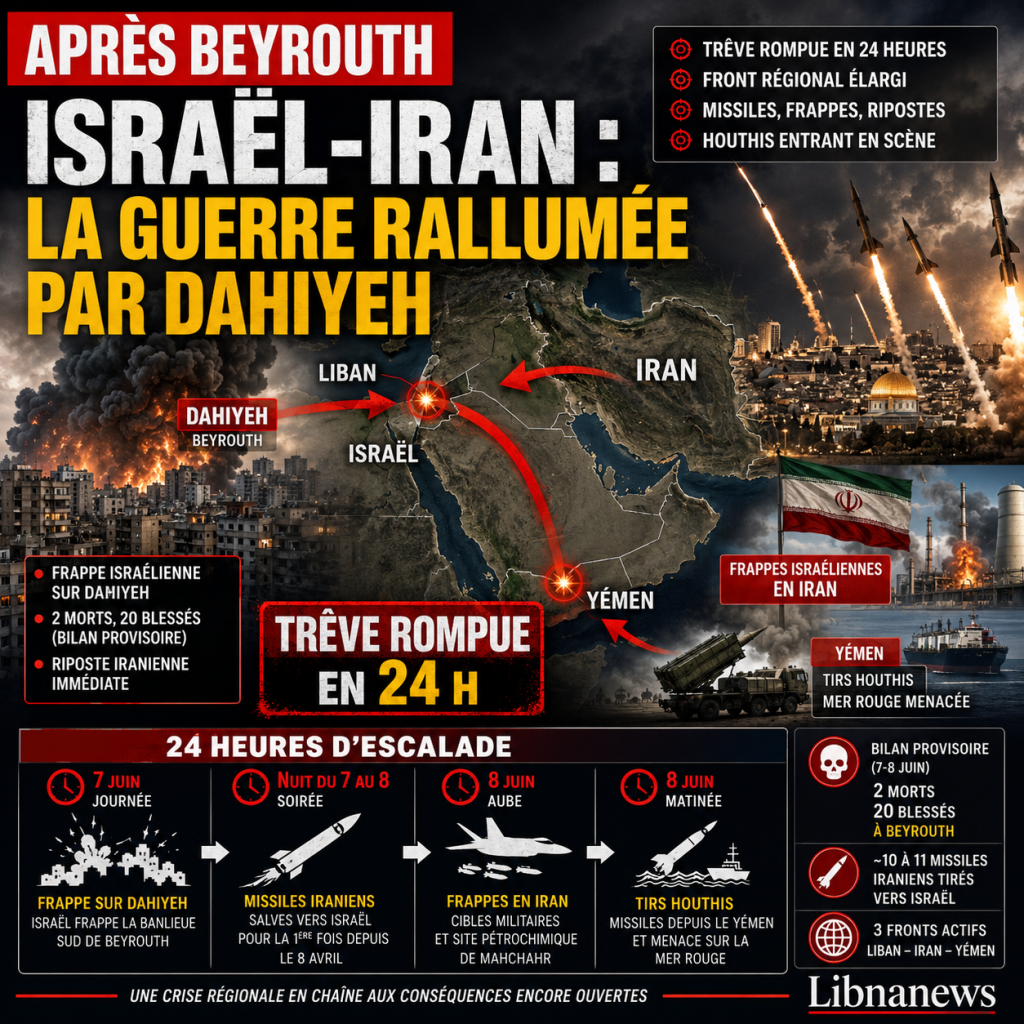
A partial truce broken in 24 hours
The sequence that reopened theisrael-Iran warnot in Iran, but in Lebanon. On Sunday 7 June, a partial truce, already fragile, gave way under the pressure of three interrelated fronts: the South Lebanon, the southern suburbs of Beirut and the face-to-face between Israel and the Islamic Republic. In less than 24 hours, an Israeli strike on Dahiyeh, persistent fighting in the South, Iranian missiles against Israel, Israeli strikes in Iran and fire from Yemen turned a crisis into an open resumption of hostilities.
The Israel-Iran war had been frozen since the 8 April ceasefire. This pause had not settled the Lebanese case. Israel continued to treat the Hezbollah front as a separate theatre. On the contrary, Tehran argued that any regional truce should cover Lebanon. This long diplomatic disagreement became military on Sunday. The day showed that a strike on Beirut could trigger a direct response from Iran, and then an Israeli counter-ripost on Iranian territory.
The following schedules are given in Beirut and Jerusalem, unless otherwise specified. The balance sheets remain provisional, as several figures have evolved between the first dispatches and the press releases published during the night. The sources consulted, however, agree on the central chain of fire from Lebanon or Hezbollah operations, Israeli strikes on the southern suburbs, Iranian salves, Israeli strikes in Iran, and new alerts in Israel and Huthia involvement.
Before Dahiyeh, a truce already cracked
The flaw appeared before Sunday. On 1 June, a partial ceasefire framework was announced. He predicted that Israel would avoid Beirut and its southern suburbs, while Hezbollah would stop its attacks on Israel. The text did not end the war in Lebanon. He focused on preventing an extension to the capital and opening a space for discussion under American mediation. But fighting in the South did not stop. The Israeli army continued its ground operations, while Hezbollah refused a truce which it considered incomplete.
On 5 June, Israel ordered the evacuation of nine villages from southern Lebanon before further strikes. Thousands of people have left the targeted areas, including around Anqoun and Nabatiyah. Strikes hit large parts of the South. Hezbollah announced that it had attacked Israeli soldiers near Beaufort Castle, a strategic area that dominates the axes towards Nabatiyah. The day confirmed that the ceasefire did not really cover the South Lebanese terrain, where the Israeli army sought to expand its control zone.
On June 6, the tension crossed another level. Three Lebanese soldiers, including two officers according to a news agency, were killed in an Israeli strike against a vehicle on the Khardali-Nabatiyah axis. Another agency reported nine deaths in the South on the same day, including three members of the Lebanese army and six people killed in Saksakiyah. The Israeli army claimed to have targeted a vehicle after identifying a threat to its forces. Beirut denounced an infringement of its sovereignty.
On Sunday morning, the Israeli army announced that it had intercepted two projectiles from Lebanon after sirens in the Yiftah and Ramot Naftali areas. Hezbollah claimed responsibility for several operations against Israeli troops in Lebanon, but did not claim these cross-border fire. This detail counts. Israel presented the next strike as a response to Hezbollah. The Shiite movement allowed a grey zone to persist between its attacks on Israeli forces on Lebanese soil and the projectiles fired north of Israel.
Israel-Iran War: Dahiyah hit as threshold
In the morning and early afternoon, warnings increased. The Israeli army asked the inhabitants of Tyre and its surroundings to evacuate before any strikes were made. The city, one of the main agglomerations of southern Lebanon, also hosts displaced persons from border villages. Strikes were then reported within its perimeter, including near historical areas. No complete technical assessment has yet established the extent of damage to the remains, but the proximity of the explosions has increased local concern.
The decisive shift takes place with the Israeli strike on Dahiyeh. Israel announced that it had hit Hizbullah infrastructure in the southern suburbs of Beirut. The office of Prime Minister Benjamin Netanyahu and the Minister of Defence Israel Katz assumed the order, claiming to respond to Hezbollah fire to Israel. According to the Lebanese press and agencies, the attack hit a dense area, where people had returned since the last military break. The first assessment reported two deaths and 11 injuries. The Lebanese Ministry of Health then reported two deaths and twenty injuries.
This strike was broader than its stated objective. For several days Iran had warned that an attack on Beirut would be considered a breach of the regional ceasefire framework. The southern suburbs, a political and social bastion of Hezbollah, remained a sensitive threshold. By striking Dahiyeh, Israel imposed its reading: Lebanon and Iran would be two separate dossiers. Tehran replied with the opposite reading: Beirut was part of the same field of confrontation.
In the hours that followed, Iranian officials shook the tone. A member of the Iranian National Security Commission announced a painful response. The President of Parliament, Mohammad Bagher Ghalibaf, also an important negotiator in contacts with Washington, accused the United States of covering the attack and claimed that American bases and Israeli assets in the region were becoming legitimate targets. That declaration transformed the Lebanese crisis into an immediate regional crisis.
Sunday night Iran shoots at Israel
On Sunday evening, Iran launched its first battle against Israel since the 8 April ceasefire. The figures vary slightly according to the sources. The international media reported about ten ballistic missiles. The Israeli ambassador to the United States spoke of eleven missiles. The Israeli army claimed to have intercepted the threats or witnessed them falling into open areas. The Revolutionary Guards presented the operation as a warning, not as an isolated incident. They also threatened to continue firing for several days if Israel continued its attacks.
The alert put the north of Israel under pressure. The sirens rang in several areas. Air defences have been activated. Iran justified its shooting by the strike on Beirut. Israel rejected this link, through its ambassador to the United States, by saying that Hezbollah was part of the Lebanese file and not of the Iranian file. But the military sequence already denied this political separation. Iran’s projectile party responded to a strike in Lebanon. The Israel-Iran war therefore resumed with the detour of Beirut.
During the evening, Donald Trump tried to prevent another escalation. According to information reported by American media and confirmed by several diplomatic accounts, the US President called Benjamin Netanyahu to ask him not to respond immediately. He said he wanted to preserve the chances of an agreement with Tehran. He also publicly stated that the Israeli strikes in Lebanon had not been coordinated with Washington. However, the White House has not published a full official record of this exchange.
Monday at dawn, Israel hits Iran
The restraint did not last. On Monday, at 0427 hours, the Israeli army announced that it had struck military targets in Iran, in the west and in the centre of the country. Iranian state television reported explosions in Tehran, Tabriz and Ispahan. Other Iranian and American media also mentioned Karaj and Kermanshah. The Revolutionary Guards said that Israel had used ballistic missiles launched from the air. This point remains attributed to the Iranian side.
The details then given by Israel clarified the nature of the targets. According to the Israeli Ambassador to the United States, the army targeted ground-to-ground missile launch sites and non-energy infrastructure. But in the morning, the Israeli army also announced that it had hit the petrochemical complex of Mahshahr, in south-western Iran. An Iranian regional official confirmed that the petrochemical company Karoon had been affected and that some of the facilities had been damaged. Iranian media reported that no injuries were recorded immediately and that the employees had been evacuated.
This strike on Mahchahr added an economic and energy dimension to the escalation. Until then, Israel had claimed to favour military infrastructure. Reaching a petrochemical site, even if limited, sent a wider signal. It also contributed to rising oil prices, already fuelled by tensions in the Strait of Ormuz. Markets reacted even before the magnitude of the damage was known, indicating that the resumption of direct conflict was sufficient to revive the fear of a regional shock.
Houthis enter the sequence
At 0504 hours the Israeli army announced that it had identified a missile from Yemen to its territory, with the activation of air defence systems and alerts in the Jerusalem area. The attack was not isolated. In the morning, the Houthis military spokesman, Yahya Saree, claimed that Yemeni forces had launched a missile salve against sensitive Israeli targets in the Jaffa area. He also announced a total ban on Israeli maritime navigation in the Red Sea, stating that Huthies operations would intensify as fighting progressed.
Huthie participation has strengthened the image of a coordinated regional front, although the degree of operational coordination remains difficult to establish. The Houthis, Iran’s allies, had already carried out attacks against Israel and maritime traffic in the Red Sea. Their return to the sequence, a few hours after the strikes on Iran, expanded the theatre. Israel was no longer only facing fire from Iran and Lebanon. It also had to monitor the Red-Yemen Sea axis, with possible consequences for commercial roads.
At 0703 hours, new Iranian salves were detected towards Israel. Explosions were heard in Jerusalem, according to local correspondents, as the Israeli army announced the activation of anti-missile systems. At 0726 hours Israeli relief services did not detect any injuries after Iranian fire. At 0744 hours the Israeli army reported a second round of missiles launched from Iran towards its territory. These alerts kept the population in shelters and delayed any return to minimal normality.
At 0834 hours, the Revolutionary Guards claimed to have targeted two Israeli air bases, Nevatim and Tel Nof. They described the operation as a response to Israeli strikes at radar sites in Iran. This point was not independently confirmed at the time of the first announcements. However, he sheds light on the Iranian story: Tehran did not only want to respond to Beirut, but also to show that the Israeli counter-attacks in Iran called for a new military response.
At 0930 hours the Israeli army announced that it had identified missiles launched from Iran to Israel. The inhabitants of the affected areas were ordered to enter protected areas and remain there until further notice. The latter alert on Monday morning confirmed that the resumption of the Israel-Iran war was not limited to a night of response. The pace of the announcements already showed a gear: each hit was presented as a response to the previous one, but each also created the pattern of the next step.
South Lebanon, trigger and permanent front
South Lebanon remained the most exposed front for Lebanese civilians throughout the sequence. In Tyre, the strikes hit the outskirts of a major historic site. In Bint Jbeil, urban fighting has continued for several weeks, with slow Israeli progress, artillery exchanges, strikes and attacks by Hezbollah against advanced positions. Available sources describe a battle of wear and tear. Israel is seeking to neutralize a strategic bastion. Hezbollah seeks to prevent a rapid victory and maintain a military cost to the Israeli army.
This South Lebanese continuity explains the rapidity of the explosion. The partial ceasefire protected mostly Beirut. He did not stop the strikes in the South, settle the Israeli withdrawal, or impose an agreed stop on Hezbollah. The strike on Dahiyeh therefore did not arise in the void. It arrived after several days of fighting, evacuation orders, civilian deaths and casualties in the Lebanese army. She turned an already active front into a regional trigger.
On the morning of 8 June, three facts were confirmed. Israel and Iran had resumed direct strikes after two months of relative truce. Lebanon, far from being a secondary theatre, had served as an immediate starting point for this recovery. The Houthis had added a third line of pressure with claimed fire from Yemen and a maritime threat in the Red Sea. A major unknown was whether Washington and the regional mediators could still dissociate the files, while the weapons had just brought them together on the ground.




