

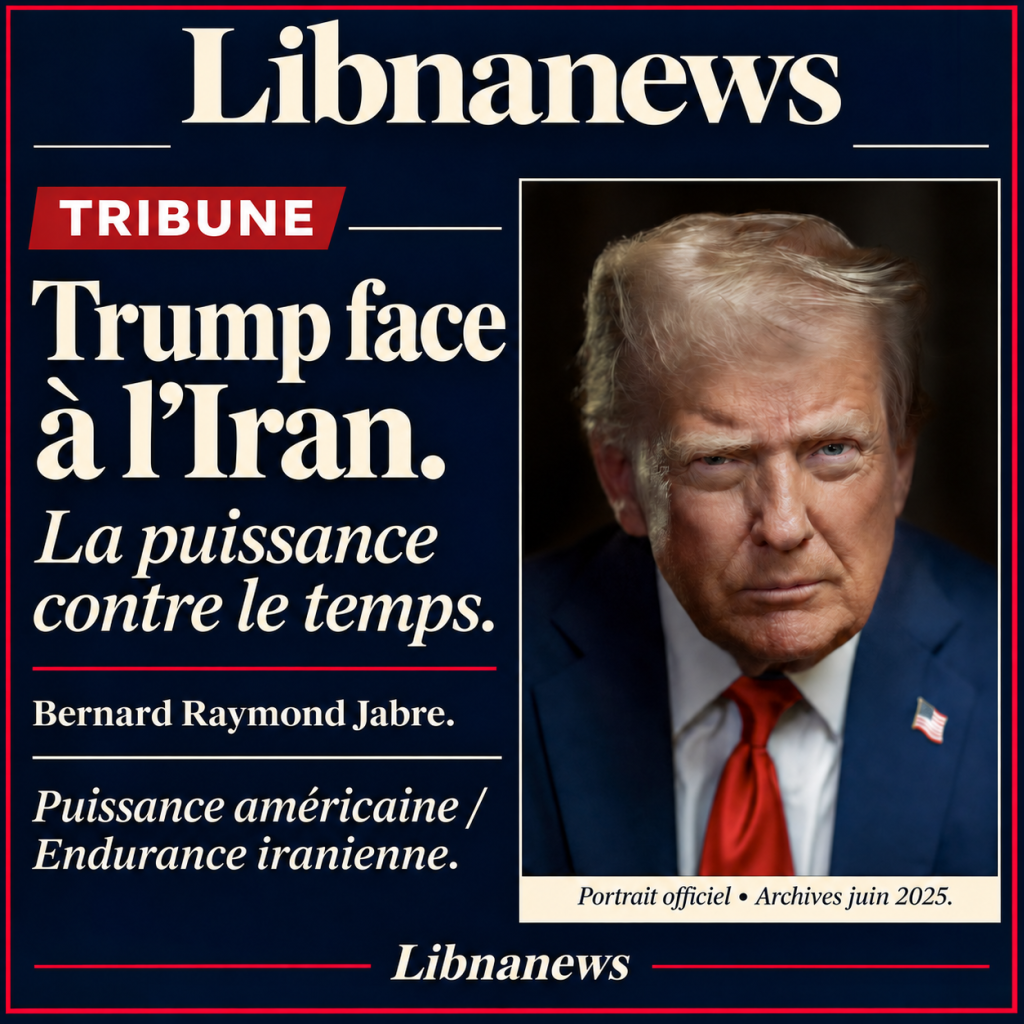
How the world’s first power was able to dominate the balance of forces without succeeding in imposing its logic on Tehran
Bernard Raymond Jabre
November 2026
The United States believed that it could solve the Iranian problem through an accumulation of power: sanctions, blockades, strikes, technological superiority, air and financial domination. But Iran never played exactly on this field. Where Washington measures power in capabilities, Tehran also measures survival in time. Perhaps this is where the fundamental misunderstanding of the American strategy lies: to have thought that Iran could be ceded without understanding what Iran considers a defeat.
A mistake reading before being a military error
The Iranian problem was not born with Donald Trump, and it would be simplistic to attribute it alone the failure of several decades of American politics in the Middle East. But Trump pushed a certain conception of power to its extreme point: if the adversary refuses the proposed agreement, the price of his refusal is increased until it becomes rational for him to yield.
This logic is consistent. It operates in trade negotiations, in certain diplomatic crises, sometimes even between States when the interests at stake are quantifiable. But it assumes one essential thing: that both opponents calculate their losses and earnings on a comparable scale.
This is precisely not the case between Washington and Tehran.
For the United States, Iran is a strategic problem: nuclear, missiles, Israeli security, Gulf security, freedom of navigation, regional armed networks. For the Islamic Republic, confrontation with the United States is about something deeper: the survival of the regime, its founding narrative, its strategic independence and its ability not to become a state with its main orientations dictated from the outside.
Therefore, inflicting considerable economic suffering does not mechanically lead to capitulation. A country can be impoverished without breaking its political will. Facilities can be destroyed without destroying the reason for their construction.
Trump tried to fix a price on Iranian resistance
The « maximum pressure » strategy was based on a simple intuition: depriving Iran of revenues, including oil, making its external financing more difficult, hitting its military capabilities and then presenting it with an alternative — agreement or asphyxiation.
This strategy has indeed imposed real costs on Iran. It would be wrong to pretend otherwise. The sanctions, followed by the naval blockade and military pressure, have greatly reduced Tehran’s economic space for manoeuvre. In November 2026, the U.S. administration continued to argue that this pressure had its effects and that it could avoid further large-scale military operations.
But there is a limit to reasoning: it assumes that Iran seeks first to maximize its prosperity. But a revolutionary regime that has been subject to sanctions for decades can accept a level of economic suffering that Western democracy would find politically unbearable.
This is where Trump seems to have miscalibrated the adversary. He wanted to set a price for resistance. Iran replied that some things had no price — or, more precisely, that the price of bid could be considered by the regime to be higher than the price of poverty, isolation and even war.
Iran is not just a regime: it is a strategic memory
To understand Tehran, one must emerge from the image of a country that appeared in 1979 with the Islamic revolution. Iran has an exceptional historical, imperial and national depth. Diets change; The awareness of being an ancient power, surrounded by rivals and regularly exposed to foreign intervention, remains.
Iranian memory is crossed by Russian and British interference, the question of oil, the overthrow of Mossadegh in 1953 with the involvement of the American and British services, the Western support for Shah, and the Iran-Iraq war during which Tehran felt abandoned in the face of Saddam Hussein.
This does not justify the regime’s policy or its regional interventions. But this helps to understand his obsession with strategic autonomy.
In this vision, missiles are not just weapons. The nuclear programme is not just an infrastructure. Regional networks are not only ideological instruments. Together they constitute a security architecture designed to make the cost of an attack on Iran high enough to discourage the adversary.
It is a strategy that is largely due to weakness. Because Iran cannot compete with the United States aircraft against aircraft, fleet against fleet or dollar against dollar, it seeks its advantage elsewhere: missiles, drones, dispersion, regional depth, ambiguity, asymmetric capabilities and above all patience.
Destroying a capacity is not destroying a will
This is probably the most serious conceptual error of any strategy based primarily on force.
A nuclear facility can be destroyed. Centrifuges can be wiped out. A missile depot can disappear under bombs. A command can be decapitated. But scientific knowledge is not easily bombarded. Above all, the perception of the threat that had led to the construction of these capabilities can survive — or even be reinforced by their destruction.
Even before the present war, American public assessments clearly distinguished the nuclear capability from the political decision to manufacture a weapon. In June 2025, the Congressional Research Service recalled that American intelligence did not believe that Tehran had then taken the decision to build a nuclear weapon, but stressed that the expansion of enrichment had considerably shortened the time needed to produce the required fissile material.
That’s the paradox.
If a State believes that it can be struck despite the absence of nuclear weapons, some of its officials may conclude that the nuclear option must not be abandoned permanently, but that a more difficult deterrent must be acquired. The European leaders mentioned in the last few days are very concerned that the war has strengthened the Iranian elements most hostile to compromise.
Military power can therefore produce two contradictory effects: materially delaying a programme and, at the same time, politically reinforcing the reasons for wanting to rebuild it.
The great scorn: believing that Iran wanted to win like America
The United States has traditionally sought an identifiable outcome: a military victory, a treaty, a surrender, a change of behaviour, a verifiable agreement. Their own political system imposes a timetable. We need to show results. The cost of war must be explained. Public opinion, Congress, elections and markets must be addressed.
Iran can define victory differently.
Not falling may be a victory.
Not surrendering may be a victory.
Keeping part of his abilities can be a victory.
Surviving long enough for the opponent to change his goals can be a victory.
It is a much more defensive and time-consuming conception of success. It does not require military defeat of the United States. It requires preventing the United States from transforming its military superiority into a definitive political result.
This is exactly what we see today. After nearly nine months of war, Washington and Tehran remain far from an agreement. The United States is relying on the blockade and economic exhaustion. Iran refuses to negotiate under pressure and demands prior concessions. Everyone is waiting for the cost of time to become unbearable for the other.
So we are no longer just in a war of missiles, sanctions or oil. We went into a clock war.
The war of time
This is where I see the key to the whole confrontation.
America has the superiority of the moment. Iran seeks the superiority of duration.
Washington can concentrate in a few hours a military power that Tehran will probably never be able to match. It can close financial circuits, move aircraft carriers, hit infrastructure, intercept cargo, sanction companies across the world.
But the Iranian question is not who wins in the first 24 hours.
She knows who’s holding after six months. After a year. After two years.
The Islamic Republic has made this temporal asymmetry a component of its strategy. It absorbs, disperses, reconstructs, bypasses, waits. She knows that American political time is not hers.
The U.S. president lives in election time, market, television, gas prices and popularity. The Iranian power lives in a different institutional time, much more brutal internally but also able to impose considerable sacrifices on its population.
This does not mean that time necessarily works for Iran. An economy can collapse. A society can revolt. A diet can crack. Prolonged pressure can eventually alter the calculation of its leaders.
But this means that the US strategy cannot be assessed solely by the amount of damage inflicted. It must be judged by its ability to transform such damage into lasting political behaviour.
And that’s where the equation stays open.
The illusion of all-power
There is a constant temptation among the great powers: to confuse the ability to destroy with the ability to order the next world.
America encountered this difficulty in Vietnam. She met him in Iraq. She met him in Afghanistan. The situations are obviously not the same, and easy analogies are dangerous. But one constant remains: military superiority does not guarantee control of the political outcome.
We can win all major battles and lose control of the goal.
The question that should have preceded any escalation against Iran was therefore less: « What can we destroy? » than: « What Iranian behavior do we want to obtain, and by what precise mechanism will the destruction of these objectives produce this behavior? »
An Iran without a nuclear weapon? It’s a goal.
An Iran without enrichment? It’s another one.
An Iran without ballistic missiles? Another one.
An Iran without regional relays? Another thing.
A change of regime? It’s a completely different war.
When several objectives are pursued simultaneously without a clear hierarchy, the adversary no longer knows what concession would suffice to stop the pressure. And when a regime thinks that even its capitulation on a file will not guarantee its survival, it has less reason to surrender.
The paradox of coercion
Coercion only works if the adversary believes that there is an exit door.
To obtain a concession, it takes two things: making refusal costly and making acceptance credible.
If Tehran thinks that giving up on nuclear power will be followed by a new demand on missiles, then another on its regional allies, and then finally by an attempt at regime change, the very rationality of the concession disappears.
This is why the credibility of a compromise counts as much as the credibility of a threat.
Trump developed the second extraordinarily. He made the first much less clear.
Its method often consists of creating maximum uncertainty in the opponent: never exclude climbing, keep all options open, make the next movement difficult to predict. This method can be tactically formidable. But in an existential negotiation, unpredictability can also convince the other side that no concession will bring it the security sought.
At that time, fear does not necessarily lead to compromise. It leads to fortification.
What Washington might not have looked at enough
Iran needed to be analysed not only as a problem to be solved, but as a system to be understood.
Understand the difference between the Iranian people and the regime.
Understanding Iranian nationalism, which can survive the unpopularity of the Islamic Republic.
Understand the role of the Revolutionary Guards, who are not only a military force but a political, economic and ideological apparatus.
Understand the memory of foreign interventions.
Understand the fear of encirclement.
Understand that regional relays, however weakened, have been conceived as insurance against direct war.
Finally understand that an opponent can be rational without sharing our rationality.
This is probably the most important point. Irrational Iran because it accepts costs that Washington considers exorbitant does not allow it to be understood. Its rationality is simply structured around other priorities: regime survival, autonomy, deterrence, regional status, historical continuity.
A good strategy always begins with this question: what does my opponent fear more than what I inflict on him?
If the answer is: capitulation itself, then increasing pain is no longer enough.
Trump had, however, seen a real weakness
It would be equally wrong to turn this analysis into a celebration of Iran’s strategy.
Iran pays a huge price. Its economy is vulnerable. Its infrastructure is exposed. His regional relays were hit. The US pressure on its energy exports is severe. The indefinite continuation of this confrontation entails considerable economic, social and political risks for the regime.
Trump had therefore identified a real weakness: Iran is not invulnerable to pressure.
The possible error is elsewhere: it may have believed that vulnerability necessarily meant malleability.
A state may be weak and obstinate.
A regime can be economically burdened and strategically inflexible.
Above all, weakness can make an actor more dangerous if he believes his survival is threatened.
So the question is not whether the US pressure is working. It works: it costs Iran a lot. The real question is what it produces politically. A concession? Radicalization? Wait? A leak forward? A delayed negotiation?
This causality must be demonstrated, not presumed.
Power Against Time
We thus come to the heart of the problem.
Trump thought Iran through power.
Iran has responded through time.
America has the military, financial, technological and logistical advantage. Iran has a nuisance capacity, a geographical depth, a culture of endurance and a political system capable — to some extent — of dissociating the suffering of the population from the strategic decision of power.
The confrontation then becomes a competition between two time functions.
Washington asks: How long can the Iranian economy last?
Tehran asks: How long will America accept to pay the economic, military and political price of this confrontation?
Everyone is waiting for the other to break up.
And that is why conflict may seem paradoxical: the strongest power does not necessarily succeed in imposing its will, while the weakest power cannot obtain what it wants. One dominates space; The other seek refuge for the duration.
The result is a dead end.
The Iranian Lesson
The great lesson of this confrontation goes beyond Trump and even beyond Iran.
In the twenty-first century, power can no longer be measured solely by the number of aircraft, missiles, aircraft carriers, billions of dollars or sanctions available.
Another variable must be added: time.
How long does a society accept the cost of a war?
How long can a regime absorb sanctions?
How long does a coalition remain united?
How long do markets endure uncertainty?
How long can the adversary wait before our own political system forces us to change our strategy?
True power is therefore the power multiplied by the duration during which it can be politically sustained.
This may be what Washington has insufficiently integrated into its Iranian calculation.
The United States can win almost all ad hoc military confrontations with Iran. But they will only win politically if they know exactly what concession they are looking for, what compromise they are willing to accept and what security they offer in return.
Without this, pressure becomes an end in itself.
And when a war no longer aims to create a definable peace, it risks becoming its own system.
Conclusion — Iran did not ask to be stronger. All she had to do was not give in.
Trump therefore did not necessarily « undervalue » the Iranian military power. The problem is more subtle.
He may have underestimated the very nature of Iranian resistance.
He thought that the accumulation of costs would necessarily change the decision. He thought of power as a lever whose increasing pressure was eventually to open the door.
But some doors are strengthened when it is pushed on.
To understand Iran, it was necessary to count its centrifuges less than to understand its memory; less counting its missiles than understanding its perception of encirclement; less measure its GDP than measure what its regime was willing to sacrifice to survive.
And above all, it had to be understood that Tehran did not need to defeat America.
He just had to last.
Maybe it’s all the history of this war.
The United States wanted to impose its power on time.
Iran tried to impose time on power.
And as long as neither side transforms this confrontation into a realistic, limited and negotiable political objective, the world’s greatest power can continue to dominate the battlefield without necessarily mastering the outcome.
For there is a truth that empires rediscover generation after generation:
force often decides the beginning of wars.
Time, on the other hand, very often decides their end.
Documentaries
Reuters, 17 November 2026 — « Trump and Tehran gamble on time as Iran war stalemate deepens »: state of impasse, US strategy of blockade and economic pressure, Iranian refusal to negotiate under pressure and European concerns about a possible tightening of the regime.
Reuters, November 10, 2026 — Statements by Marco Rubio on American preference for economic campaigning rather than new major military operations, and on the effects of the blockade and sanctions.
Reuters, November 14, 2026 — Information on Trump’s reluctance to resume major strikes in the absence of further provocations.
Congressional Research Service, 24 June 2025 — Iran and Nuclear Weapons Production: state of US public assessments of Iran’s decision to manufacture a weapon, enrichment and breakout deadlines.
Congressional Research Service, 2025 — Iran: Background and U.S. Policy: objectives of the « maximum pressure » policy, negotiations and challenges of Iran’s nuclear programme.
Note by the author. This article is a strategic and interpretative analysis. It distinguishes documented facts from analytical findings and does not purport to attribute unestablished psychological intentions to the leaders concerned.





Comments