

Dialogue with Hezbollah is less affected by the absence of open statements than by the content that each interlocutor wants to give it. On 15 November, Hassan Fadllallah affirmed his party’s readiness to discuss with his political opponents. He simultaneously defended the maintenance of « resistance » as an instrument for the protection of Lebanon. These two messages therefore do not constitute an acceptance of disarmament.
An opening with a political line
The deputy of the Resistance Faith bloc was speaking in Ghaziyeh at a memorial for the deaths of Aytaroun. He announced that he wanted to respond positively to the gestures of rapprochement and to cooperate with those seeking internal stability, even in the event of political disagreement.
Fadallah, however, places this approach within a specific framework: the Taif Agreement, the Constitution and Lebanese laws. He invoked the liberation of the occupied territories to defend the legitimacy of the resistance. This reading is that of the Member. It is neither a judicial decision nor an agreement by all institutions on the status of Hezbollah weapons.
In the same speech, he linked his party’s perspectives to the regional context and Iranian positions. He did not announce any delegation designated for a meeting with the Presidency, nor date, nor agreed agenda. The declaration provides information on a political provision and its limitations, not on the initiation of negotiations.
Baabda Gate and Mandate Question
On November 10, at the end of an interview with Joseph Aoun, MP Alain Aoun said that the president’s door remained open to Hezbollah. This presentation came from the parliamentarian: it was not a formal invitation accepted by the party. Alain Aoun distinguished the bilateral discussions of a collective dialogue table whose conditions were not yet met, according to the narrative he reported.
The approximation of these positions shows a possible space for exchanges, but not a common process already defined. Accepting to speak does not specify what will be negotiated, which will engage each camp and which institution will make decisions. The difference between a trigger signal and an operational political mechanism is measured at this level.
Taif is not limited to one provision
The 1989 Agreement sets out several objectives. It provides for the dissolution of Lebanese and non-Lebanese militias and the handing over of their weapons to the State. It also organizes the strengthening of the armed forces and the extension of public sovereignty.
Its part devoted to the end of the Israeli occupation combines the liberation of the territory, the restoration of state authority and the deployment of the army in the border area. Invoking this text therefore requires that its provisions be considered together, rather than being isolated from it in order to presume an agreement on arms.
In order for a dialogue to lead to a decision, it will be necessary to distinguish three stages: the meeting itself, the definition of its object and the modalities for implementing a possible compromise. The statements of 10 and 15 November concern the first. They alone do not make it possible to announce a rapprochement between Baabda and Hezbollah.
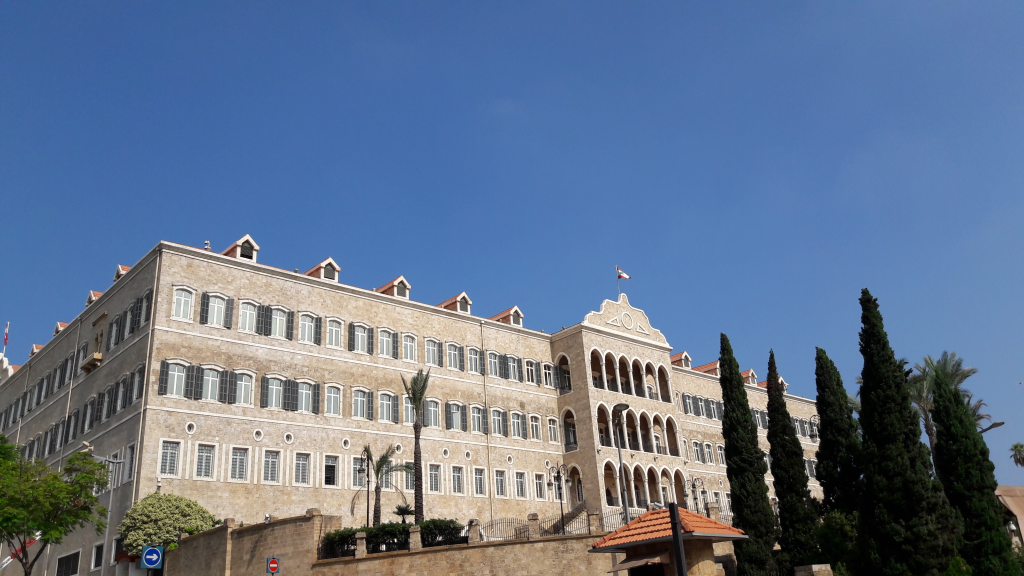
Institutional illustration of archives: the Grand Sérail in Beirut, August 12, 2017. Photo Pjposullivan1, CC BY-SA 2.0. This image does not represent the meetings mentioned.





Comments