

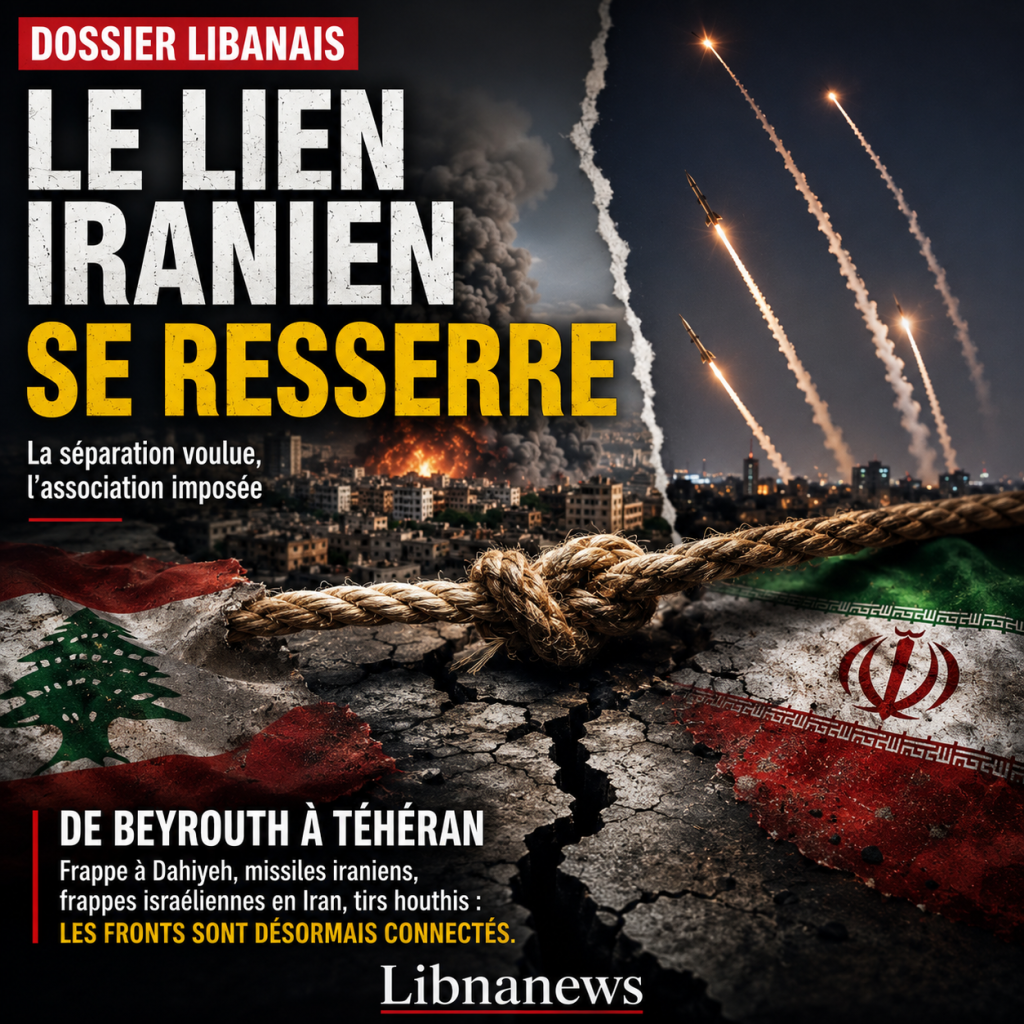
The necessary separation, the imposed association
The diplomatic debate was presented as a question of methodology. Washington, Tel Aviv and the Lebanese authorities want to deal separately with the Lebanese case and the war between Israel and Iran. This dissociation must protect the ongoing negotiations. It must also prevent Lebanon from remaining hostage to a regional arm that is beyond it. But the events of the last 48 hours say the opposite. The strike on the southern suburbs of Beirut, Iranian fire on Israel, Israeli strikes on Iran and missiles from Yemen linked the fronts into a single military sequence. The Lebanese case was not isolated. It has become the most sensitive point of contact between regional actors.
The contradiction is now visible. On paper, Lebanon claims its sovereignty. The United States wants to preserve its channel with Tehran. Israel claims to target Hezbollah without integrating every operation into the Iranian file. In fact, each actor acts taking into account the other theatre. Tehran is a precondition for discussions at the end of the fighting in Lebanon. Hezbollah refuses a truce that does not provide for Israeli withdrawal. Israel strikes Beirut in the name of its security in the north. Iran responded to a strike outside its territory. The huthis add the Red Sea to the crisis map. The declared separation then becomes a political exercise, not a strategic reality.
Monday morning, the observation was even clearer than at the beginning of the weekend. The mediators were trying to save two distinct frameworks: a limited Lebanese ceasefire and a negotiation with Iran on the end of the regional conflict. These two frameworks were crossed by the same missiles. Iranian fire followed the attack on Dahiyeh. Israeli strikes in Iran followed those shots. The missile from Yemen has placed Tehran’s allies in the same dynamic. Oil markets have responded to the escalation. Lebanese, Israeli and Iranian civilians paid the price for a diplomatic border that the land no longer recognizes.
Washington wants to isolate the Lebanese front
Washington first tries to prevent an uncontrollable gear. The US administration wants to maintain a discussion with Iran on war, nuclear, sanctions, navigation in the Strait of Ormuz and Gulf stabilization. In that context, Lebanon was becoming a practical problem. Israeli strikes in southern Lebanon, Hezbollah attacks and threats to Beirut can ruin a negotiation officially located elsewhere. That is why the US President has attempted to obtain restraint from Israel on the Lebanese capital. This restraint did not hold. The bombing of the southern suburbs has shown that the Lebanese front remains capable of exceeding any diplomatic timetable.
The American position is based on a legal distinction. Lebanon is a sovereign State. Iran is another state. Hezbollah is not the Lebanese government. Israel and Lebanon can therefore discuss a ceasefire, while Washington and Tehran discuss a regional agreement. This architecture has an institutional logic. It allows the Lebanese power not to be confused with Hezbollah. It also allows the United States to speak in Beirut without recognizing a direct decision-making role in Tehran on Lebanese territory. But war does not always fall within the categories of law. Arms, financing, alliances and response chains create their own geography.
The Lebanese Power Facing its Limits
The Lebanese authorities also have an interest in this dissociation. They seek to reaffirm that the State, not an armed organization, must decide war and peace. They want to avoid the country being presented as a mere extension of Iran. They are therefore negotiating in Washington a mechanism that would give the Lebanese army a central role in certain areas of the South. This line protects Lebanon’s formal sovereignty. It also responds to an internal emergency: to prevent economic collapse, displacement and military destruction from being aggravated by an endless regional war.
But the Lebanese power has a known limit. He can negotiate a text. It does not control all weapons in its territory. He can report Israeli violations. He can’t stop strikes alone. He can ask Hezbollah to respect a truce. It does not have the political and military means to impose disarmament in an emergency. This weakness gives the Lebanese file a dual nature. It is legally national. It is militarily regional. It is precisely this duality that the latest events have exposed.
Israel defends a functional separation. Hezbollah officials claim that Hezbollah is a Lebanese front and that Iran is under another level of threat. This distinction helps maintain pressure in South Lebanon without recognizing that each strike can jeopardize discussions with Tehran. It also allows the Israeli army to say that it responds to attacks from Lebanon, not that it opens a new chapter against Iran. But Sunday’s sequence contradicted this presentation. A strike against Dahiyeh resulted in Iranian missiles. An Iranian response resulted in Israeli strikes in Iran. Operational separation has disappeared in a few hours.
Lebanese diplomacy marginalized by its own rupture
The crisis with the Iranian ambassador aggravated this loss of control. In March, the Lebanese Ministry of Foreign Affairs withdrew the accreditation of Iranian Ambassador Mohammad Reza Sheibani and recalled the Lebanese Ambassador to Tehran for consultations. The gesture was intended to show a resumption of Lebanese sovereignty in the face of Iranian interference. It has had the opposite effect on an essential point: at the time when the Iranian case was becoming central again for Lebanon, the official channel with Tehran was weakened, if not neutralized.
This decision can now be read as a strategic mistake by the Lebanese Foreign Minister. It has certainly responded to an internal political demand: to remind the Lebanese State that it cannot accept that a foreign ambassador intervenes in its internal affairs. But it also removed from the ministry one of the few direct instruments it had with Iran. However, the communication did not stop. She moved. It now passes more through Nabih Berri, Hizbullah networks and indirect mediation, rather than through the traditional channels of Lebanese diplomacy.
The paradox is heavy. The ministry wanted to reduce Iranian influence in Lebanon. It has, de facto, contributed to strengthening the role of actors who already have political and operational access in Tehran. Nabih Berri, President of the Parliament and traditional interlocutor of Hezbollah, appeared as one of the privileged relays in discussions about a ceasefire. An adviser to Mr Berri thus conveyed to the Americans Hezbollah’s position on a complete cessation of hostilities, while the Ministry of Foreign Affairs was in retreat on the Iranian channel.
This marginalization is not only aprotocol problem. It weighs on Lebanon’s ability to defend its own reading of the crisis. If communication with Iran goes through Berri and Hezbollah, Lebanese power loses part of its diplomatic autonomy. It becomes more difficult for Beirut to explain that the Lebanese case must be treated as a state file, distinct from Tehran’s regional calculations. The official break with the Iranian ambassador was to affirm the authority of Lebanon. It revealed above all that this authority remains partial when the stakes affect Hezbollah, Israel and Iran.
The case also offered Tehran a way to bypass the ministry. The Iranian ambassador did not leave Lebanon despite the order he was told, according to several media citing an Iranian diplomatic source. The same source claimed that its maintenance was in accordance with the will of Nabih Berri and Hezbollah. Even though this formulation is an anonymous source, it sums up the balance of power created by the crisis: the state announces a decision, but its application depends on actors not directly involved in official diplomacy.
The article’s thesis should therefore be slightly modified:the lebanese file and the iranian file are not only associated with weapons; they are also by the failure of official diplomatic channels.By breaking the direct dialogue with the Iranian ambassador, Beirut wanted to take over. On the contrary, recent events show that the Lebanese hand has weakened on the file where it most needed a credible state channel.
Lebanese file: Dahiyeh as tipping point
The southern suburbs of Beirut occupy a special place in this mechanics. For Israel, Dahiyeh represents a stronghold of Hezbollah. For the Shiite movement, it remains a political, social and symbolic space. For Iran, it is a sign of the strength of its regional alliance. For the Lebanese state, it is first and foremost a dense and inhabited district of the capital, whose security is a matter of national sovereignty. So Sunday’s strike hit several readings at once. It aimed at an objective presented as military. She hit a civilian space. She challenged the American line. She offered Tehran the announced motive for a response.
Hezbollah is not only a Lebanese actor in this crisis. He is also Iran’s main armed ally on the eastern Mediterranean. This reality does not mean that every local decision is mechanically dictated from Tehran. However, it means that the costs and benefits of its actions go beyond the national framework. When the movement continues its attacks on Israeli forces in Lebanon or claims fire to the north of Israel, it acts in a space where the defence of southern Lebanon, the Lebanese political balance and the Iranian balance of power overlap. It is this superposition that makes any dissociation unstable.
The last few days have shown with brutal precision. A partial ceasefire was announced to protect Beirut and reduce Hezbollah’s attacks on Israel. But the fighting continued in the South. Israeli strikes hit towns, roads and vehicles. Hezbollah fired at Israeli positions. The Lebanese army was also hit in strikes, which weakened the idea of a future mechanism based exclusively on its capabilities. In every incident, the truce lost a little of its strength. With each violation, Iran found an argument to refuse to separate the negotiating scenes.
Iran refuses peace without Lebanon
Iranian logic is clear. Tehran believes that the open war with Israel and the United States cannot end if its Lebanese ally remains under military pressure. Its officials reiterated that a comprehensive agreement should include Lebanon. They see it as an issue of influence, but also of credibility. To accept an arrangement that would leave Hezbollah exposed would, for the Islamic Republic, abandon a pillar of its regional machinery. This position complicates American efforts. It turns every strike in southern Lebanon into a message to Tehran, even when the military target is a few kilometres from the Israeli border.
The Israeli calculation is the opposite. Israel wants to prevent Hezbollah from turning southern Lebanon into a zone of permanent pressure. He also wants to prevent Iran from obtaining, in a negotiation with Washington, indirect guarantees for its Lebanese ally. Tel Aviv therefore has an interest in maintaining the Lebanese file in a local context: border security, the withdrawal of combatants, control by the Lebanese army, and the Israeli right of reply in case of fire. This method can produce text. It is not enough to cut the bonds created by war. The Iranian missiles on Sunday night strongly recalled.
This association of files is not limited to the Israel-Iran-Hezbollah duel. The Houthis have expanded since Yemen. Their claimed fire at Israel, and then their threat to Israeli navigation in the Red Sea, extended the open sequence in Beirut. The Red Sea, Bab al-Mandeb Strait and Ormuz Strait now belong to the same crisis landscape as southern Lebanon. Sea routes, oil prices, American bases and Israeli cities are linked by the same risk of escalation. The Lebanese case is therefore not only associated with Iran. It is connected to the whole network of alliances and pressures in Tehran.
A Lebanese sovereignty taken in vice
The danger to Lebanon is immediate. The more the files mix, the less Beirut controls its own fate. A strike against an area of the capital can trigger Iranian fire. An Israeli response in Iran can lead to Houthis fire. An attack in South Lebanon may affect a nuclear or maritime discussion. This channel deprives the Lebanese state of part of its autonomy. It imposes a permanent expectation on civilians. It makes any truce fragile because its maintenance depends on actors who do not always sit at the same table and do not pursue the same objectives.
The dissociation defended by the Lebanese power is therefore not illegitimate. It is a national necessity. Lebanon cannot accept being reduced to a battlefield by proxy. It must be able to negotiate the security of its borders, the return of the displaced, the role of its army and the reconstruction without waiting for a comprehensive agreement between Washington and Tehran. But this ambition requires more than a speech. It requires concrete guarantees against Israeli strikes, a real capacity for control in the South, and an internal political agreement on the place of Hezbollah’s weapons. Without these three elements, dissociation remains an objective, not a state of affairs.
The difficulty also comes from the role assigned to the Lebanese army. The mediators want to put it at the centre of any stabilization. In principle, this option strengthens the state. On the ground, it exposes the institution to enormous pressure. The army must remain a symbol of unity in a divided country. It must avoid internal confrontation. It must control areas where destruction, displacement and Israeli positions complicate any deployment. It must also convince the people that its presence really protects, while Lebanese soldiers have been killed in recent strikes. This equation cannot be solved by diplomatic formula.
The truce weakened by the facts
The strike against Dahiyeh also weakened confidence in mediation. An agreement presented as a framework for de-escalation must at least preserve Beirut. But the capital was hit as soon as the tension rose. For the inhabitants, the message is simple: the truce does not offer stable protection. For Hezbollah, this fragility feeds the argument that he cannot leave the ground under pressure. For Iran, it confirms that the Lebanese front must remain in the global negotiations. For the United States, it complicates the promise of a controlled regional order. Thus, only one strike produced four different readings, all of which were unfavourable to dissociation.
However, there is a difference between linking files and confusing responsibilities. The latest events show that the fronts are linked. They do not prove that all actors have the same role. Israel decides its strikes. Hezbollah decides on its attacks. Iran decides on its response. The Houthis decide on their fire and maritime threats. The Lebanese government is trying to preserve a state margin in a space saturated with constraints. This distinction is essential. Without it, Lebanon disappears as a political actor and becomes only a territory crossed by the decisions of others.
The challenge of the next few days will therefore be less to repeat that the files are separated than to create the conditions that could actually separate them. This includes a halt to the attacks on Beirut and southern Lebanon, clarification of the Israeli withdrawal, a credible fire control mechanism from Lebanese territory, and a regional negotiation that does not turn Lebanon into a currency of exchange. Until these conditions are met, each local incident will remain capable of rekindling the Israel-Iran war. On Monday morning, alerts, military announcements and diplomatic reactions were still drawing this reality: Lebanon is not near the Iranian crisis, it has become one of the points of articulation.




