





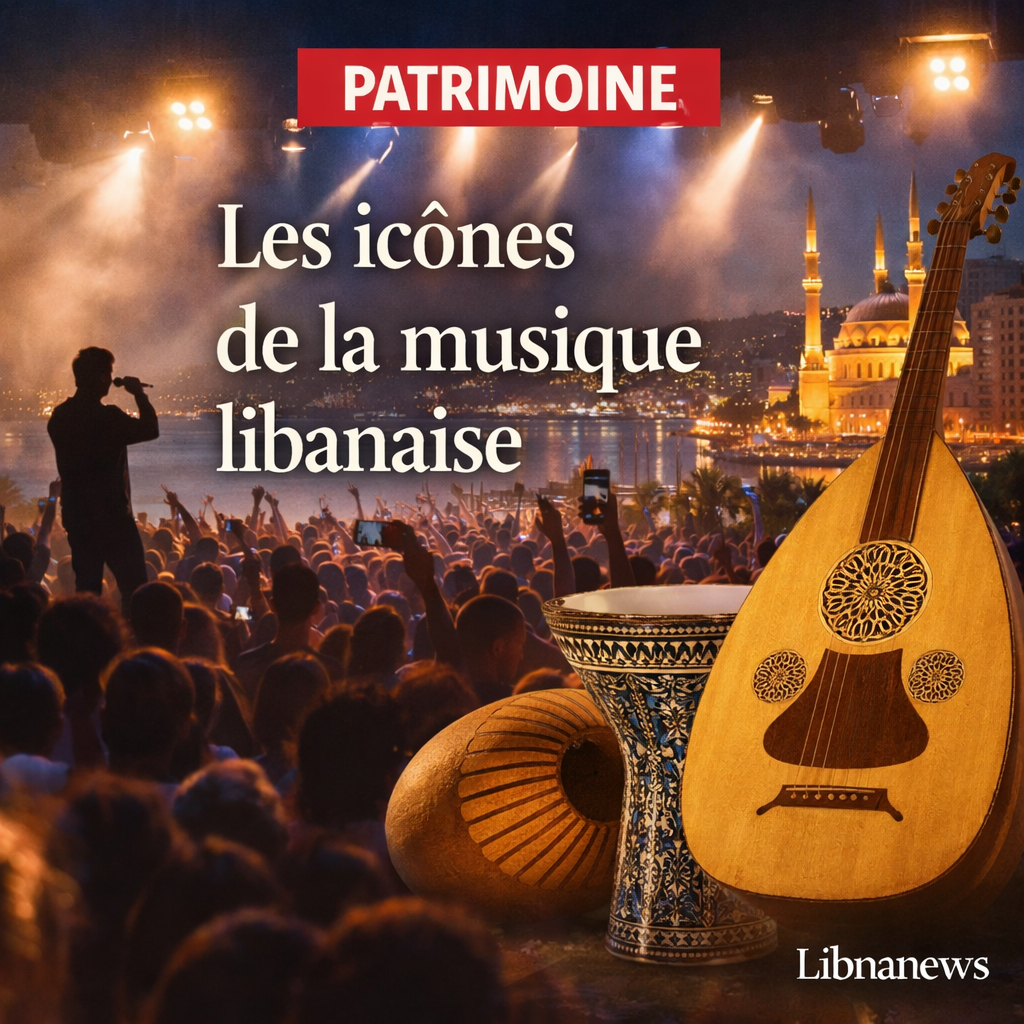
The icons of Lebanese music have, over the decades, transcended the borders of a small country marked by history to impose itself on the world stage. With a rare ability to mix Eastern traditions with contemporary rhythms, these artists not only exported the sounds of the Levant, but also carried messages of love, resistance and cultural identity. From Beirut’s golden years to international festivals today, Lebanese music continues to resonate as an echo of resilience and creativity, charming audiences as diverse as those in Paris, New York and Rio. At this time when Lebanon is still going through trials, these voices remind us that art can unite beyond crises.
The pioneers: voices that opened the way
From the 1950s and 1960s, Lebanese music freed itself from the borders of the Arab world to reach a global audience, thanks to iconic figures such as Fairuz, Sabah and Wadih El Safi. These artists, often from modest families, drew on Lebanese folklore – with its Ottoman, French and Arab influences – to create a repertoire that combines raw emotion and musical sophistication.
Fairuz, by his real name Nouhad Haddad, born in 1935 in a popular neighbourhood of Beirut, remains the undisputed queen. Nicknamed « the voice of Lebanon » or « the Arab diva », she began her career on Lebanese radio before conquering the international. His collaborations with the brothers Rahbani – Assi, whom she married, and Mansour – revolutionized Arabic music by integrating theatrical and orchestral elements. Songs like « Kifak Inta » or « Habbaytak Ta Nsit El Nawm », composed by his son Ziad Rahbani, explore love and nostalgia with poetry that transcends languages. Fairuz performed on mythical scenes: the Olympia in Paris in 1979, where she captivated a French audience moved by her crystalline voice, or the Carnegie Hall in New York. With more than 1,500 songs to her credit and sales of more than 150 million records, she embodies the artistic emancipation of Arab women, as evidenced by exhibitions such as that of the Arab World Institute in Paris.
Sabah, born Jeanette Feghali in 1927 and died in 2014, was the embodiment of joy and exuberance. Nicknamed « the golden voice » or « the Shabuba », she recorded more than 3,000 songs and played in about 100 films, mixing Arab tarab and popular rhythms. His tubes like « Zay el Hawa » resonated well beyond Lebanon, in Egypt and Syria, where she was adulated. Sabah has dared to make bold international tours for the time, performing in Europe and the United States, and his flamboyant style – with its extravagant dresses – has influenced generations of pop divas.
Wadih El Safi, born in 1921 and died in 2013, was the male « voice of Lebanon », master of the mawwal and ataba, these traditional vocal improvisations. A collaborator of the Rahbani, he popularized patriotic songs such as « Libnan Ya Akhdar », sung at festivals like Baalbeck. His performances in France and Latin America have introduced Western audiences to the emotional depth of Levantine music, and there remains a reference for contemporary folk singers.
These pioneers did not only export melodies; They carried the soul of a cosmopolitan Lebanon, marked by French colonization and cultural exchanges.
From Fairuz to Mika: the rise of a new generation
The 2000s saw the emergence of a wave of Lebanese artists who, taking advantage of globalization and digital media, propelled Lebanese music to world pop peaks. Mika, born Michael Holbrook Penniman Jr. in Beirut in 1983, is the most striking example. Fleeing from civil war with his family to settle in Paris and then in London, he infused his Lebanese origins into an eclectic and colourful pop. His album « Life in Cartoon Motion » (2007), with hits such as » Grace Kelly » or « Relax, Take It Easy », has passed to more than 7 million copies, dominating charts in Europe and the United States. Mika, openly gay, brings a touch of vulnerability and queer energy to his performances, as during his concerts in Lebanon where he pays tribute to his roots.
At the same time, stars like Nancy Ajram, born in 1983, conquered the Arab world and beyond with a mix of eastern pop and western beats. Leading albums such as « Ya Salam » (2003) or « Ah W Noss » (2004) have become bestsellers, with clips seen billions of times on YouTube. A UNICEF ambassador, she performed in Las Vegas, attracting a multicultural audience. Elissa, born in 1972, follows a similar trajectory: her albums « Ayshalak » (2002) and « Bastanak » (2006) won multiple World Music Awards. Ragheb Alama, born in 1962, veteran of Arab pop, multiplied hits like « Ya Rayt » and collaborated with Shakira, strengthening the bridges between East and West.
These artists benefited from the rise of satellite channels such as Rotana, which broadcast their clips to a global audience, transforming Lebanese music into a pop phenomenon.
Influences and fusions: a mix that seduces the planet
The strength of Lebanese music lies in its ability to absorb and reinvent influences. Beirut, the historic crossroads between the East and the West, has favoured bold fusions: jazz imported by Louis Armstrong during his concerts in 1959 and alternative rock today.
A perfect example of this is the Mashrou-Leila group, formed in 2008 at the American University of Beirut. Lead by openly gay singer Hamed Sinno, they mix indie rock, electro and Arabic poetry to address taboo themes such as homosexuality, corruption and human rights. Albums like « Raasük » (2015) were acclaimed in Europe, with Coachella tours and controversial bans in Egypt and Jordan for their progressive positions. Their music has influenced underground world scenes, proving that Lebanon can export not only melodies, but ideas.
Other innovators like DJ Said Mrad integrate Arab samples into electro, while Soapkills, pioneers of the Lebanese trip-hop, opened the way to hybrid sound experiences. Even world electronic music bears traces of Lebanon, as at Guy Manoukian, which merges oud and piano in international symphonic concerts.
Modern icons: a living and evolving legacy
Today, artists like Yasmine Hamdan, born in 1976, perpetuate this tradition by exploring experimental sounds. A singer from Soapkills, she collaborated with Jim Jarmusch for the soundtrack of « Only Lovers Left Alive » and performed in Glastonbury, combining dialectal Arabic and alternative rock. Tania Saleh, with her poetic folk, addresses social themes in albums like « Wehde » (2011), and echoes in Europe.
Ziad Rahbani, son of Fairuz, deserves a special mention: jazz composer and satirist, he modernized his mother’s repertoire while criticizing Lebanese society in theatre plays. His influence extends to beiruti jazz, a scene that is resilient despite crises, as at Blue Note Café.
International figures such as Madonna, who incorporated Fairuz’s inspired elements into « Isac » on her album « Confessions on a Dance Floor », or Serj Tankian from System of a Down, of Lebanese-Armenian origin, show the persistent global impact.
From Fairuz to Mashrou It is a cultural dialogue that, despite the country’s torments, continues to inspire and unite. In a fragmented world, these voices recall that Lebanese art, rich in its mixed heritage, remains an irreplaceable place on the world music map.