






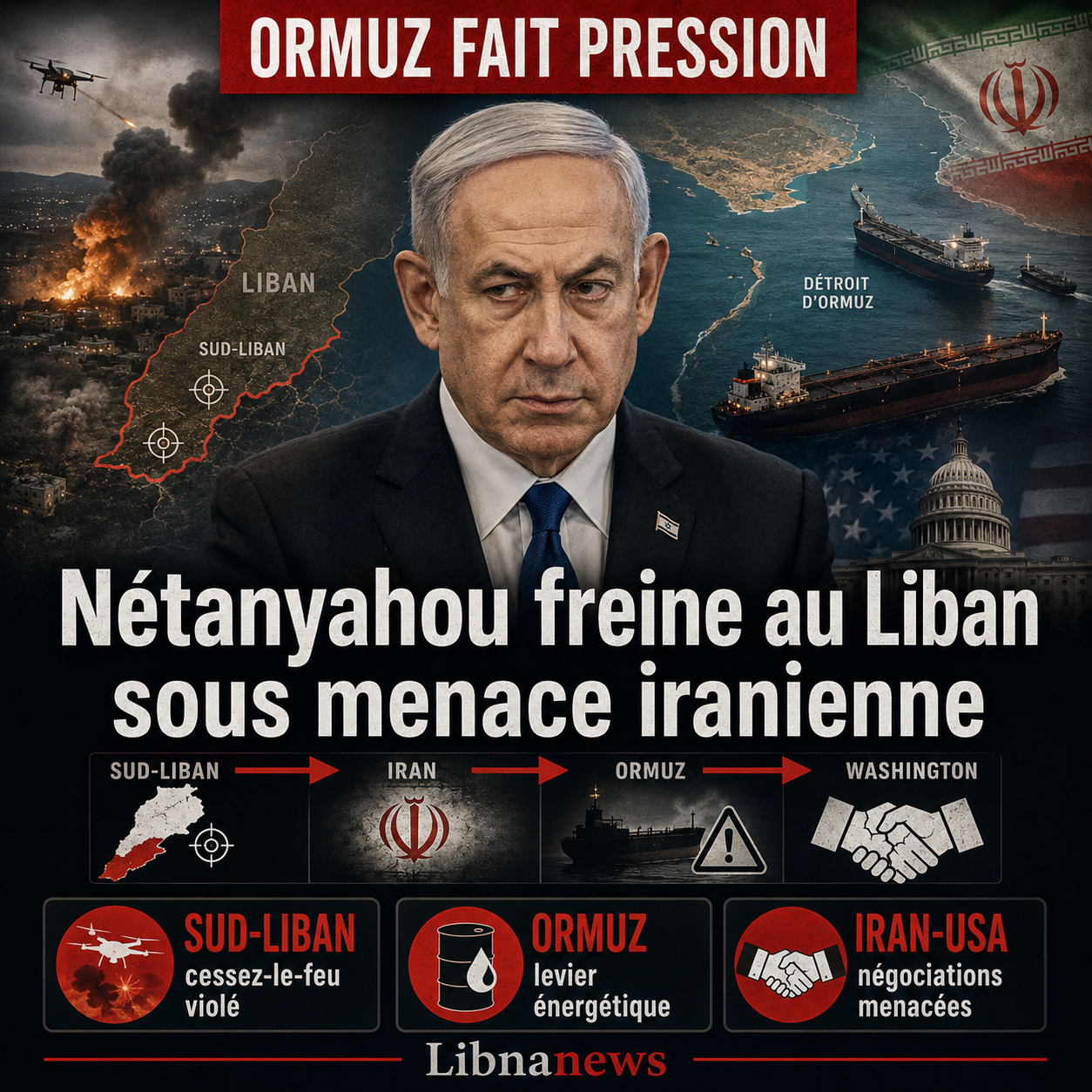
Benyamin Netanyahu reportedly ordered the Israeli army to stop military operations in Lebanon, while Iran threatened to close the Strait of Ormuz and conditioned the continuation of negotiations with the United States to halt Israeli ceasefire violations in southern Lebanon. The Israeli staff reportedly confirmed the cessation of the fighting following a new series of deadly Israeli strikes, Hezbollah reprisals and an increasing civilian record in several southern localities. For Washington, the sequence becomes critical: every bombardment in Lebanon now threatens dialogue with Tehran and can turn the crisis into one of the most strategic energy flows in the world. For Beirut, the stakes go beyond the mere suspension of the strikes. Lebanon must obtain a verifiable halt to operations and then a total Israeli withdrawal from the occupied areas, failing which the ceasefire will remain a fragile truce, exposed to every incident on the ground.
An order attributed to Netanyahu, but still to be checked
At this stage, no detailed official Israeli communication confirms a complete, lasting and verifiable cessation of military operations in Lebanon. The information circulates in a context of strong diplomatic pressure, following Iranian threats to Ormuz and warnings related to the American-Iranian negotiations. It can therefore correspond to a real operational decision, a tactical pause or a message sent to Washington to calm a dangerous escalation.
The shade is important. « Ending military operations » can mean several things. This may mean stopping air strikes. This may concern drone attacks. This may include artillery, ground incursions or targeted assassinations. This may also apply to certain areas only. Israel may suspend offensive operations while maintaining a military presence, monitoring capacity and self-proclaimed right of response.
This ambiguity is the first challenge for Lebanon. An Israeli military order is not enough if it is not accompanied by a verification mechanism. The inhabitants of southern Lebanon will not judge the situation on the basis of a sentence attributed to Netanyahu. They will see if the bombardments stop, the drones disappear, the roads become practical, and the rescue teams can access the affected areas. The truce is only valid for its visible effects.
The timing, however, gives this information a major political significance. Netanyahu now appears under pressure. It must take into account Iran’s reaction, American impatience and the risk of a maritime crisis in Ormuz. The Lebanese front, long treated by Israel as an immediate security theatre, thus becomes a factor of global tension.
Ormuz transforms South Lebanon into a global issue
The Iranian threat to the Strait of Ormuz changed the scale of the crisis. Tehran claims to respond to Israeli ceasefire violations in Lebanon and accuses Washington of not containing its ally sufficiently. Iran has announced the closure of the Strait, according to its official agency, while US officials have indicated that they do not see all signs of an effective and complete closure of maritime traffic. This difference between the political announcement and the operational reality must be underlined. But the signal sent is clear.
Ormuz is not an ordinary sea crossing. It concentrates a major part of world oil and gas flows. The threat of its closure is sufficient to cause market tensions, worry shipowners and push the United States to seek rapid de-escalation. By linking Ormuz to South Lebanon, Tehran makes every Israeli strike a global energy risk factor.
This strategy places Washington in a difficult position. The United States wants to preserve the dialogue with Iran. They want to avoid rising energy prices. They also want to maintain their support for Israel. These objectives are now in conflict. If Israel continues its operations in Lebanon, Iran can suspend discussions or tighten its position on Ormuz. If Washington presses Israel too strongly, Netanyahu will have to explain to his opinion that he acts under US and Iranian compulsion.
Lebanon thus becomes the link between three crises. The first is military in South Lebanon. The second is diplomatic, between Iran and the United States. The third is economic, around Ormuz and energy. This superimposition gives the Lebanese ceasefire an importance that it did not have at the time of its announcement. It is no longer just a matter of calming a border. The aim is to prevent regional escalation.
Israeli violations of the ceasefire
The ceasefire was to end the clashes between Israel and Hezbollah. It should also create the conditions for a resumption of regional negotiations. Yet the first hours of the truce were marked by new Israeli strikes in southern Lebanon. Attacks have been reported in Nabatiyah and Tyre districts, as well as in areas already affected by previous waves of violence.
According to an international news agency and several media outlets, at least sixteen people were killed in Lebanon in Israeli strikes despite the ceasefire. The assessment includes civilians, a family of four and a Lebanese soldier. Dozens of wounded were also reported. This assessment gives a direct political dimension to the crisis. Strikes do not only affect combatants or military positions. They hit Lebanese homes, vehicles, families and institutions.
Artillery bombing, drone strikes and air raids have also been reported. The inhabitants of the South describe a precarious truce, interrupted by the constant overflight of drones and the fear of further attacks. In a number of locations, relief assistance was required in difficult conditions, with the risk of further strikes at the sites already affected. Fear of a second attack often hinders residents seeking to rescue relatives or inspect their homes.
Israel justifies its operations by firing Hezbollah and by the need to neutralize immediate threats. The Israeli army claims to have responded to projectiles fired from Lebanon. But this justification does not answer the central question: can a ceasefire stand if one of the parties retains a unilateral freedom of military action? For Beirut, the answer is no. A truce that allows permanent preventive strikes is not a truce. It is a conditional suspension of war, decided by the strongest party.
Hezbollah’s retaliation and risk of gearing
Hezbollah also claims to have responded to Israeli violations, strikes and continued Israeli positions in Lebanon. Rocket fire and other actions were reported against Israeli positions. Israel reported dozens of projectiles fired from Lebanon and blamed Hezbollah for an attack that killed four Israeli soldiers, including an officer. This attack served as a justification for a massive Israeli response.
The logic of retaliation is at the heart of the danger. Israel strikes by claiming to respond to Hezbollah. Hezbollah shoots by claiming to respond to Israel. Each camp claims defensive action. Each operation produces a new justification for the opponent. This mechanism makes the ceasefire very vulnerable. Suffice a shot, a drone strike or a charge of infiltration to reopen a sequence of violence.
For Lebanon, this cycle is particularly dangerous. Hezbollah’s reprisals escape the state. But the Israeli strikes affect Lebanese territory and its population. The state is therefore held accountable to its citizens, without fully controlling military decisions that cause or prolong escalation. This situation feeds the discourse of Hezbollah, which claims that the state cannot protect the South without its armed force.
Every Israeli violation reinforces this argument. Every Iranian threat to Ormuz reinforces it too. Hezbollah can say that its regional alliance imposes a cost on Israel and the United States. It can present Iranian pressure as evidence of effectiveness. That is why Beirut must turn the current crisis into a state gain. The cessation of Israeli operations must be followed by a total withdrawal and an effective deployment of the Lebanese army. Otherwise, Hezbollah will remain the main political beneficiary of the escalation.
A civilian record that weighs on Washington
The civil record now weighs heavily on American diplomacy. The Israeli strikes that killed at least sixteen people after the ceasefire, including a family of four and a Lebanese soldier, weakened Washington’s position. The United States cannot defend a regional agreement while allowing the Lebanese front to simmer. They cannot ask Iran to continue negotiations if Israel continues to strike a major ally of Tehran. Nor can they claim to strengthen the Lebanese State if a Lebanese soldier is among the victims.
The balance sheet is part of a wider sequence. International media reported a deadly outbreak in the 24 hours preceding the renewal of the ceasefire, with dozens of deaths in Lebanon. The cumulative figures since the outbreak of the war remain very high. According to data reported by the international press and attributed to the Lebanese authorities, several thousand people have been killed and more than ten thousand injured since the beginning of the spring escalation. The precise balance sheets vary according to the updates, but the extent of civilian and material losses is beyond doubt.
On the Israeli side, the authorities point out the victims caused by the Hezbollah fire. The death of four Israeli soldiers in the recent escalation has had a profound impact on the response decision. Israel also claims to have to protect its northern communities from rockets, drones and infiltration. This reality exists. But it does not justify, from the Lebanese point of view, the continuation of operations that strike inhabited areas after the announcement of a truce.
The weight of civilian victims obliges mediators to leave the general formulae. It is no longer enough to call both parties to the restraint. You have to figure out who rapes what, when and how. It is necessary to document the strikes, the shootings, the occupied positions, the affected areas and the victims. Without a verification mechanism, each side will impose its own narrative. And without operational truth, the ceasefire will remain a diplomatic fiction.
Iran conditionals negotiations upon cessation of operations
Tehran set the bar very high. Iran requires the continuation of negotiations with the United States to stop Israeli violations of the ceasefire in Lebanon. This position allows him to protect Hezbollah while avoiding breaking dialogue alone. It places responsibility on Washington and Israel. It says, in essence, that the regional agreement cannot move forward if an ally of Iran is struck in Lebanon.
This strategy serves several purposes. It allows Iran to show that it does not negotiate by abandoning its regional relays. It strengthens Hezbollah in the balance of power. It obliges the United States to treat Lebanon as a condition of negotiation, not as a secondary issue. Finally, it uses Ormuz as an economic lever to remind us that the crisis can be costly beyond the Middle East.
For Washington, the equation becomes urgent. The US administration must convince Israel to strictly abide by the ceasefire, without giving the impression of giving in to Iranian blackmail. She must keep Tehran at the table, without appearing to be weakened. It must reassure the markets, without minimizing the risks in Ormuz. It is in this context that the order attributed to Netanyahu makes sense. It may represent an American attempt to stop climbing before it overflows.
But an Israeli suspension will not be enough if it remains verbal or tactical. Iran may judge that the violations continue. Hezbollah can resume fire. Israel can respond. The retaliation chain will resume. The Iranian condition therefore obliges the mediators to obtain a stronger agreement: cessation of operations, monitoring mechanism, withdrawal schedule and reciprocal guarantees.
Netanyahu between internal security and regional constraint
Benyamin Netanyahu has to deal with several conflicting pressures. At the domestic level, it must show that it protects northern Israeli communities and does not allow Hezbollah to rebuild its capabilities. At the military level, it wants to maintain freedom of action against positions, depots, launchers or armed groups considered to be threatening. At the diplomatic level, it must take into account Washington, whose support remains essential. At the regional level, it must avoid giving Iran a pretext to harden around Ormuz.
This tension explains the possibility of an order to stop operations. Netanyahu may want to reduce pressure without abandoning its objectives. It may suspend certain strikes to allow American-Iranian discussions to continue. It can try to avoid an energy surge. He can also wait for a provocation from Hezbollah to resume the initiative. The exact nature of the order will therefore be decisive.
Lebanon must be wary of a simple break. A break can save a diplomatic meeting. She can calm the markets. It can offer Israel a political respite. But it does not restore Lebanese sovereignty. It does not guarantee the return of displaced persons. It does not end the Israeli presence in the disputed areas. It does not permanently reduce Hezbollah’s argument.
The only strategic outcome for Beirut remains the total withdrawal. A truce without withdrawal would leave the South in a grey zone. A grey zone means drones, possible strikes, dangerous roads, partially empty villages and renewed legitimacy of Hezbollah. This is precisely what Lebanon must avoid.
For Beirut, a narrow window
Lebanon has a rare diplomatic window. Iran has made South Lebanon a negotiating condition. The United States wants to avoid the failure of dialogue and a crisis on Ormuz. Israel could be forced to suspend its operations. This combination gives Beirut a lever. But this leverage can disappear quickly if the case is handled by other actors without a clear Lebanese mandate.
Beirut must therefore make a simple request. The cessation of Israeli operations must be immediate, complete and verifiable. It must include air strikes, armed drones, artillery, incursions and targeted assassinations. It must be followed by a timetable for withdrawing the positions occupied. It should allow the deployment of the Lebanese army and the return of displaced inhabitants. It must also include a mechanism for dealing with violations that does not leave Israel alone a judge of its response.
This line is not an overbid. It corresponds to the minimum necessary for a ceasefire to become real. A State cannot accept that a foreign army retains a presence or freedom to strike in its territory. It cannot ask its citizens to trust the institutions if the institutions cannot prevent the bombing. It cannot reduce the role of Hezbollah if the Israeli occupation continues to fuel its discourse.
The Lebanese presidency, the government, the army and the mediators must therefore speak with one voice. Lebanon must not be content with being traded between Washington, Tehran and Tel Aviv. He must use the pressure of Ormuz to put his sovereignty back at the centre of the settlement. Calm in South Lebanon should not be the price paid to Iran. It must be a recognized right of the Lebanese State.
One exit suspended in the field
In the next few hours, the reality of the terrain will tell whether the order attributed to Netanyahu marks a turning point or a pause. Will the strikes really stop? Will the drones withdraw? Will artillery fire end? Will Hezbollah’s retaliation stop? Will relief workers have free access to the affected areas? Will displaced families receive guarantees to return?
These issues matter more than statements. A ceasefire is measured by the security of villages, the reduction of victims, the silence of weapons and the return of institutions. If Israeli order remains limited, Iran will be able to maintain its threat to Ormuz. Negotiations with Washington will remain suspended for each incident. Hezbollah will retain its argument. Lebanon will remain vulnerable.
If, on the other hand, the cessation of operations becomes verifiable, a new sequence may open. The American-Iranian discussions could resume on a less unstable basis. Washington could turn its pressure on Israel into a guarantee for Lebanon. Beirut could prepare for the deployment of the army and document violations. Total Israeli withdrawal would then become the next demand, not as a diplomatic conclusion, but as a concrete condition for the end of the war.