





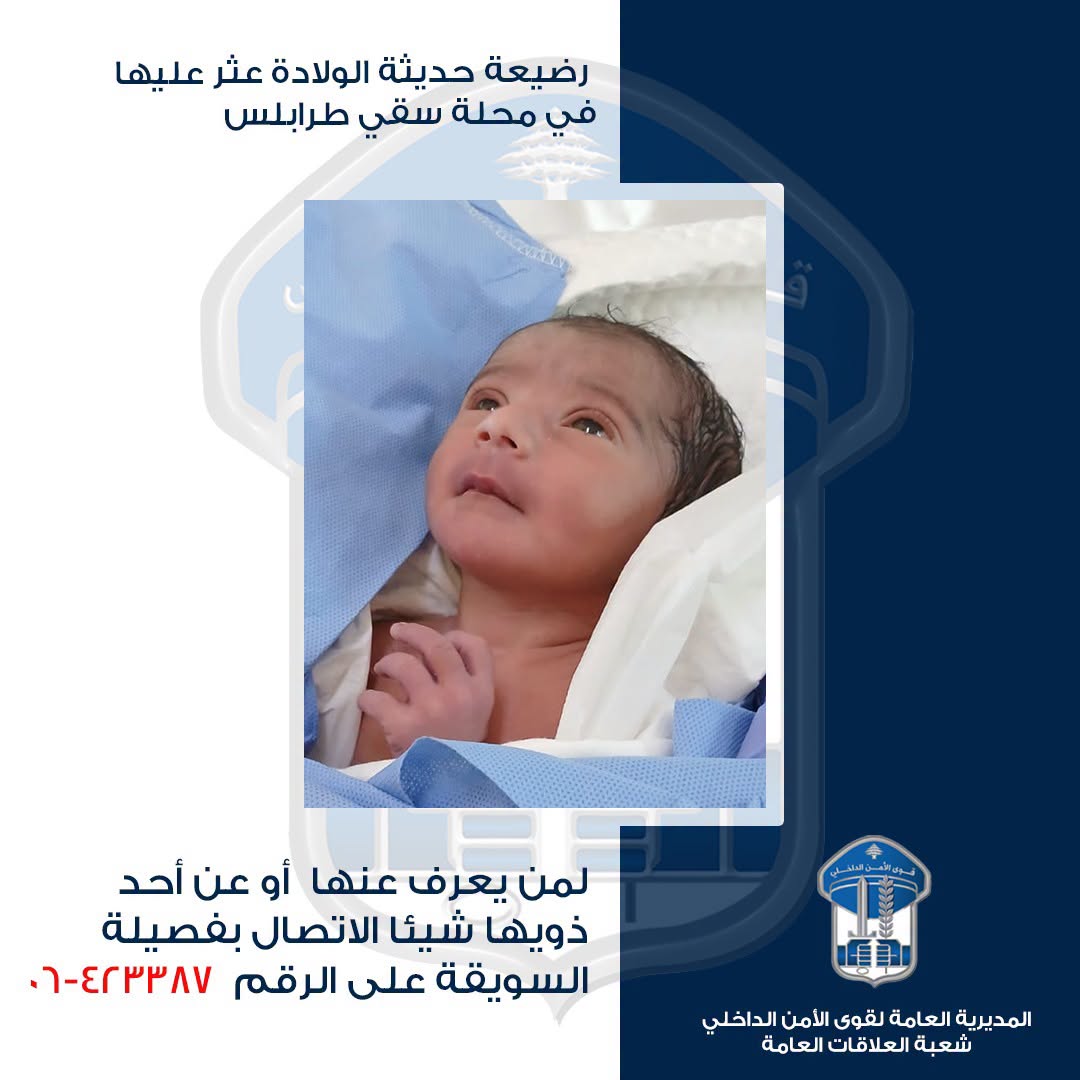
A newborn was found in Tripoli, northern Lebanon, near the roundabout of the municipal stadium, in the Saqi Tripoli area. The Internal Security Forces issued a call for witnesses, on instructions from the competent court, in order to identify the child or a relative of the child. The communiqué asks anyone with information to contact the Sueika Brigade, which is part of the regional gendarmerie unit, at 06-423387. At this stage, there is no official indication of the circumstances of abandonment, the identity of the mother, the child’s family status or the reasons for this tragedy. The case therefore imposes a twofold requirement: to relay the public appeal without further exposing the infant, and to recall that child protection begins with prudence, medical care and judicial work.
A newborn found in Saqi Tripoli
The fact reported by the Internal Security Forces is brief but heavy. A little girl, described as a newborn, was found in the area of Saqi Tripoli, near the roundabout of the municipal stadium. The authorities did not provide medical details of his condition in the text transmitted. They also did not specify the exact time of discovery, the conditions under which the infant was found, or the identity of the persons who reported it.
This sobriety is important. In this type of case, the first hours are often dominated by emotion, assumptions and comments. Social networks quickly broadcast images, incomplete narratives and sometimes unfounded accusations. An abandoned child cannot become an object of public curiosity. First, she is a potential victim, placed under the protection of justice and competent services.
The Internal Security Forces reported that the distribution of the photo was carried out on instructions from the prosecutor ‘ s office or the competent judicial authority. This clarification shows that the call for witnesses is part of a proceeding. The aim of the publication of the image is to identify the child or his or her relatives, not to feed a media exhibition. Any reproduction of this photo should therefore be measured, justified and limited to the research objective.
The number provided by the authorities is that of the Sueika Brigade: 06-423387. Persons who recognize the infant, who have seen a woman in distress in the area, or who have information about the circumstances of the discovery, are called to contact the unit directly. It is not a question of commenting publicly on the case, but of providing investigators with verifiable information.
Tripoli facing a human tragedy
Tripoli is experiencing old poverty, aggravated by the Lebanese economic crisis. This reality does not make it possible to explain alone the abandonment of an infant. However, it requires that the tragedy be placed in a difficult social context. In several neighbourhoods in the north, families live under heavy pressure: unstable incomes, fragile access to care, unpaid rent, unemployment, debt, internal displacement and lack of effective social safety nets.
A birth in such an environment can become a test when the mother is isolated, minor, ill, without family support or exposed to violence. These assumptions should not be applied mechanically in the case of Saqi Tripoli. There is nothing at this stage to say what happened. But they recall that infant abandonment does not always occur through a simple gesture or a criminal intent. They can reveal a situation of panic, shame, distress or extreme vulnerability.
Priority therefore remains the protection of the child. It requires immediate medical care. A newborn found outside should be examined promptly. Physicians must check the temperature, hydration, weight, respiratory condition, possible injuries, signs of infection or any complications associated with birth. Even when an infant appears stable, the first hours remain decisive.
Protection also requires judicial supervision. The court must determine the circumstances of the abandonment, seek the parents or legal guardians, check whether there is a danger for the child and decide on placement measures. The role of the police is then to collect information, identify witnesses and document the facts. The role of social institutions is to ensure that the child is not only saved in emergency, but is protected over time.
A call for responsible witnesses
The call of the Internal Security Forces has a clear objective: to find anyone who could identify the infant or his or her relatives. This approach can be decisive. A neighbor may have seen something. A driver may have transported a woman in distress. A trader may have noticed an unusual presence near the roundabout. A healthcare professional can remember a recent birth not followed by a normal family return.
But the dissemination of the call requires responsibility. The information should be sent to the appropriate brigade, not published on social networks. Accusing a woman, family or neighbourhood without evidence can destroy reputations, hinder investigation and expose vulnerable people. In this type of case, a rumor can become a second drama. It can also deter a relative from coming to the authorities for fear of being lynched publicly.
Protection of the child’s identity is also essential. Even when the authorities broadcast a photo, the media and Internet users must avoid unnecessary coverups, montages, humiliating comments or intrusive descriptions. This little girl may have a long legal, medical and social path. She must not grow up with a viral image attached to her first days of life.
The press can relay the call, call the contact number and locate the facts. It must stop before the staging of suffering. The vocabulary counts. We need to talk about a found infant, an open investigation, a call for witnesses. Unconfirmed certainty about the mother, intentions, social origin or motivation must be avoided. Emotion must not replace verification.
What the authorities need to establish
The survey must first identify the chronology. When was the infant abandoned or dropped off? How long did she stay there? Who found it? Do surveillance cameras cover the roundabout of the municipal stadium or the adjacent streets? Did any vehicles park briefly in the area? These elements can help find the person who left the child or understand if other adults were involved.
Investigators will also have to determine whether the birth took place in a health facility, a home or an unsanitary place. This information is important to the infant’s health and to the mother’s search. A birth without assistance can cause serious complications for both the mother and the child. The mother may be herself in danger, injured, infected or in shock.
Justice will then have to qualify the facts. The abandonment of a newborn may arise from several legal situations, depending on the intention, the danger involved, the state of the child and the circumstances. It would be premature to criminalize the case without investigation. The urgency is not to appoint a culprit in public space. It is to protect the child, to find relatives and to understand whether an adult needs help or must be held accountable.
Social services will finally have to prepare for the future. If the family is found, the child cannot be simply handed over without evaluation. Safety conditions, management capacity and the existence of a hazard will have to be checked. If no relative is identified, a protection or placement procedure should be organised. In all cases, the decision must take into account the best interests of the child.
A city marked by social fragility
Tripoli has long been wearing an image of an injured city. As Lebanon’s second largest city, it concentrates a significant part of the country’s urban poverty. Successive crises have weakened households. The fall in the currency, the rise in prices, the collapse of public services and the difficulties of access to care have reduced the margins of survival. The most precarious inhabitants often find themselves alone in the face of impossible situations.
It would be dangerous to turn this tragedy into a charge against Tripoli. The city is not responsible for an abandonment. Rather, it is the mirror of a country where social systems are not always able to prevent family collapse. When pregnant women do not have access to medical follow-up, when isolated mothers do not know where to ask for help, when families fear stigma, crisis situations can shift into irreparable situations.
Local associations, social centres, clinics and religious structures often play a leading role. But they lack resources. They intervene after the emergency more than before. The case of Saqi Tripoli recalls the need to strengthen the discreet mechanisms of assistance to pregnant women in distress. A person who is afraid of not being able to keep his or her child must be able to ask for help without immediate fear of shame, violence or public exposure.
This aid must be concrete. It involves listening lines, accessible medical consultations, shelters, available social workers and clear protection procedures. It also requires coordination between police, justice, hospitals, Ministry of Social Affairs and associations. Without this chain, each case becomes an isolated rescue, then disappears from public attention until the next drama.
Child first, before the rumor
The public treatment of this case will also say something about Lebanese society. Compassion is necessary. It’s not enough. Anger is understandable. She can become dangerous if she turns into a culprit hunt. The child found in Saqi Tripoli needs a name, medical attention, legal protection and a life perspective. She doesn’t need massive exposure or comments that reduce her to her abandonment.
Internet users who see the photo circulating must ask themselves a simple question: does sharing really help the survey? If they know nothing about the child or his or her relatives, the image can only increase its exposure. On the other hand, any specific information must be transmitted to the Sueika Brigade. An apparently minor detail may become useful if it is verified by the investigators.
The media also have a responsibility. They must relay the appeal of the authorities, but avoid republishing the image when this is not necessary. They have to call the official number. They must protect the child’s identity. They must avoid assumptions about the mother. They must resist the temptation of the spectacular narrative. A different fact involving a newborn is not viral content. This is a child protection case.
Justice will have to continue its work away from the noise. If the mother is found, she will have to be heard, but also examined and protected if her situation so requires. If violence, pressure or exploitation are discovered, they will have to be treated. If the child was abandoned in distress, the file will also ask the question of the social responses that the State could not offer in time.
A call that exceeds one file
The case of Saqi Tripoli must not disappear after the emotion of the first hours. It should be used to question Lebanon’s ability to protect newborns, isolated mothers and families in rupture. The institutions have procedures. Security forces are calling. Magistrates give instructions. Hospitals are treating. But the whole is often reactive. He intervenes when the danger is already there.
A policy of prevention should act earlier. It should identify unattended pregnancies, situations of domestic violence, pregnant teenage girls, undocumented or resourceless women, and mothers facing extreme social pressure. It should offer confidential solutions before abandonment becomes, for some, the only imaginable outcome. This prevention is difficult in a country in crisis. It is nevertheless necessary.
The case of the newborn found near the municipal stadium also recalls the importance of community services. The Sueika Brigade, police stations, clinics and associations are often better known than the major administrations. They can collect a word, identify distress, or direct a person to help. However, the citizens must provide them with useful information and the means must follow.
For the time being, the investigation remains open. The Internal Security Forces ask anyone with information to call 06-423387. The rest is the responsibility of justice, doctors and social services. In Saqi Tripoli, a child has just entered public life through a drama. The first duty now is to get her out of the noise, to put her under protection and, if possible, to find the missing threads in her story.