

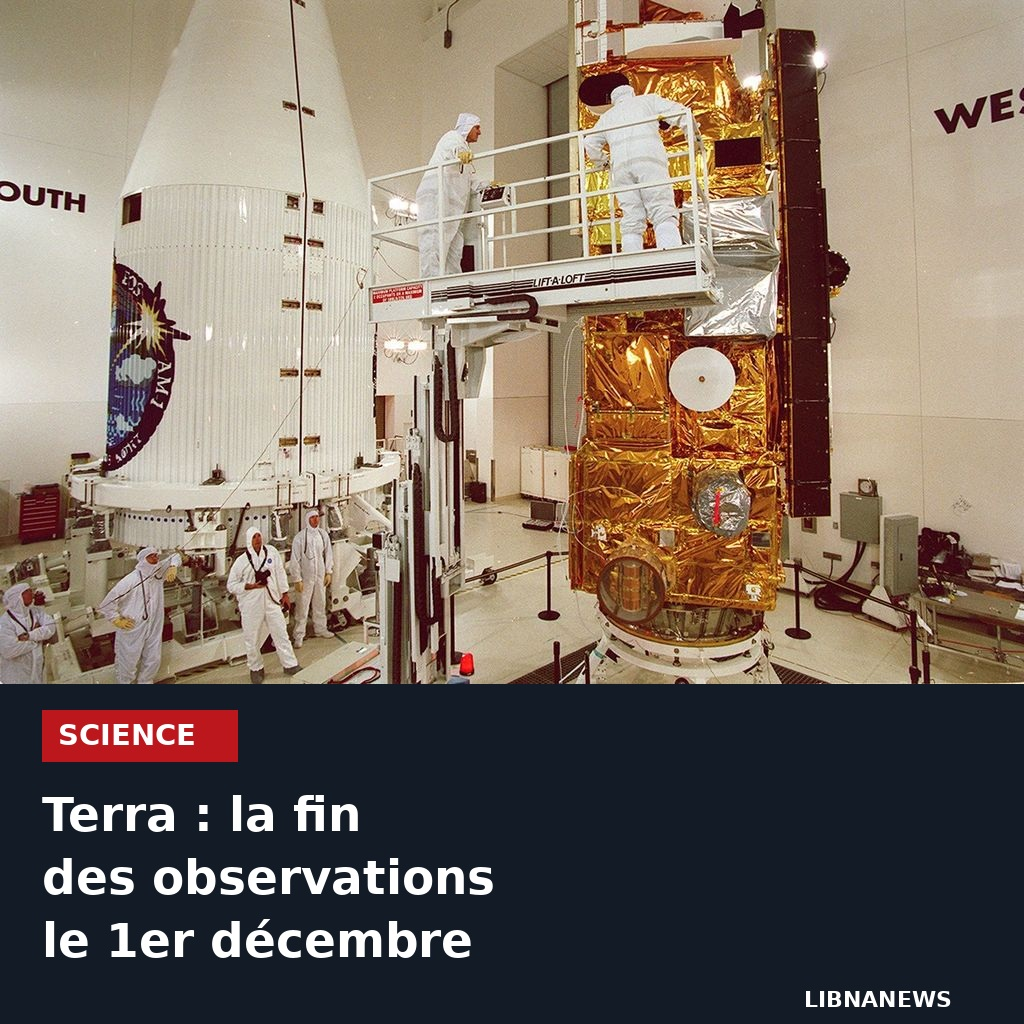
Terra will cease collecting scientific data on December 1, 2026, announces NASA in a press release on November 17. The Agency then plans to shut down all satellite systems in January 2027. This decision concludes an Earth observation mission launched in December 1999 and originally designed for six years.
Two steps, not one stop already achieved
The schedule distinguishes the end of the observations from the complete decommissioning. In between, the teams must use the remaining fuel to lower the orbit and then extinguish. NASA invokes the aging of systems and orbital drift of the aircraft. Its announcement does not give an atmospheric re-entry date: stopping the instruments therefore does not mean an immediate fall of the satellite.
This calendar of 17 November is the most recent specific communiqué at the end of Terra. A note still contained in a NASA historical record, published on 29 December 2025, envisaged the end of scientific activities in February 2027. This old projection must now be distinguished from the deadlines announced for December 2026 and January 2027, without transposing them to the other satellites of the fleet.
Nearly 27 years to observe a linked planet
Terra took off on December 18, 1999 from Vandenberg, California. After initial verifications and manoeuvres, he joined his work orbit on 24 February 2000. At the announced stop of the observations, it will therefore miss a few weeks to reach exactly 27 years since its launch.
The interest of this observatory was to measure together several components of the terrestrial system. Its five instruments, ASTER, CERES, MISR, MOPITT and MODIS, were used to study surfaces, clouds, aerosols, pollution and energy exchange. This approach combined US, Japanese and Canadian contributions.
The mission’s historical record illustrates this complementarity: ASTER maps the properties of surfaces, CERES measures the Earth’s radiative balance, while MOPITT followed carbon monoxide in the troposphere. MODIS provides observations in 36 spectral bands. These capabilities are not interchangeable and their meeting on the same platform was a particular feature of Terra.
The measures stop, the archives remain
NASA’s contributions include monitoring land cover, fire, dust and smoke transport, atmospheric composition and ice. These series have been used for research and agricultural, hydrological or public safety applications.
The apparatus was already operating with a reduced scientific load: MOPITT and parts of CERES and d However, the end of the collection will not remove the accumulated observations. NASA confirms that Terra’s data will remain free and accessible to the public.
Illustration: NASA photography of Terra’s preparation before its launch in December 1999, KSC-99PP-1412 reference. It is an archive, not an end-of-mission operation.
Sources
- NASA, end of mission announcement, November 17, 2026.
- NASA, Terra historical record and old calendar projection.
- NASA, re-use of images.





Comments