

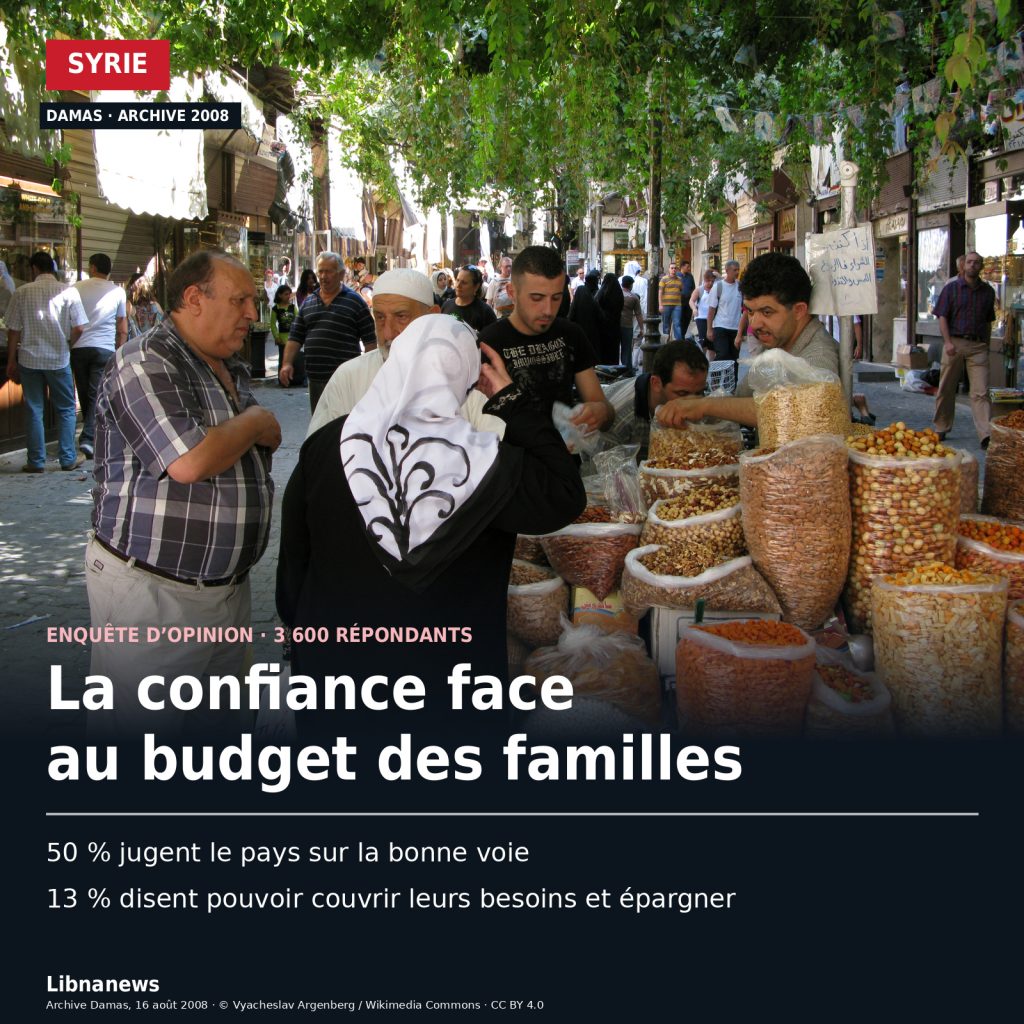
The new Syrian opinion index draws a contrast between the assessment of the general situation and family resources. Published on November 2, its first results indicate that 50% of respondents believe their country is moving in the right direction, compared with 35% in the wrong direction. But only 13% say they can meet their basic needs and save.
Syrian opinion on income
In the survey, 55% say they have the necessary without saving, while 30% say they have insufficient income for their basic needs. 68% of respondents rated security as positive, 63% rated political, and 41% rated economic. Another gap: 66% believe that foreign policy expresses their views, but only 44% say so from domestic economic policy, which 52% disavow.
These responses do not all measure the same. To judge favourably the leadership of the country does not amount to approving each government decision, nor to considering its own standard of living as satisfactory. Security, political representation and the family budget are separate registers. Aggregating them into a single verdict would remove precisely what the investigation makes clear.
A survey, not a census
The Arab Centre for Research and Political Studies carried out this work with the Arab Centre for Studies on Contemporary Syria. The survey involved 3,600 respondents between September 28 and October 15, 2026, using multi-stage stratified cluster sampling. The organizers report covering all provinces and social and economic components. They announced a confidence level of 98% and a margin of error of two to three points.
This statistical accuracy does not remove all the limitations of a survey. The formulation of questions, the conditions of the interviews and the freedom felt to respond can influence the results. Above all, a sample interviewed in the country should not be presented as a vote of all Syrians, including those living abroad. The percentages describe reports collected over a specified period, not a certification of institutional quality.
Economic recovery does not immediately solve the difficulties
The context described by the World Bank helps to understand why global improvement can coexist with constrained budgets. The institution notes signs of recovery, but stresses that official statistics remain limited and of uneven quality. She referred in particular to the improvement of electricity supply, the return of refugees and the resumption of certain activities. It also warns that regional conflict can affect trade, tourism, investment and electricity. Its estimate of physical reconstruction is $216 billion, based on damage to infrastructure and buildings estimated for 2011–2024.
The IMF, too, made an important distinction at the end of its July mission: a strengthened but uneven economic recovery across regions, and a pervasive poverty. Its services were an upsurge in inflationary pressures in 2026, linked in particular to the cost of food and energy imports, utilities and housing. They insisted on employment, public services and housing rehabilitation to support sustainable returns.
Changes in real income, access to services and disparities between regions remain at the centre of the difficulties described by economic institutions. To assess future surveys, these indicators will be more informative than a single satisfaction rate, provided that they compare questions and methods that are truly equivalent.
Cover: street market in Damascus, Syria, archive of August 16, 2008. Illustration, not an image of the 2026 survey; photographed persons are not presented as participants. Photo:© Vyacheslav Argenberg / Wikimedia Commons,CC BY 4.0. Boxing and dressing Libnanews.






Comments