

The tenancy is supported by the President and CEO of the Habitat Bank, Antoine Habib. In an interview in Al-Markazia broadcast on 2 November 2026, he proposes to study his financing with public and private actors. The formula would allow part of the monthly payments to be spent on housing. Its legal framework, resources and conditions remain to be defined.
Antoine Habib targets young people and low- and middle-income families. It presents this formula as an additional way to property. The Habitat Bank is willing to examine the mechanisms necessary to contribute to the projects, without announcing an envelope already allocated.
The announcement is about this availability to work on editing. It does not open an application window and does not present a housing list. No launch schedule, monthly payment schedule or number of beneficiaries are included in the detailed proposals by the head.
The lease-accession is based on a contract to be built
The principle described by Antoine Habib distinguishes the occupation of housing from its progressive acquisition. The household would reside in the property and make monthly payments. Part of these payments would enter into the purchase price, subject to the terms of the contract.
The share devoted to acquisition is therefore a central point. The scheme does not mean that all rents paid so far automatically become capital. It presupposes a specific agreement, which establishes the amounts taken into account and the conditions for the transfer of ownership.
This mechanism is of particular interest to households which do not immediately have an input to buy. But its accessibility will depend on the total amount requested and the expected duration. These parameters will allow us to know which families will actually be able to bear the monthly payments.
Antoine Habib calls for a comprehensive legal, regulatory and financial framework. It should define the rights of the occupant, promoter and financier. It should also specify the calculation of payments and guarantees of each party.
The protection of sums already paid is a concrete question of this assembly. The contract must allow the household to understand what it acquires and when. Details of departure, interruption of payments or delay in delivery remain to be clarified. No detailed arrangements on these situations accompany the announcement.
Associate the bank, state and promoters
The leader envisages cooperation with the Lebanese State, real estate developers and financial institutions. He also mentioned Arab and international funds as possible partners. Their participation is a funding channel, not a commitment already obtained.
The Habitat Bank could provide its experience in lending management. The other partners should contribute, depending on the set-up chosen, to land, infrastructure or construction. The project thus requires more than just a spread of payments between a seller and a buyer.
Among the possible applications, Antoine Habib cites residential units for military and security personnel. He also referred to programmes for young people and families. These categories appear as envisaged audiences, without constituting already agreed admission criteria.
The selection is itself part of the conditions it imposes. It calls for transparent rules and priority for families most in need of housing. However, it does not specify any income threshold or procedure for filing applications.
Public debate still precedes decisions
This position follows a meeting held on 27 October at the Economic, Social and Environmental Council. Its president, Charles Arbid, and the general manager of the Habitat Public Institution, Rony Lahoud, had organized the exchanges. Social Affairs Minister Hanine Sayyed and MP Georges Okais participated.
Rony Lahoud presented a roadmap for a national housing strategy. One of several avenues is the rental-accession scheme, with particular attention to households unable to raise an initial contribution. He also mentioned tax incentives for owners and promoters.
Hanine Sayyed indicated that the draft strategy continued to evolve as consultations progressed. It was then to be submitted to the Council of Ministers. Charles Arbid defended a five- or ten-year policy capable of surviving changes of government.
The discussions therefore concern both a contractual tool and a public policy. The Habitat Bank and the Habitat Public Establishment operate as two separate institutions. The support expressed by Antoine Habib is not worth adopting the road map presented by Rony Lahoud.
In Saida, the question of land meets that of the budget
A municipal response illustrates the practical difficulties. In a report released on 30 October, Saida presented the participation of its advisor Youssef Tohmé at the meeting. He represented the president of the municipal council, Mustapha Hijazi.
He discussed the possible use of property related to reconstruction projects following the 1956 earthquake. The idea would be to develop new housing. According to the advisor’s account, the head of the Habitat Public Institution opposed the weakness of the available credits.
The local project therefore remains an opportunity to discuss. The municipality advocates a role for municipalities in identifying needs, beneficiaries and land. This example distinguishes the possible availability of land from the ability to finance its transformation.
On 29 October, Rony Lahoud also presented President Joseph Aoun with preparations for a resumption of his establishment’s loans. It linked this perspective to the adoption and promulgation of the 2027 budget. This preparation concerns the credits of the Public Housing Institution; it does not constitute an opening of the lease-accession.
For the latter, the next steps remain the definition of the contract, the identification of financing and the adoption of selection criteria. Households expect mainly published conditions: what housing, monthly payments, how long and what guarantees until the transfer of property.
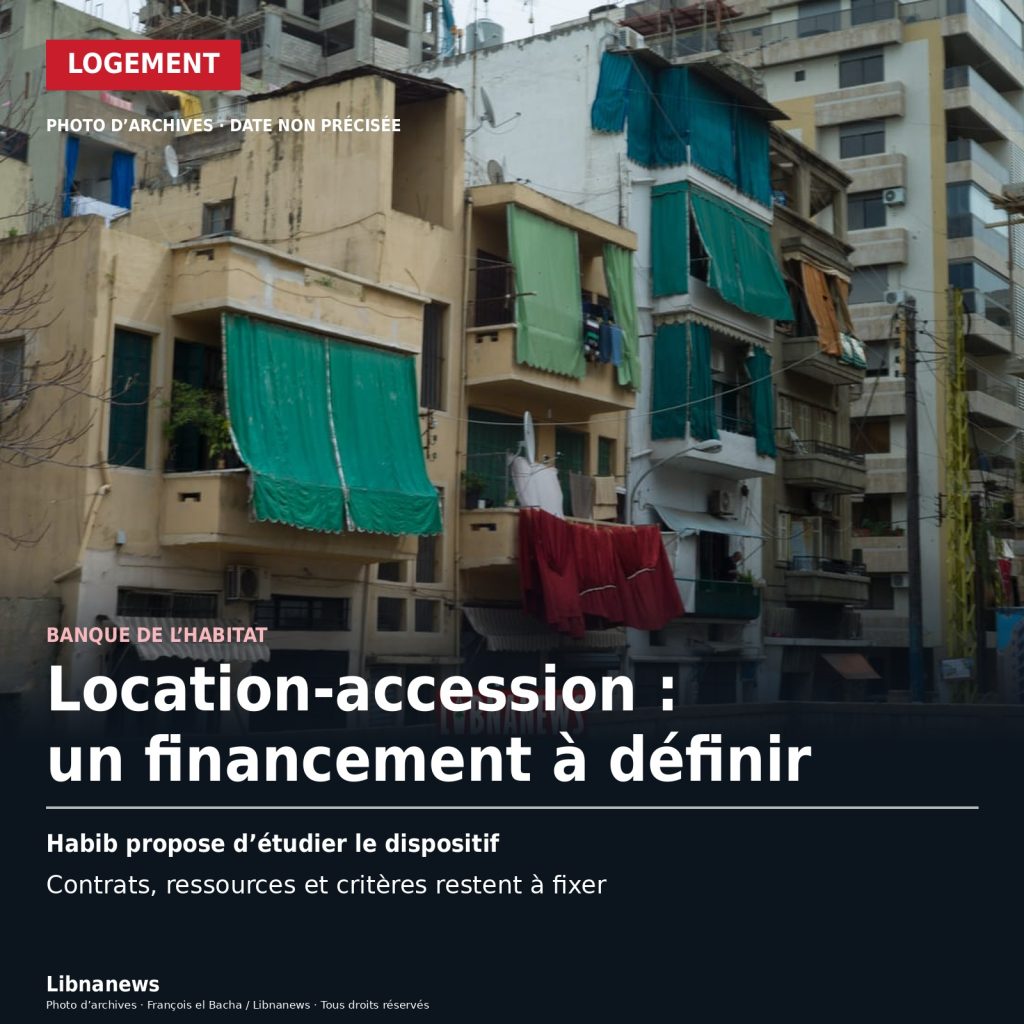
Cover: residential buildings in Lebanon, photo archives of François el Bacha / Libnanews. Unspecified shooting date; photograph published in the media library of April 2018. None of these buildings is identified as participating in an accession lease program. All rights reserved; Libnanews reuse allowed. Boxing and dressing Libnanews.





Comments