

The losses of agriculture in Lebanon also affect herds, hives and the means to resume farming. In an interview in Anadolu published on November 2, 2026, Minister Nizar Hani reaffirms an estimate of 56,000 hectares of agricultural land affected by the war. It also reports more than 30,000 lost hives and a sharp reduction in livestock numbers in the South.
These departmental assessments describe several components of agricultural activity. They are not limited to fires. The return to a field, the availability of a herd or the maintenance of animal feed each pose a different problem for farmers.
Agriculture in Lebanon: damage concentrated in the South
According to the Minister’s breakdown, approximately 52,000 hectares of land are in the southern governorates and Nabatieh. The remaining 4,000 hectares are located in Baalbek-Hermel. The total is estimated to represent 22.5 per cent of the country’s agricultural land.
This total is not a count of the only areas burned. It covers land directly affected by the conflict. Therefore, it is not necessary to add to a fire balance as if it necessarily described different plots. The public data cited do not provide this correspondence plot by plot.
The overall figure of 56,000 hectares was already circulating in official declarations before November. The ministry mentioned him after a meeting with President Joseph Aoun on September 10. Its recovery this week is therefore not alone evidence of a recent worsening of the same magnitude.
Lost hives, weakened farms
Nizar Hani estimates losses at over 30,000 hives. It also estimates that the conflict took over about 70 per cent of the livestock in southern Lebanon. This proportion concerns the South, not all the national livestock. The Minister cites cattle, sheep and goats in particular.
The difficulties do not stop at animals already lost. Still active farmers need to finance food, veterinary care and other production expenses. FAO points out that these burdens were already on the dairy sector before the last fighting.
The organisation estimates that this sector provides more than 13,000 farms in Lebanon. This number describes the entire sector, not the only farms destroyed or beneficiaries of aid. It helps to identify the economic stake of measures to preserve animals still in production.
Targeted aid for 465 farmers
On 21 October, the Ministry and FAO announced a financial intervention for 465 vulnerable farmers in the South and Nabatieh. Each beneficiary must receive $300. The total announced envelope is approaching $140,000.
The programme is aimed at small Lebanese farmers active in the dairy chain, especially those with large, still productive ruminants. Transfers should help to meet urgent expenses such as fodder, veterinary services and other livestock needs.
This intervention supports the continuation of an existing activity. Its amount and scope do not allow it to be presented as general compensation for all agricultural losses. The announcement also does not detail the actual payment to each beneficiary.
Resuming production requires access to land
The ministry had placed access to the fields at the centre of its discussions with the Presidency in September. He referred to the work done with the army to facilitate farmers’ movements and harvest. This issue remains separate from the financial assessment of damage.
FAO also describes damaged land and agricultural infrastructure, as well as affected irrigation networks. Its teams examined these needs in Nabatieh with producers, cooperatives and the Ministry’s departments. Reactivation must therefore cover equipment and services, in addition to crops.
One hectare identified as affected does not, on its own, provide information on the work necessary to restore it to production. The type of cultivation, the condition of the facilities and the possibility of access to the land remain decisive. The area balance sheets must therefore accompany, rather than replace, the examination of the needs of each holding.
For farmers covered by the October scheme, the next concrete step remains access to announced transfers. For the other producers, the recovery still depends on access to the plots and the means to restore their facilities.
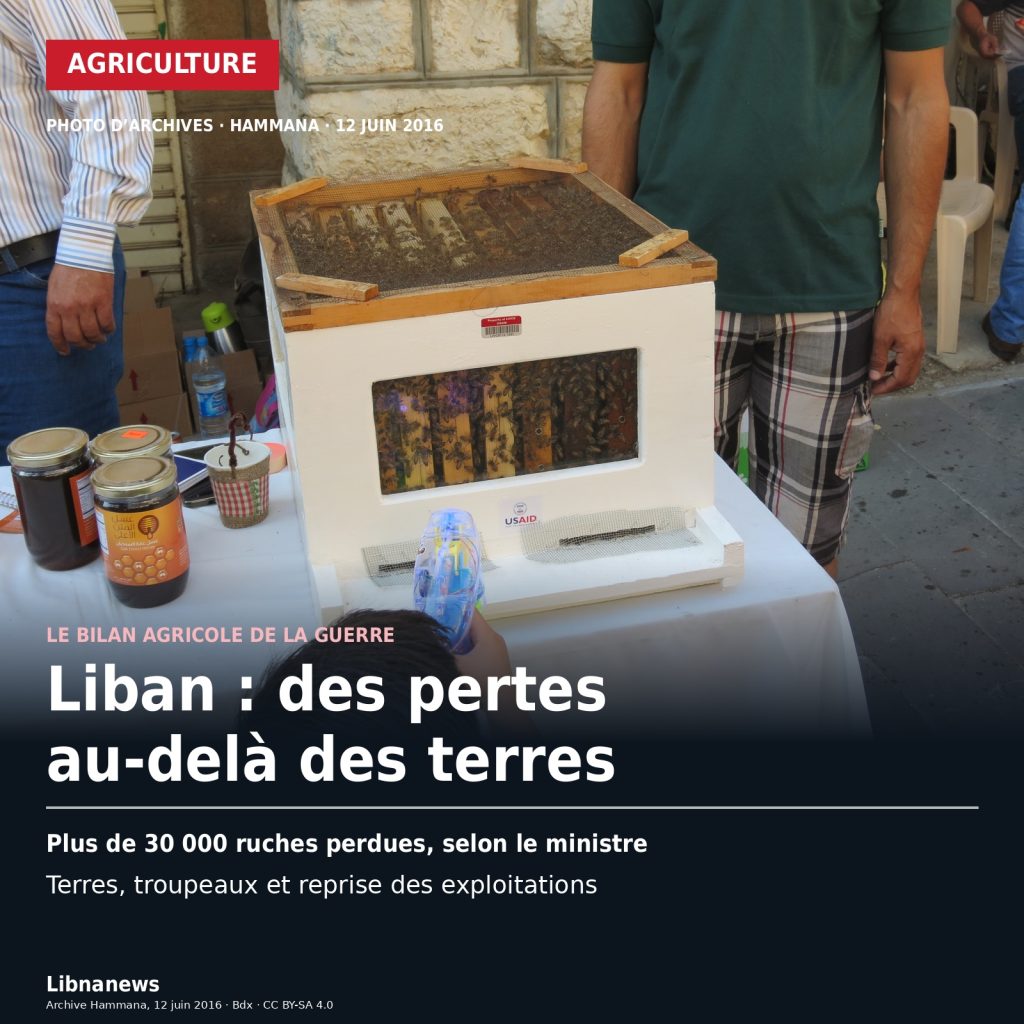
Cover: exhibition hive at the cherries festival in Hammana, Lebanon, June 12, 2016. Illustration of Lebanese beekeeping, no beehives destroyed or photographs of affected areas. Photo:Bdx / Wikimedia Commons,CC BY-SA 4.0. Boxing and dressing Libnanews; adaptation CC BY-SA 4.0.






Comments