

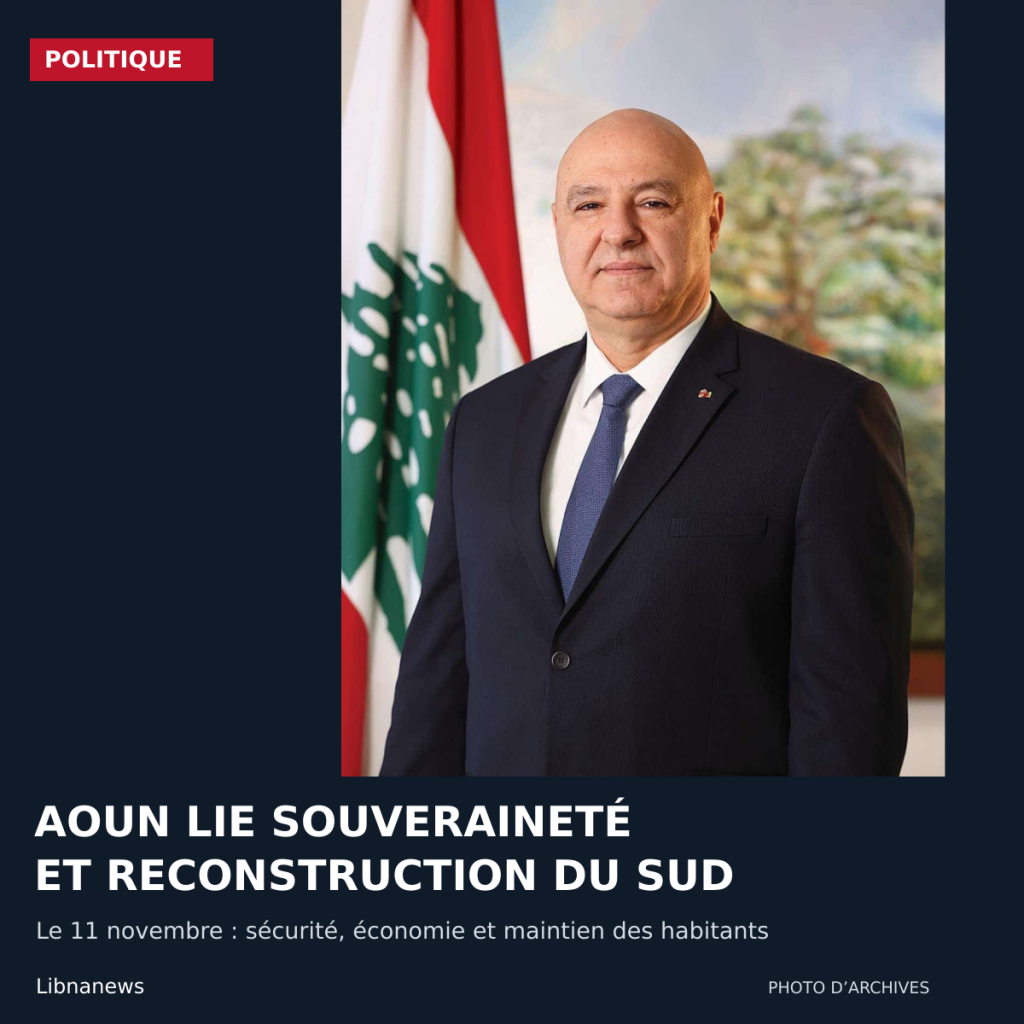
Joseph Aoun links state authority to two requirements: to reserve arms to institutions and to make economic life in the South possible. In front of a delegation from the Leaders Club, received in Baabda on 11 November, the president defended the framework agreement while insisting on reconstruction. He does not present it as a mere accompaniment to the security issue, but as a component of Lebanese objectives.
Sovereignty also requires reconstruction
The Head of State maintains his assessment of the framework agreement as the best option available. It calls for the preservation of internal cohesion in the face of regional developments. This political defence is not accompanied by the announcement of a new agreement, a withdrawal schedule or a funded work programme.
For Joseph Aoun, the deployment of public authority must allow the people of the South to live in safety and to have economic opportunities. It thus combines reconstruction, social conditions and the possibility of staying there. At the same time, the President reaffirms his support for the army and the security forces, whose missions he considers inseparable from sovereignty.
This speech extends the remarks made on November 10 before Defence Minister Michel Ménassa. The president then requested that the military institution be preserved from attacks against his command, officers and soldiers. The next day, in front of economic leaders, he expanded his argument: State authority must also produce sustainable living conditions.
Two studies submitted by companies
The Leaders Club presented two proceedings to the President. The first concerns economic recovery. The second concerns material and economic reconstruction in the context of the framework agreement. Ramzi Hafez, who spoke on behalf of the delegation, proposed to continue their development with the authorities.
This is a contribution from the private sector, not the adoption of two government plans. No funding, timetable or project selection mechanism is announced. The meeting therefore distinguishes a political and economic orientation from a public decision committing appropriations.
Maintaining the inhabitants, a concrete challenge
The meeting day in Baabda also includes an exchange with the Kellna Ayleh association. Karin Gemayel and Jessica Moawad present the difficulties encountered in the villages of Rmeich, Debel and Ain Ebel. They refer to travel restrictions, declining employment and difficult access to care and education.
The proposals included medical services, marketing of local products, education and fuel for basic needs. They give concrete content to the question of keeping families in border villages. However, they remain requests for assistance: the report does not present them as benefits already opened or approved expenses.
Joseph Aoun assures that the State must support the inhabitants who remain in their villages as those forced to move. The implementation challenge remains that of the means available, access and services actually provided. No new aid is fixed in these declarations of 11 November.
Photographic portrait of Joseph Aoun, photo library Libnanews. Exact date of shooting not established. This photograph does not represent the meeting of November 11, 2026. © Archives Libnanews.





Comments