

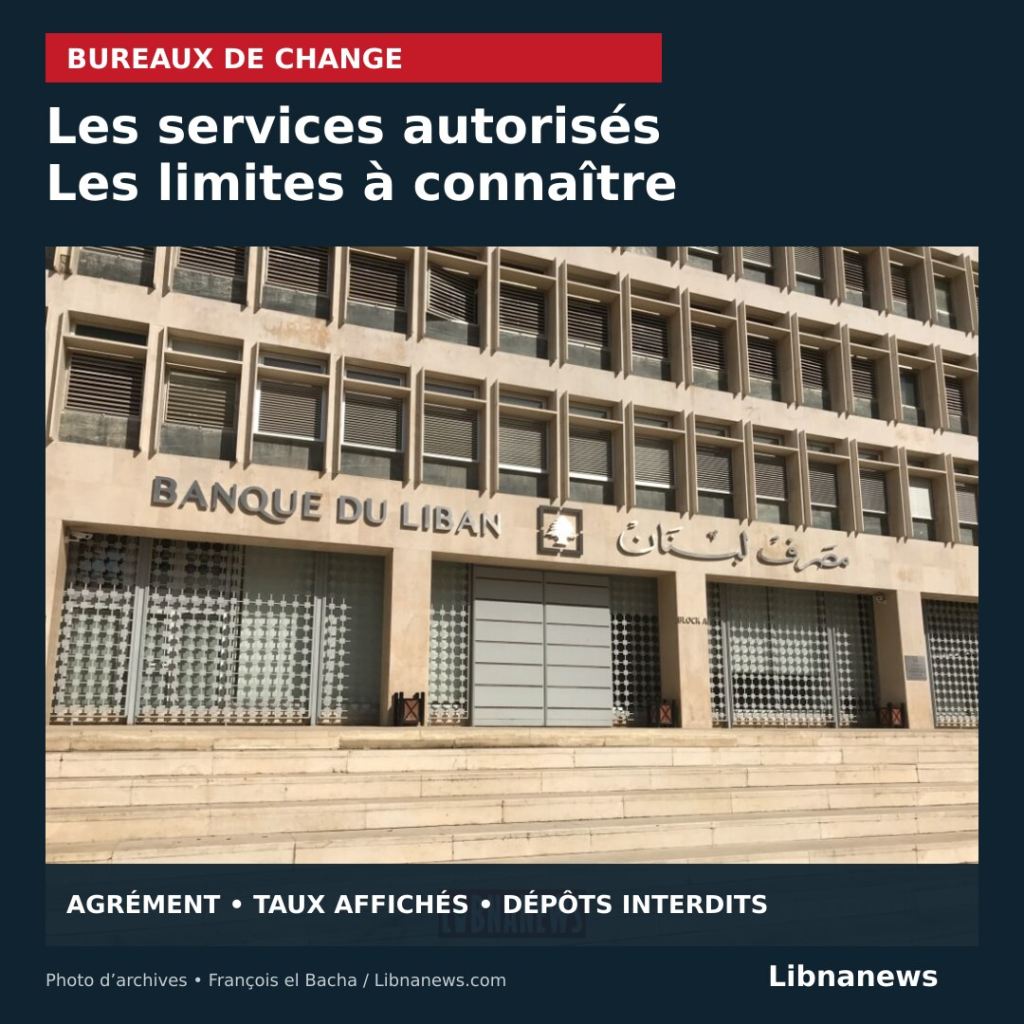
The Lebanese exchange offices have had a reorganized framework since September 2026. Decision 13837 distinguishes authorized services by category and maintains a clear border with banking activities. For the client, there are three audits: accreditation, the proposed service and the terms and conditions for the remittance of funds. However, already approved establishments benefit from a compliance period.
Adopted on 18 August, the decision is contained in the Official Journal of 10 September 2026. It brings together the conditions for the establishment and operation of foreign exchange institutions. Its coming into force does not mean that each institution has all the required authorizations immediately. Nor does it turn a foreign exchange counter into a bank.
Exchange offices: check authorized category
The first benchmark is the listing of the Bank of Lebanon. The documents, correspondence, advertising and any site of the professional must indicate his registration number. They must also specify the category of services authorized. The sign must bear its approved name, without any other business name.
Categories A and B can buy and sell currencies. They can also affect metal parts and precious metals. But category B is limited to precious metals weighing less than 1,000 grams. Both categories may act as agents of electronic payment providers under the conditions laid down in the texts.
Category A has an additional possibility: marketing prepaid bank cards. This activity remains subject to prior authorisation and a contract with a bank or an authorized financial institution. The card must be issued on behalf of the holder by that partner institution. The exchange office therefore does not itself become the bank issuer.
| Category | Activity to be distinguished | Determining limit |
|---|---|---|
| A | Exchange, precious metals and certain complementary services | Special conditions for prepaid cards |
| B | Change and precious metals | Precious metals less than 1000 grams |
| A1 | Cross-border transport of banknotes and precious metals | Additional approval for category A |
| A2 | Hawala-type transfers | Additional approval for category A |
The entries A1 and A2 are not automatically derived from category A. They require a clean authorisation, an increase in capital and payment of the corresponding fee. An institution authorized to change banknotes cannot therefore deduct from this activity a general right to transfer money.
An amount left at the counter does not become a deposit
The regulations prohibit foreign exchange offices from receiving deposits within the meaning of the Currency and Credit Code. It also prohibits advertising and the opening of temporary or transitional deposit accounts. Professionals cannot offer credit, manage funds for their clients or grant loans, facilities and guarantees.
This separation protects the understanding of the operation. A discount of tickets to buy another currency is a specified exchange. It must not be presented as a savings placed with the changer. Settlement balances between professionals are also a specific function. They do not constitute bank accounts or customer deposits.
The text also prohibits the exchange office from depositing cash directly into its customer’s bank account. It prohibits him from accepting a power of attorney from the latter. The existence of a usual relationship or a known window does not remove these limits.
The posted rate and the delivery of tickets
Buying and selling courses must remain clearly visible on a legible device, as well as on the professional’s possible site. They must be updated immediately after each change. Article 17 covers the difference between the price displayed and the price applied, providing for a derogation only in a way favourable to the customer.
Before handing over cash, the client can check which column corresponds to his transaction and what amount he will receive. The purchase price of a currency by the changer and its selling price to the customer do not refer to the same transaction. The professional’s computer system must allow the issue of successively numbered purchase and sales receipts.
Remittance of the counterparty is in principle immediate for a cash or metal exchange. Even in an A1 operator, this principle remains in place when the customer is an individual or a commercial enterprise. A specific period of three working days concerns certain professional counterparties: foreign exchange institutions, institutions licensed by the BDL or gold dealers. This exception does not allow payments to individuals to be deferred without distinction.
Finally, the regulations prohibit the delivery of defective or damaged tickets to customers. An exchange therefore also involves controlling the denominations received, their amount and their status.
Identification is part of the operation
The office must verify the client’s identity and apply due diligence. It must refuse a transaction when it cannot complete the required identification or verify the origin of the funds when such verification is required. Contradictory or insufficient information may prevent understanding of the purpose of the transaction.
The text requires records, documents and data to be kept for at least 10 years. It also provides for monitoring of operations and obligations to the competent authorities. These requirements do not allow the change to be presented as an anonymous service.
A transition still running in November
Previously approved establishments have one year from the date of issue of the decision to fully comply with the new framework. The case of capital increase must be submitted within six months of its publication in the Official Journal. Additional time limits remain possible in exceptional cases, upon reasoned request.
It is therefore necessary to distinguish between an obligation contained in the new Regulation, the time limit granted to existing operators and the individual situation of an establishment. The general provisions alone are not sufficient to state that a specific professional is in breach. For former hawala operators, the text sets a separate documentary deadline: 30 November 2026.





Comments