

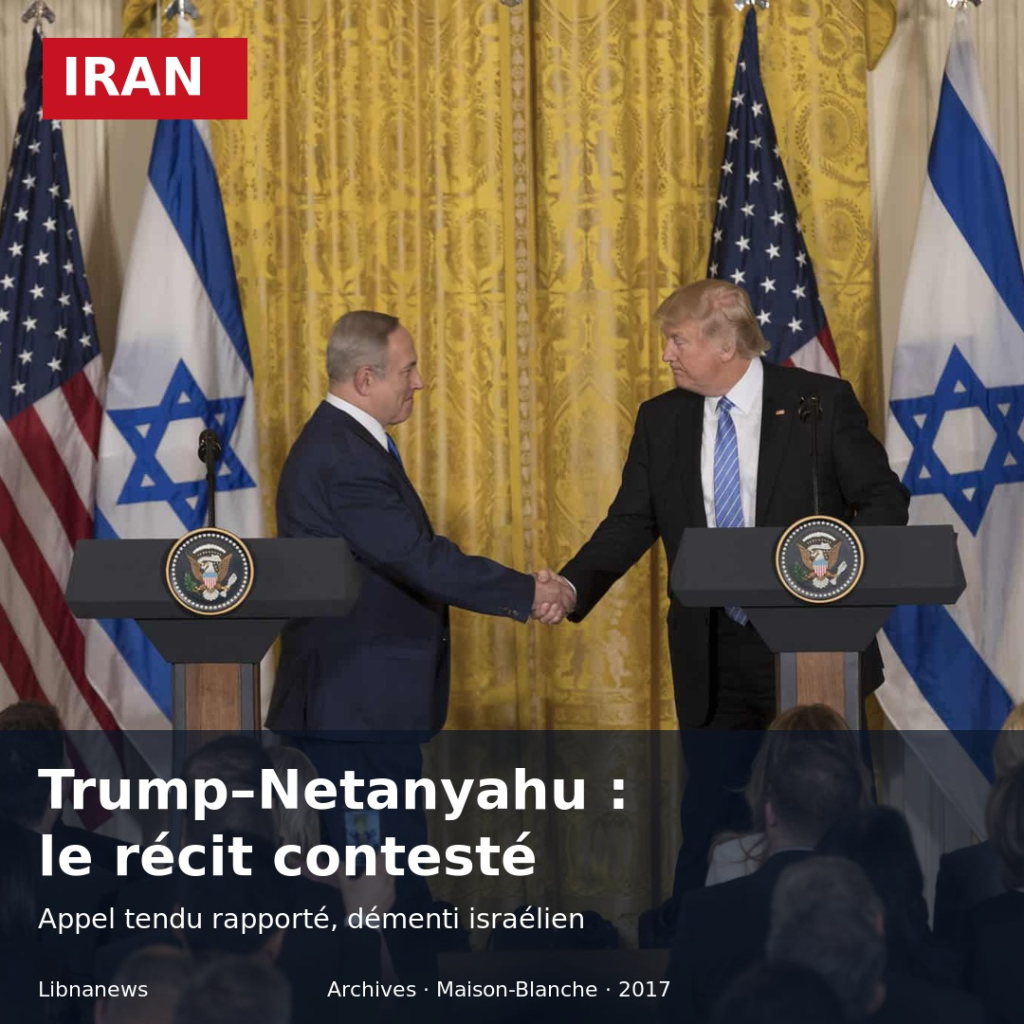
A call between Donald Trump and Benjamin Netanyahu on Iran would have given rise to a particularly tense exchange, according to anonymous sources quoted by an Israeli media. The Prime Minister’s office denies this story. The news, published in the international press on 11 and 12 November, comes as the two leaders display different positions on the aftermath of the conflict.
Trump and Netanyahu: one call, two stories
The report places the conversation during the weekend before its publication. It does not specify the exact day or hour. Interlocutors presented as being informed of its content describe a difficult exchange on the possibility of relaunching the war against Iran. One evokes a « infernal scream scene », a translation of the English expression « shuting match from hell ».
Benjamin Netanyahu’s office rejects this presentation and calls it « fake news » and « total absurdity ». A senior Israeli official, also anonymously quoted, confirms the existence of the appeal but challenges its conflict. The disagreement therefore concerns the course of the conversation, not only its political interpretation.
No recording or verbatim of this private exchange is provided in the record consulted. The international recaptures refer to the same Israeli story: their multiplication does not constitute a series of independent confirmations. At this stage, the spectacular formula describing the screams remains a disputed statement, not an established fact.
November 9th, Trump dismisses immediate recovery
Public statements, on the other hand, clarify the American position. On Monday, 9 November, after a meeting with Qatari Prime Minister Mohammed bin Abdelrahmane Al-Thani, Donald Trump said that he did not feel that a new military action against Iran was necessary at that time.
He did not give up the military option. In front of journalists, the US President stressed that his forces remained ready to act if the situation changed. He also stated that he perceived a positive momentum towards the end of the conflict. These remarks express his political appreciation; they do not announce any signed agreement with Tehran or joint settlement schedule.
The distinction is important to understand the issue of the appeal. Suspending an expanded campaign does not mean excluding any future intervention. Washington explicitly retains this possibility, while leaving room for negotiation. Qatar intervenes in this sequence as a diplomatic interlocutor, not as a party empowered to decide US operations.
Netanyahu links security to regime change
On Tuesday, November 10, Benjamin Netanyahu defended a different approach to the new Knesset. In his speech following the swearing-in of the deputies, he accused Iran of seeking to rebuild its nuclear program. He described the overthrow of the Iranian regime as the only way to permanently eliminate what he described as an existential threat.
This accusation and strategic conclusion belong to the Israeli Prime Minister. They alone do not constitute an independent assessment of the state of Iran’s nuclear programme. Nor does they prove that a new campaign would have been decided with Washington.
His intervention, however, sheds light on the difference between the publicly formulated objectives. Donald Trump leaves open a negotiated outcome with a military threat. Benjamin Netanyahu claims that a lasting settlement requires the disappearance of the regime in Tehran. These positions can be compared without validating the story of the phone screams.
No joint decision announced in this exchange
The available elements therefore do not allow us to present this conversation as an actual break between the two allies. They also do not allow for the announcement of an imminent offensive. The operational content of a possible American-Israeli agreement remains absent from the published narrative.
The information to be retained has two distinct levels: a disputed media version of the appeal and documented public statements about Iran. Netanyahu’s office maintains its denial of verbal confrontation. On the American side, the position expressed on 9 November retains negotiation and the possibility of using force simultaneously.





Comments