

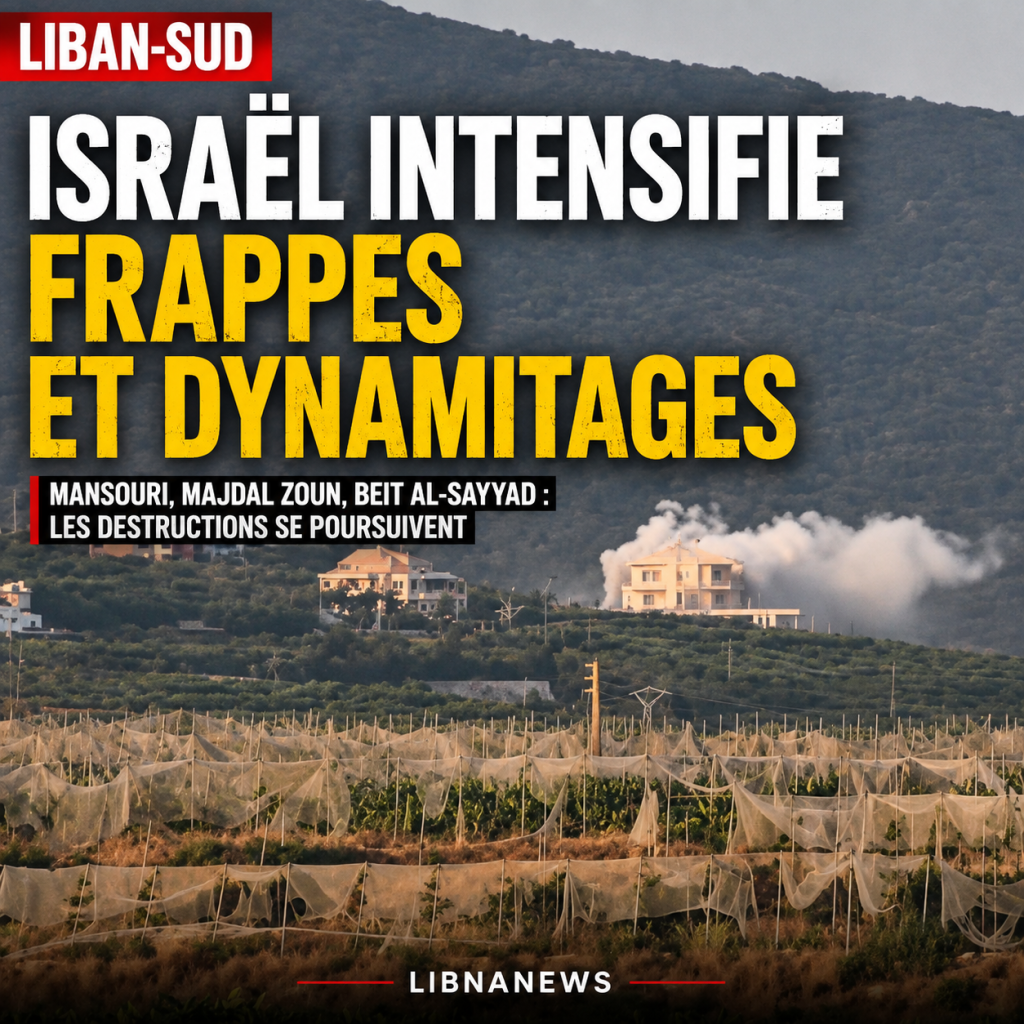
Israeli forces continued and expanded their military operations in the South on Wednesday, 26 August, combining air strikes, artillery fire, blasting and house fires in several localities. Majdal Zun, Mansuri, Beit al-Sayyad, Sarbine and Hadatha were among the affected areas, while an Israeli drone bomb exploded over Mansuri and a Merkava tank fired several shells at that area. Drones also overflew the southern suburbs of Beirut at low altitude. This new day of tension comes as a major economic delegation from the United Arab Emirates arrives in the capital for two days of meetings devoted to investment and cooperation with Lebanon.
Strikes and artillery from the first hours in South Lebanon
Israeli military activity resumed at night and the first hours of Wednesday in several areas of theSouth Lebanon. Explosions were reported in the vicinity of Sarbine in Bint Jbeil District, accompanied by raking operations. The outskirts of Hadatha also suffered intermittent Israeli artillery fire at dawn.
Operations continued in several sectors during the day. Strikes and shootings were reported in an area already heavily exposed to Israeli operations in the previous days. This activity is part of a continuous sequence rather than an isolated resumption of the bombings: on Tuesday 25 August, the operations had already concerned the cazas of Tyre, Marjayoun, Bint Jbeil and Nabatiyeh.
The day before, strikes had hit the area between the heights of Ali al-Taher and Dabsheh hill, near Nabatiyah al-Fawqa. Another strike targeted Dohat Kfar Rummane, while artillery and ground movements were reported in several border villages.
Mansouri targeted by a drone bomb and a Merkava tank
Mansouri, south of Tyre, was again at the centre of operations on Wednesday. An Israeli drone bomb exploded in the local sky. At the same time, a Merkava tank fired several shells at the village, according to reports during the day.
The locality has been under significant military pressure for several days. Bombings, explosions and armoured movements had already been reported in the previous week. On 22 August, Mansuri and surrounding areas were subjected, inter alia, to heavy artillery fire along with Majdal Zoun and Beit al-Sayyad.
The operations of 26 August thus confirm the persistence of military activity in this area of the Tyre District. The means used alternate between air strikes, artillery, drones, tanks and destruction operations conducted directly on the ground.
This combination makes the situation particularly difficult for civilians still present or wishing to access their properties. It also complicates the immediate assessment of the damage, as some areas remain difficult to access due to the Israeli presence.
Burning houses in Beit al-Sayyad
Israeli forces also burned houses in Beit al-Sayyad on Wednesday. This locality had already suffered extensive destruction in the previous days in operations combining bombing and blasting.
On 22 August, reports from the ground indicated that the village was particularly destroyed. The bombings and explosions had affected the houses to the point that the records of the time indicated that no house had been spared from the damage.
The fires reported on Wednesday therefore prolong a process of destruction already begun. In several locations in the South, Israeli operations no longer consist solely of striking specific positions or targets. They directly affect the residential structure and the conditions necessary for the return of populations.
This is one of the main concerns of the Lebanese authorities. The Lebanese army had already denounced on 12 August the destruction of civilian infrastructure and houses, believing that Israeli operations prevented its deployment and delayed the return of the inhabitants to their villages.
New blasting in Majdal Zoun
In Majdal Zun, in Tyre District, Israeli forces conducted a new blasting operation on Wednesday. Air strikes were also reported in the area during the day.
Majdal Zoun has regularly appeared in the Israeli operations for several weeks. Explosions, fire and destruction had already been reported on 13, 14, 20 and 22 August. The repetition of these operations shows that the village is in one of the areas where Israeli military activity remains particularly strong.
Destruction is not limited to housing. The surrounding areas were also affected by fire, explosions and operations affecting land and vegetation. This situation is part of a wider phenomenon of degradation of the border band.
Repeated use of blasting is now a major feature of this phase of conflict. It allows the complete destruction of buildings or construction groups without the use of air strikes. For the villages concerned, these operations make the prospect of a return dependent on a future reconstruction project.
Sarbine and Hadatha under pressure
In Bint Jbeil, Sarbine was also affected by Israeli operations. Explosions were reported in the vicinity, along with raking shots. Hadatha had intermittent artillery fire from the early hours of the day.
These two localities had already been affected by previous operations. Hadatha, Beit Yahun and Aïta al-Jabal had been shaken by explosions during the night of 21-22 August. Gunfire also targeted the surrounding valleys.
The repetition of the same operations in the same sectors shows that military pressure did not decrease in a lasting way despite the political arrangements reached early in the summer. It moves between several localities, with successive periods of intensification.
On 25 August, Bint Jbeil’s caza had already been hit in Ainata and Beit Lif. Movements of military vehicles and raking operations had also been reported. The results of the last two days thus draw a geographical continuity between the areas of Bint Jbeil, Nabatiyah, Marjayoun and Tyre.
Drones at low altitude over the southern suburbs
Israeli air activity was not limited to the South. On Wednesday morning, drones overflew the southern suburbs of Beirut at low altitude.
No strikes were reported in this area in the information available at the time of the 18 hours point. However, the overflight is a significant factor given the sensitivity of the southern suburbs, where Hizbullah historically has a strong political and social settlement.
Israeli drones regularly fly over different parts of Lebanon. Their presence over the capital, however, takes place over a day marked by sustained military activity in the South, which reinforces the perception of simultaneous Israeli pressure on several areas.
At 1800 hours, however, the largest documented operations remained concentrated in the South. There is no verified evidence at this stage to link the overflight of the southern suburbs with an additional military operation.
An escalation despite the agreement of 26 June
The operations on 26 August took place exactly two months after the framework agreement concluded on 26 June under American mediation. This includes a gradual withdrawal of Israeli forces from the occupied Lebanese territories, along with the deployment of the Lebanese army and the handling of the issue of armed groups.
Two months later, however, the situation on the ground remains far from normalisation. Israel maintains a military presence in parts of Lebanese territory and continues with strikes, bombardments and demolition operations.
The Lebanese Army claims that this situation hinders its own deployment. In August, it had denounced the destruction by Israeli forces of the municipal building, a school, a clinic, a day care centre and several houses in Zawtar al-Sharqiya.
For Beirut, the Israeli withdrawal therefore remains a central condition for stabilization. However, the accumulated destruction creates a second problem: even after a withdrawal, several localities will need important work before they can return to normal conditions.
Fires and destruction transform the border band
The succession of bombings and blastings is also accompanied by significant environmental damage. Fires caused during the operations affected agricultural land, olive groves, forests and other natural areas in several parts of the South.
The Lebanese National Council for Scientific Research estimates the area burned since October 2023 in connection with Israeli military activities at approximately 160 square kilometres, or 16,000 hectares. About half would be agricultural land.
The Lebanese authorities now accuse Israel of changing the border territory in a sustainable manner. Prime Minister Nawaf Salam spoke of a « scorched earth policy », while Environment Minister Tamara Elzein used the term « ecology ». Israel also claims to take precautionary measures to limit damage to civilians and the environment.
The destruction operations reported on Wednesday are in this context. The houses burned in Beit al-Sayyad and the blasting in Majdal Zoun add further damage to those accumulated since the beginning of the month.
Emirati delegation in Beirut in the opposite context
As military operations continue in the South, Beirut hosts a major economic delegation from the United Arab Emirates on Wednesday. His visit, scheduled for 26 and 27 August, had been announced several days earlier as part of the economic rapprochement between the two countries.
The delegation is led by Thani ben Ahmed Al Zeyoudi, Minister of Foreign Trade of Emirati. Its composition was initially announced around67 business leaders and managersThis makes it an unusually large mission in recent economic relations between Beirut and Abu Dhabi.
The aim is to explore opportunities for cooperation, investment and partnerships. For the Lebanese authorities, the arrival of Emirati economic leaders is an important political signal after several years in which Gulf capital has been particularly cautious towards Lebanon.
However, the visit does not mean that 67 investors have decided to invest capital in the country. The discussions should precisely identify projects that might be of interest to the Emirati companies and the conditions for their implementation.
Two Lebanese realities a few dozen kilometres away
The simultaneous events highlight two realities to which the Lebanese Government must respond. In Beirut, the authorities seek to restore international and Arab confidence in order to attract investment. In the South, they face the continuation of foreign military operations and destruction that increase the cost of reconstruction every day.
Both files should not be confused. His delegation did not come to Lebanon in response to the Israeli operations of 26 August, and no direct link could be established between the two events. But security stability is necessarily a parameter for any long-term investment project.
At 6 p.m. on Wednesday, no announcement had yet been made that Israeli operations for the day had been completed. Mansouri, Majdal Zun, Beit al-Sayyad, Sarbine and Hadatha had already been affected by various forms of military intervention, while drones continued to constitute a visible presence in the Lebanese sky. Two months to the day after the 26 June agreement, the continuation of the blasting and bombardment continues to dominate the situation in the South.




